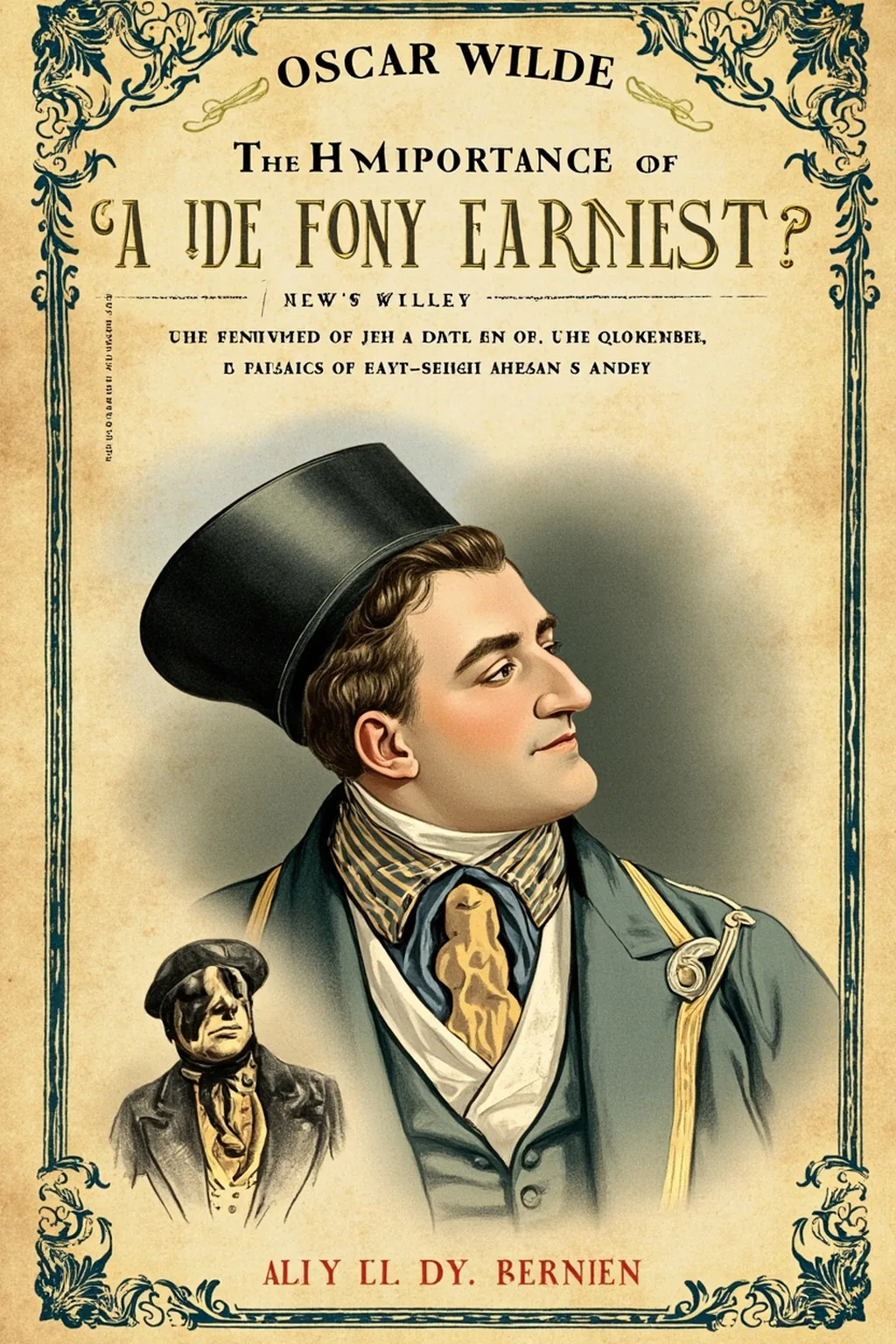
The Importance of Being Earnest: A Study Guide
The Serious Business of Triviality
Oscar Wilde subtitled his 1895 play “A Trivial Comedy for Serious People,” and this paradoxical framing provides the essential lens through which every element of the work must be understood. The comedy operates on a fundamental inversion: its characters treat the most consequential matters of life—marriage, death, identity, morality—with breezy indifference, while investing the most trivial concerns—cucumber sandwiches, muffins, the music of a Christian name—with desperate gravity. This study guide examines how Wilde constructs this inversion, the social machinery it exposes, and the deeper questions it raises about authenticity, performance, and the nature of truth itself.
The play’s structure follows a classic comic arc: deception established, deceptions colliding, and revelation resolving all complications. Yet Wilde subverts this arc at every turn. The resolution does not come through the triumph of truth over falsehood but through the improbable transformation of fiction into fact. Jack Worthing, who has lied about being named Ernest, discovers he has been named Ernest all along. The lie becomes truth not through confession or redemption but through an accident of birth he could never have anticipated. This final irony is not merely a comic convenience—it is the play’s central statement about the arbitrary relationship between names and identities, between social categories and the persons who inhabit them.
Movement I: The Architecture of Deception
The play opens in Algernon Moncrieff’s morning-room, a space of cultivated idleness where the serious business of Victorian society—marriage, family obligation, social duty—is reduced to material for witty exchange. The opening dialogue between Algernon and his manservant Lane establishes the tone: Lane’s observation that he attributes the superior quality of wine in bachelor establishments to “the fact that there are fewer servants to drink it” passes without challenge, and his remark that he has “been married only once” to a misunderstanding reveals the play’s attitude toward matrimony before any principal character has uttered a word on the subject.
Into this atmosphere of studied triviality enters Jack Worthing, a man whose very existence depends upon the maintenance of fictions. The revelation of his double life unfolds through the seemingly casual mechanism of a cigarette case inscription—“From little Cecily, with her fondest love to her dear Uncle Jack.” The object betrays the deception, forcing Jack to explain what he has previously concealed: that in the country he is Jack, the responsible guardian of Miss Cecily Cardew, while in London he becomes Ernest, his own fictitious wicked brother. This invention serves a specific purpose: it allows him to escape the moral surveillance that governs his country existence while enjoying the pleasures of town life.
Algernon’s delighted response to this confession introduces the play’s key term: “Bunburying.” Algernon has created his own fictional alter ego, an invalid named Bunbury whose perpetual ill health provides convenient excuse for avoiding unwelcome social obligations. The term names a practice that extends beyond these two characters to encompass a broader social phenomenon. In a society where propriety demands constant performance of duty, Bunburying offers a private space of freedom. The question the play raises—but never definitively answers—is whether such deception constitutes a healthy assertion of individual autonomy or a symptom of a fundamentally dishonest social order.
The proposal scene with Gwendolen Fairfax reveals the first crack in Jack’s carefully constructed fiction. Gwendolen accepts his proposal with alacrity, but her acceptance depends upon a condition Jack cannot fulfill: she loves him because she believes his name is Ernest. “It is a divine name,” she declares. “It has a music of its own. It produces vibrations.” The name has become detached from any referent and acquired an almost mystical power of its own. Jack’s attempts to suggest that “Jack” might be equally charming meet with contempt: “Jack?… No, there is very little music in the name Jack, if any at all, indeed. It does not thrill. It produces absolutely no vibrations.” The comedy here operates on multiple levels: Gwendolen’s fetishization of a mere name satirizes romantic idealism, while Jack’s inability to correct her misconception demonstrates how thoroughly his deception has trapped him.
Lady Bracknell’s interrogation transforms the scene from romantic comedy to social critique. Her examination of Jack’s eligibility proceeds with bureaucratic precision: age, income, property, politics—all are assessed and found satisfactory until she reaches the fatal question of parentage. Jack’s confession that he was found as an infant in a handbag at Victoria Station produces one of the play’s most famous lines: “To lose one parent, Mr. Worthing, may be regarded as a misfortune; to lose both looks like carelessness.” The absurdity of applying standards of “carelessness” to the circumstances of an abandoned infant reveals the mechanical nature of Lady Bracknell’s moral calculus. More significantly, her refusal to allow her daughter to “marry into a cloak-room and form an alliance with a parcel” demonstrates how thoroughly identity in this world depends upon documentation and lineage rather than character or achievement. Jack’s unknown parentage makes him socially impossible regardless of his personal qualities or financial standing.
The movement ends with Jack’s romantic hopes destroyed and the central problem established: how can a man with no name marry into a family obsessed with names? The question will drive the remainder of the plot, but it also points toward a deeper concern—the arbitrary relationship between the categories society uses to define persons and the actual persons being defined.
Movement II: The Collision of Fictions
The action shifts from London to the Manor House in Hertfordshire, and with this geographical transition comes a transformation in the nature of deception. In the first movement, Jack and Algernon’s fictions operated in separate spheres: Ernest existed in town, Bunbury in the country. Now these fictions will collide, as Algernon arrives at Jack’s country home posing as the wicked brother Ernest, while Jack returns from London having “killed off” that same fictional brother.
The pastoral setting introduces new characters whose perspectives on deception differ significantly from those of the London sophisticates. Miss Prism, Cecily’s governess, represents a moral earnestness that the play both satirizes and subtly respects. Her abandoned three-volume novel hints at suppressed romantic impulses, while her flirtation with Dr. Chasuble demonstrates that even the most proper Victorian woman is not immune to desire. Cecily Cardew, Jack’s ward, presents a more complex case. Her diary, in which she records “the wonderful secrets” of her life, reveals a capacity for fantasy that rivals Jack’s own invention of Ernest.
When Algernon arrives posing as the wicked brother, Cecily’s response inverts the expected moral calculus. She is not scandalized by his supposed wickedness; she is delighted by it. “I hope you have not been leading a double life, pretending to be wicked and being really good all the time,” she tells him. “That would be hypocrisy.” The statement is comic in its apparent approval of wickedness, but it also articulates a genuine principle: authenticity matters more than conventional morality. Cecily prefers a genuinely wicked man to a hypocritically virtuous one—a position that aligns her, paradoxically, with the play’s deeper critique of Victorian social performance.
The collision of deceptions reaches its peak when Jack arrives in mourning clothes to announce Ernest’s death, only to find his “dead” brother alive and courting his ward. The absurdity of the situation—Jack must explain how Ernest can be dead and present simultaneously—exposes the impossibility of maintaining fictions when they encounter the material world. But the more significant collision occurs between the two women’s claims to Ernest.
Gwendolen’s arrival triggers a rivalry that dissolves into sisterhood when both women discover the truth: neither man is named Ernest. The scene in which they compare diaries, each claiming prior engagement to the same fictional person, demonstrates how thoroughly they have been deceived by names rather than persons. Gwendolen loves “Ernest” as an idea; Cecily has constructed an entire imaginary courtship with a man she has never met. Both women have fallen in love with fictions, and the revelation that Ernest does not exist forces them to confront the emptiness of their romantic ideals.
The movement ends with both couples in crisis and both men facing the consequences of their inventions. The carefully constructed fictions have collapsed under their own weight, and the question of how to resolve the resulting complications drives the final movement.
Movement III: The Unraveling and Resolution
The final movement brings together all the play’s threads in a cascade of revelations that resolves the plot through the most improbable means imaginable. The men confess their deceptions and arrange to be christened “Ernest”—a solution that treats a name as a mere label to be changed at will, ignoring the deeper question of whether a name changed through such mechanical means can carry the same significance as a name given at birth.
Lady Bracknell’s intervention initially blocks both engagements, but her discovery of Cecily’s fortune transforms her opposition to Algernon’s marriage into enthusiastic consent. The speed of this transformation—Cecily goes from being a potentially unsuitable match to “a most attractive young lady” the moment her wealth is revealed—exposes the economic foundations of Victorian marriage. Lady Bracknell’s concern for her daughter’s welfare extends only to the forms of respectability; the substance of the match is financial.
The recognition scene that follows provides the play’s most audacious comic device. Miss Prism’s confession that she accidentally placed her manuscript in the bassinet and the baby in the handbag reveals Jack as Lady Bracknell’s lost nephew, the son of her sister Mrs. Moncrieff, and consequently Algernon’s elder brother. More remarkably, consultation of the Army Lists reveals that Jack was christened Ernest John. His lie has become truth. The name he invented for his fictional alter ego was his real name all along.
This resolution operates on multiple levels. On the most basic comic level, it provides the happy ending the genre demands: Jack can marry Gwendolen because he is named Ernest, and he is named Ernest because he was christened Ernest, and he was christened Ernest because his father was named Ernest. The chain of causation is logical even if the means of its discovery are absurd.
On a deeper level, the resolution comments on the relationship between fiction and truth. Jack has been “Ernest” in London for years; the name has shaped his behavior, his relationships, his very identity. The revelation that this was his birth name suggests that his fiction was somehow more true than his “real” identity as Jack. He was pretending to be who he actually was. The play thus suggests that identity is not a fixed essence to be discovered but a performance to be enacted—and that the performance may be more authentic than the social categories that claim to define us.
The Interpretive Stakes
The play’s treatment of deception raises fundamental questions about the nature of honesty and authenticity in a society governed by rigid social codes. Jack and Algernon’s Bunburying can be read as either a healthy assertion of individual freedom or a symptom of a fundamentally dishonest social order. The play provides no definitive answer, but it suggests that a society which demands constant performance of propriety inevitably produces the deceptions it claims to condemn.
The name “Ernest” itself carries obvious symbolic weight. The word “earnest” denotes seriousness, sincerity, gravity—precisely the qualities that the play’s characters most conspicuously lack. The irony of naming a fictional character “Ernest” is obvious, but the final revelation that Ernest was Jack’s real name complicates the irony. Is the play suggesting that earnestness itself is a kind of fiction, a performance that may or may not correspond to any underlying reality? Or is it suggesting that true earnestness consists in the honest pursuit of one’s desires, regardless of social convention?
The women characters present their own interpretive challenges. Gwendolen and Cecily appear at first to be victims of male deception, but their willingness to forgive that deception once the men agree to change their names suggests that they too are invested in the fiction. Gwendolen loves the name “Ernest” more than she loves the man who bears it; Cecily has constructed an entire relationship with a man she has never met. Both women are authors of their own romantic fictions, and their eventual marriages represent not the triumph of authentic love over deception but the successful alignment of fantasy with reality.
Lady Bracknell embodies the social order against which the play’s deceptions operate. Her concern for respectability, lineage, and financial security represents everything that the romantic ideal claims to transcend. Yet the play does not simply condemn her. Her objections to Jack as a suitor are, from her perspective, entirely reasonable: a man with no known parentage cannot provide the social standing that marriage is supposed to secure. Her eventual acceptance of both matches comes not from a change of heart but from the discovery that Jack’s unknown parentage was actually quite distinguished. The social order she represents remains intact; only the categorization of particular individuals within that order has changed.
Structure and Consequence
The play’s three-movement structure mirrors the classical pattern of comic resolution: problems are established, complications arise, and all is resolved through revelation and recognition. But Wilde’s resolution depends upon the most arbitrary of devices—the accidental placement of a baby in a handbag—and this arbitrariness is itself meaningful. The social categories that determine life outcomes in Victorian England—legitimacy, lineage, class standing—are revealed as matters of pure chance. Jack’s transformation from social impossibility to eligible bachelor requires no change in his character, his actions, or his worth; it requires only the discovery of a document that reclassifies him within the system.
The final irony returns us to the play’s subtitle. “A Trivial Comedy for Serious People” suggests that the proper response to the weighty machinery of Victorian society is not earnest reform but trivial laughter. The play does not argue for the dismantling of social conventions; it demonstrates their fundamental absurdity. Jack does not earn his happy ending through moral growth or heroic action. He stumbles into it through an accident of birth that was always already true. His declaration in the final line—“I’ve now realized for the first time in my life the vital Importance of Being Earnest”—is itself a kind of joke. He has been Ernest all along. The vital importance he announces is something he has achieved without trying, without knowing, without deserving.
The comedy thus resolves not through the triumph of sincerity over deception but through the collapse of the distinction between them. In a world where names determine destiny and lineage determines legitimacy, the honest man is simply the one whose fictions happen to be true. Wilde’s trivial comedy for serious people leaves us with a question that remains as unsettling as it is amusing: if the difference between truth and lies is merely a matter of documentation, what remains of earnestness itself? The play offers no answer—only the pleasure of watching its characters discover, against all probability, that their most elaborate fictions were facts waiting to be recognized.