Study Guide: The Mysteries of Udolpho
Book Overview
The Mysteries of Udolpho is a foundational Gothic novel written by Ann Ward Radcliffe and published in 1794. The book follows Emily St. Aubert, a young French woman of gentle birth and sensitive disposition, as she navigates a series of devastating losses, romantic entanglements, imprisonment in a forbidding Italian castle, and ultimate triumph over adversity through virtue and constancy. The novel established many conventions of Gothic fiction and became enormously popular in its era, influencing writers from Jane Austen to Sir Walter Scott.
Major Themes
The Power of Nature and Landscape
Nature functions throughout the novel as both moral instructor and emotional refuge. Emily’s appreciation of sublime landscapes—the Pyrenees, the Italian coast, the Apennines—elevates her spirits and provides counsel during her darkest hours. Radcliffe uses descriptive passages of natural beauty to contrast with the corrupt interiors of human-made spaces, especially Montoni’s castle.
Sensibility and Self-Command
Emily inherits her father’s teachings about governing extreme emotion while preserving genuine feeling. The novel debates whether excessive sensibility leads to weakness or represents the mark of a refined soul. Emily must balance her natural emotional responses with the rational self-control her father prescribed on his deathbed.
The Tyranny of Guardians and Relatives
Emily suffers under a chain of guardians—her aunt Madame Cheron, her uncle Mons. Quesnel, and finally the villainous Montoni—who abuse their authority over her person and property. The novel critiques the legal and social power granted to male relatives over young women.
Appearance Versus Reality
The novel systematically distinguishes between outward appearances and inner truths. Emily learns that charming faces may conceal villainous intentions, that respectable gentlemen may be dissolute, and that frightening supernatural phenomena often have rational explanations.
Providence and Moral Justice
Ultimately, the novel affirms that virtue is rewarded and vice punished, though radcliffe typically allows characters opportunity for reformation before delivering poetic justice. Providence guides the narrative toward restoration and reunion.
Character Analysis
Emily St. Aubert
Emily serves as both protagonist and moral center of the novel. She is described as possessing great sensibility—quick to perceive beauty, slow to recover from grief, and perpetually susceptible to the influence of nature. Her education under her philosopher-father has equipped her with rational fortitude, enabling her to endure captivity and resist seduction. Emily’s virtue manifests through filial piety, romantic constancy, and compassionate treatment of servants and peasants. Her primary weaknesses include excessive emotional susceptibility and occasional credulity regarding supernatural phenomena.
Valancourt
Valancourt is Emily’s true love—a young Gascony gentleman of good family but modest fortune. He appears initially as the ideal romantic hero: frank, generous, sensitive to natural beauty, and devoted to Emily. His character arc involves a moral decline in Parisian society through exposure to gambling and fashionable vice, followed by redemption through suffering and reformation. His rescue of Mons. Bonnac demonstrates that his fundamental virtue survived his temporary corruption.
Montoni
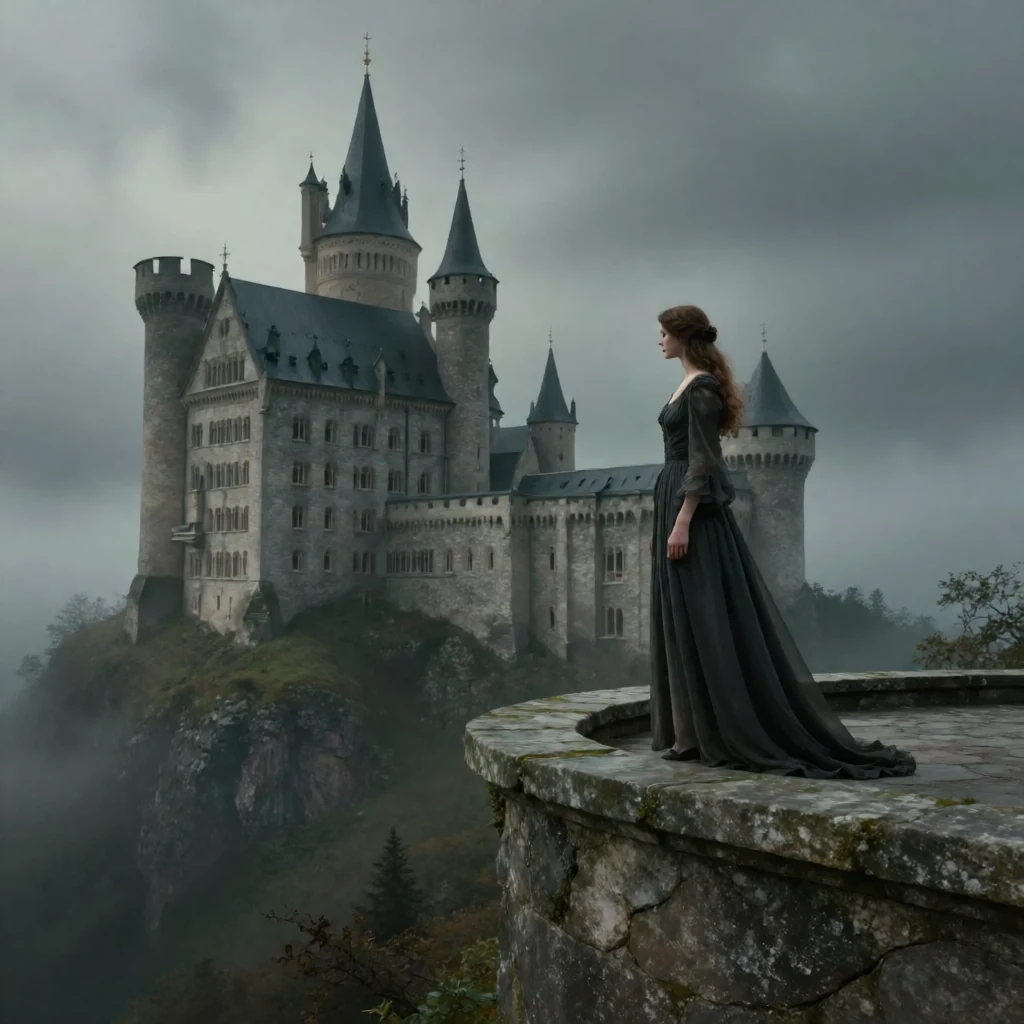
Montoni represents aristocratic villainy—he is handsome, commanding, and entirely without moral restraint. His motivations are avarice and ambition; he marries Madame Cheron for her supposed wealth and later schemes to seize Emily’s inheritance. His castle serves as the novel’s primary Gothic space, alluding to countless threats—real and imagined—that confine Emily.
Madame Cheron / Madame Montoni
Emily’s aunt begins as a frivolous, self-centered widow, indifferent to her brother’s death and eager to dispose of Emily advantageously. After marrying Montoni, she becomes a victim of his machinations, suffering imprisonment and ultimately death in the east turret. Her fate demonstrates the consequences of choosing worldly vanity over familial affection.
Plot Summary
Book One: Departure and Disasters
St. Aubert, Emily’s father, dies in Languedoc after a lingering illness, having instructed Emily to burn certain papers hidden beneath a board in the family château. Emily discovers among his effects a miniature portrait of an unknown woman resembling herself. She encounters Valancourt, a young nobleman of Gascony, during her journey through the Pyrenees; they fall in love, though circumstances separate them when St. Aubert’s death summons Emily home.
Emily returns to La Vallée to discover Valancourt has visited repeatedly during her absence. Her aunt Madame Cheron arrives, having married the Italian Signor Montoni, and summarily removes Emily to Thoulouse, then to Italy, despite Valancourt’s protestations. Montoni’s true character emerges as grasping and dangerous; he has imprisoned his wife for refusing to sign over her estates and schemes to marry Emily to the dissolute Count Morano.
Book Two: Imprisonment at Udolpho
Montoni conveys Emily to his ancient castle in the Apennines, a grim fortress whose walls confine her while he pursues criminal enterprises. She endures supernatural terrors—mysterious music at midnight, a veiled picture concealing something horrible, spectral figures on the ramparts—though many prove explicable. Morano attempts to abduct Emily; a duel results, and he is wounded and expelled.
After Madame Montoni dies from neglect in the turret prison, Emily escapes through the assistance of Ludovico and the mysterious Du Pont. She sails from Italy to France, surviving shipwreck on the coast of Languedoc.
Book Three: Restoration and Reunion
Emily takes shelter at Château-le-Blanc, home of Count De Villefort, whose family becomes her companion. She learns that Valancourt, having fallen into vice in Paris, has been imprisoned for debt. A touching reunion at La Vallée confirms their enduring love, though Emily temporarily rejects him upon hearing of his misconduct.
Meanwhile, Montoni has been imprisoned in Venice and dies under suspicion of poison. Emily reclaims her estates and, after Valancourt proves his reformation through acts of generous courage, marries him. The novel concludes with double nuptials—Emily and Valancourt, Blanche and St. Foix—at Château-le-Blanc.
Gothic Conventions Established
Radcliffe’s novel codified several features of Gothic fiction:
- The Prison-Heroine: Emily’s captivity in a remote castle, denied agency over her own marriage and property
- The Villainous Aristocrat: Montoni embodies unchecked noble power deployed for selfish ends
- Supernatural Terror: Ghostly voices, midnight music, and spectral figures, ultimately revealed to have rational explanations
- Sublimated Landscape: The natural world provides what human society denies—beauty, truth, and moral instruction
- Mysterious Inheritance: Secrets surrounding Emily’s parentage and her father’s papers drive narrative tension
- The Provençal Tale: Embedded stories and songs enrich the texture of observed scenes
Key Quotations
“I could a tale unfold, whose lightest word / Would harrow up thy soul.”
This Shakespearean epigraph to Chapter II foreshadows the revelations and terrors awaiting Emily.
“Nature’s grace” endures despite Fortune’s deprivements—the opening epigraph of Chapter VI asserts that natural beauty remains accessible to all regardless of worldly circumstance.
“Beware of the first indulgence of the passions; beware of the first! Their course, if not checked then, is rapid—their force is uncontrollable—they lead us we know not whither.”
Laurentini’s dying warning to Emily articulates the novel’s central moral lesson.
Discussion Questions
-
How does Radcliffe use descriptions of natural landscape to advance characterization and theme? Consider specific passages from the Pyrenean journey and the Italian coastline.
-
In what ways does Emily’s education under her father prepare her for—or fail to prepare her for—the trials she endures?
-
The novel provides rational explanations for most supernatural phenomena. What is radcliffe’s attitude toward superstition, and how does this reflect Enlightenment rationalism?
-
Compare the figures of Count Morano, Montoni, and Du Pont as suitors. What does their varying treatment of Emily reveal about masculine honor?
-
How does the novel represent the legal and social vulnerability of women without property or male protection?
-
Trace the symbolism of the miniature portrait throughout the novel. What does it represent, and how does its eventual explanation resolve narrative tensions?
-
Consider the role of servants and peasant characters—Annette, Ludovico, La Voisin, Theresa. How does radcliffe use these figures differently from the aristocratic characters?
-
What is the function of the embedded poems and songs in the novel? How do they relate to the prose narrative?
Historical and Literary Context
Published during the French Revolutionary period, The Mysteries of Udolpho was composed for a predominantly female readership seeking emotional intensity tempered by moral instruction. Radcliffe’s reputation for “explained supernatural”—events that prove to have rational causes—distinguished her from contemporaries like Matthew Lewis, whose Monk featured genuine demonic intervention.
The novel influenced the development of Romantic poetry, particularly the work of Wordsworth and Keats, who valued Radcliffe’s fusion of natural description with emotional intensity. Jane Austen’s Northanger Abbey parodies Gothic conventions through Catherine Morland’s misreading of respectable society as Udolpho-like conspiracy.
Study Note
Understanding Ann Radcliffe’s careful balance of emotional intensity with moral resolution illuminates how The Mysteries of Udolpho offered its original readers both the thrill of Gothic terror and the satisfaction of providential justice, establishing enduring conventions for fiction that explores the vulnerable heroine confronted by aristocratic villainy while defending virtue against fortune’s cruelties.