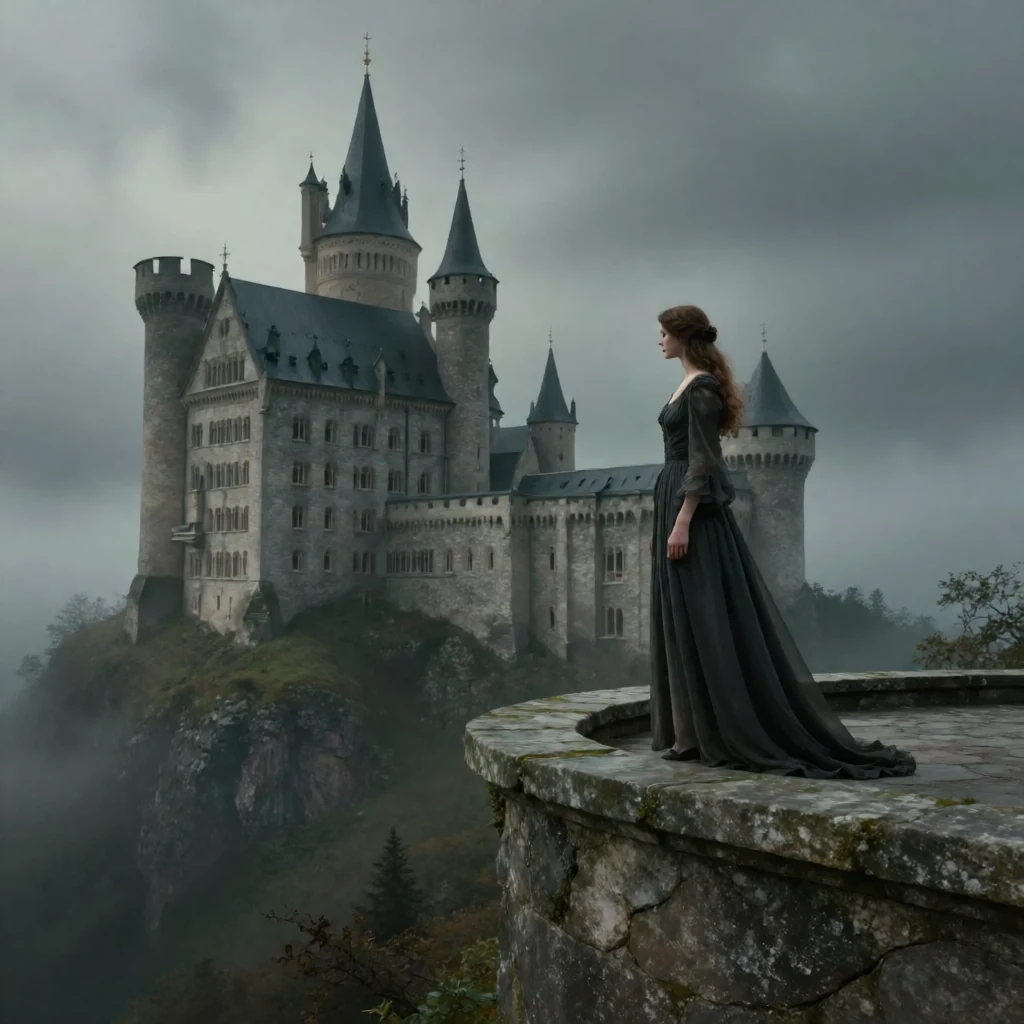
The Mysteries of Udolpho
The Mysteries of Udolpho by Radcliffe, Ann Ward unfolds through 56 chapters. St. Aubert buries his wife and, seeking to comfort his grieving daughter Emily, lectures her on the virtue of self-command, warning that even virtuous sorrow becomes vicious when indulged beyond reason. He receives a visit from the austere M. Barreaux, whose silent attentiveness speaks more to the heart than the hollow condolences offered by his sister Madame Cheron, who urges him to visit her estate near Thoulouse. Against his wishes to remain at home where his wife's memory sanctifies every scene, St. Aubert feels compelled to visit his brother-in-law M. Quesnel at the family estate, now stripped of its ancestral character by its new owner, where he introduces Emily to the Italian guests Signor Montoni and Signor Cavigni over a splendid dinner. St. Aubert's health visibly declines as weeks pass, his physician prescribing travel along the Mediterranean shores, and he dismisses all but his old housekeeper to economize, prompting Emily's surprise at this frugal decision. On the eve of departure, Emily discovers her father weeping alone over a small portrait of a lady who is not her mother, and she watches him kneel in what appears to be silent prayer, leaving her troubled by this secret grief she never knew he carried. After departing from the naturalist M. Barreaux, St. Aubert and Emily embark upon a winding route through the Pyrenees that offers sweeping vistas of romantic landscape, though the unfrequented road proves arduous and lacks adequate inns, forcing the travelers to carry provisions and rely upon the hospitality of remote mountain cottages. Along the journey, St. Aubert's melancholy surfaces as the scenery evokes tender memories of his late wife, yet Emily gradually yields to delight as the grandeur of the mountains unfolds before her—pine forests stretching toward vast plains enriched with woods, towns, and the winding Garonne. The travelers encounter Valancourt, a young wanderer in a hunter's dress who generously offers his own bed to the invalid St. Aubert when the party searches in vain for comfortable lodging among the poverty-stricken cottages of a remote hamlet, and whose literary volumes of Homer, Horace, and Petrarch—discovered later in the guest chamber—hint at a mind as susceptible to beauty as it is to nature's sublimity. After parting from Valancourt at the fork of the roads, St. Aubert and Emily continue toward Beaujeu through the Pyrenees, only to encounter a band of robbers on the dark mountain road. Valancourt appears unexpectedly, is shot in the arm while attempting to assist them, and Emily faints from distress upon seeing him wounded. They manage to dress his wound and proceed to Beaujeu, where a local surgeon tends to him. Valancourt's injury delays the travellers for several days, during which St. Aubert observes his character with philosophic interest, noting his generous spirit, clear perceptions, and romantic sensibility, while observing that this young man "has never been at Paris." Once Valancourt recovers sufficiently to travel, they continue together through the sublime alpine scenery, ascending to high regions of glaciers and eternal snow before gradually descending toward Rousillon, where beauty mingles with the grandeur they have traversed. Chapter IV follows St. Aubert, Emily, and Valancourt as they journey through the Pyrenees after sunset. A mysterious train of men, horses, and mules is observed descending a mountain, later identified as smugglers. The travelers pass an Alpine bridge where children play, then hear a distant vesper‑bell guiding them toward a convent. Ascending through moonlit woods, they pause on a summit where Valancourt and St. Aubert reflect on memory and melancholy. The party arrives at the convent, is granted lodging, shares a modest supper, and eventually retires for the night.
CHAPTER II
St. Aubert buries his wife and, seeking to comfort his grieving daughter Emily, lectures her on the virtue of self-command, warning that even virtuous sorrow becomes vicious when indulged beyond reason. He receives a visit from the austere M. Barreaux, whose silent attentiveness speaks more to the heart than the hollow condolences offered by his sister Madame Cheron, who urges him to visit her estate near Thoulouse. Against his wishes to remain at home where his wife's memory sanctifies every scene, St. Aubert feels compelled to visit his brother-in-law M. Quesnel at the family estate, now stripped of its ancestral character by its new owner, where he introduces Emily to the Italian guests Signor Montoni and Signor Cavigni over a splendid dinner. St. Aubert's health visibly declines as weeks pass, his physician prescribing travel along the Mediterranean shores, and he dismisses all but his old housekeeper to economize, prompting Emily's surprise at this frugal decision. On the eve of departure, Emily discovers her father weeping alone over a small portrait of a lady who is not her mother, and she watches him kneel in what appears to be silent prayer, leaving her troubled by this secret grief she never knew he carried.
Opening Shakespeare Epigraph
The chapter opens with an epigraph quoting Shakespeare: *"I could a tale unfold, whose lightest word / Would harrow up thy soul."* This ominous quotation foreshadows the revelations and emotional turmoil that will unfold throughout the chapter, hinting at the mystery and distress that await Emily St. Aubert and her father.
Madame St. Aubert's Funeral
Madame St. Aubert is interred in the neighboring village church. Her husband, St. Aubert, and daughter Emily attend the funeral, followed sincerely by the local peasantry who mourn the excellent woman. After returning from the burial, St. Aubert retreats to his chamber before emerging with a serene but sorrowful countenance. He summons his family for prayers, finding divine comfort in devotion that elevates his spirit above worldly grief.
St. Aubert's Counsel to Emily
St. Aubert tenderly counsels his daughter Emily on the importance of self-command, teaching her that excessive grief, though amiable in origin, becomes vicious when it compromises one's duties to oneself and others. He distinguishes between feeling and indulgence, warning that grief, like all emotions, becomes vice when extended beyond proper bounds. He promises to demonstrate his own philosophy by example and expresses confidence that Emily will prove herself worthy of his teaching.
M. Barreaux's Condolence Visit
M. Barreaux, an austere botanist who had withdrawn from society after becoming disillusioned with mankind, arrives to condole with St. Aubert—an unprecedented visit, as he had never before accepted St. Aubert's many invitations. Despite his rugged exterior, Barreaux displays deep sympathy through his modulated voice, softened looks, and attentive manner, revealing a heart that misfortune has softened. His presence brings comfort through actions rather than words.
Madame Cheron's Visit and Invitation
St. Aubert's surviving sister, Madame Cheron, a widow residing near Thoulouse, visits to offer condolences. Though her words are plentiful, she lacks the genuine emotional resonance of Barreaux's silent sympathy. She praises the deceased Madame St. Aubert and, unaware of St. Aubert's attachment to his home, presses them to visit her estate, suggesting that change of scene will help them overcome their grief.
Visit to Quesnel's Château
St. Aubert and Emily travel to Epourville to visit St. Aubert's brother-in-law, M. Quesnel, whose estate once belonged to St. Aubert's family. St. Aubert is compelled to make this visit by affairs of importance and hopes it will help rouse Emily from her dejection. As they approach through the forest, St. Aubert observes the turreted château he remembers from childhood, now owned by one who neither values nor respects its heritage.
Disappointment at the Altered Family Estate
The château has been transformed in ways that grieve St. Aubert deeply. The gothic hall no longer displays the family's ancient arms and banners; oak paneling has been painted white; the great table and benches that once hosted laughter and hospitality have been removed. Frivolous ornaments now hang on the heavy walls, reflecting the false taste and corrupted sentiments of the new owner.
Reception by the Quesnels
M. and Madame Quesnel receive St. Aubert with stately politeness, offering only perfunctory condolences before seemingly forgetting they ever had a sister. Emily feels tears of resentment rise within her, while St. Aubert maintains calm dignity that unintentionally unsettles Quesnel. Madame Quesnel informs Emily that a large dinner party is expected and insists that past grief should not prevent present festivity.
Italian Guests at Dinner
Among the dinner guests are two Italian gentlemen: Signor Montoni, a handsome man of forty with commanding features and quick discernment, and Signor Cavigni, younger but equally penetrating, superior in persuasive manner. Montoni discusses Italian political turmoil with passion, while Cavigni boasts of Venetian superiority, then smoothly flatters the French ladies with praise of Parisian fashions and opera. Their attention sometimes turns to Emily, whose modesty and simplicity form a stark contrast to her female companions.
St. Aubert's Nostalgic Reflections
During dinner, St. Aubert slips away to revisit the old chestnut tree that Quesnel threatens to cut down. Standing beneath its shade, surrounded by memories of his early days and departed friends, he contemplates the solitude of his current existence, with only Emily remaining as his emotional anchor. The recollection of his dying wife forces him to flee back to the social gathering.
Gradual Recovery from Grief
Time gradually softens Emily's acute grief, transforming its harshness into a sacred tenderness she cherishes. However, St. Aubert visibly declines in health, weakened by the fever he never fully recovered from and devastated by his wife's death. Emily, constantly at his side, fails to notice his deterioration until it becomes undeniable.
Physician's Travel Prescription
The physician prescribes travel for St. Aubert, recognizing that sorrow has attacked his already-weakened nerves. He believes that variety of scene and mental amusement will restore him to proper health. St. Aubert accepts the prescription and determines to journey leisurely along the Mediterranean coast toward Languedoc and Provence.
Preparations for Departure
Emily prepares to accompany her father on the journey while St. Aubert takes measures to reduce expenses, including dismissing all but the old housekeeper Theresa. When Emily questions this economy, citing her father's infirmities, he explains simply that they face an expensive excursion. On the eve of departure, Emily stays up past midnight gathering her belongings.
Emily's Discovery of the Secret Portrait
While collecting drawing instruments late at night, Emily discovers her father in the closet of his chambers, reading papers by candlelight while weeping aloud. He kneels in prayer with a wild, almost horrified expression, then retrieves a small case containing a miniature portrait—not of his late wife, but of another woman. St. Aubert gazes upon it with evident tenderness, pressing it to his lips and heart with convulsive sighs. Emily, watching unseen through the glass panes, realizes her father harbors a secret sorrow and a mysterious portrait she never knew existed, before withdrawing before she is discovered.
CHAPTER III
After departing from the naturalist M. Barreaux, St. Aubert and Emily embark upon a winding route through the Pyrenees that offers sweeping vistas of romantic landscape, though the unfrequented road proves arduous and lacks adequate inns, forcing the travelers to carry provisions and rely upon the hospitality of remote mountain cottages. Along the journey, St. Aubert's melancholy surfaces as the scenery evokes tender memories of his late wife, yet Emily gradually yields to delight as the grandeur of the mountains unfolds before her—pine forests stretching toward vast plains enriched with woods, towns, and the winding Garonne. The travelers encounter Valancourt, a young wanderer in a hunter's dress who generously offers his own bed to the invalid St. Aubert when the party searches in vain for comfortable lodging among the poverty-stricken cottages of a remote hamlet, and whose literary volumes of Homer, Horace, and Petrarch—discovered later in the guest chamber—hint at a mind as susceptible to beauty as it is to nature's sublimity.
Nature's Boundless Sacred Charms
Nature's Boundless Sacred Charms The chapter opens with an epigraph from "THE MINSTREL," reflecting on the boundless charms of nature that sustain the soul— woodlands, shores, fields, morning light, evening echoes, mountain shelters, and heavenly magnificence—all that can impart "love, and gentleness, and joy" to those who appreciate nature's gifts.
St. Aubert's Winding Mountain Route to Languedoc
St. Aubert's Winding Mountain Route to Languedoc Rather than taking the direct road along the feet of the Pyrenees to Languedoc, St. Aubert deliberately chooses a more winding route over the heights, seeking more extensive views and greater variety of romantic scenery for his journey with Emily.
Farewell to M. Barreaux
Farewell to M. Barreaux St. Aubert turns aside from his route to visit M. Barreaux, whom he finds botanizing in the woods near his château. Despite his reclusive nature, Barreaux expresses genuine concern at St. Aubert's departure, saying he would have been tempted to accompany him. They part with mutual regret, and Barreaux promises to await St. Aubert's return with impatience.
Journey Preparations: Provisions and Reading Materials
Journey Preparations: Provisions and Reading Materials The travelers prepare for the journey by carrying provisions in their carriage to compensate for the lack of convenient inns, allowing them to take refreshment in pleasant spots outdoors and find lodging at cottages along the way. For intellectual sustenance, they bring a botanical work by M. Barreaux and several Latin and Italian poets. Emily also brings her pencil to sketch the beautiful scenes they encounter.
St. Aubert's Melancholy View of His Château
St. Aubert's Melancholy View of His Château As they ascend the heights, St. Aubert repeatedly looks back at his château in the plain below. Melancholy images fill his mind, and he fears he may never return. Though he tries to dismiss this thought, he continues gazing until distance blends his home into the general landscape, and he feels "Drag at each remove a lengthening chain."
Emily's Delight at Mountain Grandeur
Emily's Delight at Mountain Grandeur St. Aubert and Emily travel in musing silence for some leagues until Emily's youthful fancy is struck by the grandeur of the surrounding objects, awakening delightful impressions. As the road descends into glens confined by stupendous rocky walls, Emily gazes upon pine forests, vast plains enriched with woods, towns, vines, and plantations stretching to the horizon, where the majestic Garonne river winds toward the Bay of Biscay.
Cliff-Top Rest and Grief for St. Aubert's Late Wife
Cliff-Top Rest and Grief for St. Aubert's Late Wife The travelers stop at a cliff summit adorned with palm trees, overlooking Gascony and Languedoc, where they dine while mules browse on herbs. St. Aubert points out rivers, towns, and provincial boundaries to Emily, but becomes silent and tearful as the scene resembles a favorite viewpoint of his late wife, Madame St. Aubert. Remembering her, he walks away to weep privately before regaining composure.
Decision to Travel South to Rousillon
Decision to Travel South to Rousillon St. Aubert decides to extend his journey further into the mountains, turning south toward Rousillon to coast the Mediterranean on the way to Languedoc, prompting consultation with the muleteer Michael about routes and possible hamlets reachable before nightfall.
Muleteer's Dangerous Precipice Drive
Muleteer's Dangerous Precipice Drive After Michael completes his devotions at a wayside cross, he rattles his mules at full gallop along the edge of a dizzying precipice. Terrified Emily nearly faints, but St. Aubert, fearing greater danger from suddenly stopping the driver, must trust the mules, which possess more discretion than their master and safely carry the travelers down to the valley.
Emily Spots Distant Snow-Capped Peak
Emily Spots Distant Snow-Capped Peak As they travel through mountainous glens, Emily notices a bright object at a great distance appearing like a cloud. St. Aubert identifies it as a snowy mountain peak so high it still reflects the sun's rays while the surrounding mountains lie in deep shade.
Narrow Rocky Valley with Larch and Cedar
Narrow Rocky Valley with Larch and Cedar Leaving the expansive views, the travelers enter a narrow valley screened by rocks piled in wild arrangement, with larch and cedar spreading their gloom over cliffs and torrents. The barren scene is interrupted only by lizards scrambling among dangerous rocks, recalling Salvator Rosa's romantic landscapes, where St. Aubert almost expects to see banditti emerge.
Sunset Valley with Shepherd and Cattle
Sunset Valley with Shepherd and Cattle The valley gradually opens and softens toward evening, revealing heathy mountains where a solitary sheep-bell sounds and a shepherd calls his flocks to fold. A cabin shadowed by cork-trees and ilex overlooks vivid verdure in the valley, with cattle grazing under oak and chestnut trees and reposing by the rivulet.
Encounter with Hunter Valancourt
Encounter with Hunter Valancourt The travelers, lost in twilight melancholy, are startled by gunshots, then a hunting horn. A young stranger in a hunter's dress—gun slung across his shoulders, horn at his belt, and a small pike in hand—springs from the bushes with two dogs. He offers to guide them to the nearby hamlet, declining a seat in the carriage but keeping pace with the mules.
Valancourt Guides Them to the Mountain Village
Valancourt Guides Them to the Mountain Village Valancourt, as the stranger reveals his name, guides them toward the village while conversing with St. Aubert about his wandering lifestyle. He explains he takes the hunter's dress for companionship with his dogs, for an ostensible purpose that procures respect from simple mountain people, and for the pleasure of the countryside. St. Aubert shares his purpose of seeking health and plans to travel toward Rousillon, and Valancourt offers information about the roads.
Search for Village Lodging
Search for Village Lodging The travelers arrive at the village, finding no inn but only cottages of varying comfort. They enter several where ignorance, poverty, and mirth prevail, with owners viewing them with curiosity and timidity. No proper bed can be found among the humble dwellings, consisting typically of two rooms—one housing mules and pigs, the other sheltering large families on beds of skins and dried leaves spread on mud floors, with light and smoke passing through roof apertures.
Valancourt Offers His Bed to St. Aubert
Valancourt Offers His Bed to St. Aubert Observing Emily's anxious tenderness for her fatigued father, Valancourt draws St. Aubert aside and offers his own bed, which, though modest compared to their grim discoveries, is decent enough. Though initially reluctant to accept, St. Aubert finally agrees when Valancourt insists, declining to give pain by letting an invalid lie on hard skins while Valancourt sleeps comfortably.
Evening Meal and Conversation with Valancourt
Evening Meal and Conversation with Valancourt The hostess welcomes them to a superior cottage where eggs and milk are the only local provisions. St. Aubert shares his own provisions with Valancourt, and they converse for an hour. St. Aubert admires Valancourt's manly frankness, simplicity, and keen susceptibility to nature's grandeur, reflecting that without a certain simplicity of heart, such appreciation cannot exist strongly.
Muleteer Dispute Over Mule Lodging
Muleteer Dispute Over Mule Lodging The conversation is interrupted by a violent uproar outside, where Michael quarrels with the hostess because she refuses to let his mules sleep in the same small room where her sons will spend the night. The muleteer's pride is wounded by this disrespect to his animals, which he defends eloquently, declaring them as honest and good as any in the province, and only once misbehaving when a boy was asleep in their stable.
Valancourt Resolves the Muleteer Dispute
Valancourt Resolves the Muleteer Dispute Valancourt intervenes in the dispute by proposing that the muleteer and his mules have the disputed room while the hostess's sons take Valancourt's bed of skins, and he will wrap himself in his cloak and sleep on a bench by the door. The hostess initially opposes this arrangement, but Valancourt's persistence settles the tedious affair.
St. Aubert Discovers Valancourt's Books
St. Aubert Discovers Valancourt's Books As the travelers retire late to their rooms and Valancourt takes his station at the cottage door, preferring the mild night air to a close cabin, St. Aubert discovers volumes of Homer, Horace, and Petrarch in his room. The name of Valancourt, written inside, reveals these books belong to the young stranger who has so graciously offered his bed and assistance.
CHAPTER IV
After parting from Valancourt at the fork of the roads, St. Aubert and Emily continue toward Beaujeu through the Pyrenees, only to encounter a band of robbers on the dark mountain road. Valancourt appears unexpectedly, is shot in the arm while attempting to assist them, and Emily faints from distress upon seeing him wounded. They manage to dress his wound and proceed to Beaujeu, where a local surgeon tends to him. Valancourt's injury delays the travellers for several days, during which St. Aubert observes his character with philosophic interest, noting his generous spirit, clear perceptions, and romantic sensibility, while observing that this young man "has never been at Paris." Once Valancourt recovers sufficiently to travel, they continue together through the sublime alpine scenery, ascending to high regions of glaciers and eternal snow before gradually descending toward Rousillon, where beauty mingles with the grandeur they have traversed. Chapter IV follows St. Aubert, Emily, and Valancourt as they journey through the Pyrenees after sunset. A mysterious train of men, horses, and mules is observed descending a mountain, later identified as smugglers. The travelers pass an Alpine bridge where children play, then hear a distant vesper‑bell guiding them toward a convent. Ascending through moonlit woods, they pause on a summit where Valancourt and St. Aubert reflect on memory and melancholy. The party arrives at the convent, is granted lodging, shares a modest supper, and eventually retires for the night.
CHAPTER IV
After parting from Valancourt at the fork of the roads, St. Aubert and Emily continue toward Beaujeu through the Pyrenees, only to encounter a band of robbers on the dark mountain road. Valancourt appears unexpectedly, is shot in the arm while attempting to assist them, and Emily faints from distress upon seeing him wounded. They manage to dress his wound and proceed to Beaujeu, where a local surgeon tends to him. Valancourt's injury delays the travellers for several days, during which St. Aubert observes his character with philosophic interest, noting his generous spirit, clear perceptions, and romantic sensibility, while observing that this young man "has never been at Paris." Once Valancourt recovers sufficiently to travel, they continue together through the sublime alpine scenery, ascending to high regions of glaciers and eternal snow before gradually descending toward Rousillon, where beauty mingles with the grandeur they have traversed.
The Minstrel
The chapter opens with a poetic preface describing a wandering minstrel who finds delight in both gentle and dreadful scenes, in darkness and storms, and even in vicissitude—a soul moved to sighs and tears of pity. The actual narrative continues this motif through Valancourt, a young stranger St. Aubert and Emily encounter during their travels.
Breakfast and Departure
St. Aubert wakes refreshed from sleep and invites the stranger to breakfast. Learning that Valancourt once traveled as far as Beaujeu, a significant town on the route to Rousillon, St. Aubert decides to take that path. Valancourt offers to guide them for the first league and a half, as he had planned to wander anyway and prefers their company to traveling alone. The young man declines a seat in the carriage and proceeds on foot.
The Valley at Dawn
The travelers journey through a pastoral valley bright with verdure, groves of dwarf oak, beech, and sycamore, where cattle repose beneath. The mountain-ash and weeping birch shade the steep slopes. Shepherds drive immense flocks to the hills as the sun rises, and St. Aubert inhales the pure morning air, refreshing for the invalid. The dawn transforms the landscape from grey mist to golden light touching the mountain cliffs, while the valley below remains shrouded in dew. St. Aubert is emotionally moved, weeping as his thoughts turn to the Great Creator. Emily wishes to wander freely across the dewy turf. Valancourt converses sociably with other travelers, pointing out objects of admiration, and St. Aubert notes his ingenuousness: "This young man has never been at Paris."
Valancourt's Pursuit
At the parting of the roads, St. Aubert takes an affectionate farewell of Valancourt, who lingers and searches for conversation topics to delay his departure. He gazes earnestly at Emily as the carriage departs, and St. Aubert observes him standing on the roadside bank, watching the carriage with folded arms before waving a final salute.
The Parting of the Roads
After their parting, the aspect of the country transforms dramatically. The travelers enter regions of gloomy pine forests covering mountains nearly to their summits, interrupted only by granite cliffs and expanding rivers. The landscape becomes wild and unfrequented, with only distant shepherds and their dogs visible. The only human habitations are remote goat-herd or hunter cabins perched among cliffs. St. Aubert frequently alights to examine curious plants while Emily wanders in high enthusiasm beneath the forest shades.
The Pine Forests
The travelers continue over rough, unfrequented roads through dark pine forests. St. Aubert examines botanical specimens while Emily listens to the lonely murmur of the woods. They take dinner in the open air under spreading cedars before continuing toward Beaujeu. The road descends, leaving the pine forests behind, and evening twilight falls as the travelers proceed through rocky precipices toward their destination.
The Approaching Fire
As darkness falls, a distant fire illuminates the rocks and horizon. St. Aubert suspects banditti common to the Pyrenees and grows watchful. He carries arms for protection against potential robbery. Suddenly, a voice commands the muleteer to stop from the road behind. St. Aubert orders Michael to proceed faster, but the mules refuse to quicken their pace. Horses' feet approach, and a man rides up demanding they stop.
The Wounded Stranger
When St. Aubert prepares a pistol for defense, a gunshot rings out—the man staggers on his horse. St. Aubert then recognizes Valancourt's voice calling out. He finds Valancourt bleeding profusely from an arm wound. The muleteer has pursued a runaway horse, leaving Emily alone in the carriage. Upon returning, St. Aubert discovers Emily has fainted from anxiety. Valancourt, despite his own condition, hastens to her relief. St. Aubert forms bandages from handkerchiefs to stop the bleeding. Learning Beaujeu lies two leagues distant, St. Aubert grows anxious about Valancourt's ability to travel. Valancourt insists his wound is slight, and they proceed slowly toward Beaujeu with Valancourt seated in the carriage.
Emily's Distress
Valancourt explains his unexpected reappearance: St. Aubert renewed his taste for society, and upon their departure, the hamlet seemed a solitude. He chose this romantic mountain route partly hoping to overtake them. Emily remains silent except when Valancourt addresses her directly, when tremulousness in his voice reveals his feelings. St. Aubert laments the rashness that caused the accident, while Valancourt struggles against pain to maintain a cheerful conversation and spare his companions unpleasant feelings.
The Gipsy Camp
As they approach the fire visible throughout the night, they discover a gipsy camp in the valley—one of numerous bands haunting the Pyrenees who partially subsist by plundering travelers. Emily views these savage figures with terror as the fire casts red, dusky gleams upon rocks and foliage, creating romantic effects. The rovers are busy preparing supper around a large pot and a rude tent where children and dogs play. Valancourt silently places his hand on one of St. Aubert's pistols while St. Aubert draws another, and they pass without being attacked, the gipsies apparently unprepared and occupied with their meal.
Arrival at Beaujeu
After another league and a half in darkness, the travelers arrive at Beaujeu and drive to its only inn, which though superior to mountain accommodations, remains poor. Valancourt is helped inside and laid down, while St. Aubert sends immediately for the town surgeon—a practitioner who treats horses as readily as humans and shaves faces as deftly as he sets bones. After examining Valancourt's arm, the surgeon determines the bullet passed through the flesh without touching bone, dresses the wound, and prescribes quiet.
The Surgeon's Visit
The surgeon dresses Valancourt's wound and departs with solemn instructions for rest, which Valancourt feels disinclined to follow. Relief from pain brings spirits reanimated, and he wishes to join the conversation of St. Aubert and Emily, now released from apprehensions. Late as the hour is, St. Aubert must go out with the landlord to purchase provisions for supper, leaving Emily and Valancourt alone. They converse on natural history, scenery, poetry, and particularly St. Aubert—Emily's favorite subject.
Evening Conversation
The evening passes agreeably until St. Aubert, fatigued from the journey, and Valancourt, again sensible of pain, separate after supper. The conversation covers local character, natural history, and poetry, with Emily speaking and listening with peculiar pleasure on the subject of St. Aubert. Valancourt and Emily find themselves alone during St. Aubert's absence.
Valancourt's Fever
In the morning, Valancourt has passed a restless night and is feverish, his wound painful. The surgeon advises remaining quietly at Beaujeu, advice too reasonable to reject. Though St. Aubert distrusts this practitioner, enquiry reveals no nearer town offering better medical skill. St. Aubert alters his journey to await Valancourt's recovery, despite Valancourt's polite but insincere objections to this delay.
The Pyrenean Scenery
During Valancourt's enforced rest, St. Aubert and Emily explore the beautiful environs of Beaujeu, situated at the feet of the Pyrenean Alps. The mountains rise in abrupt precipices or swell with forests of cedar, fir, and cypress stretching nearly to their summits. The cheerful green of beech and mountain-ash appears like gleams of light amid dark forest verdure, while torrents pour through the woods.
Observations on Valancourt
Valancourt's confinement allows St. Aubert to observe his disposition and talents. He perceives a frank, generous nature full of ardor, highly susceptible to grandeur and beauty, yet impetuous, wild, and somewhat romantic. Valancourt has known little of the world but possesses clear perceptions and just feelings, expressing indignation or admiration with equal vehemence. St. Aubert sometimes smiles at his warmth but seldom checks it, often reflecting, "This young man has never been at Paris." St. Aubert discovers Valancourt comes from a respectable Gascony family of the same name, and invites him to continue the journey in the carriage once he can travel, though not yet manage his horse.
The Alpine Heights
The travelers ascend higher into the mountains where glaciers exhibit frozen horrors and eternal snow whitens summits. They pause to contemplate these stupendous scenes from wild cliffs where only ilex and larch flourish, looking over dark fir forests and precipices where human foot has never wandered, down to glens so deep that torrent thunder is scarcely heard. Fantastic granite formations rise—some shooting into cones, others impending over their base with trembling snow threatening destruction. The travelers experience sublime emotions, with tears often coming to St. Aubert's eyes. The thin atmosphere makes distant objects appear near, surprising Emily. Deep silence is broken only by vultures and eagles, while billows of vapor roll below, partly revealing and concealing the landscape.
Descent Towards Rousillon
After traversing high Alpine regions for many leagues, the travelers begin descending toward Rousillon, and features of beauty mingle with the scene. They regard the sublime objects they have quitted with some regret, yet their eyes, fatigued with the extension of their powers, find rest on verdant woods and pastures along the river below, humble cottages shaded by cedars, mountaineer children, and flowery nooks among the hills.
The Spanish Pass
As they descend, a grand Pyrenean pass into Spain appears on the right, gleaming with battlements and towers in the setting sun's splendor. Yellow-topped woods color the steeps below while snowy mountain points above reflect rosy hues.
Beaujeu Inn
St. Aubert looks out for the little town the Beaujeu residents directed him toward for the night, but no habitation yet appears. Valancourt cannot assist with judging distance, having never traveled this far along the Alpine chain before. They follow the single road that has guided them since leaving Beaujeu, confident in their direction as no alternative paths have offered choices to perplex or mislead them.
CHAPTER IV
Chapter IV follows St. Aubert, Emily, and Valancourt as they journey through the Pyrenees after sunset. A mysterious train of men, horses, and mules is observed descending a mountain, later identified as smugglers. The travelers pass an Alpine bridge where children play, then hear a distant vesper‑bell guiding them toward a convent. Ascending through moonlit woods, they pause on a summit where Valancourt and St. Aubert reflect on memory and melancholy. The party arrives at the convent, is granted lodging, shares a modest supper, and eventually retires for the night.
The Mountain Train at Sunset
At sunset, St. Aubert orders the muleteer to hurry, feeling the fatigue of illness after a long day. While winding down the valley, he spots a large convoy of men, horses, and loaded mules moving down the opposite mountain, their bright arms glinting in the fading light. The appearance of military dress in the vanguard convinces him the group is a band of smugglers that has been intercepted by troops, easing his earlier anxiety.
The Alpine Bridge and Children
As the travelers continue along the valley, they come upon a rude Alpine bridge spanning two lofty crags. A group of mountaineer children is amusing itself by dropping pebbles into the torrent below, watching the white spray rise and listening to the sullen echo of the water. St. Aubert attempts to call out for directions to Montigny, but the roar of the torrent and the height of the crags prevent him from being heard, so the party pushes on.
The Vesper Bell
After twilight, the group hears the faint sound of a vesper‑bell drifting from a nearby convent. Valancourt suggests they seek shelter there, promising to ask for a night’s lodging or at least directions to Montigny. St. Aubert, exhausted and unwell, agrees, preferring the prospect of rest to a further night on the road.
Ascent Through the Moonlit Woods
Guided by the bell, the travelers ascend a steep, moonlit path into dense woods. The moonlight filters through the leaves, casting a trembling glow over the narrow track. The silence of the night, broken only by the occasional toll of the bell, creates an eerie atmosphere that strikes Emily with a mix of awe and fear, which Valancourt’s conversation partially alleviates.
Conversation on Memory and Melancholy
On a small grassy summit where the trees open to reveal a silver‑lit valley, the party pauses to rest. Valancourt speaks of the power of such scenes to soften the heart, evoke pure melancholy, and awaken feelings of benevolence and love. St. Aubert reflects on the memory of those we love and the tender melancholy that such nights inspire, while Emily silently thinks of her deceased mother. The conversation deepens their sense of shared sorrow and fleeting comfort.
Arrival at the Convent
Emerging from the woods, the travelers spot the convent perched on a turfy hillock, surrounded by a high wall. They knock on an ancient gate and are met by a humble monk who leads them to a small room to wait. The superior, seated with a large black‑letter folio, receives them courteously, asks a few questions, and grants them lodging for the night.
Supper with the Monks
After a brief, formal interview, the party is shown to a modest dining area where a simple supper is laid. St. Aubert, weakened by illness, receives gentle care from Emily and attentive assistance from Valancourt, who watches Emily with tender concern. The meal, though modest, provides a brief respite, and the travelers separate early to their respective rooms.
Emily's Midnight Meditation
Later that night, Emily is awakened by the chiming of a bell and the sound of footsteps in the corridor, realizing it is the monks’ call to prayers. Unable to return to sleep, she opens her casement to the moonlit landscape, listens to the faint midnight hymn rising from a chapel below, and contemplates the grandeur of creation, the vastness of the heavens, and the goodness of the Deity. Moved by a pure, uplifting devotion, she watches the moon set over the valley before finally drifting back to a tranquil sleep.
CHAPTER V
St. Aubert journeys with Emily and Valancourt through the wild and romantic Pyrenees toward Rousillon, where magnificent mountain scenery of towering crags, pine forests, and pastoral valleys alternately charms and awes the travelers. St. Aubert observes the tender exchanges between Valancourt and Emily with mixed pleasure and resignation, noting Valancourt's generous spirit and Emily's gentle seriousness as they stroll together through the landscape. The party becomes lost in a wooded mountain pass but finds a shepherd's cottage, where they learn that gypsies have stolen sheep belonging to a poor family, threatening their livelihood and the shepherd's employment with a harsh master. Moved by the family's distress, Valancourt gives away nearly all his money to help them, an act that fills his heart with such lightness and joy that he exclaims over the beauty of the very scenery he has always admired. From a high summit, the travelers behold an extensive prospect of Rousillon's green lowlands stretching toward the Mediterranean, contrasted against the majestic and desolate Pyrenees peaks, while a rocky pass toward Gascony reveals a gibbet and crosses that cast a shadow over their enjoyment of the sublime landscape. They descend into the cultivated beauty of Rousillon, arriving at Arles as evening falls, where the approaching separation of Valancourt from St. Aubert and Emily casts a melancholy gloom over their final evening together.
Journey to Rousillon Through Mountain Scenery
St. Aubert, sufficiently restored by a night's repose, sets out with his family and Valancourt for Rousillon, hoping to reach it before nightfall. The scenery through which they pass is wild and romantic, with beauty occasionally softening the landscape into smiles. Little woody recesses appear among the mountains, covered with bright verdure and flowers, or pastoral valleys open in the shade of cliffs with flocks and herds along rivulet banks. St. Aubert frequently must alight to walk along rugged precipices and climb steep, flinty mountains, but the sublime variety of prospects repays him for the fatigue. He finds great pleasure in conversing with Valancourt, admiring his fire, simplicity, and the justness and dignity of his elevated mind.
St. Aubert Observes Valancourt and Emily's Bond
As St. Aubert lingers to examine wild plants, he often looks forward with pleasure to Emily and Valancourt strolling together—Valancourt pointing out grand features of the scenery with animated delight, and Emily listening with tender seriousness. They appear like two lovers whose situation has secluded them from the frivolities of common life, whose ideas are simple and grand like the landscapes around them. St. Aubert reflects on how the world ridicules genuine passion, how virtue and taste are nearly the same, and how love cannot exist in a heart that has lost the meek dignity of innocence.
Lost in the Mountain Wood
Near noon, the travelers arrive at steep, dangerous road and choose to walk through refreshing shade instead of following the carriage. The woody recesses offer dewy coolness, bright verdure, fragrant flowers and herbs, and grand pines, beeches, and chestnuts. Sometimes the thick foliage excludes all view; at others, partial glimpses of distant scenery inspire the imagination. As they saunter under the trees following the road's direction, they perceive they have totally lost it, while the road wound far away over the cliff above. Valancourt calls loudly to Michael but hears only his own echoes.
Visit to the Shepherd's Cabin
Valancourt bounds ahead to a shepherd's cabin, where he finds only two little children at play on the turf before the door. The eldest boy tells him their father is with his flocks and their mother has gone down into the vale but will return shortly. St. Aubert and Emily approach the cottage and rest on a rustic bench between two pines, observing the picture of infantine simplicity, which brings remembrance of St. Aubert's own lost boys and their lamented mother. Emily sings one of his favorite simple airs to dispel his melancholy, and Valancourt pauses at a distance to listen before joining them.
Valancourt Locates Michael and Plans an Ascent
Valancourt endeavors to make his way through the thicket that clothes the steeps, following the direction of Michael's roaring voice echoing among the cliffs. After much struggle over brambles and precipices, he reaches Michael and prevails upon him to be silent and listen. Since the carriage is far away and climbing the long, steep road would be very fatiguing for St. Aubert, Valancourt is anxious to find a more easy ascent by the way he has passed. He returns to the carriage for refreshments and proposes removing higher to where the woods open upon a grand prospect.
The Grieving Shepherd's Wife and Stolen Sheep
A young woman joins the children and weeps over them, which stops the travelers. She explains that her husband, a shepherd who lives in the mountains during summer to watch over his master's flocks, lost his little all the preceding night—gang of gypsies drove away several sheep. Her husband Jacques had saved money to buy a few sheep of his own, and now they must go to his master for those stolen. Worse, their master, a hard man, will likely trust Jacques no longer with the care of his flocks, leaving the family in desperate circumstances.
Valancourt Gives His Savings to the Shepherd
St. Aubert and Emily give money to the shepherd's wife, but Valancourt lingers behind, asking how much more is needed to replace the stolen sheep. Learning it is a sum very close to all he has, he faces a dilemma: whether to give the money and struggle to reach home with little remaining, or keep it for his own journey. When the shepherd himself appears with a forlorn and melancholy look, Valancourt immediately throws down all his money except a few louis, bounded away after St. Aubert and Emily. His heart has seldom felt so light, and every object appears more interesting and beautiful than before.
Summit Panorama of the Pyrenees and Rousillon
The party reaches a shady summit where a magnificent panorama unfolds. Behind them, rock rises perpendicularly in a massy wall, branching into overhanging crags grey-tinted and brightened by wild flowers in their fractured sides. Below, steep slopes are fringed with alpine shrubs, and lower still appear the tufted tops of chestnut woods, among which the shepherd's cottage peeps forth with its bluish smoke curling high. Majestic Pyrenees summits display tremendous marble crags changing with varying lights, while their steeps are covered with forests of pine, larch, and oak. Through a vista appears the lowlands of Rousillon tinted with blue haze, uniting with the Mediterranean waters, where a lonely beacon marks the shore and distant sails glisten in sunlight.
Descent to the Rousillon Lowlands and Arles
The travelers descend the lower alps that bind Rousillon, forming a majestic barrier open only on the east to the Mediterranean. The landscape transforms to gay cultivation—groves of orange and lemon perfume the air with ripe fruit glowing among foliage, and extensive vineyards slope toward the plains. Beyond these, woods and pastures stretch toward the sea, on whose bright surface gleam distant sails, all diffused with the purple glow of evening. This landscape presents a perfect picture of the lovely and the sublime, of beauty sleeping in the lap of horror. The travelers proceed between flowering myrtle and pomegranate hedges to the town of Arles, where they propose to rest for the night.
Melancholy Evening Before Valancourt's Departure
Though they find simple but neat accommodation and might have passed a happy evening after the day's toils and delights, the approaching separation casts a gloom over their spirits. St. Aubert plans to proceed the next morning to the Mediterranean borders and travel along its shores into Languedoc, while Valancourt, nearly recovered, resolves to leave them and explore new scenes among the mountains on his return home. During this evening, Valancourt is often silent and thoughtful, St. Aubert's manner is affectionate though grave, and Emily is serious despite frequent efforts to appear cheerful. After one of their most melancholy evenings yet, they separate for the night.
CHAPTER VI
The chapter opens with an epigraph from Thomson's poem celebrating free nature's grace and the soul's resilience against Fortune's deprivements. The narrative then follows St. Aubert and Emily as they journey southward through the French provinces toward the Mediterranean coast, accompanied on the initial portion of their travels by the young and gallant Valancourt. Their route takes them through the romantic landscapes of Rousillon and Languedoc, but the journey is marked by St. Aubert's declining health and the revelation of a catastrophic financial ruin that threatens their comfortable existence at La Vallée. As evening approaches and St. Aubert grows dangerously ill, the travellers find themselves seeking shelter at a mysterious château deep in the woods, where an eerie voice echoes through the darkness. CHAPTER VI continues the journey of St. Aubert, Emily, and the servant Michael as they travel through the French countryside at night. St. Aubert has fallen seriously ill, and the travelers find themselves in need of shelter and assistance as they make their way toward their destination. St. Aubert expresses his intention to depart early the following morning, citing his desire to rest during the heat of the day and his urgency to reach La Vallée. He acknowledges that his current state of health and spirits renders a longer journey unenjoyable.
CHAPTER VI
The chapter opens with an epigraph from Thomson's poem celebrating free nature's grace and the soul's resilience against Fortune's deprivements. The narrative then follows St. Aubert and Emily as they journey southward through the French provinces toward the Mediterranean coast, accompanied on the initial portion of their travels by the young and gallant Valancourt. Their route takes them through the romantic landscapes of Rousillon and Languedoc, but the journey is marked by St. Aubert's declining health and the revelation of a catastrophic financial ruin that threatens their comfortable existence at La Vallée. As evening approaches and St. Aubert grows dangerously ill, the travellers find themselves seeking shelter at a mysterious château deep in the woods, where an eerie voice echoes through the darkness.
Thomson's Nature Poem
The chapter begins with an epigraph from Thomson's "The Seasons," asserting that Fortune cannot deprive the soul of nature's grace, the beauty of dawn, or the pleasures of wandering through woods and lawns at evening. The poem celebrates the immutable treasures of the natural world and the gifts of fancy, reason, and virtue that no adversity can destroy. This invocation of nature's enduring consolations prefigures the themes that will unfold as St. Aubert faces ruin—yet finds solace in the sublime landscapes that remain accessible to all, regardless of worldly fortune.
Breakfast with Valancourt
The morning after their meeting, Valancourt breakfasts with St. Aubert and Emily at the little inn. St. Aubert appears languid from illness, and Emily watches her father with anxious affection, noting that his disorder seems to be increasing. The breakfast is nearly as silent as the preceding supper, the three companions lost in pensive reflection. St. Aubert reveals that he already knows Valancourt's family, as their estates lie within twenty miles of La Vallée and he has met Valancourt's elder brother during visits in the neighbourhood. This prior knowledge had inclined St. Aubert to accept Valancourt as a travelling companion, for while he trusts his own judgment of character, he would not have trusted countenance and manners alone as sufficient introduction for his daughter.
Valancourt's Family
St. Aubert explains that Valancourt made known his name and family when they first met. The family estates are now held by Valancourt's elder brother, and these lands lie little more than twenty miles from La Vallée. St. Aubert has sometimes encountered the elder Valancourt during visits in the surrounding neighbourhood, making him familiar with the family's standing and reputation. This knowledge gave St. Aubert greater confidence in receiving the young man as a travelling companion, since appearances alone would not have sufficed as an introduction for someone accompanying his daughter through the countryside.
The Farewell
The carriage arrives to convey St. Aubert and Emily onward, and the moment of parting arrives. St. Aubert invites Valancourt to visit La Vallée whenever he passes through the region, and Valancourt eagerly accepts, glancing timidly at Emily as he does so. She attempts to smile away her serious mood. They share a few minutes of interesting conversation before St. Aubert leads the way to the carriage, his companions following in silence. Valancourt lingers at the door for several minutes after they are seated, and none of them can summon the courage to speak the word farewell. At length St. Aubert pronounces the melancholy word, which Emily passes to Valancourt, who returns it with a dejected smile. The carriage drives away, and Valancourt is seen at the inn door following them with his eyes until the winding road steals him from sight.
St. Aubert's Reflections
Once the carriage has departed, St. Aubert reflects on Valancourt as a promising young man, remarking that he has not been so pleased with any person on so brief an acquaintance for many years. Valancourt brings to St. Aubert's memory the days of his own youth, when every scene was new and delightful. St. Aubert sighs and recalls that when he was Valancourt's age, he thought and felt exactly as the young man does, and the world was opening before him then—now it is closing. Emily pleads with her father not to think so gloomily, expressing hope that he has many years left to live, for his own sake and for hers. St. Aubert speaks of the pleasure an old man takes in observing the ardour and ingenuousness of youth, comparing it to the reviving effect of spring upon a sick person. He declares that Valancourt is this spring to him, and Emily listens with unprecedented pleasure to her father's praises of another, finding joy in witnessing the warmth his character inspires.
Journey to Colioure
The travellers proceed through delightful landscapes of vineyards, woods, and pastures, with the grandeur of the Pyrenees on one side and the ocean on the other. By noon they reach Colioure, a town on the Mediterranean where they dine and rest until the cool of the afternoon. They then continue along the enchanting shores extending toward Languedoc. Emily gazes with enthusiasm upon the vast sea, watching how its surface transforms with the play of light and shadow, and admiring the woody banks mellowed with autumnal tints. St. Aubert is eager to reach Perpignan, where he expects letters from M. Quesnel—letters that have induced him to leave Colioure despite his need for rest. After travelling a few miles, St. Aubert falls asleep, and Emily finds opportunity to examine the books she brought from La Vallée.
Valancourt's Petrarch
Emily searches for the book Valancourt had been reading the previous day, hoping to retrace passages his eyes had touched and to dwell on the lines he had admired, letting them speak in the language of his mind and conjure his presence. She cannot find the book, but discovers instead a volume of Petrarch's poems that had belonged to Valancourt, bearing his name. He had frequently read passages from this collection to her, with all the pathetic expression that characterizes Petrarch's feelings. Emily hesitates to believe what is apparent—that Valancourt purposely left this book in place of the one she lost, and that love prompted the exchange. Opening it with impatient pleasure, she observes the lines of his pencil drawn along passages he read aloud, and beneath others more descriptive of delicate tenderness than he had ventured to trust to his voice. Conviction dawns that she is beloved, and she weeps over the memorial of his affection, recalling the variations of tone and countenance with which he had recited these sonnets.
News from Perpignan
At Perpignan after sunset, St. Aubert finds letters from M. Quesnel that grievously affect him. Emily, alarmed by his evident distress, gently presses him to reveal its cause, but he answers only with tears and immediately turns to other topics. That night, Emily passes in sleepless solicitude. In the morning, she renews the subject and appears so deeply affected by her father's silence and dejection that he relents. He reveals that M. Motteville of Paris, in whom he had invested the chief of his personal property, has been ruined by various circumstances, and St. Aubert is ruined with him. The letters from M. Quesnel enclosed others from Motteville confirming his worst fears. St. Aubert explains he had been unwilling to cloud her enjoyment of the scenic journey, but her anxiety has defeated his purpose. He is uncertain whether they must quit La Vallée, as this depends on the compromise Motteville can make with his creditors. His income was never large and will now be reduced to little indeed—it is for Emily's sake that he is most afflicted.
Dialogue on Poverty
Emily asks if they must quit La Vallée, and St. Aubert answers that this remains uncertain, dependent upon Motteville's negotiations. He acknowledges that his income will be reduced to little, and his grief is greatest for Emily's sake. She responds with tender composure, declaring that if La Vallée remains theirs, they shall be happy. They will keep only one servant, and the change in income will scarcely be perceptible to him. She argues that they will not miss luxuries they never valued, and poverty cannot deprive them of many consolations—neither their mutual affection, nor their self-respect, nor the regard of those whose opinions matter. She reminds him that poverty cannot steal intellectual delights or the comfort of affording her examples of fortitude and benevolence, nor her delight in consoling a beloved parent. She emphasizes that the scenes of nature, those sublime spectacles infinitely superior to artificial luxuries, remain open to the poor as to the rich. They retain nature's sublime luxuries and lose only art's frivolous ones. St. Aubert is moved to tears, draws Emily to his breast, and their tears flow together—not tears of sorrow. Afterward, he converses as before, assuming at least the appearance of natural tranquillity.
Leucate Evening
They reach the romantic town of Leucate early in the day, but St. Aubert is weary and they decide to pass the night there. In the evening, he exerts himself to walk with Emily to view the surrounding countryside, which overlooks the lake of Leucate, the Mediterranean, part of Rousillon, the Pyrenees, and a wide extent of Languedoc now blushing with the ripened vintage. They watch the busy peasants gathering grapes, catch the joyous songs carried on the breeze, and anticipate with apparent pleasure their next day's journey through this gay region. St. Aubert intends to continue along the sea-shore, partly from a wish to return home, but also from a desire to prolong the pleasure the journey gives his daughter and to test whether the sea air might benefit his own disorder.
Journey Through Languedoc
The following day brings them through Languedoc, winding along the Mediterranean shores with the Pyrenees forming a magnificent backdrop, the ocean on their right and wide plains melting into the blue horizon on their left. St. Aubert appears pleased and converses often with Emily, yet his cheerfulness is sometimes forced, and melancholy occasionally steals across his countenance. Emily perceives these shadows and smiles to dispel them, though her heart aches as she watches misfortune prey upon her father's mind and enfeebled frame. Evening finds them in Upper Languedoc, where they seek a place to spend the night, but the village cannot accommodate them because of the vintage. They must proceed to the next post, and St. Aubert's languor from illness and fatigue grows acute. The rich plains and the gaieties of the French festival no longer awaken pleasure in St. Aubert, whose condition forms a mournful contrast to the hilarity surrounding him. He privately contemplates that his eyes will soon perhaps be closed forever on this world, on those distant mountains, luxuriant plains, blue vault, and cheerful daylight, on the peasant's song and the cheering voice of man. Emily reads the anguish in his expression and understands that he grieves to leave her unprotected. The sun throws its last yellow gleam on the Mediterranean waves as twilight spreads, and a cool breeze from the shore proves refreshing to health but chilling to sickness, requiring the window to be raised.
The Château in the Woods
Increasing illness makes St. Aubert desperate to finish the day's journey. When told the next post is nine miles distant, he declares himself unable to proceed much further and sends Michael to enquire about any house that might accommodate them for the night. A passing peasant knows of none, but mentions a château among the woods that might receive no one, and cannot show the way as he is nearly a stranger to the area. On hearing that a steward and housekeeper reside there, St. Aubert determines to risk refusal and proceed. Another peasant reacts with surprise when they inquire about the château with a turret, warning them against going there. St. Aubert directs Michael toward an avenue to the right, guarded by a gate, where they enter between ancient oaks and chestnuts whose intermingled branches form a lofty dark arch above. The avenue's gloomy desolation and lonely silence fill Emily with apprehension as she recalls the peasant's strange manner of mentioning the place. Progress is slow in near darkness, with uneven ground and tree roots impeding them. Michael sees a figure moving in the avenue at a distance but cannot distinguish what it is. When Michael protests the wildness of the place, St. Aubert orders him to proceed a little farther. A second glimpse of the figure startles St. Aubert, who calls to Michael to stop. Michael protests that the person might be a robber, and St. Aubert, smiling at the phrasing, agrees to return to the road. As they turn about, a voice is heard from among the trees—a deep hollow tone that seems scarcely human.
The Mysterious Voice
The hollow voice from among the trees on the left is neither commanding nor distressed but deep and hollow, seeming scarcely human. Michael whips his mules into a frantic pace, regardless of the darkness, broken ground, and danger to all, and does not stop until they reach the gate where the avenue opens onto the high-road. St. Aubert, who had declared himself very ill, takes Emily's hand and admits he is worse. She is extremely alarmed by his manner, observing that he grows worse yet there is no assistance to be had. As the rattling of wheels ceases, music reaches their ears—music that represents to Emily the voice of Hope. She exclaims that they must be near human habitation and that help may soon be obtained.
CHAPTER VI
CHAPTER VI continues the journey of St. Aubert, Emily, and the servant Michael as they travel through the French countryside at night. St. Aubert has fallen seriously ill, and the travelers find themselves in need of shelter and assistance as they make their way toward their destination.
Distant Nocturnal Sounds
Emily hears distant sounds in the night, carried on the air from somewhere in the woods bordering the road. The sounds seem to come from a remote part of the forest, creating an atmosphere of mystery and nocturnal intrigue as she strains to listen.
Vision of the Château
As Emily gazes toward where the sounds originate, she perceives the faint outline of a château in the moonlight. The distant structure appears difficult to reach, and the difficulty of accessing it becomes a concern given St. Aubert's worsening condition.
St. Aubert's Faint
St. Aubert has grown too ill to tolerate the motion of the carriage. When Michael attempts to proceed slowly along the road, St. Aubert suddenly faints and lies senseless. Emily cries out in anguish, fearing he may be dying, and calls for water to sprinkle on his face, which seems to bear the imprint of death in the moonlight.
Emily's Appeal
Emily puts aside her own fears and commits St. Aubert to Michael's care, then ventures from the carriage alone to seek assistance at the distant château. Her anxiety for her father outweighs her terror of venturing into the dark woods alone, though she knows not whither she goes or to whom she will appeal.
Journey Through the Woods
Emily follows the direction of the music into a shadowy lane leading to the woods. The overhanging foliage excludes the moonlight, and the wildness of the place recalls her to a sense of danger. Without a guide but chance, she hurries through the woods until a rude avenue opens upon a moonlit spot where she hears voices in loud merriment.
The Peasants' Dance
Emily discovers a group of peasants dancing on a small circular green turf surrounded by woods. The joyous vintage music strikes up as peasant girls emerge from a cottage. Though her heart is occupied with terror for her father, Emily approaches the seated elder peasants and urgently explains her situation, begging for their help.
Rural Hospitality
Several peasants rise with alacrity, offering whatever service they can provide. They follow Emily as she hurries back toward the road and the carriage, moving as quickly as they can to assist her ailing father.
The Elder's Invitation
When Emily and the peasants reach the carriage, they find St. Aubert has recovered consciousness. A venerable peasant extends an invitation to his cottage, assuring them the château cannot accommodate them as it is scarcely inhabited. St. Aubert, himself French and accustomed to French courtesy, accepts the generous offer with frankness.
The Moonlit Glade
The carriage follows the peasants through the lane to the moonlit glade. St. Aubert, restored in spirits by the courtesy of his host, gazes with sweet complacency upon the tranquil scene. He listens to the guitar and tamborine music and watches the peasants' dance with tears that are not merely mournful. Emily, however, feels only melancholy, each note of joy heightening her distress.
The Marquis de Villeroi
Upon learning the château belongs to the Marquis de Villeroi, who reportedly died about five weeks prior, St. Aubert becomes visibly agitated and exclaims that this is extraordinary. When La Voisin mentions that the Marquis once favored the residence but later took a dislike to it and has not visited for years, St. Aubert groans and asks about the Marchioness, clearly moved by memories of the past.
Mysterious Music
As the travelers rest in La Voisin's cottage, soft and plaintive music drifts on the air from the woods. La Voisin explains that the guitar is often heard at night when all is still, but nobody knows who plays it. The music is sometimes accompanied by a sweet and sorrowful voice, and superstitious locals believe the woods are haunted or that the music comes to warn of death.
The Guitar's Melody
The mysterious music produces a tone more full and melodious than a guitar, softer and more melancholy than a lute. A voice accompanies the instrument in a sound that seems to steal upon the air like distilled perfumes, so beautiful that even Silence seemed taken by surprise. St. Aubert observes the unique quality of the sound before it fades away.
La Voisin's Story
La Voisin recounts that he first heard this music about eighteen years ago on a summer night. He had been walking alone in the woods, distressed about his sick child, when he heard sounds unlike anything he could describe—something like the music of angels. His wife later heard it too, and Father Denis from the convent of St. Clair suggested it was a warning of death, though La Voisin's son survived.
The Convent of St. Clair
St. Aubert asks if a convent is nearby, and La Voisin mentions the Convent of St. Clair on the sea shore. Upon hearing this, St. Aubert appears struck with sudden remembrance. Emily observes clouds of grief and faint horror gathering on his brow as he resembles a marble monument bending in hopeless sorrow over the ashes of the dead.
Agnes and Accommodation
La Voisin hurries out to call his daughter Agnes, a young woman of pleasing countenance. Emily learns that for their guests' accommodation, part of La Voisin's family must vacate their beds, a circumstance Emily lamenting. However, Agnes's reply demonstrates she has inherited at least a share of her father's courteous hospitality, and it is arranged that some children and Michael will sleep in a neighboring cottage.
CHAPTER VI
St. Aubert expresses his intention to depart early the following morning, citing his desire to rest during the heat of the day and his urgency to reach La Vallée. He acknowledges that his current state of health and spirits renders a longer journey unenjoyable.
St. Aubert Plans an Early Return to La Vallée
Emily recognizes that her father's sudden eagerness to return home reflects a greater degree of illness than he willingly admits, though she herself also wishes to go home. St. Aubert retires to rest while Emily remains awake in her chamber.
Emily Fears Her Father's Illness Is Worse Than He Admits
Emily's thoughts turn to the late conversation about departed spirits, a subject that deeply affects her given her father's declining condition. She leans upon her casement, gazing upon the star-filled heavens and contemplating the sublime nature of the Deity and the afterlife.
Emily's Midnight Contemplation of the Afterlife and the Cosmos
Emily observes the tranquil night—silent save for occasional distant sounds of sheep-bells and closing casements—until the planet La Voisin had pointed out sinks below the woods. She recalls his mention of the mysterious planet and the associated music, which leads her to contemplate her father's evident emotion when discussing the death of the Marquis La Villeroi and the fate of the Marchioness.
Emily Links the Mysterious Planet to Her Father's Hidden Past Grief
Emily feels particular curiosity about why her father reacts so strongly to the name Villeroi, a name she cannot recall him ever mentioning before. She lingers at the window, half-hopeful the music will return, but none comes.
Emily Retires to Rest After Her Late Night Reflections
Recognizing the lateness of the hour and remembering she must rise early for the journey, Emily withdraws from the window and goes to rest.
CHAPTER VII
Emily and St. Aubert lodge at a humble cottage where the morning brings scenes of pastoral beauty that inspire her to compose a poem called "The First Hour of Morning," celebrating the awakening of nature. Yet the serenity is shattered when St. Aubert collapses at breakfast, seized by the illness he has been concealing from his daughter. He summons Emily to his side and, with solemn gravity, reveals that death approaches, preparing both of them for the imminent separation. To protect her future peace of mind, he extracts a sacred promise that she will burn certain written papers hidden beneath a loose board in a closet at La Vallée without ever examining them, though he grants her access to two hundred louis d'ors concealed there as her sole inheritance. He further commands her never to sell the family château, making it a condition even of any future marriage contract, and commends her to the care of his sister Madame Cheron. In his final hours, St. Aubert delivers extensive counsel on the dangers of excessive sensibility and the superiority of prudent fortitude over sentimental vanity, warning her against self-delusion and insisting that genuine virtue must manifest in active benevolence rather than mere feeling. After receiving the last sacraments from a neighboring friar and entrusting Emily to La Voisin's guardianship, St. Aubert bestows a final blessing upon his daughter, his eyesight failing even as his spirit remains resigned, and he expires peacefully in the afternoon without struggle or sigh.
Beattie's Verses
The chapter opens with an excerpt from Beattie about lofty souls who can smile at fate and look beyond the tomb, as Spring promises to return and renew the world.
Emily's Morning Poem
Emily wakes from uneasy dreams but finds solace looking at the sunlit woods from her window. Struck by the beauty of the morning, she composes a poem entitled "The First Hour of Morning," celebrating the fresh breeze, awakening birds, and dewy landscape while reflecting on how nature's beauty means nothing without health.
Breakfast at the Cottage
Emily and St. Aubert join their hosts La Voisin and his daughter for breakfast. St. Aubert admires the cottage and fresh air, though Emily notices he appears very ill. Despite her concerns, St. Aubert insists on traveling immediately, expressing unusual anxiety to reach home.
St. Aubert's Faintness
While speaking with La Voisin, St. Aubert suddenly collapses from faintness. Though he briefly recovers, he recognizes himself too ill to travel and asks to be helped upstairs to bed, renewing Emily's terror.
The Deathbed Promise
Alone with Emily, St. Aubert reveals he must soon die and asks her to make a solemn promise before explaining the matter it concerns. Overwhelmed by this news, Emily faints, but upon recovering and binding herself by vow to obey him, he begins to explain.
The Secret Closet
St. Aubert describes a secret compartment in the floor of a closet at La Vallée, directing Emily to a hidden board marked by a special knot. Beneath it, she will find written papers he commands her to burn without examination, along with about two hundred louis d'ors. He also enjoins her never to sell the château.
Madame Cheron
St. Aubert explains that since little intercourse has passed between them, he has consigned Emily to his sister Madame Cheron's care until she comes of age, then to her protection afterward. He acknowledges she is not ideal but believes her to be a good kind woman.
The Confessor's Visit
When La Voisin announces a confessor from the neighboring convent has arrived, Emily initially refuses to disturb her father. After St. Aubert wakes confused, he asks to see the priest, and they remain alone together for half an hour. Upon Emily's return, St. Aubert appears more agitated.
Extreme Unction
La Voisin and his daughter join Emily in prayer as the friar performs the service for the dying. St. Aubert receives extreme unction with a serene countenance, though tears often fall from his closed eyes and Emily's sobs interrupt the service. Afterward, St. Aubert entrusts Emily to La Voisin's care.
Final Admonitions
St. Aubert delivers extensive counsel to Emily about sensibility and virtue, warning against the "romantic error" of fine feeling that extracts excess misery from circumstances. He teaches that happiness arises from peace, not tumult, and that one act of beneficence outweighs all abstract sentiment. He distinguishes between sensibility and apathy, declaring both extremes dangerous.
The Death Scene
St. Aubert requests his blessing once more, and Emily realizes his sight has failed. After giving his blessing—the last effort of expiring life—he sinks back on his pillow. Emily kisses his forehead, where the damps of death have settled. He lingers until about three o'clock in the afternoon and expires without struggle or sigh.
Emily's Desolation
La Voisin and his daughter lead Emily from the chamber, doing what they can to comfort her. The old man weeps with her, while Agnes is described as more erroneously officious in her attentions.
CHAPTER VIII
The chapter follows Emily through the immediate aftermath of St. Aubert's death as she navigates grief, religious consolation, and the gradual recovery of her spirits. The mysterious music that Emily hears during the night connects to the château of the late Marquis Villeroi, whose story remains shrouded in secrecy and evokes such fear in La Voisin that he refuses to pass near it after dusk. Through the comforting presence of the abbess and the nuns, Emily is temporarily tempted to withdraw from the world entirely, yet the memory of Valancourt, with his taste and genius, ultimately draws her back toward hope and life, convincing her to return to La Vallée rather than devote herself to the cloister. Before departing with her aunt's servant, Emily takes a poignant leave of La Voisin and his family, whose humble domestic happiness—venerable age, maternal tenderness, and innocent children—contrasts sharply with her own recent sorrow, and she hastens away from the cottage before the memory of her father overwhelms her. This chapter follows Emily's emotional departure from the convent and her journey back to her family home, La Vallée, culminating in her arrival and settling into the château alone.
CHAPTER VIII
The chapter follows Emily through the immediate aftermath of St. Aubert's death as she navigates grief, religious consolation, and the gradual recovery of her spirits. The mysterious music that Emily hears during the night connects to the château of the late Marquis Villeroi, whose story remains shrouded in secrecy and evokes such fear in La Voisin that he refuses to pass near it after dusk. Through the comforting presence of the abbess and the nuns, Emily is temporarily tempted to withdraw from the world entirely, yet the memory of Valancourt, with his taste and genius, ultimately draws her back toward hope and life, convincing her to return to La Vallée rather than devote herself to the cloister. Before departing with her aunt's servant, Emily takes a poignant leave of La Voisin and his family, whose humble domestic happiness—venerable age, maternal tenderness, and innocent children—contrasts sharply with her own recent sorrow, and she hastens away from the cottage before the memory of her father overwhelms her.
Comfort from the Monk
The monk, who had appeared before, returned in the evening to offer consolation to Emily, and brought a kind message from the lady abbess inviting her to the convent. Emily did not accept the offer but returned an answer expressive of her gratitude. The holy conversation of the friar, whose mild benevolence bore some resemblance to St. Aubert's, soothed the violence of her grief. She reflected that in the sight of God her father yet lives, truly as he existed before, and only appears dead to her. The monk left her more tranquil than she had been since St. Aubert died.
By the Bedside
Before retiring for the night, Emily trusted herself to visit the corpse. Silent and without weeping, she stood by its side, contemplating the placid features. She felt horror at the stillness death had fixed upon that countenance, then gazed with doubt and awful astonishment. Her reason could scarcely overcome an involuntary expectation of seeing that beloved countenance still animated. She took up the cold hand, spoke, continued gazing wildly, and burst into a transport of grief. She asked La Voisin to leave her alone. Again alone, she indulged her tears until the gloom of evening obscured the chamber. When her spirits were exhausted, she became tranquil. Before going to the common apartment, she kissed St. Aubert's lips as she was wont to do when bidding him good night. She kissed them again; her heart felt as if it would break, a few tears of agony started to her eyes, and she left the room.
The Night Music
Retired to her cabin, her melancholy thoughts still hovered round her father's body, and when she sunk into slumber, the images of her waking mind haunted her fancy. She dreamed she saw her father approaching with a benign countenance, then smiling mournfully and pointing upwards, his lips moving, but instead of words, she heard sweet music borne on the distant air. The strain swelled louder, and she awoke. The music continued in strains such as angels might breathe. She remembered the music of the preceding night, with the strange circumstances related by La Voisin, and the affecting conversation it had led to concerning the state of departed spirits. All that St. Aubert had said now pressed upon her heart. Chilled with superstitious awe, she rose and went to the window, observing the planet setting over the woods, and the music coming at intervals. She unclosed the casement to listen, but the sounds grew fainter and softer into silence. She observed the planet tremble between the fringed tops of the woods, then sink behind them. Chilled with melancholy awe, she retired to her bed and forgot her sorrows for a while in sleep.
Path to the Convent
On the following morning, Emily was visited by a sister of the convent with a second invitation from the lady abbess. Though she could not forsake the cottage while her father's remains were in it, she consented to pay her respects to the abbess in the evening. About an hour before sunset, La Voisin showed her the way through the woods to the convent, which stood in a small bay of the Mediterranean crowned by a woody amphitheatre. Had she been less unhappy, Emily would have admired the extensive sea view and the rich shores hung with woods and pastures, but her thoughts were occupied by one sad idea. The bell for vespers struck as she passed the ancient gate, seeming the funereal note for St. Aubert. She struggled against the sickening faintness that came over her, and was led into the presence of the abbess, who received her with maternal tenderness.
At the Convent
The abbess led Emily to a seat, held her hand, and regarded her in silence. "Be composed, my daughter," said the abbess, "do not speak yet; I know all you would say. Your spirits must be soothed. We are going to prayers; will you attend our evening service? It is comfortable to look up in our afflictions to a Father who sees and pities us." Emily's tears flowed again, but sweet emotions mingled with them. The abbess suffered her to weep without interruption and watched over her with benignity. When Emily became tranquil, she was encouraged to speak without reserve and to mention her reluctance to quit the cottage, which the abbess did not oppose. She praised Emily's filial piety and hoped she would pass a few days at the convent before returning to La Vallée. They went to the chapel, where the solemn devotion elevated her mind and brought the comforts of faith and resignation. Twilight came before the abbess permitted Emily to depart, and she left with a heart much lighter than she had entered, reconducted by La Voisin through the woods.
The Château Secret
La Voisin suddenly stopped, looked round, and struck out of the path into the high grass, saying he had mistaken the road. Emily asked if they should enquire at the château between the trees. He replied there was no occasion, mentioning a brook and a light upon the water. He said nobody liked to go near that château after dusk. Emily enquired by whom it was inhabited, and La Voisin explained it was scarcely inhabited, for the Marquis Villeroi was dead and had not been in it for many years. He called it a desolate place now, though it had been a grand, fine place. When Emily pressed for the cause of this change, La Voisin was silent. She asked why he dreaded passing near the château in the dark, and he admitted he might be a little superstitious. He said strange things had happened there and that Emily's good father appeared to have known the late Marchioness. When Emily asked what had happened, he entreated her to enquire no further, saying it was not for him to lay open the domestic secrets of his lord. Emily forbore to repeat her question, and they continued on in silence.
The Funeral
When the hour arrived for St. Aubert's remains to be taken away, Emily went alone to look upon his countenance once more. La Voisin waited patiently below stairs, but after a long time, he went to lead her from the chamber. He found Emily lying senseless across the foot of the bed, near the coffin. She was carried to her room, where proper applications restored her. During her insensibility, La Voisin gave directions for the coffin to be closed, and he persuaded Emily to forbear revisiting the chamber. St. Aubert had wished to be interred in the church of the convent of St. Clair, in the north chancel near the ancient tomb of the Villerois, and the superior had granted this place. The sad procession moved to the church, met by the venerable priest and a train of friars. The solemn chant and organ peal touched all who witnessed Emily's feebleness and assumed tranquillity. She shed no tears but walked partly shaded by a thin black veil between supporters, preceded by the abbess and followed by nuns. At the grave, when the music ceased, Emily drew her veil over her face, and in the pause between the anthem and service, her sobs were audible. She commanded her feelings until the coffin was let down, and the earth rattled on its lid. Then a groan burst from her heart. When she heard the words, "His body is buried in peace, and his soul returns to Him that gave it," her anguish softened into tears. The abbess led her from the church and administered all the consolations that religion and gentle sympathy can give, ordering a bed and recommending rest. She claimed Emily's promise to remain a few days at the convent.
The Slow Fever
Emily had no wish to return to the cottage, the scene of all her sufferings. Now that no immediate care pressed upon her, she felt the indisposition disabling her from immediately travelling. The abbess's maternal kindness and the nuns' gentle attention did all possible to soothe her spirits and restore her health, but her health was too deeply wounded to be quickly revived. She lingered for some weeks at the convent under the influence of a slow fever, wishing to return home yet unable to go thither, often reluctant to leave the spot where her father's relics were deposited. Sometimes she soothed herself with the consideration that if she died there, her remains would repose beside those of St. Aubert. She sent letters to Madame Cheron and the old housekeeper. Her aunt's answer abounded more in commonplace condolence than in real sorrow, assuring her that a servant should be sent to conduct her to La Vallée, for her own time was occupied by company. Emily was sensible to the indecorous and unkind conduct of her aunt, who suffered her to return to La Vallée where she had no relation to console and protect her, more culpable since St. Aubert had appointed Madame Cheron her guardian. Madame Cheron's servant made La Voisin's attendance unnecessary, and Emily was glad to spare him a long journey. During her stay, the peace and sanctity within the convent, the tranquil beauty of the scenery, and the delicate attentions of the abbess and nuns almost tempted her to leave a world where she had lost her dearest friends and devote herself to the cloister. The pensive enthusiasm natural to her temper spread a beautiful illusion over the sanctified retirement, but as her spirits revived, the remembrance of Valancourt silently awakened her to hope, comfort, and sweet affections. It was perhaps this remembrance alone that determined her to return to the world.
Farewell to La Voisin
It was several days after the servant's arrival before Emily was sufficiently recovered to undertake the journey. On the evening preceding her departure, she went to the cottage to take leave of La Voisin and his family. She found the old man sitting on a bench at his door, between his daughter Agnes and his son-in-law, who was playing upon a pipe resembling an oboe. A flask of wine stood beside the old man, and before him a small table with fruit and bread, round which stood several of his grandsons taking their supper. On the edge of the little green spread before the cottage were cattle and a few sheep reposing under the trees. The landscape was touched with the mellow light of the evening sun, whose long slanting beams played through a vista of the woods and lighted up the distant turrets of the château. She paused a moment to gaze upon the happy group—the complacency of healthy age on La Voisin's countenance, the maternal tenderness of Agnes as she looked upon her children, and the innocency of infantine pleasures in their smiles. The memory of her father rose with full force upon her mind, and she hastily stepped forward, afraid to trust herself with a longer pause. She took an affectionate and affecting leave of La Voisin and his family. He seemed to love her as his daughter and shed tears; Emily shed many. She avoided going into the cottage, since she knew it would revive emotions such as she could not now endure.
CHAPTER VIII
This chapter follows Emily's emotional departure from the convent and her journey back to her family home, La Vallée, culminating in her arrival and settling into the château alone.
Midnight Visit to the Grave
Before leaving the convent, Emily resolves to visit her father's grave one final time. Attending a midnight appointment with Sister Mariette, who provides the key to a private church door, Emily descends alone into the desolate church. The nun warns her of a newly opened grave in the east aisle. Despite experiencing sudden fear and briefly returning to the staircase, Emily overcomes her apprehensions and proceeds through the cold, moonlit aisles toward her father's burial place. As she passes, she glimpses a shadow between the pillars but, hearing no footsteps, dismisses it as fancy. She remains at St. Aubert's grave—marked by a simple marble near the Villerois monument—until the chime calls the monks to early prayers. After this melancholy farewell, she experiences a deeper, more restful sleep than she has known for a long time, finding her mind more tranquil and resigned.
Departure from the Convent
When the moment of departure arrives, all Emily's grief returns. The memory of the dead and the kindness of the living bind her to this sacred place where her father's remains rest. The abbess offers repeated assurances of regard and invites her to return should her situation elsewhere prove unpleasant. Many nuns express unaffected regret at her leaving. Emily parts from the convent in tears, accompanied by their sincere wishes for her happiness.
Journey to La Vallée
Emily travels for several leagues before the countryside can briefly rouse her from deep melancholy. When the scenery does penetrate her sorrow, it only reminds her that St. Aubert was at her side during her last view of these places, calling forth his former remarks on similar landscapes. The journey passes in languor and dejection without particular incident. She sleeps in a town on the skirts of Languedoc and enters Gascony the following morning. As she approaches the plains near La Vallée, well-known objects press upon her notice, awakening tenderness and grief. Looking through tears at the wild grandeur of the Pyrenees, now varied with evening's rich lights and shadows, she remembers experiencing similar pleasures with her father. Particular scenes he once pointed out—the cliffs, the pine wood, the cottage among cedars—present themselves, and the languor of despair steals upon her heart. She recalls his admiration for these views on their last passage together, and exclaims mournfully at the thought of never seeing him again.
Approaching the Château
As Emily draws nearer the château, melancholy memorials of past times multiply until the building itself appears amid the glowing beauty of St. Aubert's favourite landscape. This object calls for fortitude rather than tears, and Emily dries her eyes, preparing to meet calmly the trying moment of returning to a home where no parent awaits. She recalls her father's lessons on resisting even virtuous sorrow and admiring minds that can suffer and reason simultaneously, pleading that if he may look down upon her, he will see her endeavouring to practice his precepts. A turn in the road reveals a nearer view—the chimneys tipped with light rising from behind St. Aubert's favourite oaks, whose foliage partly conceals the lower building. She sighs heavily, remembering this was his favourite hour, and gazing upon the long evening shadows stretched across the landscape. The scene appears as lovely and tranquil as in former days. When she hears the gay melody of peasants dancing on the banks of the Garonne—sounds she once listened to while walking with St. Aubert—her remaining fortitude abandons her, and she weeps until the carriage stops at her own little gate.
Arrival at Home
Theresa, the old housekeeper, emerges to open the gate, while Manchon the dog runs barking before her, fawning and gasping with joy. Theresa struggles between offering condolement and her affection for her young mistress. Manchon, in his confusion, runs to the carriage repeatedly, searching for his master, then returns to Emily whining and discontented. Theresa acknowledges the dog's loss and tries to comfort Emily, offering refreshments. Emily gives her hand to the old servant and makes kind enquiries about her health, but lingers in the walk to the château, knowing that within awaits no parent to welcome her. She dreads seeing objects that will recall her former happiness. Moving slowly toward the door, she pauses repeatedly, finding the château silent, forsaken, and forlorn. Trembling to enter yet knowing she cannot avoid it, she passes into the hall and crosses it with hurried steps, opening the door of what she calls her own room. The gloom of evening gives solemnity to its silent air, and every familiar piece of furniture speaks eloquently to her heart. She seats herself in the window where St. Aubert often sat with her, watching the sun retire from the prospect beyond the groves. When Theresa appears with coffee, she mentions having prepared the green bed and expresses her grief at the master's death. Emily makes enquiries about her father's pensioners. Theresa tells of those who have died and those who recovered, noting that old Mary has come to see her, having looked every day for three years as if she would die. Emily, unable to bear such sights in her present state, asks Theresa to inform Mary she is too ill to receive visitors but sends a token of remembrance. Given up to sorrow, Emily finds every object awakens remembrances leading to grief—her father's favourite plants, the little drawings his taste taught her to execute, the books he selected and they read together, the musical instruments whose sounds he loved. Rousing herself from this indulgence, she summons resolution to visit the forlorn rooms she dreads yet knows will affect her more if delayed. Passing through the green-house, her courage fails momentarily upon opening the library door. The shade from evening and foliage enhances the solemnity of this apartment where everything speaks of her father. She shrinks upon observing his armchair, so familiar, and the idea of him rises so distinctly that she almost fancies she sees him. Checking the illusions of her distempered imagination, she walks slowly to the chair and seats herself. A book lies open on the reading-desk before it, as her father left it on the evening before his departure, when he had read passages from this favourite author. The sight affects her extremely, and she weeps while gazing at the page, unable to move or close what he left open for any treasures. When she perceives movement and hears a rustling sound, her imagination conjures supernatural terror, but she recovers reason and reminds herself that spirits of loved ones, if they return, come in kindness. The sound returns, and something presses beside her into the chair—revealing itself as Manchon, who licks her hands affectionately. Finding her spirits unequal to further exploration, she walks into the garden and down to the terrace overlooking the Garonne. As the sun sets, under dark branches of almond trees the saffron glow of the west spreads beyond twilight. The bat flits silently by, and the nightingale's mourning note sounds. This hour brings to her recollection lines St. Aubert once recited on this very spot, which she now repeats with melancholy pleasure in her Sonnet to Evening. Wandering to St. Aubert's favourite plane-tree, where they and her dear mother so often conversed on a future state and where her father expressed comfort in their meeting again, Emily is overcome by recollection and leaves for the terrace wall. Below, she observes peasants dancing gaily on the banks of the Garonne, a stark contrast to her desolate state. They are gay and debonnaire, as they once were when she shared their gaiety and St. Aubert listened to their merry music with pleasure and benevolence. Unable to bear these remembrances, she turns away, yet recognizes that wherever she turns, new objects will sharpen her grief. Theresa finds her wandering in the night air and pleads with her to come inside, invoking what her poor master would have said. Emily tries to silence Theresa's ill-judged but well-meaning harangue about how St. Aubert never shed tears when Emily's mother died, how he told her grieving was wrong because her mistress was happy, and how the prayers of the poor reach heaven. Emily walks silently into the château, where Theresa has laid a solitary supper with one knife and fork. Entering what proves not to be her own room but a common sitting parlour, Emily checks her emotion and seats herself quietly. Her father's hat hangs on the opposite wall, and gazing at it brings faintness. Theresa offers to remove it, but Emily refuses, declaring she will go to her chamber. Despite Theresa's protests and mention of a pheasant dressed for her supper, sent by old Monsieur Barreaux who seemed so concerned upon hearing the sad news, Emily cannot take food. Her spirits entirely overcome, she retires to her room.
CHAPTER IX
Emily St. Aubert, recently bereaved of her father, receives a letter from her aunt Madame Cheron summoning her to Thoulouse, though she desperately wishes to remain at La Vallée surrounded by memories of her parents. During her weeks of quiet mourning, she finds solace in reading her father's books and playing his favorite music, gradually transforming her acute grief into gentle melancholy. Her tranquility is broken when, visiting the fishing-house where she once accompanied her parents, she unexpectedly encounters Valancourt, a young man from her past whose arrival at this emotionally charged moment deeply moves her. Valancourt learns of St. Aubert's death and expresses his sorrow, and the two walk back to the château in companionable silence before parting for the evening, Emily remaining troubled by her neglected promise to destroy her father's mysterious manuscript papers.
Mason's Opening Poetry
The chapter opens with a brief verse by Mason comparing the simple charms of nature—a gust of wind, a small stream flowing down a mossy hill, and the gentle arrival of twilight—to artistic expressions like music, beauty, and painting. The poem sets an evocative, melancholic tone appropriate for the chapter's events.
Madame Cheron's Invitation to Thoulouse
Emily, now at La Vallée following her parents' deaths, receives letters from her aunt Madame Cheron. The aunt offers formal condolences and extends an invitation for Emily to come to Thoulouse. Madame Cheron reminds Emily that, having been entrusted with Emily's education by the late St. Aubert, she considers herself bound to oversee her niece's conduct.
Emily's Request to Remain at La Vallée
Emily wishes desperately to remain at La Vallée, where the memories of her early happiness and her parents linger. She hopes to grieve unobserved among familiar scenes. However, she is equally anxious to avoid offending her aunt, upon whose goodwill her happiness now depends. In her reply, she requests permission to stay, citing her depressed spirits and need for quiet retirement—knowing that Madame Cheron's life of dissipation would offer no such peace.
Monsieur Barreaux's Mourning Visit
During the early days of her mourning, Emily is visited by Monsieur Barreaux, who sincerely grieves for St. Aubert. He declares he shall never find another man like his friend and would not have abandoned society had he encountered St. Aubert's equal there. His deep admiration for her father endears him to Emily, and she finds comfort in discussing her parents with this kind but rough-appearing gentleman.
Emily's Recovery Through Productive Routine
As weeks pass in quiet retirement, Emily's grief softens into melancholy. She begins to engage with her father's belongings—reading his books, sitting in his library chair, tending his flowers, and playing his favorite airs on the instrument. Recognizing that indolence threatens her recovery, she commits to filling her hours with productive employment. She comes to appreciate the full value of St. Aubert's education, which provides her with intellectual refuge and varied amusement. His moral guidance also enables her to respond to others' misfortunes with benevolence and sympathy rather than selfish withdrawal.
Madame Cheron's Silence on Emily's Request
Madame Cheron provides no response to Emily's letter requesting to remain at La Vallée. Emily interprets this silence hopefully, believing she may be permitted to stay longer. Her mind has grown stronger, and she ventures once more to visit the places most associated with her parents.
Emily's Solitary Visit to the Fishing-House
Emily journeys alone to the fishing-house at the still evening hour, bringing her lute. This place holds painful memories—her last visit was with Monsieur and Madame St. Aubert shortly before her mother's fatal illness. As she walks through the woods and sees the overgrown path, weeds choking her father's carefully scattered flowers, her composure breaks. Upon entering the desolate building, she remarks that everything remains exactly as when she last left it with those who would never return. She gazes from the window over the rivulet, lost in reverie, the mournful wind in the pines more suited to her feelings than her lute. Evening darkness descends before a stranger's footsteps outside alert her.
Reunion with Valancourt at the Fishing-House
The stranger enters and, recognizing Emily's voice, reveals himself as Valancourt. Overwhelmed by their unexpected reunion and by grief for her father, Emily weeps as Valancourt takes her hand in sympathy. He struggles to find words of comfort and, learning of St. Aubert's death on the road, exclaims that he wishes he had been there to help. When Emily grows exhausted from recounting the tragedy, Valancourt shifts to speaking of himself.
Valancourt's Account of His Travels
Valancourt explains that after parting from Emily, he wandered along the Mediterranean shores before returning through Languedoc to Gascony, his native province where he usually resides. He then falls silent, leaving Emily free to absorb this information about his journeys without interruption.
Walk Back to the Château and Leave-Taking
The two walk together through the woods to the château gate, Valancourt torn between curiosity about her recent life and reluctance to ask painful questions. Emily is too distressed to speak freely until she finds strength to describe her father's death. Upon arriving, Valancourt announces his intention to return to Estuvière the next day and asks permission to take his leave of her in person the following morning. Emily, unable to refuse this ordinary courtesy without implying expectations of something more, agrees.
Emily's Evening Resolve to Destroy Her Father's Manuscripts
Emily spends a melancholy evening reviewing all that has transpired since last seeing Valancourt, while her father's death returns vivid in her memory. She particularly recalls his earnest command that she destroy his manuscript papers, and is horrified to realize she has not yet fulfilled this duty. She determines that another day shall not pass in such neglect.
CHAPTER X
Emily, after burning her father's papers in a scene of supernatural terror caused by her grief-weakened imagination, discovers among his hidden possessions a miniature portrait of a beautiful woman whose resemblance she cannot place, and she determines to preserve it despite St. Aubert's silence concerning it. The appearance of Valancourt at the château precipitates an emotional interview on the terrace overlooking the Garonne, during which he declares his love and she, though deeply moved, can offer only the guarded acknowledgment that he has long possessed her esteem while firmly explaining that propriety forbids his visits to a young woman dwelling alone and unchaperoned. The tender scene is interrupted by the arrival of Madame Cheron, who reveals herself to be censorious and supercilious, upbraiding her niece for receiving a young man unbecomingly and announcing her intention to remove Emily to Thoulouse, an arrangement to which Emily objects on the grounds that she may yet retrieve her father's affairs and that she values the retirement of La Vallée. The chapter establishes both the romantic interest that will occupy Emily's heart and the threatening family authority that will constrain her liberty, as Madame Cheron's coarse accusations and ironic smiles demonstrate her willingness to add insult to her brother's bereaved child's sorrows. In Chapter X, Emily is confronted by her aunt Madame Cheron over her secret meetings with Valancourt, defends his honor, and suffers petty oppression as she prepares to leave La Vallée. After bidding farewell to each room of the château, she wanders the moonlit garden, contemplates the heavens, recalls the plane‑tree, fears encountering Valancourt, and finally returns to the château to retire for the night.
CHAPTER X
Emily, after burning her father's papers in a scene of supernatural terror caused by her grief-weakened imagination, discovers among his hidden possessions a miniature portrait of a beautiful woman whose resemblance she cannot place, and she determines to preserve it despite St. Aubert's silence concerning it. The appearance of Valancourt at the château precipitates an emotional interview on the terrace overlooking the Garonne, during which he declares his love and she, though deeply moved, can offer only the guarded acknowledgment that he has long possessed her esteem while firmly explaining that propriety forbids his visits to a young woman dwelling alone and unchaperoned. The tender scene is interrupted by the arrival of Madame Cheron, who reveals herself to be censorious and supercilious, upbraiding her niece for receiving a young man unbecomingly and announcing her intention to remove Emily to Thoulouse, an arrangement to which Emily objects on the grounds that she may yet retrieve her father's affairs and that she values the retirement of La Vallée. The chapter establishes both the romantic interest that will occupy Emily's heart and the threatening family authority that will constrain her liberty, as Madame Cheron's coarse accusations and ironic smiles demonstrate her willingness to add insult to her brother's bereaved child's sorrows.
Burning the Papers
Emily enters the chamber where St. Aubert used to sleep to burn her father's papers as instructed. She fastens the door and opens the closet where they are hidden, feeling unusual awe and trembling at the prospect of removing the board. She notices a great chair in one corner and a table opposite, recalling how her father had sat there on the evening before his departure. Due to her solitary life and melancholy thoughts, Emily has become susceptible to fancies that deceive her senses, and when she glances at the arm-chair in the closet, she imagines seeing her dead father's countenance there. She leaves momentarily but reproaches herself for the weakness and returns to complete her task. Following her father's directions, she finds the hidden board, presses the line he described, and uncovers the bundle of papers along with some scattered ones and a purse of louis. As she rises, the same illusion of her father's face appears again, and she rushes into the chamber, nearly fainting. Recovering her reason, she looks at some loose sheets and unknowingly reads a sentence of dreadful import before hastily putting the papers aside. The words inflame her imagination and tempt her to reconsider destroying the papers, but she reminds herself of her solemn promise to obey rather than argue. She consigns the papers to the flames, watching them slowly consume while shuddering at the recollection of the sentence she saw.
The Closet Vision
The closet contains a great chair in one corner and a table opposite where Emily had seen her father sitting on the evening before his departure. The solitary life Emily has led and the melancholy subjects on which she has dwelt have rendered her susceptible to thick-coming fancies and starts of imagination that deceive the senses. When her eyes glance on the arm-chair in the obscure part of the closet, she imagines the countenance of her dead father appears there. Emily stands frozen momentarily before leaving the closet, but her spirits soon return and she reproaches herself for allowing interruption in an act of serious importance.
The Miniature Portrait
After burning the papers, Emily discovers a small packet in the purse of louis. Opening it, she finds an ivory case containing the miniature portrait of a lady. She recognizes it as the same portrait over which her father wept. The portrait depicts a woman of uncommon beauty with an expression of sweetness shaded with sorrow and tempered by resignation. Emily cannot recollect any person the face resembles, though she suspects it may be the Marchioness of Villeroi. Dark brown hair plays carelessly along the open forehead, the nose is rather aquiline, and the lips form a melancholy smile. The blue eyes are directed upwards with peculiar meekness, and the brow speaks of fine sensibility. Emily muses over the portrait, contemplating its mysterious charm and the love and pity it inspires.
Valancourt's Arrival
Emily is roused from her musing by the closing of the garden gate. Looking from the window, she sees Valancourt approaching the château. Her spirits, still agitated from her recent experiences, she feels unprepared to see him and remains in the chamber to collect herself. When they meet in the parlour, she notices a change in his air and countenance since their parting in Rousillon. Valancourt explains he has only been in Gascony for a few days and went on a long ramble after parting with the friends who made his Pyrenees wanderings so delightful. Emily is touched to tears by this, and Valancourt, observing her emotion, changes the subject to expressing admiration for the château and its prospects.
The Terrace Conversation
Emily and Valancourt walk down to the terrace where he is charmed with the river scenery and views over Guienne. Valancourt describes the source of the Garonne in the Pyrenees, detailing how it falls among mountain precipices, rushes through the Vallée d'Aran, washes the walls of Thoulouse, and fertilizes the pastures of Gascony and Guienne before reaching the Bay of Biscay. They discuss the Pyrenean Alpine scenes they shared, and Valancourt's voice becomes tremulously tender as he speaks. The subject recalls Emily's father, whose image appears in every landscape, and her silence reminds Valancourt of her grief. When he admires the grand plane-tree that shades the terrace, Emily remembers sitting there with St. Aubert expressing the same admiration. Valancourt understands her feelings and is silent, tears in his eyes.
A Declaration of Love
Valancourt becomes greatly agitated as he tells Emily he must leave and perhaps never return. He ventures to declare his admiration for her goodness and expresses hope that at some future period he might be permitted to call it love. Emily is too overcome to reply, and Valancourt speaks tenderly of his love before asking if he might be allowed to hope for a future renewal of this subject. Emily fears to trust the preference her heart acknowledges towards Valancourt on so short an acquaintance, though she has observed much admirable in his taste and disposition, and her father had sanctioned these observations. She knows his family was known to St. Aubert and found unexceptionable. Though she cannot resolve to forbid his hope, she can scarcely dare to permit it. At length, she says she must think herself honoured by the good opinion of any person her father esteemed. Valancourt asks hopefully if Emily thinks him worthy of such honour and might be permitted to enquire after her health. Emily confesses she must be ingenuous about her situation, living alone in her father's house with no parent to sanction visits, and points out the impropriety of receiving them. Valancourt mournfully accepts this but asks to carry with him the hope of being permitted to make himself known to her family. After Emily begins and leaves unfinished several sentences, Valancourt fears she thinks him unworthy. Emily then says he does himself and her injustice, acknowledging that he has long possessed her esteem and perhaps more. Valancourt passes from despair to joy, exclaiming "O Emily! my own Emily!" and pressing her hand to his lips. Tears come to Emily's relief, and Valancourt watches anxiously over her as she recovers. He speaks of the many anxious hours he has passed near her, wandering at night near the château, watching round her habitation while she slept. He confesses he once ventured within the fence and spent a happy yet melancholy hour walking under her window. Valancourt explains he has been in the neighbourhood for several days, lodging in a village and wandering among the scenes, wishing to meet her yet not daring to visit. He takes his leave, promising to return when permitted to pay respects to her family, and Emily assures him her family will be happy to see any friend of her dear father.
Madame Cheron's Arrival
As Valancourt lingers, unwilling to depart, and gazes on Emily, a hasty footstep approaches from behind the plane-tree. Emily turns to see Madame Cheron, and feels a blush steal upon her cheek while her frame trembles. She rises to meet her visitor. Madame Cheron greets her with surprise and enquiry about Valancourt, observing that Emily has already recovered her loss. Emily corrects her, saying her loss can never be recovered. Madame Cheron remarks on Emily having her father's disposition and suggests it would have been happier for him if it had been different. Emily regards her aunt with dignified displeasure. Madame Cheron examines Valancourt with supercilious scrutiny, and he takes his leave of Emily hastily, pained both at his own departure and at leaving her with Madame Cheron. When her aunt asks who the young man is and implies he is an idle admirer, Emily is extremely shocked.
The Demand for Obedience
Madame Cheron informs Emily that the world will observe and talk about her receiving a young man's visit in her unfriended situation. She announces her intention to oversee Emily's conduct, as St. Aubert made it his last request that she do so. She declares that unless Emily determines to be conformable to her direction, she will not trouble herself further. Madame Cheron reveals she has come to take Emily with her to Thoulouse. She expresses sorrow about St. Aubert's indifferent circumstances at death but states she will take her niece home. She suggests St. Aubert was always more generous than provident and would not have left his daughter dependent on relations. Emily calmly replies that she hopes he has not done so, and that his pecuniary misfortunes did not arise from his generosity. She trusts the affairs of M. de Motteville may yet be settled without deeply injuring creditors, and says she would be very happy to remain at La Vallée. Madame Cheron responds ironically, questioning Emily's desire for tranquility and retirement and accusing her of duplicity in pleading this excuse when she has so agreeable a companion as M. La Val—.
Emily's Grief and Duty
Emily cannot endure these cruel indignities and asserts that her excuse was a just one. She declares she feels more than ever the value of the retirement she solicited, and if the purport of her aunt's visit is only to add insult to the sorrows of her brother's child, she could well have spared it. Madame Cheron claims she has undertaken a very troublesome task. Emily mildly assures her that she is certain her father did not mean it should be such, and that she has the happiness to reflect that her conduct under his eye was such as he often delighted to approve. She says it would be very painful to her to disobey the sister of such a parent, and if Madame Cheron believes the task will really be so troublesome, she must lament that it is hers.
Overcoming Temptation
Emily resists the temptation to read further into her father's papers. Though the sentence she unknowingly reads inflames her imagination and she is urged by the most forcible and apparently necessary curiosity to enquire farther concerning the terrible and mysterious subject she has seen alluded to, she ultimately overcomes this temptation. She reminds herself that she has given a solemn promise to observe a solemn injunction, and it is not her business to argue but to obey. She hastens to remove the temptation that would destroy her innocence and embitter her life with the consciousness of irremediable guilt, while she has strength to reject it. Thus reanimated with a sense of her duty, she completes the triumph of her integrity over temptation, more forcible than any she has ever known, and consigns the papers to the flames.
CHAPTER X
In Chapter X, Emily is confronted by her aunt Madame Cheron over her secret meetings with Valancourt, defends his honor, and suffers petty oppression as she prepares to leave La Vallée. After bidding farewell to each room of the château, she wanders the moonlit garden, contemplates the heavens, recalls the plane‑tree, fears encountering Valancourt, and finally returns to the château to retire for the night.
Confrontation with Madame Cheron
Madame Cheron scolds Emily for receiving a lover unknown to the family, accusing her of impropriety; Emily demands clarification and is drawn into a tense confrontation.
Defense of Valancourt
Emily recounts how Valancourt was introduced to her father, how he was wounded, and how they travelled together, asserting his respectable lineage and that her father approved of him.
Dismissal of the Adventurer
Madame Cheron mocks Valancourt as a “young adventurer” and a beggar, dismissing his pretensions and scoffing at Emily’s quick affection, insisting that looks have no bearing on character.
Refreshment and Departure Plans
Emily offers refreshments to ease the tension; her aunt declares an immediate departure for Thoulouse, but Emily persuades her to postpone the journey until the next day.
Severe Reproof
Madame Cheron reproves Emily sharply, condemning her father’s prejudices and romantic notions; Emily, in tears, rebukes the injustice and reminds her aunt of her loss and need for tenderness, to no avail.
Petty Tyranny
The day passes under the aunt’s petty tyranny while Emily is consumed by grief and foreboding, dreading the imminent loss of her home.
Farewell to La Vallée
Emily takes a melancholy farewell of each room in the château, lingering in her father’s study, selecting his favourite books, and reflecting on the memories of her childhood.
Directions for Theresa
Before going to bed, Emily gives Theresa detailed instructions on how to keep the château ready for her return, drawing comfort from the old servant’s simple devotion.
Night Walk in the Garden
Clad in a light veil, Emily slips into the moonlit garden, wandering among the groves, breathing the night air and feeling the weight of her impending exile.
Contemplation of Nature
Under the serene night sky, she contemplates the vast universe, the calm landscape, and the divine order, finding solace and elevating her thoughts to her late father and faith.
The Plane-Tree Remembrance
She pauses beneath the old plane‑tree, recalling happy moments with her parents and the recent conversation with Valancourt, stirring mixed feelings of esteem, tenderness, and anxiety.
Fear of Meeting
Recalling Valancourt’s confession of night wanderings, she fears encountering him and being censured; she leaves the plane‑tree, scans the shadows, hears possible footsteps, and hurries back toward the château.
Return to the Château
She re‑enters the château, glimpses a figure in the moonlight, and, still uneasy, climbs to her chamber, watching the garden from her window before seeking rest.
Retirement to Rest
Exhausted and agitated, Emily retires to bed, seeking a brief oblivion in sleep to escape her emotional turmoil.
CHAPTER XI
Emily departs from her family château with Madame Cheron for Thoulouse, navigating farewells, a melancholy journey, and reflections on fortitude.
The Minstrel
The chapter opens with a brief poetic verse titled "The Minstrel," evoking the innocence and beauty of childhood pathways and romantic landscapes before transitioning into prose.
Departure from the Château
At an early hour, the carriage arrives to take Emily and Madame Cheron to Thoulouse. Emily eats breakfast in melancholy silence while her aunt reproves her dejection. Reluctantly, Emily is permitted to bring her father's favourite dog. Before departing, Emily takes a final look at the library and garden, and old Theresa stands at the door to bid her farewell with "God for ever keep you," receiving only a silent hand pressure in return.
Farewell to the Pensioners
At the gate, several of Emily's father's pensioners have assembled to say goodbye, but Madame Cheron refuses to let the carriage stop. Emily distributes nearly all her money to them and sinks back into the carriage, yielding to her sorrow.
The Journey to Thoulouse
During the journey, Emily catches views of the château between steep banks—the Garonne winding below, vineyards and pastures, and the Pyrenees in the distance. These scenes, once objects of admiration, now bring only sorrow and regret. The conversation with Madame Cheron fades into profound silence as Emily becomes absorbed in mournful reflections.
Valancourt's Reflections
Valancourt returns to Estuvière, occupied with thoughts of Emily and anxious about opposition from her family. As the younger son of an ancient Gascony family with a diminished fortune, he has been educated in accomplishments suitable for his era and enrolled in the army. He intends to declare himself to Emily's family despite reasonably fearing their disapproval of his modest circumstances, though he believes his military prospects offer promising opportunities for advancement.
Arrival at Thoulouse
The travellers arrive at Thoulouse, where Emily, who has not visited in many years, is struck by the ostentatious style of her aunt's house—a stark contrast to the modest elegance she has known at La Vallée.
Madame Cheron's Château
Madame Cheron leads Emily through a large hall with servants in rich liveries to an elaborately furnished saloon. Her aunt declares her happiness at returning home and immediately begins extolling the splendour of her house and the parties she hosts, while criticising Emily's quiet and reserved demeanour as potential pride or ignorance rather than natural diffidence.
The Evening Supper
Supper is served with ostentatious display—a multitude of servants and abundant silver. Madame Cheron's discourse on her social importance continues while Emily suppresses her tears and tries to appear cheerful. Her aunt interprets Emily's natural reserve as a character flaw requiring correction rather than a gentle disposition deserving encouragement, and she reprehends what she misconstrues as pride.
Emily's Chamber
After supper, a servant escorts Emily to a small chamber in a remote part of the château, reached by back stairs. Alone with her father's favourite dog, she finally weeps openly, embracing the animal as her only remaining comfort and declaring "I have nobody now to love me—but you!"
Fortitude and Patience
Emily remembers her father's instructions about fortitude and patience, recalling how he taught that the mind's faculties strengthen through exertion until they finally unnerve and triumph over affliction. These recollections gradually dry her tears, soothe her spirit, and inspire her to put his teachings into practice.
CHAPTER XII
CHAPTER XII** The chapter opens with an epigraph from Collins on the theme of acquiring power to overcome passions and follies. The narrative continues with Emily at Madame Cheron's house near Thoulouse, where she wanders through extensive gardens before breakfast. From an elevated terrace, she gazes across Languedoc toward the distant Pyrenees, her thoughts drifting to her beloved home in Gascony and to Valancourt. Lost in contemplation, she remains at the pavilion window until summoned by a servant. In this chapter, Emily's aunt forbids her to see Valancourt and threatens to send her to a convent, but at a ball she is heartbroken to see Valancourt dancing with the wealthy Mademoiselle d'Emery, and later learns he is Madame Clairval's nephew. After returning home, Emily receives a letter from Valancourt requesting a meeting, and when her aunt allows her to read it, she asks what she should say. Madame Cheron grants Valancourt permission to court Emily once she learns he is the nephew of the distinguished Madame Clairval, though she forbids any talk of marriage until he advances in his profession. The two young lovers spend the happiest hours Emily has known since her father's death, meeting frequently at the terrace pavilion where Valancourt reads aloud works of genius while Emily works beside her aunt. Meanwhile, Madame Cheron's motives are revealed as purely selfish vanity, as she eagerly promotes the connection for the prestige it affords her rather than any concern for her niece's happiness, and Montoni emerges as a favored suitor to Madame Cheron herself.
CHAPTER XII
CHAPTER XII** The chapter opens with an epigraph from Collins on the theme of acquiring power to overcome passions and follies. The narrative continues with Emily at Madame Cheron's house near Thoulouse, where she wanders through extensive gardens before breakfast. From an elevated terrace, she gazes across Languedoc toward the distant Pyrenees, her thoughts drifting to her beloved home in Gascony and to Valancourt. Lost in contemplation, she remains at the pavilion window until summoned by a servant.
Collins' Verse on Power
Collins' Verse on Power** The chapter begins with an epigraph: "Some pow'r impart the spear and shield, / At which the wizard passions fly, / By which the giant follies die!" by Collins. This verse introduces the theme of inner struggle against dangerous desires and foolish pursuits.
View from the Terrace
View from the Terrace** From the highest terrace of Madame Cheron's gardens, Emily enjoys an expansive view over Languedoc. On the distant southern horizon, she sees the wild peaks of the Pyrenees, and her imagination paints the green pastures of Gascony at their base. Her thoughts turn to her peaceful home, to the neighborhood where Valancourt resides, and to the memory of her father. She experiences inexpressible pleasure in believing she beholds the countryside surrounding La Vallée, though only the retreating chain of the Pyrenees can truly be distinguished. The straight walks, formal parterres, and artificial fountains of her aunt's garden seem inferior when compared to the natural beauties of her childhood home.
Reproof for Early Walking
Reproof for Early Walking** Madame Cheron scolds Emily for her early morning wanderings, including walks in the gardens. She declares she does not approve of solitary walks at such early hours and delivers a pointed reproof: "my gardens are very extensive; and a young woman, who can make assignations by moonlight at La Vallée, is not to be trusted to her own inclinations elsewhere." Emily is both surprised and shocked by this accusation.
Accusation of Impropriety
Accusation of Impropriety** When Emily asks for an explanation of her aunt's harsh words, Madame Cheron refuses to provide one, though her severe looks and half-sentences suggest she believes she knows of degrading circumstances concerning her niece's conduct. Emily, though conscious of her innocence, cannot prevent a blush from appearing, and she trembles under her aunt's bold gaze. Madame Cheron's own blush is one of triumph at her perceived penetration. Emily suspects her aunt witnessed her garden walk at La Vallée on the night before departure from that house.
Dinner Party Arrivals
Dinner Party Arrivals** Madame Cheron informs Emily that a large party is expected for dinner. She reviews expected conduct, examines Emily's simple dress, and insists she appear with gaiety and taste. She shows Emily the splendors of her château before both retire to prepare. When guests arrive, Emily enters the saloon timidly, her mourning dress, dejected countenance, and retiring manner making her an interesting figure to many present. Among the guests are Signor Montoni and his friend Cavigni, who had visited M. Quesnel's previously.
Signor Montoni Described
Signor Montoni Described** Signor Montoni possesses an air of conscious superiority animated by spirit and strengthened by talents, to which all involuntarily yield. His quick perceptions are striking, yet his face can submit when occasion demands. Though his visage is long and rather narrow, he is considered handsome, perhaps due to the spirit and vigor of his soul shining through his features. Emily feels admiration mixed with inexplicable fear. Cavigni proves gay and insinuating as before, paying constant attention to Madame Cheron while finding opportunities to converse with Emily, directing wit at first, then assuming an air of tenderness that makes her shrink.
Fortnight of Dissipation
Fortnight of Dissipation** Two weeks pass in a continuous round of social engagements. Emily accompanies her aunt on all visits, sometimes entertained but more often wearied. She is struck by the apparent talents and knowledge displayed in conversation, only gradually discovering that most talents are those of imposture and the knowledge merely serves to assist deception. She observes that the constant gaiety displayed by visitors, which she initially attributed to contentment and benevolence, proves instead to result partly from insensibility to others' suffering and partly from a desire to display the appearance of prosperity that commands attention.
Evening at the Pavilion
Evening at the Pavilion** Emily's most pleasant hours are spent in the pavilion on the terrace, where she retires with books or her lute to overcome melancholy. One evening, she excuses herself from accompanying her aunt and withdraws to the pavilion as a sultry day gives way to a mild, beautiful evening. The western windows frame the glory of a setting sun, illuminating the Pyrenees cliffs and touching their snowy summits with roseate hues that persist after the sun sinks below the horizon. Emily plays melancholy songs of her native province on her lute. Her thoughts turn to Valancourt, from whom she has heard nothing since arriving in Thoulouse. As she sits viewing the Garonne flowing toward La Vallée, she perceives how great an interest he holds in her heart.
The Resembling Horseman
The Resembling Horseman** Emily is awakened from her musing by the sound of horses' hooves along a road beneath the pavilion windows. A gentleman on horseback passes by, whose resemblance to Valancourt in air and figure immediately strikes her, though twilight prevents a clear view of his features. She retreats hastily from the lattice, fearing to be seen yet wishing to observe further. The stranger passes without looking up, and she sees him faintly winding through the high trees toward Thoulouse. This incident disturbs her spirits, and she returns to the château.
Confrontation over the Letter
Confrontation over the Letter** The following morning, Madame Cheron summons Emily with an inflamed countenance. She holds out a letter and demands to know if Emily recognizes the handwriting. When Emily examines it and denies knowing it, Madame Cheron insists she confess the truth. Emily remains silent and turns to leave, but her aunt calls her back, accusing her of guilt based on her silence. Emily calmly points out the inconsistency in this reasoning. Her blushes later confirm Valancourt's name as the author, though she does not recollect recognizing his handwriting. Madame Cheron accuses her of having received many such letters secretly. Emily attempts to vindicate herself, referencing their earlier conversation at La Vallée when she told her aunt she had not forbidden Valancourt from addressing her family.
Threat of the Convent
Threat of the Convent** Madame Cheron declares she will not permit disturbance from letters or visits from young men flattering Emily. She threatens to send Valancourt a proper answer and gives Emily an ultimatum: conform to her directions or she will abandon the task of overseeing her conduct and send her to board at a convent. Emily, overcome with tears, asks how she has deserved such reproofs. Weakened by fear and filled with scruples, she agrees to any restrictions her aunt requires. Madame Cheron demands a promise that Emily will neither see Valancourt nor write to him without her consent. Emily readily gives this promise and withdraws to walk in the garden.
Garden Solitude
Garden Solitude** In the garden, Emily composes her spirits and proceeds to her favorite pavilion at the terrace's end. Seated at an embowered window, she reviews all particulars of her conversation with Valancourt at La Vallée. She finds nothing to alarm her delicate pride and feels confirmed in the self-esteem necessary to her peace. Her mind becomes tranquil, and she sees Valancourt as amiable and intelligent as before. However, the thought of resigning him brings painful emotions, and she determines that no consideration will induce her to permit clandestine correspondence. As she repeats the words "should we ever meet again," tears come to her eyes.
Meeting with Valancourt
Meeting with Valancourt** Hearing footsteps and the pavilion door open, Emily turns to see Valancourt himself. An emotion of pleasure, surprise, and apprehension presses upon her heart. Her color fades then returns brighter, and for a moment she cannot speak or rise. His countenance reflects her emotions, rousing her to self-command. Joy animates his features as he enters, though he suppresses it upon perceiving her agitation. He asks after her health in a tremulous voice. After some embarrassed conversation, she leads him into the gardens and asks if he has seen Madame Cheron. He replies he has not yet seen her and came directly to the gardens upon learning she was there. He asks permission to explain the purpose of his visit and to hope she will not accuse him of precipitation in availing himself of her former permission to address her family.
Discovery by Madame Cheron
Discovery by Madame Cheron** As Emily speaks with Valancourt, she raises her eyes to see Madame Cheron turning into the avenue. Despite her fear, the consciousness of innocence permits her to appear tranquil, and she advances with Valancourt to meet her aunt. Madame Cheron regards them with haughty, impatient displeasure, and from a single glance Emily understands that her aunt believes the meeting was preconcerted. Emily becomes too agitated to remain with them and returns to the château, awaiting in trembling anxiety the conclusion of their conference. She learns later that Valancourt's letter had been undated, making it impossible for Madame Cheron to return an answer, and that this omission served as his excuse for calling before receiving a refusal.
Dismissal of Valancourt
Dismissal of Valancourt** After a long conversation, Madame Cheron returns with an expression of ill-humor but less severity than Emily had feared. She declares she has dismissed the young man and hopes her house will never be disturbed by similar visits. Valancourt has assured her the interview was not preconcerted. When Emily exclaims that her aunt asked him such a question, Madame Cheron defends her prudence. Emily is distressed that Valancourt must form such an opinion of her, but her aunt declares it matters little what opinion he forms since she has ended the affair. She lets him see she will not be trifled with and possesses more delicacy than to permit clandestine correspondence in her house.
CHAPTER XII
In this chapter, Emily's aunt forbids her to see Valancourt and threatens to send her to a convent, but at a ball she is heartbroken to see Valancourt dancing with the wealthy Mademoiselle d'Emery, and later learns he is Madame Clairval's nephew. After returning home, Emily receives a letter from Valancourt requesting a meeting, and when her aunt allows her to read it, she asks what she should say.
Madame Cheron's Ultimatum
Madame Cheron rebukes Emily regarding Valancourt's visit, threatening to send her niece to a convent if she continues seeing him. She reveals that Valancourt confessed his small fortune and dependence on an elder brother, which she considers impertinent. Valancourt had also declared he would accept his dismissal from Emily alone, a request Madame Cheron refuses. She forbids Emily from any secret meetings with him and departs to dress for an evening engagement at Madame Clairval's.
The Entertainment at Madame Clairval's
Emily reluctantly accompanies her aunt to the residence of Madame Clairval, an elderly widow who formerly lived in splendor at Paris and now hosts magnificent entertainments at Thoulouse. Madame Cheron, unable to rival these festivities, seeks to be counted among Madame Clairval's intimate friends, paying her obsequious attention and never refusing an invitation. The entertainments include a fancy ball with dancing in the illuminated garden.
The Ball in the Gardens
The gardens are illuminated with tastefully arranged lamps beneath high, luxuriant trees. Company in gay and various dresses dance, converse on the turf, observe the cotillons, and enjoy refreshments and music from lute, hautboy, and tabor. The scene presents a striking picture of French festivity, which Emily surveys with melancholy pleasure.
Emily's Distress
Emily spots Valancourt dancing with a young, beautiful lady and conversing with familiar attention toward his partner. Overcome with emotion, she grows faint and sits on a turf bank beneath the trees. Despite her efforts to compose herself, her color fades again when her eyes meet Valancourt's across the garden.
Count Bauvillers' Remarks
Count Bauvillers, seated nearby, comments on Valancourt's dancing partner being among the beauties of Thoulouse with a large fortune. He criticizes Valancourt's dancing abilities despite his fine air and figure. Emily tries to turn the conversation but rises to join Madame Cheron when Valancourt approaches. The Count apologizes for criticizing someone Emily knows, but Madame Cheron denies any acquaintance with him.
Cavigni's Ironical Praise
Cavigni claims that only one woman deserved Montoni's praise, playfully suggesting women of refined understanding are above compliment. When Madame Cheron asks who this woman is, Cavigni's satirical meaning becomes apparent—he implies such women exist only to refuse compliments. His ironic encomiums on Madame Cheron, comparing Valancourt's lack of discernment to his admiration of Emily, leave Madame Cheron flattered yet oblivious to the mockery.
Montoni's Arrival
Montoni finally joins the party, murmuring regrets for his absence. Madame Cheron, piqued by his neglect, addresses herself entirely to Cavigni, while Montoni exchanges arch glances with him. Emily begins to suspect that Montoni is paying serious addresses to her aunt, a prospect she finds both ridiculous and wonderful given their respective ages and pretensions.
The Supper Scene
Supper is served in garden pavilions and a large saloon with more taste than splendor. Madame Cheron, seated near Emily, surveys Valancourt with displeasure and asks his identity. When informed of Valancourt's supposed engagement to Mademoiselle d'Emery and her large fortune, Madame Cheron contradicts the report by revealing she had rejected his suit that morning.
Valancourt's Relationship Revealed
Madame Cheron's attempts to depreciate Valancourt continue until the lady seated nearby reveals that Valancourt is Madame Clairval's nephew. This revelation completely overturns Madame Cheron's judgment, and she immediately begins praising him with servile enthusiasm, contradicting her earlier censures with equal frivolity. Cavigni, barely containing laughter, withdraws from the scene.
The Letter from Valancourt
The following morning, a letter arrives from Valancourt. Madame Cheron, unusually moderate, permits Emily to read it. Valancourt requests permission to visit Emily on the approaching evening, declaring he will accept his dismissal from her alone. Emily looks at her aunt with timid expectation, asking what she should say.
CHAPTER XII
Madame Cheron grants Valancourt permission to court Emily once she learns he is the nephew of the distinguished Madame Clairval, though she forbids any talk of marriage until he advances in his profession. The two young lovers spend the happiest hours Emily has known since her father's death, meeting frequently at the terrace pavilion where Valancourt reads aloud works of genius while Emily works beside her aunt. Meanwhile, Madame Cheron's motives are revealed as purely selfish vanity, as she eagerly promotes the connection for the prestige it affords her rather than any concern for her niece's happiness, and Montoni emerges as a favored suitor to Madame Cheron herself.
Madame Cheron's Note
Madame Cheron unexpectedly decides to allow Valancourt to visit, instructing her niece to summon him. Emily can scarcely believe what she hears, having expected continued resistance from her aunt. The reader later learns that Madame Cheron's change of heart stems from her discovery that Valancourt is the nephew of Madame Clairval—a connection of considerable social consequence in their neighborhood.
Valancourt's Evening Visit
Valancourt arrives at the château in the evening and is received by Madame Cheron alone. They engage in a lengthy conversation before Emily is called down. When Emily finally enters the room, she observes her aunt speaking with complacency while Valancourt rises with eyes animated by hope. The stage is set for what proves to be a pivotal discussion of their future.
The Conditions of Consent
Madame Cheron reveals that Valancourt has informed her of his family connection to the Countess de Duvarney through his late uncle Monsieur Clairval. She expresses regret that he had not disclosed this relationship earlier, as she would have viewed it as sufficient introduction. Her tone shifts to a conditional acceptance: she will permit his visits, though she stops short of acknowledging him as family, and she speaks of "any further connection" as a distant possibility contingent upon his professional advancement.
The Guardian's Prohibition
Madame Cheron explicitly forbids any thoughts of marriage between Valancourt and Emily, refusing to bind herself with promises. She insists that while she permits their current intercourse, she will only "look forward to any further connection" as an event that may possibly occur in the course of years, and only if Valancourt rises in his profession or circumstances make it prudent for him to take a wife. Emily's countenance varies throughout this speech, her distress mounting almost to the point of departure.
Valancourt's Embarrassed Appeal
Valancourt, equally embarrassed, hesitates to look at Emily, for whom he is distressed. When Madame Cheron falls silent, he attempts to explain himself but falters, requesting that he may not hope until he receives Emily's explicit permission. Madame Cheron interrupts impatiently, taking it upon herself to answer for Emily, while asserting her authority as guardian and declaring that her will must be Emily's in every instance.
Left Alone Together
Madame Cheron rises and quits the room, leaving Emily and Valancourt in mutual embarrassment. Only when Valancourt's hopes overcome his fears does he address her with the zeal and sincerity natural to his character. A considerable time passes before Emily is sufficiently recovered to hear his solicitations and inquiries with any degree of distinctness.
The Analysis of Selfish Motives
The narrator provides an illuminating analysis of Madame Cheron's conduct, which had been entirely governed by selfish vanity. When Valancourt first approached her with candor about his present circumstances and future expectancies, she had abruptly and unfeelingly rejected him, wishing her niece to marry ambitiously—not for Emily's happiness, but for the importance such an alliance would bring herself. Only upon discovering Valancourt's connection to the distinguished Madame Clairval did she become anxious for the match, calculating that the prospect of fortune and distinction for Emily promised the elevation she coveted. Her calculations rested on wishes rather than probability, and she seems to have forgotten that Madame Clairval has a daughter of her own. Valancourt had not forgotten this complication, which accounted for his modest expectations and his initial failure to mention the relationship.
Valancourt's Frequent Visits
From this period, Valancourt makes frequent visits to Madame Cheron's home, his regiment stationed near Thoulouse allowing for regular intercourse. Emily passes in his society the happiest hours she has known since her father's death. Both are so engaged by present moments that they give little serious consideration to what their attachment might cost them in the years ahead. Meanwhile, Madame Cheron's intercourse with Madame Clairval becomes more frequent, and her vanity is gratified by the opportunity to proclaim their nephews' and nieces' attachment throughout the neighborhood.
Montoni's Suit
Montoni becomes a daily guest at the château, and Emily is compelled to observe that he is genuinely a suitor—and a favored one—to her aunt. This development introduces a new element of tension and complication to the household dynamics.
Winter Months of Happiness
The winter months pass for Valancourt and Emily not merely in peace but in genuine happiness. His military station remains close enough to allow this frequent intercourse, and their attachment deepens with each meeting.
The Terrace Interviews
The pavilion on the terrace becomes the favorite scene of their interviews. There, Emily works alongside Madame Cheron while Valancourt reads aloud works of genius and taste, creating an intimate setting for their growing connection.
Shared Tastes and Sentiments
Valancourt listens to Emily's enthusiasm and expresses his own, observing repeatedly that their minds are formed to constitute each other's happiness. Their shared taste and identical noble and benevolent sentiments animate both, creating a profound intellectual and emotional bond.
Growing Mutual Affection
Emily and Valancourt's attachment deepens as they discover in each other a meeting of minds and hearts. Their love, while forbidden to culminate in marriage by Madame Cheron's decree, flourishes in these winter months of happiness, drawing them ever closer in understanding and affection.
CHAPTER XIII
Madame Cheron surprises Emily by announcing that she has secretly married the Signor Montoni, having yielded to vanity after Madame Clairval's entertainments elevated her social aspirations. The marriage ceremony has already taken place, and Madame Cheron, now calling herself Madame Montoni, intends to celebrate with a grand entertainment and reuse Emily's wedding preparations for her own festivities. Meanwhile, Montoni assumes control of the château with the ease of a man who has long considered it his own, and his associate Cavigni is installed in comfortable apartments. Shortly after the nuptial celebration, Madame Montoni informs Emily that the family will journey to Italy—to Venice and then to Montoni's estate in Tuscany—and that the proposed marriage between Emily and Valancourt must be abandoned, as Montoni considers it far inferior to what Emily might reasonably expect. Emily is overwhelmed by this intelligence, particularly when she realizes that Montoni likely intends her for his friend Cavigni, and that she will be taken far from France during a period of civil turmoil in Italy. Valancourt, upon learning of these developments, attempts to confront Montoni but is denied an interview; Madame Montoni also refuses to receive him, and he is eventually barred from the château entirely. His desperate letter to Emily, expressing his anguish and requesting a secret meeting, is intercepted by Madame Montoni, who reads it, burns with resentment at its contents, and destroys it before Emily can ever see it. Emily arrives at the pavilion and encounters Valancourt, who has been waiting there in hope of seeing her one last time before her departure. Their reunion is marked by passionate declarations and Valancourt's desperate proposal of an immediate clandestine marriage, which Emily ultimately refuses, citing her duty to her aunt and her concern for the difficulties such a union might bring upon them both. Moved by her reasoning and her evident care for his welfare, Valancourt reluctantly renounces his proposal, and they exchange a tearful farewell. Before parting, Valancourt warns Emily that he has heard suspicious accounts of Montoni from an Italian stranger—hints that Montoni is a man of desperate fortune and dangerous character, possibly connected to a castle in the Apennines and mysterious past circumstances. Although the information is vague and possibly unreliable, it deepens Emily's existing unease about her uncle's disposition, and Valancourt seizes upon these new doubts to renew his entreaty that she marry him at once, so that he might become her lawful protector against the dangers he now perceives. Valancourt's attempts to dissuade Emily from journeying to the château collapse as she sees through his exaggerated fears and identifies the logical flaws in his warnings. His despair deepens when her composure seems to him proof of indifferent love, yet her tears and faltering voice ultimately restore his conviction of her devotion. Though Valancourt proposes they abandon their parting, Emily firmly refuses this imprudent course, and he subsequently repents his selfishness, pledging to show greater fortitude in her absence. They linger at the gate where Valancourt promises they shall meet again to part no more, pressing her hand to his heart in solemn farewell before departing up the avenue. Emily listens to his footsteps fade into the night until only the silence of evening remains, then retires to her chamber seeking the rest that her wretchedness denies her.
CHAPTER XIII
Madame Cheron surprises Emily by announcing that she has secretly married the Signor Montoni, having yielded to vanity after Madame Clairval's entertainments elevated her social aspirations. The marriage ceremony has already taken place, and Madame Cheron, now calling herself Madame Montoni, intends to celebrate with a grand entertainment and reuse Emily's wedding preparations for her own festivities. Meanwhile, Montoni assumes control of the château with the ease of a man who has long considered it his own, and his associate Cavigni is installed in comfortable apartments. Shortly after the nuptial celebration, Madame Montoni informs Emily that the family will journey to Italy—to Venice and then to Montoni's estate in Tuscany—and that the proposed marriage between Emily and Valancourt must be abandoned, as Montoni considers it far inferior to what Emily might reasonably expect. Emily is overwhelmed by this intelligence, particularly when she realizes that Montoni likely intends her for his friend Cavigni, and that she will be taken far from France during a period of civil turmoil in Italy. Valancourt, upon learning of these developments, attempts to confront Montoni but is denied an interview; Madame Montoni also refuses to receive him, and he is eventually barred from the château entirely. His desperate letter to Emily, expressing his anguish and requesting a secret meeting, is intercepted by Madame Montoni, who reads it, burns with resentment at its contents, and destroys it before Emily can ever see it.
The Shepherd's Vision
The chapter opens with an epigraph from "Castle of Indolence" describing a shepherd of the Hebridean Isles who sees a vast assembly appearing on hills and valleys, then dissolving mysteriously into air. This visionary opening establishes an atmosphere of mystery and magical revelation that will unfold throughout the chapter, foreshadowing the dramatic events to come.
The Proposed Marriage
Madame Cheron's avarice eventually yields to her vanity after witnessing the splendid entertainments given by Madame Clairval and the adulation bestowed upon her. Eager to elevate her status in her own eyes and in the world's view, she proposes immediate marriage terms between her niece Emily and Madame Clairval's nephew Valancourt. Madame Clairval accepts, considering Emily the apparent heiress to her aunt's wealth. Emily, however, remains ignorant of these negotiations until Madame Cheron informs her she must prepare for imminent nuptials. Astonished and unable to comprehend this sudden conclusion—which Valancourt himself had not even solicited—Emily objects decisively. Yet Madame Cheron, now as jealous of contradiction as she had formerly opposed any possibility of such a match, insists upon a speedy marriage with vehemence. Emily's objections vanish when she sees Valancourt, now informed of the intended happiness, who comes to claim her promise.
Montoni's Marriage
As preparations proceed for Emily and Valancourt's nuptials, Montoni becomes the acknowledged lover of Madame Cheron. Madame Clairval, though much displeased upon hearing of this approaching connection and willing to prevent Valancourt's marriage to Emily, feels her conscience prevents her from trifling with their peace. One morning, Emily is summoned to her aunt and learns with astonishment that Madame Cheron and Montoni were married that same morning. The secrecy of the marriage surprises Emily more than the union itself, though Madame Cheron claims she wished merely to avoid a bustle. Madame Montoni announces she will now celebrate her own marriage with splendor, even using the preparations made for Emily's wedding, and intends to delay Emily's nuptials. She expects Emily to wear her wedding clothes to honor this festival and announces a grand entertainment to follow.
The Grand Entertainment
Within days, Madame Montoni hosts a magnificent entertainment with a numerous company, including Valancourt, though Madame Clairval excuses herself from attending. The evening features a concert, ball, and supper. Valancourt serves as Emily's partner and, though he cannot help remembering that the decorations were designed for different festivities, he consoles himself with the thought that soon they would serve their original purpose. Madame Montoni dances, laughs, and talks incessantly, while Montoni remains silent, reserved, and somewhat haughty, seeming weary of the frivolous parade. This entertainment proves to be the first and last celebration of their nuptials. Montoni, though his severe temper and gloomy pride prevent him from enjoying such festivities, is willing to promote them for the advantage they might bring. However, Madame Montoni, suddenly conscious of her inferiority to other women in personal attractions and driven by jealousy, opposes her husband's inclination for company, believing him to be well-received in the local female society.
The Italian Journey
A few weeks after the marriage, Madame Montoni informs Emily that the Signor intends to return to Italy as soon as preparations can be made for the long journey. They will go first to Venice, where Montoni has a fine mansion, and then to his estate in Tuscany. When Emily expresses surprise at being included in this party, her aunt insists she must accompany them—how could they possibly leave her behind? Madame Montoni then delivers devastating news: Valancourt must be told that the proposed connection between the families must be thought of no more. Montoni himself has forbidden the connection, considering it greatly inferior to what Emily might reasonably expect. Madame Montoni claims she now leaves the affair entirely to the Signor, acknowledging that Valancourt never was a favorite of hers and that she was overpersuaded into giving consent. She declares her determination that Emily shall submit to those who know better how to guide her. Emily, overwhelmed by this sudden shock, retreats to her apartment, contemplating her dark prospects in Italy, torn by civil commotion, far from Valancourt.
Valancourt's Appeal
Valancourt arrives at the château in a state of agitation, finding Emily in tears. He implores her to speak with him privately, but she initially refuses, insisting he must see her aunt first. When he asks where Montoni is, his tone alters and his eyes flash with indignation. Emily, terrified of the consequences, assures him Montoni is not home and entreats him to moderate his resentment. At her tremulous voice, his eyes soften from wildness to tenderness. He leads her into an adjoining parlour, where she urges him not to seek violence against Montoni, warning him of what she would suffer from such revenge. Deeply moved, Valancourt promises to restrain himself and avoid violence, though he cannot tamely submit to Montoni's authority. Emily comforts him with assurances of her unalterable affection and the hope that in little more than a year, she will be her own mistress, free from her aunt's guardianship. However, Valancourt realizes she will then be in Italy, in the power of those whose dominion will not cease with legal rights.
The Confrontation
When Madame Montoni enters and discovers Valancourt with Emily, she rebukes them sharply for this seemingly clandestine interview. Valancourt explains his purpose was to request an interview with Montoni and proceeds to make his case with tempered spirit. His eloquent expostulations make Madame Montoni somewhat sensible of her unworthy conduct, and she becomes susceptible to shame—though not remorse. She hates Valancourt for awakening her to this painful sensation, and her anger rises so high that Valancourt is compelled to leave abruptly, fearing an intemperate reply. He realizes from Madame Montoni he has nothing to hope, for what pity or justice could be expected from someone who feels the pain of guilt without the humility of repentance? To Montoni he writes, not demanding but soliciting an interview, but Montoni refuses, claiming an interview could neither remove objections nor overcome wishes, serving only to produce useless altercation. Valancourt's repeated solicitations go unanswered, and finally his letters are returned unopened.
The Intercepted Letter
In the first moments of passionate despair, Valancourt hastens to Montoni's château, determined to see him by whatever means necessary, but Montoni denies him admittance. When Valancourt then asks for Madame and Ma'amselle St. Aubert, the servants absolutely refuse him entry. Departing in a state approaching frenzy, Valancourt writes to Emily, expressing all his agony without restraint and entreating her to grant him a secret interview. Soon after dispatching this letter, his passions cooling, he becomes sensible of his error in giving Emily new subject for distress and would give half the world to recover it. However, Emily is spared this pain by the suspicious policy of Madame Montoni, who has ordered that all letters addressed to her niece be delivered to herself. After perusing the letter and indulging in expressions of resentment at Valancourt's mention of Montoni, Madame Montoni consigns the letter to the flames.
CHAPTER XIII
Emily arrives at the pavilion and encounters Valancourt, who has been waiting there in hope of seeing her one last time before her departure. Their reunion is marked by passionate declarations and Valancourt's desperate proposal of an immediate clandestine marriage, which Emily ultimately refuses, citing her duty to her aunt and her concern for the difficulties such a union might bring upon them both. Moved by her reasoning and her evident care for his welfare, Valancourt reluctantly renounces his proposal, and they exchange a tearful farewell. Before parting, Valancourt warns Emily that he has heard suspicious accounts of Montoni from an Italian stranger—hints that Montoni is a man of desperate fortune and dangerous character, possibly connected to a castle in the Apennines and mysterious past circumstances. Although the information is vague and possibly unreliable, it deepens Emily's existing unease about her uncle's disposition, and Valancourt seizes upon these new doubts to renew his entreaty that she marry him at once, so that he might become her lawful protector against the dangers he now perceives.
Montoni's urgent preparations to depart France
Montoni grows increasingly impatient to leave France and repeatedly orders his servants to expedite preparations for the journey. He also conducts unspecified business with certain persons. Regarding Valancourt's letters, Montoni maintains a deliberate silence, neither responding to the young man's requests nor acknowledging his pleas.
Valancourt's pleas for a final farewell with Emily
Valancourt, having subdued his earlier passionate transgressions against propriety, writes to Emily requesting only the simple indulgence of bidding her farewell. His tone becomes increasingly desperate as he learns that Emily will depart in just a few days and that Montoni intends to prevent any meeting between them. Valancourt's modest requests go entirely unanswered, leaving him in torturing suspense without even a line of comfort.
Valancourt's clandestine marriage proposal to Emily
When Valancourt learns that Emily will truly depart in a few days and that he is intended never to see her again, he abandons all consideration of prudence. In a second letter to Emily, he ventures to propose a clandestine marriage. This letter, like his previous correspondence, is transmitted to Madame Montoni rather than reaching Emily directly. The proposal arrives too late, as the last day of Emily's stay at Thoulouse arrives without granting Valancourt any response or hope of a parting interview.
Madame Montoni's refusal of Valancourt's requests
When Emily finally gathers courage to inquire whether Valancourt will be permitted to take his leave, Madame Montoni informs her that this consolation has been refused. She explains that after the provocation she received from Valancourt in their last interview and the persecution Montoni has suffered from his letters, no entreaties shall avail to grant the request. Madame Montoni rebukes Emily for her grief, calling Valancourt's behavior "extremely presumptuous and impertinent" and commanding her niece to overcome her "foolish sorrows" and behave properly.
Emily's overwhelming grief over impending separation
Emily sinks into a stupor as sudden and irremediable misfortune overwhelms her mind. Having loved Valancourt with the tenderest affection and long considering him the friend and companion of all her future days, she can conceive of no happiness unconnected with him. The thought of permanent separation—perhaps forever, certainly to distant parts of the world where they could scarcely hear of each other's existence—afflicts her deeply. She yields to an impression she mistakes for a presentiment that she is going from Valancourt forever, and the image of the Alps rising between them seems almost unbearable.
Emily's midnight walk to her shared pavilion with Valancourt
On the night before her departure, Emily's agitation becomes so intense that she opens the casement of her chamber and, revived by the night air and moonlight falling upon the elms of a long avenue, determines to walk in the open air. Passing silently through the château into the garden, she enters the avenue and moves toward the terrace and pavilion where she and Valancourt have spent many happy hours admiring the prospect over Languedoc and her native Gascony. Despite her fear of being observed, her desire to revisit this sacred place overcomes her apprehension.
Valancourt's surprise reunion with Emily in the pavilion
As Emily sits at the pavilion window, mourning that they shall never view the landscape together again, she is startled by a voice speaking near her in the darkness. It is Valancourt, who has haunted the gardens and pavilion for many nights with a faint hope of seeing her. Their emotion at this unexpected reunion is so intense that for some moments neither can speak. Valancourt explains that he came to the pavilion after sunset and has been watching ever since, unable to tear himself from a place so near to Emily.
The pair's emotional discussion of likely permanent separation
In the pavilion bathed in moonlight, Valancourt and Emily struggle with their emotions. Valancourt expresses his horror of the separation and despair of their ever meeting again, while Emily tries to comfort him with every circumstance that might lead to hope. However, Valancourt's fears detect the friendly fallacies she endeavors to impose upon them both, and his imagination conjures visions of Emily surrounded by new society and admirers in a distant country who will try to make her forget him. Their tears flow freely as they confront the likelihood of permanent separation.
Valancourt's renewed plea for an immediate secret marriage
Valancourt, overwhelmed by emotion and fear of losing Emily forever, proposes an immediate marriage. He suggests that at an early hour the following morning, Emily should quit Madame Montoni's house and be conducted by him to the church of the Augustines, where a friar shall await to unite them. His voice trembles as he pleads with Emily to trust her own heart and be his forever. Emily listens in silence to this proposal, her cheek growing cold as her senses seem to fail her, though she does not actually faint.
Emily's refusal of the clandestine marriage on grounds of duty
After recovering from her momentary collapse, Emily rejects Valancourt's proposal with candor that proves her true esteem and love for him. She explains her reasons: her duty to her father's sister, her repugnance to a clandestine marriage, and her fear that emerging into the world with embarrassments might ultimately involve Valancourt in misery and repentance. She dreads involving him in obscurity and vain regret, choosing to endure present suffering rather than provoke distant misfortune. Valancourt, touched by her consideration for his welfare, renounces his proposal, though the triumph nearly breaks his heart.
Valancourt's warnings about Montoni's dubious, dangerous character
Before Emily departs, Valancourt reveals troubling information he gathered from an Italian stranger who spoke of Montoni in suspicious terms. The Italian hinted that Montoni may be a man of desperate fortune and character, mentioning a castle of Montoni's among the Apennines and strange circumstances concerning his former mode of life. When pressed for details, the Italian grew reserved and would say only that his information came from floating report, which might arise from personal malice. Valancourt warns Emily that Montoni's countenance exhibits a fire, keenness, and sullen watchfulness that confirms his suspicions about the man's character.
Valancourt's final insistence on marrying Emily to protect her from Montoni
With his imagination awakened to every danger and his apprehensions for Emily strengthened by the Italian's warnings, Valancourt determines to persevere in opposing her departure. He tells Emily that this is no time for scrupulous distinctions or weighing dubious circumstances. Seeing clearly the serious dangers she will encounter with a man of Montoni's character, he implores her to accept his protection. His voice trembles as he begs Emily to let his tenderness and arms withhold her from the evils he shudders to foresee.
Emily's conflicted resolve after Valancourt's warnings about Montoni
Emily remains leaning on the balustrade in deep thought as Valancourt paces the terrace with hurried steps. The information about Montoni excites alarm she can scarcely justify, raising once more the conflict of contrasted interests. Though she has never liked Montoni and recognizes in his countenance the traits Valancourt describes, she reflects that a vague terror cannot be expected to prove more powerful than the united influence of love and grief, which she has already conquered. Yet the warnings from Valancourt recall all their energy, and she must achieve a second conquest over her own fears before departing for Italy.
CHAPTER XIII
Valancourt's attempts to dissuade Emily from journeying to the château collapse as she sees through his exaggerated fears and identifies the logical flaws in his warnings. His despair deepens when her composure seems to him proof of indifferent love, yet her tears and faltering voice ultimately restore his conviction of her devotion. Though Valancourt proposes they abandon their parting, Emily firmly refuses this imprudent course, and he subsequently repents his selfishness, pledging to show greater fortitude in her absence. They linger at the gate where Valancourt promises they shall meet again to part no more, pressing her hand to his heart in solemn farewell before departing up the avenue. Emily listens to his footsteps fade into the night until only the silence of evening remains, then retires to her chamber seeking the rest that her wretchedness denies her.
Valancourt's Entreaties Against Separation
Valancourt remonstrates and entreats with Emily against their impending separation, employing all the energy that love and apprehension can inspire. His imagination magnifies the possible evils she may encounter, presenting to her vivid depictions of the dangers ahead.
Emily's Doubt of Montoni Rumors
Emily begins to see through Valancourt's exaggerated warnings. She reflects that there is no proof Montoni is the person the stranger meant, and that even if he was, Montoni merely noticed Valancourt's character and fortunes from report. She determines that such circumstances cannot justify implicit belief in the rumors.
Valancourt's Despair Over Perceived Unrequited Love
When Emily gently attempts to convince Valancourt of his errors in reasoning, his demeanor transforms to one of dark despair. He exclaims that this moment is the bitterest yet, insisting she cannot love him if she can reason so coolly and deliberately.
Emily's Confession of Love
Emily, endeavouring to conceal her emotion, reveals that if Valancourt is yet to learn how dear he is to her heart, no assurances can give him conviction. Her words falter and tears flow freely, bringing instantaneous conviction of her love back to Valancourt.
Valancourt's Repentance for His Conduct
Valancourt declares himself a wretch who has felt only for himself. He acknowledges he ought to have shown fortitude and supported Emily, but instead increased her sufferings through childish conduct, and begs her forgiveness for the unnecessary anguish his terrors have caused them both.
Exchange Over Separation and Hasty Proposals
Valancourt questions why they must part, asking why they should separate for longer than until tomorrow. Emily admits she is unequal to these moments and cannot consent to his hasty, imprudent proposal. They acknowledge they must submit to circumstances, having already revealed all their hearts.
Château Gate Farewell
Reaching the gate that terminates the avenue near the château, they stop. Emily insists on parting there and asks Valancourt to teach her the fortitude she has forgotten. He struggles to compose himself and says farewell with solemn tenderness, promising they shall meet again to part no more.
Valancourt's Departure and Emily's Sorrow
Valancourt presses Emily to his heart one final time and holds her in silence, weeping. They exchange farewells, lingering before parting. Valancourt forces himself away and passes up the avenue, while Emily moves slowly toward the château, listening to his distant footsteps fade until only the melancholy stillness of night remains. She hurries to her chamber seeking repose, which has fled from her wretchedness.
CHAPTER I
This is Chapter 14 of the narrative, opening with an epigraph from Oliver Goldsmith: “Where’er I roam, whatever realms I see, My heart untravell’d still shall turn to thee.” The chapter segues into the early morning departure preparations from Toulouse, where the protagonist Emily awakens from harrowing, grief-filled dreams following her forced separation from her beloved Valancourt.
Departure from Toulouse
The section opens with travel carriages waiting at the château gates before dawn, the bustle of household staff moving through the galleries rousing Emily from fitful sleep. Haunted by terrifying dreams and vague forebodings about her future, waking only brings the real grief of her permanent-seeming parting with Valancourt, as memory revives her sorrow. She tries to suppress her anguish, and the effort lends her pale, melancholy countenance a gentle, resigned air, but Madame Montoni only notices her paleness and scolds her for indulging in fanciful sorrows, demanding she show more decorum rather than displaying her improper attachment to Valancourt. Emily’s cheek flushes with pride at the rebuke, but she says nothing. Montoni enters the breakfast room shortly after, speaks little, and is visibly impatient to depart. As Emily passes the room’s windows opening onto the garden, she sees the exact spot where she parted with Valancourt the night before, and the memory weighs heavily on her heart. Once all baggage is loaded, the travelers enter their carriages; Emily would leave the château without regret if not for its proximity to Valancourt’s home. From a small rise, she looks back at Toulouse and the distant Gascon plains, where the broken Pyrenees peaks are lit by the morning sun. She speaks to herself, wishing she could be certain she would return to the mountains and find Valancourt still faithful to her, and imagines him still gazing at the same peaks from afar. As the carriage travels along the high, tree-lined road, dense branches threaten to block her view of the distant mountains, but the blue Pyrenees remain visible beyond the dark foliage until a bend in the road finally hides them from sight. A figure walking along the road bank soon catches her eye: a man in a hat with a military feather pulled over his eyes, who turns suddenly at the sound of the carriage wheels, and she realizes it is Valancourt. He waves, springs into the road, and slips a letter into her hand through the carriage window, trying to smile through the despair on his face as the carriage moves on. Emily leans out the window to see him standing on a knoll of the broken bank, leaning against the tall trees waving above him, watching the carriage until distance blurs his figure and a turn in the road separates them from view entirely. The party stops at a roadside château to pick up Signor Cavigni; Emily is seated disrespectfully with Madame Montoni’s servant in a second carriage, where she restrains her urge to read Valancourt’s letter to avoid exposing any emotion to the servant’s observation.
Farewell to Valancourt
The party stops only to change horses at a village without alighting, so Emily still has no privacy to read Valancourt’s letter, her hand trembling near the seal every moment with the urge to open it. They stop at last for a midday meal, giving Emily the chance to read the letter in private. Though she never doubted Valancourt’s sincerity, his fresh assurances of affection revive her spirits; she weeps over the letter in tenderness, sets it aside to read when she is feeling particularly distressed, and finds her grief eased by his requests, including his entreaty that she think of him every sunset, so their minds may “converse” across the distance as they both watch the sun set, a ritual he says will bring him great comfort. That evening, Emily watches the sun set over the long stretches of Languedoc plain, toward the province where Valancourt lives, and finds her mind far more tranquil and resigned than it has been since Montoni married her aunt, comforted by the shared sunset promise.
Journey Across Languedoc
For several days, the travelers journey across the wide plains of Languedoc, then enter the province of Dauphiny, winding for a time through the romantic mountains of the region before abandoning their carriages to begin the arduous ascent of the Alps.
Ascent of the Alps
The ascent of the Alps reveals scenes of overwhelming sublimity no words can adequately capture; Emily’s mind is so engaged by the new, wondrous images that they sometimes banish thoughts of Valancourt, only to return more vividly as she recalls the Pyrenean vistas they admired together, and wishes she could share the new Alpine sights with him, even anticipating his remarks as if he were present. The Alpine landscape initially mixes solitude and habitation: villages, convent spires, and vineyards sit at the foot of perpendicular marble and granite cliffs whose peaks are tufted with alpine shrubs or bare crags, rising to snow-capped summits where torrents thunder down into the valleys below. The party crosses Mount Cenis while snow still remains on its summit; Emily looks out over its clear lake and open plain ringed by broken cliffs, and imagines its summer beauty, with shepherds bringing midsummer flocks from Piedmont to graze on its flower-covered peaks, adding Arcadian figures to the already idyllic landscape. As they descend the Italian side of the Alps, precipices grow more terrifying and scenery more wild and majestic, with shifting sunlight painting the snow-capped peaks in blushing morning light, bright noon glow, and soft purple evening tint. Human presence is now only marked by the simple huts of shepherds and hunters, or rough pine bridges thrown across torrents to help hunters chase chamois over crags that would otherwise seem too dangerous for any creature but the chamois or wolf to traverse. Emily composes a sonnet inspired by the sight of one of these perilous bridges spanning a chasm above a roaring torrent. As they travel among the clouds, Emily watches their billowy surges roll below: sometimes they close entirely over the landscape like a world of chaos, other times they thin to reveal partial glimpses of torrents, snow-white cliffs, and dark pine forests stretching halfway down the mountains. Her greatest rapture comes when the party passes through a sea of mountain mist to catch their first view of Italy: from a ridge of a tremendous precipice on Mount Cenis, she looks down through the parting clouds to see the grassy Piedmont vales at their feet, the Lombardy plains stretching to the farthest horizon, and the faint, uncertain towers of Turin visible on the distant edge. The wild, solitary grandeur of the surrounding Alpine landscape—towering mountain regions, deep precipices, dark pine and oak forests, thundering torrents that appear like mist clouds or sheets of ice—is heightened by the soft, reposing beauty of the Italian landscape below, where the same soft blue tint seems to blur the line between earth and sky. Madame Montoni only shudders at the dizzy precipices, where porters trot lightly and swiftly along the edge almost like bounding chamois, while Emily’s fear is mixed with admiration, astonishment, and awe unlike anything she has ever felt. The party stops to rest at a cliffside landing, where Montoni and Cavigni renew their debate over Hannibal’s route across the Alps: Montoni insists Hannibal entered Italy via Mount Cenis, while Cavigni argues he crossed Mount St. Bernard. The subject sparks Emily’s imagination, and she pictures Hannibal’s vast army winding through the Alpine defiles, their fires lighting the night, torches illuminating their indefatigable march, the gleam of arms and glitter of spears in the dusk, banners floating dimly in the twilight, distant trumpets echoing through the passes, and mountain tribes assaulting the troops from higher cliffs with falling rocks, sending soldiers and elephants tumbling to their deaths in the precipices below. The vision is so vivid she shudders at her own position on the dizzy height. Meanwhile, Madame Montoni daydreams of the palaces and castles she will soon rule as mistress in Venice and the Apennines, imagining herself almost a princess, and resolving to host lavish concerts, conversation parties, and displays of wealth to outdo the French nobility, despite her lack of ear for music or talent for conversation, reasoning Montoni’s pride will be gratified by showing off his wealth in his native city. As the party descends, the landscape gradually shifts from Alpine winter to the genial warmth and beauty of Italian spring: the sky takes on Italy’s characteristic serene blue, patches of young green growth, fragrant shrubs, and flowers push through the rocks, often fringing the cliff edges or hanging in tufts from the rocky sides, while oak and mountain ash buds unfurl into foliage. Lower down, orange and myrtle trees with yellow blossoms appear in sunny nooks, mixed with scarlet pomegranate flowers and pale arbutus climbing the crags above, while the lowest valleys of Piedmont show lush pastures where early flocks graze on the luxuriant spring grass. The River Doria, which thundered down the Alpine precipices for many leagues, grows less impetuous though no less romantic as it winds through the green Piedmont valleys, which the party enters as the evening sun sets. Emily is delighted by the tranquil pastoral beauty of the landscape, dotted with flocks and herds, slopes tufted with lively green woods and beautiful shrubs like those she saw on the Alps above, and pastures dotted with yellow ranunculuses and fragrant pansy violets she has never seen surpassed. She almost wishes she could become a Piedmontese peasant, living in one of the pleasant cottages tucked beneath the cliffs, spending her days in the romantic landscape, and contrasts this idyllic vision with the dread she feels for the months she will spend under Montoni’s control, and regret for the happy past she has left behind. Each step they take further distances her from Valancourt, and her heart sinks even as the surrounding landscape charms her no more.
The Storied Sonnet
This section presents the sonnet Emily composes after seeing a rickety pine bridge spanning a deep Alpine chasm above a roaring torrent. The narrative sonnet follows a weary traveler who has spent the night climbing the dangerous Alpine precipices, skirting pathless cliffs crowded with hidden dangers. If he spots a mountain shepherd’s solitary home peeking through the moonlit trees at a distance, sudden joy fills his heart; but if he finds a hideous chasm blocked only by a precarious pine bridge, he stands forlorn on the brink in dreadful silence, staring down at the torrent’s rising surge far below, listening to its wild roar, too afraid to turn back and too terrified to cross. Desperate, he finally attempts to cross the tottering plank, his weak feet slip, he shrieks, and falls to his death in the torrent below.
First View of Italy
The section opens with Emily’s overwhelming rapture upon catching her first view of Italy, after the party passes through a sea of Alpine mountain mist. From the ridge of a tremendous precipice on Mount Cenis that guards the entrance to Italy, she looks down through the parting clouds to see the grassy Piedmont vales at their feet, the Lombardy plains stretching to the farthest horizon, and the faint, uncertain towers of Turin visible on the distant edge. The wild, solitary grandeur of the surrounding Alpine landscape—towering mountain regions, deep precipices, dark pine and oak forests, thundering torrents that appear like mist clouds or sheets of ice—is heightened by the soft, reposing beauty of the Italian landscape below, where the same soft blue tint seems to blur the line between earth and sky. Madame Montoni only shudders at the dizzy precipices, where porters trot lightly along the edge almost like bounding chamois, while Emily’s fear is mixed with admiration, astonishment, and awe unlike anything she has ever felt. The party stops to rest at a cliffside landing, where Montoni and Cavigni renew their debate over Hannibal’s route across the Alps, a subject that sparks Emily’s imagination to picture Hannibal’s army winding through the Alpine defiles, their fires lighting the night, torches illuminating their march, the gleam of arms and glitter of spears in the dusk, banners floating dimly in the twilight, distant trumpets echoing through the passes, and mountain tribes assailing the troops from higher cliffs with falling rocks, sending soldiers and elephants tumbling to their deaths in the precipices below. The vision is so vivid she shudders at her own position on the dizzy height.
The Piedmontese
As the travelers descend into the Italian countryside, the landscape shifts to mild spring warmth, with the sky taking on Italy’s characteristic soft blue, fragrant flowers and young green growth dotting the rocks, and orange, myrtle, pomegranate, and arbutus trees blooming in sunny nooks, while lower valleys show lush pastures grazed by early flocks. After the party arrives at the small Alpine town of Susa, Emily learns from her aunt’s servant Annette that the talented violin player they heard the night before at the inn is a young local shepherd from a neighboring valley, planning to travel to Venice for the upcoming Carnival to earn money playing his violin, as he has considerable skill. Emily laments that he is leaving the innocence and beauty of the Alpine landscape for the corrupt, decadent atmosphere of Venice, and later, unable to sleep, she thinks of her own lost happiness and separation from Valancourt, and composes the narrative poem *The Piedmontese*. The poem follows a merry young shepherd who laughs along the mountain vales, playing his gay pipe to make the mountains ring, and questions why he would leave his cottage, woods, thyme-scented meadows, and beloved friends for anything wealth can bring. He travels to Venice to play over the moonlit seas, his untrained mind dazzled by Venetian gold, but often sings songs of home as he travels, and pauses at the last Alpine peak to look back at his cabin amid the pine tops, his familiar woods, clear brook, and gay pastures, thinking of the friends and parents he left behind, the sylvan revels, dances, and festive songs of home, hearing the faint sound of his reed pipe in the wind, and prolonging his sad sighs with the distant notes. The poem resolves that he will ultimately reject Venetian wealth, return to his mountain home, and resume his simple life: his pipe will sound light on the morning breeze over the vales, he will lead his flocks to the clear stream, and watch the sunset beneath the western trees, finding far more joy in his simple home and loved ones than any foreign wealth or spectacle can bring.
Evening at Susa
The travelers arrive after nightfall at the small, ancient Alpine town of Susa, which once guarded the Alpine pass into Piedmont, though its fortifications have been rendered obsolete by the invention of artillery. The romantic heights surrounding the town, seen by moonlight with the town’s walls and watchtowers partially illuminated, present an evocative, interesting picture to the party, who rest for the night at a local inn with only basic, sparse accommodation. The travelers’ hunger and fatigue make even the coarsest inn food taste delicious, and ensure a deep, restful sleep. That evening, Emily sits at a small window opening onto the country, observing the moonlight on the broken surface of the surrounding mountains, and remembering a similar night she spent with her father and Valancourt resting on a Pyrenean cliff, when she hears the sweet, delicate, expressive notes of a violin from below. Cavigni, who approaches the window, reassures her that such talented playing is common at inns along their route, and says the player is likely a member of the innkeeper’s family. The plaintive, sweet strains harmonize perfectly with the tender emotions Emily is feeling, and lull her into a reverie from which she is very reluctantly roused by Cavigni’s raillery and Montoni’s voice giving orders to have the carriages ready early the next morning for the journey to Turin, adding that he plans to dine in the city. Madame Montoni is overjoyed to be back on level ground, and complains at length about the terrors she suffered crossing the Alps, declaring that no amount of persuasion would tempt her to cross the mountains again, before retiring to rest, lost in daydreams of the Venetian splendor awaiting her. Emily learns from Annette, her aunt’s servant, that Cavigni’s conjecture is correct: the violin player is the son of a peasant from the neighboring valley, traveling to the Venetian Carnival to earn money playing, as he has a fine talent for the violin. Annette adds that the Carnival is just beginning, and says she would prefer living among the pleasant Alpine woods and hills to living in Venice, where there are no woods, hills, or fields. Emily agrees, lamenting that the young man is ignorantly sacrificing his happiness by leaving the innocence and beauty of the Alpine landscape for the corruptions of Venice. Left alone and unable to sleep, Emily is haunted by memories of her native home, Valancourt, and the circumstances of her forced departure; she imagines scenes of simple social happiness amid the grand simplicity of nature, which she fears she has left behind forever, and the thought of the young Piedmontese shepherd thoughtlessly trading his happiness for wealth returns to her mind. Glad to escape her own grief for a time, she indulges her fancy by composing the poem *The Piedmontese*.
CHAPTER II
The chapter opens with an epigraph from Shakespeare's "A Midsummer Night's Dream," invoking Titania's invitation to "moonlight revels," which sets a dreamlike, fantastical tone for the journey that follows. Early the next morning, the travelers depart for Turin, traversing a luxuriant plain adorned with olives, mulberries, palms, and festooned vines, through which the Po River winds toward Turin to meet the Doria. As they approach the city, the Alps reveal themselves in "awful sublimity"—chain rising over chain, peaks darkened by hovering clouds, their lower steeps broken into fantastic forms touched with blue and purplish tints. To the east stretch the plains of Lombardy, with Turin's towers rising in the distance and the Apennines bounding the horizon.
Titania's Moonlight Revels Invitation
The chapter begins with a quote from Shakespeare's "A Midsummer Night's Dream": "If you will patiently dance in our round, And see our moonlight revels, go with us." This epigraph establishes a dreamlike, enchanted quality that will permeate the journey to come, particularly as the travelers approach Venice and its moonlit waters and festivities.
Departure for Turin and Alpine Scenery
Early the following morning, the travelers set out for Turin. The luxuriant plain extending from the Alps to the city was then adorned with plantations of olives, mulberries, and palms festooned with vines, through which the Po River wandered after its descent from the mountains. As they advanced, the Alps began to appear in all their "awful sublimity"—chain rising over chain in long succession, their higher points darkened by hovering clouds, sometimes hidden, at other times shooting up far above them. The lower steeps, broken into fantastic forms, were touched with blue and purplish tints that changed with the light, seeming to open new scenes to the eye. To the east stretched the plains of Lombardy with the towers of Turin in the distance, and beyond, the Apennines bounding the horizon.
Grandeur of Turin and Montoni's Travel Demeanor
The general magnificence of Turin, with its vistas of churches and palaces branching from the grand square, opening to landscapes of distant Alps or Apennines, was beyond anything Emily had ever seen in France or imagined. However, Montoni, who had been often to Turin, cared little for such views. He did not comply with his wife's request to survey the palaces, staying only long enough for refreshments before departing for Venice with "all possible rapidity." Montoni's manner during the journey was grave and haughty, especially reserved toward Madame Montoni—not from respect, but from pride and discontent. He took little notice of Emily. With Cavigni, he discussed political and military topics relevant to their convulsed country. Emily observed that Montoni's eyes gleamed with fire at mentions of daring exploits, yet retained a "lurking cunning," their fire partaking more of malice than valor, though his high chivalric air suggested the latter.
War-Torn Milanese Countryside Journey
On entering the Milanese, the gentlemen exchanged their French hats for Italian caps of scarlet cloth, embroidered. Montoni added a military plume, possibly to ensure safer passage through a country overrun with military parties. Over the beautiful plains, the devastations of war were frequently visible—lands tracked with the spoiler's steps, vines torn down, olives trampled, and mulberry groves hewn to light fires that destroyed hamlets and villages. Emily turned away with sighs from these painful vestiges of contention, gazing instead at the Alps of the Grison, whose "awful solitudes seemed to offer to persecuted man a secure asylum." The travelers frequently saw distant troops and experienced scarcity at road inns, though they had no serious safety concerns and passed through Milan without surveying its grandeur or its vast cathedral, then under construction. Beyond Milan, the country wore "the aspect of a ruder devastation"—a deathlike repose spread over features retaining the impression of last convulsions.
Encounter with Utaldo's Victorious Army
After passing the eastern limits of the Milanese, the travelers descried at evening's close what appeared to be an army winding along the distant plains, spears and arms catching the last rays of sun. As the column advanced through a contracted part of the road, mounted commanders on a small eminence directed the march, while officers rode along the lines. Montoni recognized the feathers, banners, and liveries as belonging to the army of the famous captain Utaldo, an old acquaintance. He ordered the carriages drawn up to give them passage. Martial music grew stronger—drums, trumpets, and cymbals. Montoni hailed Utaldo, who returned the compliment by raising and lowering his spear. Officers rode up to salute Montoni, and Utaldo himself soon arrived, expressing joy at the meeting. Emily understood this to be a victorious army returning to their principality, with wagons containing spoils, wounded soldiers, and prisoners to be ransomed when peace was negotiated. The chiefs would separate the following day, each returning to his castle with his share of the spoil. This evening was to be one of general festivity in commemoration of their victory and the farewell the commanders were taking of each other. Emily observed with admiration their high martial air, haughtiness of noblesse, gallantry of dress—plumes, armorial coats, Persian sashes, and ancient Spanish cloaks. Utaldo invited Montoni to join their celebration, but Montoni declined, intending to reach Verona that evening, and they parted.
Brenta River Scenic Journey to Venice
The travelers proceeded without interruption but did not reach Verona until hours after sunset; its beautiful environs were seen only the following morning. Departing early for Padua, they embarked on the Brenta for Venice. Here the scene changed entirely—no vestiges of war appeared. The verdant banks of the Brenta exhibited a continued landscape of beauty, gaiety, and splendor. Emily gazed with admiration at the villas of the Venetian noblesse—cool porticos and colonnades overhung with poplars and cypresses, rich orangeries perfuming the air, luxuriant willows dipping light leaves in the waves, sheltering gay parties whose music came on the breeze. The Carnival extended along these enchanting shores; the river was gay with boats in masquerade dresses, and toward evening groups of dancers were seen beneath the trees. Cavigni amused Emily with light sketches of the noblemen owning the villas, exhibiting his own wit rather than truth. Emily was sometimes diverted by his conversation, but Madame Montoni was frequently grave, and Montoni retained his usual reserve.
First Sunset View of Venice
Nothing could exceed Emily's admiration on her first view of Venice—its islets, palaces, and towers rising from the sea, whose clear surface reflected the tremulous picture in all its colors. The sun, sinking in the west, tinted the waves and the lofty mountains of Friuli with a saffron glow, while rich lights and shades of evening fell upon St. Mark's marble porticos and colonnades. As they glided on, grander features appeared more distinctly—terraces crowned with airy yet majestic fabrics, touched with the splendor of the setting sun, appearing as if called up from the ocean by an enchanter's wand rather than reared by mortal hands. The sun then sank to the lower world; shadow stole gradually over the waves, up the mountains of Friuli, extinguishing even the last beams on their summits, and the melancholy purple of evening drew over them like a thin veil. How deep, how beautiful was the tranquility that wrapped the scene! All nature seemed to repose; the finest emotions of the soul were alone awake. Emily's eyes filled with tears of admiration and sublime devotion as she raised them to the vast heavens, hearing notes of solemn music that stole over the waters from a distance.
Venetian Moonlight Processions and Sea Nymph Reveries
A deep stillness succeeded the music for several minutes until a general sigh released the company from enchantment. Emily long indulged the pleasing sadness that had stolen upon her spirits, but the gay scene approaching St. Mark's Place roused her attention. The rising moon threw a shadowy light upon the terraces and illumined the porticos and magnificent arcades, discovering various company whose light steps, soft guitars, and softer voices echoed through the colonnades. The music they had heard passed in gondolas skimming along the moonlight sea, most with music made sweeter by the waves and the measured sound of oars. Emily gazed and listened, thinking herself in a fairy scene. Even Madame Montoni was pleased; Montoni congratulated himself on returning to Venice, which he called the first city in the world. Along the grand canal, other forms of beauty and grandeur unfolded in the palaces of Sansovino and Palladio. Groups of masks danced on the moonlight terraces, seeming to realize the romance of fairyland. A servant from Montoni's mansion met them, and they disembarked at a large house with a noble hall and marble staircase leading to a magnificent saloon with fresco paintings, silver tripods, Indian mats, and pale green silk drapery. Emily was surprised by the splendor, remembering reports of Montoni's broken fortune. After Montoni and Cavigni departed for the evening's scenes, Madame Montoni became serious and thoughtful. Emily withdrew to a lattice, observing dancers on the terrace below—girls with guitars and tambourines in light grace and gaiety, followed by fantastic figures singing verses of Ariosto about the wars of the Moors against Charlemagne and the woes of Orlando. The melancholy sweetness of Petrarch succeeded, assisted by Italian music and expression heightened by Venetian moonlight. Emily's tears flowed silently as her fancy bore her to France and Valancourt. Soon the solemn harmony of horns swelled from the distance, and gondolas arranged themselves along the terraces. A procession floated on the water's surface—Neptune with Venice personified as his queen, surrounded by tritons and sea-nymphs. The fantastic splendor and grandeur of surrounding palaces appeared like a poet's vision suddenly embodied. Emily indulged in imagining the manners and delights of a sea-nymph, wishing almost to "throw off the habit of mortality, and plunge into the green wave to participate them."
Arrival at Montoni's Venetian Mansion
The barge stopped before the portico of a large house, where a servant immediately helped the party disembark. From the portico they passed a noble hall to a marble staircase leading to a saloon fitted up with historical and allegorical fresco paintings, silver tripods illuminating the apartment, and Indian mats covering the floor in various colors and devices. The couches and drapery of the lattices were of pale green silk embroidered and fringed with green and gold. Balcony lattices opened upon the grand canal, whence rose a confusion of voices and musical instruments, and a refreshing breeze. Emily, considering Montoni's gloomy temper, looked upon the splendid furniture with surprise, remembering reports of his broken fortune with astonishment. Madame Montoni assumed the air of a princess, but Montoni was restless and discontented, failing even to bid her welcome to her home. Soon after arrival, he ordered his gondola and departed with Cavigni for the evening's scenes.
Grand Canal Evening Festivities
After supper, while Madame Montoni sat late, Montoni did not return. Emily retired to a lattice to observe the enchanting scene below. A group of dancers on the terrace was led by a girl striking a guitar and another flourishing a tambourine, passing with light grace and gaiety. They were followed by fantastic figures dressed as gondolieri, minstrels, and others, singing in parts from Ariosto's works—verses about the wars of the Moors against Charlemagne and the woes of Orlando. The measure then changed to the melancholy sweetness of Petrarch, whose grief was assisted by Italian music and expression heightened by Venetian moonlight. Emily, moved by the songs, wept silently, her fancy bearing her to France and Valancourt. Other sounds soon awakened her attention—the solemn harmony of horns swelling from a distance, as gondolas arranged themselves along the terraces. In the distant perspective of the canal, she discerned a procession floating on the water's surface. As it approached, Neptune with Venice personified as his queen came on the undulating waves, surrounded by tritons and sea-nymphs. The fantastic splendor of this spectacle, together with the grandeur of surrounding palaces, appeared like the vision of a poet suddenly embodied, and the fanciful images lingered in Emily's mind long after the procession passed away.
Emily's Chamber and The Sea-Nymph Poem
After supper, Madame Montoni sat late while Montoni did not return. Emily eventually retired to rest, passing through long suites of noble rooms that seemed from their desolate aspect to have been unoccupied for many years. The walls of some rooms displayed faded remains of tapestry; others, painted in fresco, had suffered from damp that had almost withdrawn both colors and design. At length she reached her chamber—spacious, desolate, and lofty, with high lattices opening toward the Adriatic. The view brought gloomy images to her mind, but soon gave way to airier thoughts, including the sea-nymph whose delights she had amused herself picturing. To escape serious reflections, she endeavored to throw her fanciful ideas into a train and concluded the hour composing "THE SEA-NYMPH"—a substantial poem describing the speaker's life in ocean depths, playing round sea-cliffs, guiding rivers, dancing with nymphs, and living in coral bowers hearing surges roll above. The poem includes passages of nocturnal adventures floating on moonlight waves, singing to dreaming sailors, guiding storm-tossed vessels to peaceful shores, and ultimately declaring a wish for any who love her lay to come to the still sands at sunset where the sea-nymph loves to bathe.
CHAPTER III
The chapter opens with an epigraph from *Julius Caesar* framing Montoni’s stern, power-obsessed nature, and introduces his circle of Venetian acquaintances, setting the context for the series of social engagements and personal tensions that unfold across the chapter. Emily's anticipation of a country journey provides temporary respite from Count Morano's persistent courtship, yet the Count declares his passion directly to her and secures Montoni's encouragement despite her unambiguous rejection. A letter from M. Quesnel announces his arrival at Villa Miarenti, but it is Valancourt's correspondence that truly moves Emily, as he describes wandering through the beloved scenes of La Vallée where tender memories of her linger beneath her favorite plane-tree, only to discover that Quesnel has let the estate and dismissed the faithful servant Theresa without Emily's knowledge or consent. Montoni then summons Emily to discuss what she believes concerns her uncle's affairs, but the interview reveals that Montoni has apparently intercepted or manipulated her written response to Quesnel in a manner that suggests her acceptance of Morano's proposal, a claim she strenuously denies as the Count and she argue over the meaning of her words while aboard a gondola on the Venetian waters. This chapter centers on Emily's continued defiance against Count Morano's proposal and Montoni's machinations, her confrontation with her aunt's cruelty, and her reluctant journey from Venice to the villa of Miarenti. The narrative explores Emily's steadfast integrity amid pressure from multiple directions, her reflections on Valancourt and her uncertain future, and her poignant departure from Venice as the beautiful Italian landscape unfolds before her. The chapter follows Emily's journey by river to the Quesnel Villa, detailing her emotional state, the journey itself, her reception at the villa, the magnificent marble hall, conversational exchanges among the party, the breaking of dawn over the Brenta, a garden excursion, and finally the party's retirement to rest.
CHAPTER III
The chapter opens with an epigraph from *Julius Caesar* framing Montoni’s stern, power-obsessed nature, and introduces his circle of Venetian acquaintances, setting the context for the series of social engagements and personal tensions that unfold across the chapter.
Montoni's Character and Companions
Montoni's Character and Companions Montoni is a man who finds joy only in conflict, power, and the thrill of risk, having adopted gambling first to stave off the boredom of inaction before turning it into a consuming passion. He associates with a crowd of young men with more wealth than status and more vice than either, though he despises most for their lack of talent and only keeps their company to use them as tools for his own ends. His close inner circle includes Bertolini, a generous but dissipated man; Orsino, his chief favorite, a cruel, cunning, power-hungry schemer; and Verezzi, a talented but impulsive, fickle man ruled by shifting passions, easy for those who know him to manipulate.
The Dinner Party
The Dinner Party The day after Montoni’s late-night return to Venice, he hosts a dinner for his inner circle, joined by Venetian nobleman Count Morano and Signora Livona, a woman he introduces to his wife as a lady of exceptional merit.
Madame Montoni's Displeasure
Madame Montoni's Displeasure Madame Montoni greets the dinner guests with open hostility, resenting them for keeping her husband out late the prior night, envying his preference for their company over hers, and disliking them for being his associates. She withholds the courtesy she shows Count Morano from the rest of the party, and her haughty, sullen demeanor and overly extravagant, non-Venetian dress stand in sharp contrast to the modest, gentle sweetness of Emily, who is quietly charmed by Signora Livona’s warmth and beauty.
The Evening Gondola Ride
The Evening Gondola Ride As evening cools, the party embarks on Montoni’s gondola and rows out onto the Adriatic. Emily is swept up in the quiet beauty of the scene: the sunset’s red glow on the water, the emerging stars, the soft sound of oars and distant music, which brings memories of her father St. Aubert and Valancourt flooding back, bringing quiet tears to her eyes. The moonlight catches the soft, pensive expression of her face, framed by a thin black veil.
Count Morano's Rondeau
Count Morano's Rondeau As distant music fades, Count Morano, seated next to Emily, picks up a lute and performs a tender, melancholy rondeau full of declarations of soft, faithful love, his fine tenor voice carrying over the water with exquisite, gentle expression that moves his entire audience.
Emily's Song
Emily's Song To avoid appearing affected, Emily immediately begins to play and sing a simple, moving folk song from her native province, though the familiar melody brings back too many memories of home, causing her voice to tremble and fail. She quickly switches to a bright, airy dance song to cover her emotion, delighting the company, and after receiving effusive praise (including from Count Morano) she passes the lute to Signora Livona, who accompanies it with skilled Italian taste. The group then sings several *canzonettes* together, accompanied by lutes and other instruments, with harmonies swelling and fading in turn.
Montoni Departs for the Casino
Montoni Departs for the Casino Tired of the musical entertainment, Montoni plots to leave the gondola party to gamble at a casino. When the music pauses, he proposes returning to shore, a suggestion eagerly seconded by Orsino but opposed by the rest of the group. He abandons any pretense of excuse when an empty gondola returning to Venice passes by, and leaves the ladies in the care of his companions, heading to St. Mark’s to join the gamblers. Emily feels a flicker of regret at his departure, as his presence felt like a vague, unplaceable protection.
Count Morano's Attentions
Count Morano's Attentions After Montoni leaves, Count Morano secretly sends for his own gondola and musicians, and the group transfers to his more lavishly decorated boat. While they eat a collation of fruit and ice, with the band playing from a following boat, the Count sits beside Emily and pays her constant, increasingly obvious attention, offering her bold, impassioned compliments she cannot mistake. She tries to avoid him by talking to Signora Livona and adopting a gentle but reserved manner, which fails to deter him, and only makes Cavigni eye him with displeasure and Emily with uneasiness. She longs to return to Venice, but it is near midnight when they finally approach St. Mark’s Place, loud with the sound of gaiety and song.
The Supper at the Casino
The Supper at the Casino The group lands at St. Mark’s, and Madame Montoni is easily persuaded by Count Morano to join the promenade and then a supper at his casino, despite Emily’s quiet dread of the Count’s attentions. The casino is lavishly decorated, and a splendid banquet is laid out; Emily’s reserve makes the Count realize he must first win Madame Montoni’s favor to get closer to Emily, so he shifts his attention to her aunt, who is so flattered by his notice that she drops all her usual haughtiness and agrees to all his suggestions. Before the party ends, he has completely won Madame Montoni’s esteem, and invites the group to join him in his opera box the next evening, leaving Emily anxiously searching for an excuse to avoid attending.
A Return at Sunrise
A Return at Sunrise The party does not leave the casino until very late, and Emily is shocked to see the sun rising over the Adriatic as they depart, though the fresh sea breeze and the lingering beauty of the moonlit city soften her regret at leaving. Count Morano escorts them home, where they learn Montoni has not yet returned; Madame Montoni retires to her rooms in a bad temper, finally freeing Emily from the fatigue of the long night.
A Visit from Venetian Ladies
A Visit from Venetian Ladies The next evening, Madame Montoni receives visits from a group of Venetian ladies whose warm, easy kindness and refined, alternately tender and playful conversation charms Emily, even as their gentleness highlights Madame Montoni’s own coarseness and selfishness.
Signora Herminia's Song
Signora Herminia's Song During the visit, a lady named Signora Herminia picks up a lute and sings a song with an uncommonly rich, expressive tone, performing with such natural gaiety that she seems completely unaware of her own skill, playing simply for her own enjoyment rather than to show off.
Emily's Sketch
Emily's Sketch Emily steps back from the group and sketches a portrait of Signora Herminia playing the lute, set against the small potted plants and lattice of the saloon. The drawing, while not technically perfect, has enough spirit and taste to charm Signora Herminia, who is delighted by the gift and the sentiment behind it, and promises to keep it as a token of their new friendship.
An Evening at St. Mark's
An Evening at St. Mark's That evening, Cavigni joins the ladies for a gondola ride to St. Mark’s, as Montoni has other engagements. The scene is as lively and beautiful as the night before, but Emily is not bothered by Count Morano’s attentions this time, and is able to enjoy the cool breeze, the glimmering sea, the distant music, and the grand arcades of St. Mark’s, though the view of the moonlit water and the sound of a distant gondolier’s song still bring back tender memories of her home and Valancourt.
The Opera
The Opera After walking for a time, the group sits outside a casino for coffee before heading to the opera. The spectacle of the opera is far less moving to Emily than the natural beauty she has just experienced, and she finds herself longing for the end of the evening so she can escape Count Morano’s continued attentions. The contrast between the Count and Valancourt only deepens her longing for home.
Memories of Valancourt
Memories of Valancourt Throughout the opera, Emily is unable to focus on the performance, as her thoughts keep drifting to Valancourt. The persistent, unwanted attention of Count Morano only makes her memories of Valancourt more vivid, and she often sighs as she thinks of him.
The Persistent Count Morano
The Persistent Count Morano Over the following weeks, the group continues their regular rounds of Venetian social visits, and Count Morano repeatedly finds ways to insert himself into Emily’s company. While his manners, appearance, and accomplishments are widely admired, Emily’s heart remains fixed on Valancourt, and his unwanted, persistent attentions make her notice and dislike several unappealing traits in his character that she might have overlooked otherwise.
News of M. Quesnel's Inheritance
News of M. Quesnel's Inheritance Shortly after arriving in Venice, Montoni receives a letter from M. Quesnel announcing that his wife’s uncle has died at his villa on the Brenta, leaving M. Quesnel his estate and other possessions, which he will now travel to claim. The deceased uncle was Madame Quesnel’s maternal uncle, and while Montoni has no claim to the inheritance, he struggles to hide his sharp envy of M. Quesnel’s good fortune.
Montoni's Disappointment
Montoni's Disappointment The news of the inheritance stings Montoni deeply, as it highlights the extent of his own financial disappointment in his marriage to Madame Montoni. He had married her believing she was wealthy, but has discovered she deliberately concealed her relative poverty, and has secured most of her actual property for herself, leaving Montoni with only a small, inadequate sum that he brought to Venice to maintain a facade of wealth and attempt to recoup his lost fortunes.
Montoni's True Character
Montoni's True Character The narrative confirms earlier hints about Montoni’s true nature: he is driven by greed and a desire for power, and his marriage to Madame Montoni was a calculated attempt to access her supposed wealth. He despises her for her inferior understanding and resents her deception, which left him worse off than before, having sacrificed his pride and freedom for a union that has brought him only financial strain and contempt.
Madame Montoni's Delusions
Madame Montoni's Delusions Madame Montoni lacks the grace to bear her husband’s contempt with dignity, or to acknowledge any fault of her own in their strained marriage, choosing instead to blame Montoni entirely for her unhappiness. Her vanity has already been wounded by his obvious contempt, and she clings to the delusion that she is still a wealthy woman of high status, believing she owns a palace in Venice and a castle among the Apennines, while Montoni occasionally hints at plans to visit their Udolpho castle to collect rent, a property he has not visited in two years and which is only occupied by an elderly steward.
CHAPTER III
Emily's anticipation of a country journey provides temporary respite from Count Morano's persistent courtship, yet the Count declares his passion directly to her and secures Montoni's encouragement despite her unambiguous rejection. A letter from M. Quesnel announces his arrival at Villa Miarenti, but it is Valancourt's correspondence that truly moves Emily, as he describes wandering through the beloved scenes of La Vallée where tender memories of her linger beneath her favorite plane-tree, only to discover that Quesnel has let the estate and dismissed the faithful servant Theresa without Emily's knowledge or consent. Montoni then summons Emily to discuss what she believes concerns her uncle's affairs, but the interview reveals that Montoni has apparently intercepted or manipulated her written response to Quesnel in a manner that suggests her acceptance of Morano's proposal, a claim she strenuously denies as the Count and she argue over the meaning of her words while aboard a gondola on the Venetian waters.
Emily's Anticipation of the Journey
Emily viewed the approaching journey with pleasure, expecting it would provide new experiences and free her from Count Morano's persistent attentions. She anticipated having time in the countryside to reflect on Valancourt and indulge the melancholy that thoughts of him and memories of La Vallée, connected to her parents, always stirred. These idealized scenes seemed more comforting than any worldly splendor.
Count Morano's Proposal
Count Morano soon moved beyond silent devotion, openly declaring his passion to Emily and making formal proposals to Montoni. While Montoni encouraged the suit, Emily firmly rejected it. Bolstered by Montoni's support and his own vanity, Morano remained undeterred in his pursuit of success.
Montoni's Secret Conferences
Montoni said nothing of his planned journey, causing Emily growing impatience. He was rarely home except when the Count or Signor Orsino visited, as a coolness had developed between himself and Cavigni. Montoni frequently closeted himself with Orsino for hours, sacrificing his beloved gambling to remain home through the night. This new privacy in Orsino's visits excited both Emily's surprise and alarm, as she had reluctantly perceived much of Orsino's character despite his efforts to conceal it. Following these meetings, Montoni often appeared deeply troubled, sometimes abstracted from everything around him with a terrible gloom, or else with eyes flashing fire and energies roused for some great enterprise.
Letters from Quesnel and Valancourt
A second letter arrived from M. Quesnel announcing his arrival at Villa Miarenti with his lady, describing his good fortune in Italian affairs, and requesting that Montoni, his wife, and Emily visit his new estate. Emily also received a far more affecting letter from Valancourt, written hopeful she might still be in Venice, telling of his health and unceasing affection. He had lingered at Thoulouse after her departure to wander through familiar scenes, then gone to his brother's château near La Vallée.
Valancourt's Expression of Affection
Valancourt described how the vicinity to La Vallée alone had detained him at Estuvière, where he rode early each morning to wander through scenes once her home. He had renewed acquaintance with the old servant Theresa, who delighted to speak of Emily. He wandering the grounds seeking her image under every shade, especially beneath her favorite plane tree where they had first sat together and he had confessed his love. Memory of those moments overcame him as he sat in tears, remembering her voice and the tender hope she had inspired.
Valancourt's Consolation in Writing
Valancourt explained that his letter was composed over many days, begun soon after her departure, as writing was the only employment that made her absence bearable. When conversing with her on paper, she almost seemed present. He had deferred sending his packet merely to prolong this comfort, and whenever depressed, had poured forth sorrows to her and found consolation. The letter was a picture of his life and thoughts for the past month, though other readers might find it trivial.
The Letting of La Vallée
Valancourt learned that La Vallée had been let, which destroyed his "fairy paradise of ideal delight." Theresa had wept telling him she must leave her dear mistress's service and the château after receiving Quesnel's letter informing her the place was let and her services no longer required. Theresa had been surprised by a visit from M. Quesnel accompanied by a stranger viewing the premises with curiosity. Valancourt received a summons from his regiment and rode to La Vallée one final morning, learning the new tenant had arrived and Theresa was gone. He passed an hour in the fishing-house in the woods before departing.
Valancourt's Farewell to the Chateau
Having been shut out from the scenes so interesting to his heart, Valancourt was reconciled to returning to his regiment. He lamented being unable to gain admittance to take another farewell beneath Emily's favorite plane tree, forbearing to tempt strangers' curiosity. In the fishing-house, he passed an hour he could not recall without emotion, wondering if they might not be separated forever.
Emily's Grief Over Her Lost Home
Emily's letter from Valancourt moved her to tears of tenderness upon learning he remained well and that time had not erased her image from his heart. The intelligence concerning La Vallée struck her with new force, for that Quesnel had let it without consulting her both surprised and shocked her, particularly as it proved his absolute authority over her affairs. Though Quesnel had proposed letting the château before her departure, she had strongly opposed surrendering her father's villa to strangers and depriving herself of a sure home. Her father had received her solemn promise never to dispose of La Vallée, and she considered letting it a violation of that vow. She wept bitterly over Theresa, whom she had resolved to help, fearing Quesnel's cold heart could feel only for itself.
Montoni's Demand for Submission
Montoni summoned Emily to his study to discuss a subject from M. Quesnel's letter. Emily expressed her wish to speak on the topic, and Montoni insisted that any objection founded on sentiment ought to yield to solid advantage. When Emily acknowledged it was too late to deliberate and she must regret losing her power to reject, Montoni praised her strength of mind, claiming she would later perceive that romantic illusions were snares of childhood to be vanquished. He allowed her to add lines to his letter to Quesnel confirming her acquiescence.
Emily's Message to Monsieur Quesnel
Emily wrote to her uncle expressing that she had hoped the affair had been concluded with less precipitation so she might have subdued some prejudices lingering in her heart. She submitted in point of prudence but had much to say on other matters when they met. She entreated him to take care of Theresa, signing herself his affectionate niece.
Count Morano's Exultation
The following day, Count Morano dined again at Montoni's in uncommon spirits, showing something like exultation in addressing Emily that she had never observed before. His cold civility from her only seemed to encourage rather than discourage him. He sought opportunity to speak with her alone, but Emily insisted she could hear nothing he would be unwilling to repeat before the company.
The Evening Excursion
That evening, Madame Montoni and her party went out upon the sea. As Count Morano led Emily to his zendaletto, he kissed her hand and thanked her for condescension. Emily hastily withdrew her hand and concluded he spoke ironically, but observing the Count's zendaletto waiting while others arranged themselves in gondolas, she determined not to permit a separate conversation and wished him good evening, returning to the portico. The Count followed to expostulate, but Montoni came out, took her hand without speaking, and led her to the zendaletto. Despite her entreaties in a low voice about impropriety, Montoni was inflexible, declaring the caprice intolerable and claiming there was no impropriety in the case.
Montoni Forces Emily into the Zendaletto
Emily's dislike of Morano rose to abhorrence at his undaunted assurance, and she felt indignation that he thought her opinion of no consequence so long as Montoni sanctioned his pretensions. Montoni sat on one side of her while Morano placed himself on the other, and Emily trembled in apprehension of the discourse that might follow the initial silence. She broke the silence herself to prevent fine speeches from Morano, but Montoni gave only short, disobliging replies.
Morano's False Assumptions
Morano expressed gratitude for her goodness and thanked Montoni for providing this opportunity, seeming to believe she had secretly accepted him. He asked why she wished to diminish the delight of the moment with cruel reserve, teaching her eyes to contradict the kindness of her "late declaration." Emily regarded him with astonishment and displeasure, and when Montoni demanded she adhere to a declaration she had allegedly made through him, Emily denied ever doing so, declaring Morano's perseverance had deprived him even of the esteem she had been inclined to believe he merited.
Emily Demands an Explanation
Montoni accused Emily of caprice, noting the Count offered an alliance that would honor any family while hers was not noble, and that his honor was now engaged. Emily insisted her answers had been uniform and it was unworthy to accuse her of caprice. When Montoni claimed she had acknowledged hours ago it was too late to recede and accepted the Count's hand, Emily denied all this, her own hand bearing no such testimony. Montoni demanded her explanation, and Emily requested he first give his confidence. After Montoni agreed to share his confidence, Emily asked what subject his letter to Mons. Quesnel had addressed, and Montoni replied it was the same subject as her note to him—she had stipulated for his confidence before demanding that question.
CHAPTER III
This chapter centers on Emily's continued defiance against Count Morano's proposal and Montoni's machinations, her confrontation with her aunt's cruelty, and her reluctant journey from Venice to the villa of Miarenti. The narrative explores Emily's steadfast integrity amid pressure from multiple directions, her reflections on Valancourt and her uncertain future, and her poignant departure from Venice as the beautiful Italian landscape unfolds before her.
Montoni's Accusation
Montoni confronts Emily regarding their earlier conversation about Count Morano's proposal, accusing her of deliberately misunderstanding his intentions. He sarcastically acknowledges her skill at "this same art of misunderstanding" and warns her of his displeasure, declaring he lacks the patience and humility she might expect from a lover. Emily attempts to explain herself, but Montoni dismisses the need for explanation, suggesting her intentions have changed and will likely change again.
Emily's Firm Refusal
Emily steadfastly maintains her rejection of Count Morano's proposal, declaring to both men that she "never can accept the honour of your alliance." She refuses to engage further in conversation about the subject, asserting that further discussion brings only pain to everyone involved. Despite Morano's impassioned pleas and protestations of devotion, Emily remains unmoved, pointing out that his continued pursuit resembles persecution rather than honorable courtship.
Morano's Indignation
Count Morano becomes increasingly agitated as Emily maintains her refusal and Montoni mocks his submission. When Montoni insults him as a "slave of a pretty tyrant" and implies Emily treats him like a puppet, Morano's resentment shifts from Emily to Montoni. He declares Montoni has a "stronger enemy than a woman to contend with" and announces his intention to protect Emily from Montoni's threatened resentment, accusing Montoni of misleading him and seeking revenge upon an innocent person.
The Return to Venice
Emily explains the misunderstanding regarding her conversation with Montoni about La Vallée, entreating him to write to M. Quesnel to rectify the situation. Montoni appears incredulous, and Morano remains perplexed. However, the attention of both men becomes diverted, and their passion diminishes. Montoni asks Morano to return to Venice for private conversation, and Morano complies, somewhat soothed. The two men depart together in Morano's zendaletto, leaving Emily with hope for release from her difficult situation.
Emily's Reflections on Her Situation
Alone in her apartment, Emily considers the tyrannical conduct of Montoni, Morano's dauntless perseverance, and her desolate situation far from friends and country. She contemplates her options: returning to France to escape Montoni's power, though M. Quesnel has shown himself equally oppressive; residing in a convent where her father is buried; or waiting until La Vallée's lease expires. She determinedly resolves to represent her distress to M. Quesnel and entreat permission to return to France.
Thoughts of Valancourt
Emily looks in vain to Valancourt as her protector, knowing he is confined by his profession to a distant kingdom. She takes comfort in knowing at least one person would sympathize with her afflictions. Though she refuses to give him pain by relating her reasons for regretting her rejection of his better judgment concerning Montoni, she does not lament the delicacy and disinterested affection that made her reject his proposal for a clandestine marriage. She has no intention of consenting to immediate marriage with Valancourt, believing it would defeat both his interest and fame at this early stage of their lives.
Aunt and Niece
The following day, Madame Montoni questions Emily about the previous evening's events. Emily relates what transpired and requests her aunt's support in urging Montoni to give Count Morano a definitive denial. However, Emily soon perceives that Madame Montoni has been fully aware of the conversation and is not inclined to help. The aunt expresses her opinion that Montoni is right to enforce Emily's consent by any means, questioning what pretensions Emily has to such a match.
Madame Montoni's Malevolence
Madame Montoni reveals her cruelty by making malevolent allusions to Emily's father, suggesting he had too much pride for his fortune and criticizing his educational choices for Emily. Emily defends her father's memory with dignity, explaining that his pride had "a noble object—the happiness which he knew could be derived only from goodness, knowledge and charity." She states her highest glory would be to emulate such pride. The aunt's venomous envy extends to attacking her late brother's character, deepening Emily's distress and isolation.
Preparations for Departure
In the days before departure for Miarenti, Montoni does not address Emily at all. His looks declare his resentment, but his silence regarding the Count surprises her. She notices that Count Morano neither visits nor is mentioned for three days, leading her to various conjectures—fear that their dispute ended fatally, hope that he has wearied of his suit, or suspicion that he employs stratagem, expecting gratitude to prevail where love could not.
The Journey Begins
Montoni determines to depart in the evening to avoid the heats and catch cool breezes. About an hour before sunset, the family embarks in a barge for the Brenta. Emily sits alone near the stern of the vessel as it begins its journey away from Venice, contemplating the landscape and her circumstances as the sun begins its descent.
A Farewell to Venice
As the barge floats slowly away, Emily watches the gay and lofty city lessening from view. The palaces seem to sink into distant waves, while the loftier towers and domes, illuminated by the declining sun, appear on the horizon like far-seen clouds lingering on the western verge. Eventually even these fade into distance, leaving only the vast scene of cloudless sky and mighty waters as Emily departs the city that has been the source of her recent troubles.
Classical Remembrances
Emily's gaze over the Adriatic toward distant, unseen shores of Greece fills her with classical remembrances. She experiences "that pensive luxury which is felt on viewing the scenes of ancient story" as thoughts of Homer's Iliad come to her mind. The scenes "once the haunt of heroes—now lonely, and in ruins" inspire her fancy with melancholy, leading her to reanimate the landscape with a little story composed in her imagination, blending ancient classical references with oriental imagery.
Stanzas: O'er Ilion's Plains
Emily composes verses depicting a weary camel driver named Hamet crossing the ruined plains of Troy at twilight. The poem contrasts the former grandeur of the city with its present desolation—where "princes wont to joy," now "wandering shepherds" seek shelter. After falling asleep beside his camels, Hamet is attacked by a robber Tartar but is saved by an anonymous shepherd who had watched his flock nearby. The poem concludes with Hamet departing at dawn, his heart merry as he anticipates returning to his wife and children, while the classical landscape is bathed in morning light.
The Beauties of the Brenta
As Emily approaches the shores of Italy, she distinguishes the rich features of the landscape—purple hills, groves of orange, pine and cypress shading magnificent villas, and towns rising among vineyards. The noble Brenta appears as the barge reaches its mouth, where horses are attached to tow it upstream. The grandeur of Palladian villas along the shores is heightened by setting sun rays creating strong contrasts of light and shade, with the scent of oranges and flowering myrtles wafting across the water as strains of music occasionally drift from embowered retreats.
Melancholy Reverie
As twilight falls over the Brenta landscape, Emily sits in musing silence, watching features gradually vanish into obscurity. She remembers happy evenings observing twilight with her father at La Vallée, and a tear falls to his memory. Her spirits soften into melancholy under the hour's influence, the low murmur of waves, and the stillness broken only by distant music. She experiences afflicting presages about Valancourt, feeling as though she has taken leave of him forever, and is seized by a conviction, "if such that may be called," that she shall never see him again.
A Haughty Silence
Montoni rouses Emily from her reverie, and she follows him to the cabin where Madame Montoni sits alone. Her aunt's countenance shows the inflamed signs of resentment, apparently from a recent conversation with her husband. Montoni regards his wife with "sullen disdain," and both maintain a haughty silence for some time. When Montoni finally speaks to Emily about M. Quesnel, he dismisses her hope that he has been convinced of error, stating she might as reasonably expect to find "sincerity and uniformity of conduct in one of your sex" as to convict him of error.
CHAPTER III
The chapter follows Emily's journey by river to the Quesnel Villa, detailing her emotional state, the journey itself, her reception at the villa, the magnificent marble hall, conversational exchanges among the party, the breaking of dawn over the Brenta, a garden excursion, and finally the party's retirement to rest.
Emily Discovers Montoni's Deliberate Conduct
Emily recognizes with painful clarity that Montoni's conduct toward her has not been the result of misunderstanding or error, but rather of deliberate intention. She feels both afflicted and humiliated by this realization, prompting her to withdraw from conversation and seek solitude on the deck of the vessel.
Midnight Deck Contemplation
Seeking escape from painful conversation, Emily retreats to the deck where she finds some measure of peace in the tranquil night air. Past midnight, starlight provides a dim illumination of the riverbanks and water's surface. As the moon rises, she contemplates her upcoming reception by Mons. and Madame Quesnel, attempts to plan what she might say regarding La Vallée, and tries to distract herself from anxiety by observing the moonlit landscape. She notices a building emerging between the trees in the distance.
River Journey to the Quesnel Villa
The vessel glides smoothly along the Brenta River through the still midnight hours. Emily hears the occasional calls of barge-men addressing their horses on the banks, and from a remote part of the vessel comes the melancholy song of a sailor. As the barge approaches, voices become audible and the lofty portico of a villa, shadowed by groves of pine and sycamore, emerges from the darkness—previously pointed out to Emily as belonging to Madame Quesnel's relative.
Reception at the Quesnel Portico
The barge stops at a flight of marble steps leading up to a lawn. Mons. and Madame Quesnel are discovered seated on sofas in the portico with several friends, enjoying the cool night air andrefreshments while a simple serenade plays from the riverbank. The company exchanges customary greetings, and Emily, now accustomed to the nocturnal customs of the warm climate, is not surprised to find her hosts abroad two hours after midnight.
Description of the Marble Banquet Hall
After the initial bustle of arrival subsides, Emily observes the singular beauty of the hall—a white marble apartment with columns and a cupola-supported roof. Two open sides terminate in porticos admitting views of the gardens and river. A central fountain refreshes the air and blends with fragrance from surrounding orangeries. Etruscan lamps illuminate the interior while softer moonlight reaches the outer porticos.
Conversational Boasts Among the Party
The guests engage in a pattern of mutual boasts and affected pity. M. Quesnel speaks self-importantly of his affairs, boasting of acquisitions while feigning sympathy for Montoni's disappointments. Montoni responds with contemptuous silence until Quesnel mentions Emily, then departs with her into the gardens. Madame Quesnel, who praised Italy while in France, now extols France while in Italy, attempting to excite envy with descriptions of places her audience has not seen. Madame Montoni retaliates with boasts of Venetian delights and Montoni's castle on the Apennines. Emily listens in vain for any mention of Valancourt.
Dawn Scenery Over the Brenta
Dawn trembles on the eastern horizon as light gradually expands to reveal the Italian mountains and gleaming landscapes. Sunbeams spread a fine saffron tinge across the scene. The landscape transforms from glinting to fully revealed colors, with distant features softened by atmospheric mist. Dark verdure of pines and cypresses contrasts with the light. Market boats now populate the Brenta with painted awnings, displaying fruit, flowers, and peasant girls, creating a moving, festive picture animated by oars, passing choruses, and rustic instruments.
Garden Walk and Landscape Views
The party explores the villa gardens, where Emily finds relief from painful thoughts. She admires the majestic cypresses, groves of cedar, lemon, and orange trees, pine and poplar clusters, and luxuriant chestnut and oriental planes, all casting rich shade. Bowers of flowering myrtle and spicy shrubs mingle their fragrance with vivid flowers. Rivulets refresh the air throughout the green recesses. Emily lingers to contemplate distant landscapes through vistas—mountain summits touched with purple, steep but gradually shelving, open valleys without formal artifice, and groves sometimes embellished by ruined villas with broken columns.
Party Retires to Rest
As the sun gains prominence in the sky, the party concludes their garden excursion and withdraws to rest, bringing this night's journey and activities to a close.
CHAPTER IV
This chapter chronicles Emily St. Aubert’s escalating ordeal as her uncle Mons. Quesnel and guardian Montoni collude to force her into marriage with the predatory Count Morano, despite her repeated rejections of his suit and her loyalty to Valancourt. The narrative follows her confrontation with Quesnel over her family estate La Vallée, her quiet resolve to honor her late father’s advice to prioritize fortitude, a melancholy excursion along the Brenta River, her journey to Venice, Montoni’s violent ultimatum to hold the wedding against her will, the temporary delay to the wedding caused by Montoni’s criminal associate Orsino seeking asylum after a murder, Emily’s final failed appeal to Morano, and her grief-stricken, terrified state on the eve of the forced marriage.
Confrontation with Mons. Quesnel
Emily confronts her uncle Mons. Quesnel alone to discuss the sale of her family estate La Vallée. Quesnel dismisses her concerns, claims she should be grateful for the small remaining income, and notes the planned marriage to a wealthy Venetian nobleman (whose name he claims to have forgotten) will end her dependence. When Emily tries to correct his misunderstanding of the note she included with Montoni’s letter, Quesnel refuses to believe she has rejected the nobleman’s suit, and accuses her of capriciousness. Once convinced she will not marry Morano, Quesnel flies into a violent rage, humiliated that his ambition to connect with a noble family will be thwarted, and threatens to abandon Emily to public contempt if she persists in her refusal.
Grief and Resolve
Overwhelmed by her uncle’s cruelty, Emily retreats to weep alone, recalling the deathbed advice of her father, who urged her to prioritize fortitude over sensibility. She resolves to honor his request and stop indulging in unproductive grief, regains her composure, and appears calm when she joins the group for dinner.
The Brenta Excursion
In the cool of the evening, the group takes a carriage ride along the Brenta River for a fresco excursion. Emily’s melancholy contrasts sharply with the merry, relaxed groups dancing and picnicking beneath the tree cover along the shore. She briefly fears Montoni will take her to his remote castle to force her obedience, but dismisses the thought as she realizes he holds just as much power over her in Venice. The group returns to the villa after dark, where supper is laid out in the airy hall, and Morano arrives with Montoni and Quesnel shortly after.
Rejection of Morano
Alone after the excursion, Emily considers confessing her prior attachment to Valancourt to Morano in the hope he will release her out of generosity, but rejects the plan as humiliating and contrary to her pride. When Morano renews his addresses the next day, she repeats her absolute, decisive rejection of his suit, even adding a sharp censure of his conduct. Morano appears mortified but persists in his professions of admiration until Madame Quesnel interrupts.
Departure for Venice
Under continued pressure from Morano, Quesnel, and Montoni, Emily looks forward to leaving the villa for Venice, where she will be free from Morano’s constant presence and Montoni’s daily oversight. She pleads with Quesnel to look after the impoverished Theresa, and he gives vague, dismissive promises to do so. Montoni and Quesnel finalize plans for the marriage, with Quesnel agreeing to travel to Venice as soon as the wedding is concluded. Emily feels only relief when she takes her leave of the Quesnels.
Montoni's Ultimatum
The group arrives in Venice after midnight, and Montoni pulls Emily aside the next day to deliver an ultimatum: her marriage to Morano will take place the next morning, with or without her consent, as any further resistance is “folly” that cannot be convinced. When Emily questions his authority over her, Montoni threatens violent, unspecified punishment if she defies him. Emily is left in a state of despair and stupefaction, and her appeal to Madame Montoni for help fails, as her aunt is determined to become the aunt of a countess and dismisses Emily’s distress as foolish pride. Emily resolves to refuse to participate in the wedding ceremony, hoping this will make the marriage invalid, though she trembles at the thought of Montoni’s vengeance.
The Orsino Secret
Shortly after arriving in Venice, Montoni’s criminal associate Orsino, who arranged the murder of a Venetian nobleman who had provoked his hatred, seeks asylum at Montoni’s home after his hired assassin is apprehended and confesses to the crime, naming Orsino as his employer. Montoni agrees to hide Orsino until police vigilance relaxes, despite the danger to himself, as he feels obligated to the man. Orsino’s presence forces Montoni to delay the wedding temporarily to avoid public scrutiny, though he plans to proceed as soon as Orsino can escape the city.
Final Meeting with Morano
After Orsino departs, Montoni informs Emily the wedding will take place the next morning as planned. Overcome with grief and terror, Emily decides to summon Morano for one final appeal. She meets him with quiet dignity and solemnly repeats her absolute rejection of his suit, warning him she will maintain her refusal no matter what pressure is applied. Morano remains determined to marry her, and Emily retreats to her room in tears, fixated on memories of Valancourt and fearful of Montoni’s promised vengeance.
The Eve of the Forced Marriage
Emily remains alone in her apartment long after the rest of the household has gone to bed, torn between grief and terror, and trying to fortify her resolve to resist the wedding. Madame Montoni visits late, bringing bridal ornaments sent by Morano, and taunts Emily for her “foolish” refusal of a “fortunate” match, accusing her of vanity and of pining for Valancourt. Emily makes no reply, too heartsick to argue, and is left to her despair as the hour of the forced wedding draws near, unable to sleep.
CHAPTER V
The chapter opens with an epigraph from Collins' "Ode to Fear," establishing a tone of suspense and dread that permeates the narrative to follow. Annette leads Emily through the castle's desolate corridors, expressing superstitious fears about ghosts while Emily tries to calm her with playful talk of fairies appearing in the hall at midnight. They become lost in the intricate passages until Emily opens a door leading to a suite of ancient, decaying apartments, some hung with tapestries and others paneled with cedar and black larch-wood. The furniture appears nearly as old as the rooms themselves, retaining grandeur though covered with dust and damaged by damp and age. Emily examines a painting depicting a soldier about to strike a supplicating man; the soldier's vengeful expression strikes her as resembling Montoni. She then discovers a portrait concealed behind a black silk veil, which intrigues her, though Annette refuses to stay and help examine it, having heard at Venice that something "very dreadful" is connected to this picture, and that it has remained covered since before Montoni acquired the castle. After finding their way back to the marble staircase, Emily is escorted to her chamber—a remote, damp room at the corridor's end, with ancient furniture and a high casement overlooking a rampart. She discovers an unfastenable door opening onto a steep, narrow staircase, which alarms her, particularly as it cannot be bolted from inside. When Annette returns with supper, she recounts a tale about Signora Laurentini, the castle's former mistress who refused Montoni's marriage proposals, became melancholic, and one autumn evening walked alone into the woods below and was never seen again. Montoni subsequently claimed the castle as next heir after a legally specified period, and servants afterward reported sighting the Signora's spirit wandering the woods and castle at night. The chapter concludes with Emily alone in her chamber, where she reflects on the strange history of Signora Laurentini and her own precarious situation in a foreign castle under the power of Montoni, whose ruthless character Valancourt had warned her about. Plagued by the howling wind and mysterious sounds, Emily investigates a door to a private staircase that has mysteriously opened, but decides to wait until daylight before exploring further, and despite her efforts to calm herself, she remains too frightened to sleep until the castle clock strikes one.
CHAPTER V
The chapter opens with an epigraph from Collins' "Ode to Fear," establishing a tone of suspense and dread that permeates the narrative to follow.
Collins' Ode to Fear
The brief quotation from Collins' poem—"Dark power! with shudd'ring, meek submitted thought / Be mine to read the visions old"—foreshadows the terrors Emily will encounter at Udolpho Castle, setting the gothic atmosphere that characterizes this pivotal chapter in Emily's journey.
Annette brings Montoni's hasty departure order
Emily is startled from a troubled sleep by urgent knocking at her chamber door. Annette arrives with alarming news that Montoni has commanded the household to depart Venice immediately. The servants are in chaos, and no one knows the reason for this sudden departure. Emily fears Count Morano may be involved, but Annette confirms he is not present. Montoni's state of agitation and the rushed preparations suggest something sinister is afoot. Emily's trembling hands and pale appearance betray her extreme distress at this unexpected summons.
Emily prepares for the sudden journey
Emily prepares for departure with trembling urgency, throwing her books and clothes into a travelling trunk. She goes down to her aunt's dressing-room, where Montoni impatiently reproves his wife for delay. Both Emily and her aunt appear ignorant of the reason for this hurried journey, though Madame Montoni undertakes it with visible reluctance. Emily accepts the situation, reasoning that no change in her circumstances could possibly be for the worse, unaware of the horrors that await her.
The family departs Venice by gondola at dawn
The family embarks on gondolas departing from Venice at dawn. Neither Count Morano nor Cavigni accompanies them, which provides Emily some relief. As the gondola leaves the portico steps, she feels like a criminal receiving a short reprieve. When they pass St. Mark's without stopping to collect Count Morano, her heart grows lighter still. Emily watches the rising dawn illuminate the mountain-tops of Friuli while the shores and lower elevations remain in shadow. She observes the busy scene on the lagoon as market boats head toward the city, and she takes a last look at the splendid city, her mind turning to the uncertain future and the motives behind this sudden removal.
Emily mourns Valancourt during the overland journey
As Montoni and his party travel by carriage across the Terra-firma toward the Apennines, Emily falls into deep depression. Montoni's manner is particularly severe, confirming her fears that he has brought her to this secluded place to force her compliance with his schemes—whether to terrify her into obedience or to solemnize her marriage to Count Morano with the necessary secrecy. Emily's spirit, briefly revived by Morano's absence, fails completely. Her mind is consumed with thoughts of Valancourt, who is now far beyond her reach, and she can never hope to hear from him in the solitude to which she hastens.
The travellers ascend the Apennine Mountains
The travellers begin their ascent among the immense pine-forests of the Apennines. The dark woods and winding roads exclude all views except of aspiring cliffs above, with occasional openings offering glimpses of the country below. The gloom of these shades, their solitary silence broken only by mountain breezes, and the tremendous precipices raise Emily's feelings into solemn awe. She sees only images of gloomy grandeur and dreadful sublimity. Her mind conjures equally terrifying possibilities: she knows not where she is going, under the dominion of a man from whom she has already suffered much, possibly to marry against her will or to endure whatever punishment Montoni's Italian revenge might dictate.
Emily takes in the dramatic Apennine scenery
The travellers reach a resting point where a magnificent scene opens below—an amphitheatre of mountains extending to the campagna of Italy, with cities, rivers, woods, and the Adriatic Sea visible on the horizon. Emily momentarily loses her sorrows in the immensity of nature's grandeur, gazing upon the splendor of the world she is quitting. Yet for her, only Valancourt exists in that world; to him alone her heart turns, and for him alone she sheds bitter tears. As they continue ascending through pine forests, the road enters a narrow pass exhibiting tremendous crags with no vegetation except occasional oak trees clinging to rocks. Wild and romantic scenes unfold—cascading waterfalls, pastoral vales with herds and shepherds' cabins—yet these lack the indescribable awe Emily experienced crossing the Alps.
Emily first glimpses Udolpho Castle at sunset
As evening approaches, the travellers descend into a deep valley surrounded by inaccessible mountains. A vista opens to the east showing the Apennines in their darkest horrors, with ridges of pines creating an image of grandeur Emily has never witnessed. The setting sun's rays stream through an opening in the cliffs, illuminating the towers and battlements of a castle spreading along a precipice's brow. Montoni breaks his long silence to announce: "There, is Udolpho." Emily gazes with melancholy awe upon this gothic edifice, its grey stone walls and mouldering features rendered sublime yet gloomy. As twilight deepens, the light fades from the castle, leaving only its clustering towers visible against the darkening sky. The castle appears to reign sovereign over the desolate scene, its solitary and forbidding aspect awakening terror in Emily's heart.
The party enters Udolpho Castle
The carriages ascend through dark, extensive woods that awaken terrifying images in Emily's mind. Upon reaching the castle gates, the deep tone of the portal bell announces their arrival. Emily surveys the edifice, distinguishing only its massy walls and the extent of its ramparts, noting that it is vast, ancient, and dreary. The gateway, defended by round towers with overhanging turrets, is united by an embattled curtain with a portcullis. Long grass and wild plants wave from the crumbling battlements, appearing to sigh over the surrounding desolation. As carriage wheels roll heavily under the portcullis, Emily feels as if entering a prison. The first court is gloomy, and a second gate leads to an even wilder, grass-grown court where briony, moss, and nightshade overgrow the lofty walls. An extensive gothic hall, obscured by evening gloom and illuminated only by a glimmering light through distant arches, reveals black wainscoted walls and a corridor leading to upper apartments. Montoni's sudden arrival prevented adequate preparations, and the servant who greets them shows no joy, his muscles relaxed and his countenance grave.
Carlo discusses needed castle repairs
An ancient servant named Carlo appears to receive his lord. He welcomes Montoni to the castle, explaining that preparations were necessarily limited due to their short notice. Carlo reveals that the castle has been lonely for nearly two years, and he recounts numerous disrepair issues: the north tower has damaged battlements that nearly killed his wife, a section of the great hall roof has collapsed, winds whistled through the castle all winter, the rampart wall has tumbled down in three places, and dangerous stairs lead to the west gallery. Montoni impatiently cuts short Carlo's detailed explanations, promising to discuss repairs tomorrow. The old man's reluctance to leave these walls despite his hardships speaks to the melancholy character of the place.
Montoni rebukes Emily's journey enquiry
When Montoni's family gathers round a fire in a spacious apartment with black larch-wood walls, Madame Montoni attempts conversation but receives only sullen responses. Emily, observing the solemn desolation of the room and the tall figure of Montoni passing slowly with folded arms, gathers courage to ask the reason for their sudden journey. After a long pause and repetition of her question, Montoni responds curtly that it does not suit him to answer enquiries, nor is it becoming for her to make them. He tells her time may unfold everything, but he desires no further harassment. He recommends she retire to her chamber and endeavor to adopt a more rational conduct, dismissing her sensibility as mere weakness. Madame Montoni, showing unexpected kindness, bade Emily good night, which moves her niece to tears. Montoni orders a servant to guide Emily to her chamber.
Emily retires to her chamber with Annette
Emily curtsies to Montoni and begins to withdraw, but Montoni points out she does not know the way. His lady's woman is summoned to escort Emily. As they cross the hall, Emily asks Annette about her room. Annette replies that it is called the double chamber, over the south rampart, reached by the great staircase. She has already become lost in this rambling place, and notes that her lady's room lies at the opposite end of the castle—emphasizing the vast and disorienting nature of the edifice Emily must now call home.
CHAPTER V
Annette leads Emily through the castle's desolate corridors, expressing superstitious fears about ghosts while Emily tries to calm her with playful talk of fairies appearing in the hall at midnight. They become lost in the intricate passages until Emily opens a door leading to a suite of ancient, decaying apartments, some hung with tapestries and others paneled with cedar and black larch-wood. The furniture appears nearly as old as the rooms themselves, retaining grandeur though covered with dust and damaged by damp and age. Emily examines a painting depicting a soldier about to strike a supplicating man; the soldier's vengeful expression strikes her as resembling Montoni. She then discovers a portrait concealed behind a black silk veil, which intrigues her, though Annette refuses to stay and help examine it, having heard at Venice that something "very dreadful" is connected to this picture, and that it has remained covered since before Montoni acquired the castle. After finding their way back to the marble staircase, Emily is escorted to her chamber—a remote, damp room at the corridor's end, with ancient furniture and a high casement overlooking a rampart. She discovers an unfastenable door opening onto a steep, narrow staircase, which alarms her, particularly as it cannot be bolted from inside. When Annette returns with supper, she recounts a tale about Signora Laurentini, the castle's former mistress who refused Montoni's marriage proposals, became melancholic, and one autumn evening walked alone into the woods below and was never seen again. Montoni subsequently claimed the castle as next heir after a legally specified period, and servants afterward reported sighting the Signora's spirit wandering the woods and castle at night.
Conversations in the Corridor
Emily ascends the marble staircase with Annette, who resumes her chat about the wild and lonely castle. Annette expresses her fear of living in such a place, wishing herself back in France, and compares it to a giant's castle where she expects to see fairies. Emily playfully engages with the idea of fairies holding their revels in the illuminated hall at midnight, requiring penance for such a sight. Annette declares she will come to the corridor at midnight and keep silent, though she confesses to being more frightened of ghosts than fairies. She mentions Benedetto's opinion that the dismal galleries and halls are fit only for ghosts, and threatens to become one herself if she lives there long. Emily warns her not to let Signor Montoni hear of these fears, which would highly displease him.
Lost in the Castle Passages
Down the passage leading to a back staircase, Annette continues her haranguing on ghosts and fairies while Emily follows. However, Annette misses her way and they wander about through other passages and galleries, growing frightened by their intricacies and desolation until Annette calls aloud for assistance. They are beyond the hearing of the servants, who are on the other side of the castle, so Emily opens the door of a chamber on the left.
The Ancient Apartments
Annette warns Emily not to go in, saying she will only lose herself further, but Emily insists on examining the rooms to find their way through. The chamber opens into a suite of spacious and ancient apartments, some hung with tapestry and others wainscoted with cedar and black larch-wood. The furniture seems almost as old as the rooms, retaining grandeur though covered with dust and dropping to pieces with damp and age. Annette remarks on the coldness of the rooms, saying nobody has lived in them for many years, and begs to go. Emily presses on, hoping the rooms may open upon the great staircase.
The Veiled Portrait
Emily comes to a chamber hung with pictures and examines one of a soldier on horseback in a field of battle, thrusting his spear at a supplicating man beneath the horse. The soldier's vengeful expression strikes Emily as resembling Montoni, and she shudders and turns away. Passing hastily over several other pictures, she comes to one concealed by a veil of black silk. The singularity of this circumstance arrests her attention as she wishes to remove the veil and examine what has been so carefully concealed, though she somewhat lacks the courage. Annette exclaims in surprise at the veiled picture, mentioning it is the picture she was told about at Venice.
Leaving the Picture Chamber
When Emily asks what the picture is about, Annette hesitates and cannot explain exactly what she has heard. Emily commands Annette to remove the veil, but Annette refuses outright, her countenance growing pale. Emily inquires what Annette has heard to terrify her so. Annette claims to know nothing, only that something very dreadful belongs to it and that it has been covered in black ever since. She mentions it somehow concerns the owner of the castle before Signor Montoni came into possession. Emily observes that Annette knows nothing after all, and Annette reveals she has been made to promise never to tell, struggling between her inclination to reveal a secret and her fear of the consequence. When Emily lifts the veil, Annette immediately walks away with the light, and Emily, unwilling to be left alone in the dark chamber, follows her. They pass to the extremity of the apartment suite and find themselves at the top of the marble staircase.
Emily's Reflections
Annette goes to call a servant while Emily remains, and her thoughts return to the picture. An unwillingness to tamper with a servant's integrity has checked her inquiries, as well as concerning alarming hints about Montoni, though her curiosity is entirely awakened and she knows her questions might easily be answered. She is inclined to go back and examine the picture, but the loneliness of the hour and the place, with the melancholy silence and a certain degree of awe excited by the mystery attending the picture, prevent her. She determines to examine it when daylight has reanimated her spirits. As she leans from the corridor over the staircase, she again observes the vast strength of the walls, somewhat decayed, and the pillars of solid marble rising from the hall.
The Double Chamber
A servant appears with Annette and conducts Emily to her chamber, which is in a remote part of the castle at the very end of the corridor from which the suite of apartments opens. The lonely aspect of the room makes Emily unwilling for Annette to leave immediately, and the dampness chills her with more than fear. She asks the servant Caterina to bring wood and light a fire. Caterina says it is many a year since a fire was lit there, and Annette remarks every room feels like a well and she wishes herself at Venice again. Emily waves for Caterina to fetch the wood, and Annette wonders why they call it the double chamber. Emily surveys the room, finding it lofty and spacious with walls lined with dark larch-wood, the bed and furniture very ancient with an air of gloomy grandeur. One of the high casements overlooks a rampart, but the view beyond is hidden in darkness. Emily tries to support her spirits in Annette's presence and restrain tears that come to her eyes, having been accustomed to tenderness and affection until losing her parents. The stern manners of Montoni still shock her. A servant brings supper from Madame Montoni, and Emily makes Annette sit down and sup with her. When the meal is over, Annette, encouraged by Emily's kindness and stirring the wood into a blaze, draws her chair nearer and asks if Emily has ever heard the strange accident that made the Signor lord of this castle.
The Secret Staircase
To call off her attention from pressing subjects, Emily rises and examines her room and furniture. Walking round it, she passes a door that is not quite shut, and upon bringing the light forward, discovers it leads to a steep, narrow staircase winding between two stone walls. She wishes to know where it leads, and is the more anxious since it communicates so immediately with her apartment, but lacking courage to venture into darkness alone, she closes the door and tries to fasten it. Finding it has no bolts on the chamber side, though it has two on the other, she places a heavy chair against it to remedy the defect. She remains alarmed at the thought of sleeping alone in this remote room with a door opening she knows not whither and which cannot be perfectly fastened inside. She sometimes wishes to entreat that Annette might remain with her all night, but is deterred by fear of betraying what would be thought childish fears and by unwillingness to increase Annette's apt terrors.
Annette's Tale of the Castle
Annette, who dearly loves the marvellous, has heard a circumstance connected with the castle that highly gratifies this taste. Having been enjoined not to mention it, her inclination to tell is so strong that she is every instant on the point of speaking what she knows, though she fears incurring Montoni's displeasure by offending him. She looks round the chamber and draws closer to Emily, saying she has heard all about it from Benedetto during their travels. She promises to tell Emily because she trusts her to keep a secret, having promised others never to tell. Emily smiles and says she will keep it as faithfully as Annette. Annette begins the tale by explaining the castle is very old and strong and has withstood many sieges. It was not Signor Montoni's always, nor his father's, but by some law was to come to the Signor if a certain lady died unmarried.
Signora Laurentini
Annette explains the lady lived in the castle with everything very grand about her. Signor Montoni used often to come to see her and was in love with her, offering to marry her, though somehow related. However, she was in love with somebody else and would not have him, which made him very angry. She was very melancholy and unhappy for a long while, used to walk about upon the terrace under the windows by herself and cry. Montoni left the castle and never came near it for a long time, but she was just as unhappy whether he was present or not. They called the lady Signora Laurentini, and she was very handsome, though she too was sometimes in great passions like the Signor.
The Disappearance of the Lady
Annette relates that one evening at the latter end of the year—possibly September, October, or November—Signora Laurentini walked out of the castle into the woods below, as she had often done before, alone except for her maid. The wind blew cold and strewed leaves about, whistling dismally among the great chestnut trees. Her woman would have persuaded her to return, but she was fond of walking in the woods at evening, particularly when the leaves were falling. They saw her go down among the woods, but night came and she did not return. Ten, eleven, twelve o'clock passed with no lady. The servants went out to seek her and searched all night long but could find her or any trace of her. From that day to this, nothing has been heard of her.
The Ghostly Apparitions
Emily asks if this is true, and Annette confirms it with a look of horror. However, Annette adds that the Signora has been seen several times since, walking in the woods and about the castle at night. Several of the old servants who remained for some time after declare they saw her, and she has been seen by vassals who happened to be in the castle at night. Emily points out the contradiction—that nothing has been known of her yet she has been seen—and Annette, without noticing the remark, emphasizes this was told her as a great secret and begs Emily not to hurt her or Benedetto by telling it again. Emily assures her of discretion and advises her to be discreet herself and never mention what she has told. When Emily asks what inquiries were made, Annette explains that the Signor laid claim to the castle directly as next heir, and the judges or senators said he could not take possession until so many years were gone by, and then if the lady could not be found, she would be as good as dead and the castle would be his own. Many strange reports were spread that Annette will not tell. When Emily asks if anyone spoke to the apparitions, Annette declares with terror that nobody would dare speak to a spirit. The apparition never came in or went out of the castle, was in one place now and then the next minute in another part of the castle, and never spoke. Several parts of the castle have never been entered since because of these sightings.
The Haunted Chapel
Annette relates that there is an old chapel adjoining the west side of the castle where, at midnight, one may hear such groans that it makes one shudder to think of them. Strange sights have been seen there. Emily begs her to stop these silly tales, but Annette protests they are not silly and says she will tell one story that Caterina told her.
Caterina's Ghost Story
Caterina often came to the castle then to keep old Carlo and his wife company, and Carlo later recommended her to the Signor, so she has lived there ever since. On a cold winter's night, Carlo wished for figs to roast that lay in the store-closet, but it was a long way off, so he asked Caterina to fetch them, telling her they lay in a corner of the store-room at the end of the north-gallery. He told her to take the lamp and mind as she went up the great staircase that the wind through the roof did not blow it out. So Caterina took the lamp and went to the north-gallery—the wide gallery they had passed before coming to the corridor. As she went with the lamp in her hand, thinking of nothing at all, Annette suddenly exclaims she has heard a noise again and it was not fancy.
CHAPTER V
The chapter concludes with Emily alone in her chamber, where she reflects on the strange history of Signora Laurentini and her own precarious situation in a foreign castle under the power of Montoni, whose ruthless character Valancourt had warned her about. Plagued by the howling wind and mysterious sounds, Emily investigates a door to a private staircase that has mysteriously opened, but decides to wait until daylight before exploring further, and despite her efforts to calm herself, she remains too frightened to sleep until the castle clock strikes one.
The Knock at the Wall
Emily and Annette sit trembling in silence when they hear a low knocking against the wall. Annette screams in alarm, and the chamber door slowly opens.
Caterina's Arrival
The visitor is Caterina, who has come to summon Annette to Madame Montoni. Though Emily recognizes who it is, she cannot immediately overcome her terror. Annette, caught between laughter and tears, scolds Caterina for frightening them while secretly worrying that her earlier revelations may have been overheard. Emily, reluctant to be left alone given her shaken nerves, nevertheless dismisses Annette for the night to avoid offending Madame Montoni.
Emily's Reflections
Alone with her thoughts, Emily dwells on the strange history of Signora Laurentini and her own precarious situation—isolated in foreign mountains, trapped in a castle under the power of a man who was a stranger to her just months ago. She considers how Montoni has already wielded usurped authority over her.
Montoni's Character
Emily reflects with terror on Montoni's character. She believes he possesses both the ingenuity to conceive schemes and the talents to execute them, and she fears he has a heart entirely devoid of compassion that would permit any atrocity his interests demanded. She recalls Madame Montoni's unhappiness and Montoni's harsh, contemptuous treatment of his wife, all of which confirms her alarm.
Valancourt's Memory
Emily remembers Valancourt's warnings about Montoni on the eve of her departure from Languedoc, and his attempts to dissuade her from this journey. His fears now seem prophetic and confirmed. Her heart mourns when she recalls Valancourt, yet reason consoles her: whatever her suffering, she has not involved him in misfortune, and she is free from self-reproach.
The Wind and the Door
The hollow sighing of the wind fills the corridor. When a violent gust sweeps through and shakes the castle, Emily discovers that her makeshift door fastening has been displaced and the door to the private staircase stands half open. Curiosity and fear both stir within her. She takes her lamp to investigate but hesitates at the top of the steps, daunted by the profound stillness and gloom. She decides to wait until daylight for further investigation and closes the door with a stronger guard in place.
The Private Staircase
Emily examines the door to the private staircase and, finding it still partially open, secures it more firmly with an additional barrier before retreating to her bed.
Midnight Fears
Emily leaves the lamp burning, but its dim, uncertain light only deepens her dread. By its wavering rays, she imagines seeing shapes pass her curtains and glide into the darkness of her chamber. She does not close her eyes to sleep until the castle clock strikes one.
CHAPTER VI
Emily's morning at Udolpho Castle begins with her gazing from her chamber window at sweeping Alpine scenery bathed in golden light as morning mist lifts from the valley, revealing green pastures, dark pine forests, foaming streams, and distant mountains shelving toward the sea. When she attempts to leave her room, she discovers to her alarm that the door—secured only from the outside—has been bolted during the night, yet Montoni dismisses her fears and refuses to assign her another chamber, attributing the occurrence to wind despite the rusted bolts she knows would not shift so easily. Count Morano's arrival appears imminent when carriages approach and strangers enter the great hall, but Emily learns from her maid Annette that Morano has not come, only Cavigni, Verezzi, and their servants, which eases her immediate dread. While exploring the castle's desolate rooms and contemplating its strange former master, she seeks out a veiled picture she noticed the previous night, but upon lifting the veil she sees something so horrifying that she instantly collapses unconscious on the floor, and when she recovers she cannot bear to remain alone in her chamber. She decides not to confide in Madame Montoni what she witnessed, fearing the consequences of indiscretion, and joins the household for a tense dinner where the conversation turns to wars troubling the Italian states and to a wounded man named Orsino for whom strict search is being made, while Montoni shows evident agitation despite his stern composure. After dinner, Emily accompanies Madame Montoni to the ramparts, where both women walk in troubled silence—Emily suppressing the terrible secret that preys upon her nerves while calculating that her aunt's indiscretion might prove fatal to them both, and Madame Montoni seemingly occupied by her own gloomy interests. The two women observe a long procession of cavalry and infantry winding through the distant valley and mountains, which Montoni's companion Cavigni identifies as condottieri on their march toward Modena, and the cavaliers watch the troops pass by without incident before retiring to supper while Emily lingers alone on the ramparts until dusk settles over the castle. When Emily later visits her aunt's dressing-room, she finds Madame Montoni in tears and much agitation, though the proud woman dismisses her niece as soon as propriety allows. Emily then retires to her own chamber, where she waits anxiously for Annette, questioning the servant about a mysterious locked door and a portrait hidden behind a black veil, while the Count's unexpected late-night arrival throws Emily into fresh alarm and she discovers her aunt entertaining a mysterious late visitor whom she cannot identify before withdrawing unnoticed into the darkness of the castle corridors. Emily, left alone in her chamber at midnight after dismissing Annette, finds herself haunted by fears concerning a private staircase that she suspects has some hidden communication with her room. Her anxious vigilance is rewarded when she hears a noise like the drawing of rusty bolts, and she watches in terror as the staircase door slowly opens and a figure enters the darkness of her room. As the lamp illuminates the approaching form, she recognizes Count Morano, who has secretly entered to beg her to flee with him to Venice, revealing that Montoni intends to sell her to him and has new, more profitable schemes in mind. When Emily steadfastly refuses to accompany him, Morano's passion turns to fury, and he threatens to take her by force, declaring that he has bribed a servant to open the castle gates. Montoni and his servants suddenly burst into the chamber, and a desperate sword fight ensues between the two men, with Morano driven by jealousy and Montoni displaying cold, calculating prowess. Morano is severely wounded and disarmed, yet Montoni, with savage vengeance, would have slain his fallen enemy had Cavigni not intervened, and Montoni orders the wounded Count to be carried from the castle in his defenseless state. Emily, displaying generous compassion despite her own perilous situation, pleads for Morano to receive medical assistance, but Montoni, consumed by cruelty, commands that he be taken into the woods, and Morano, with anguish surpassing even his physical pain, is forced to depart for a neighboring cottage. Count Morano, despite his injuries, confronts Cavigni and Verezzi while his servants support him, and Verezzi threatens violence in defense of Montoni, though the confrontation ends when Morano is carried away. Emily's compassionate interest in Morano's deplorable condition draws Montoni's severe disapproval, as he accuses her of caprice and hypocrisy for lingering in the corridor contrary to his express orders, but she defends her actions as stemming from uncommon compassion rather than improper motives. After Morano departs to a neighbouring cottage and Verezzi is persuaded not to inform Montoni of Morano's accusations, Emily arranges for Annette to stay in her chamber, where she and her maid barricade themselves against intrusion, having observed the bloodstains marking the scene of the earlier combat.
CHAPTER VI
Emily's morning at Udolpho Castle begins with her gazing from her chamber window at sweeping Alpine scenery bathed in golden light as morning mist lifts from the valley, revealing green pastures, dark pine forests, foaming streams, and distant mountains shelving toward the sea. When she attempts to leave her room, she discovers to her alarm that the door—secured only from the outside—has been bolted during the night, yet Montoni dismisses her fears and refuses to assign her another chamber, attributing the occurrence to wind despite the rusted bolts she knows would not shift so easily. Count Morano's arrival appears imminent when carriages approach and strangers enter the great hall, but Emily learns from her maid Annette that Morano has not come, only Cavigni, Verezzi, and their servants, which eases her immediate dread. While exploring the castle's desolate rooms and contemplating its strange former master, she seeks out a veiled picture she noticed the previous night, but upon lifting the veil she sees something so horrifying that she instantly collapses unconscious on the floor, and when she recovers she cannot bear to remain alone in her chamber. She decides not to confide in Madame Montoni what she witnessed, fearing the consequences of indiscretion, and joins the household for a tense dinner where the conversation turns to wars troubling the Italian states and to a wounded man named Orsino for whom strict search is being made, while Montoni shows evident agitation despite his stern composure.
Morning Apprehensions and the Alpine View
Emily awakens troubled by thoughts of Count Morano and anticipated misfortunes. To quiet her restless mind, she gazes from her casement upon the magnificent Alpine landscape. She observes the wild grandeur of mountain peaks fading into misty hues, dark woods sweeping down to valleys, and the castle's fortifications spreading across rocky terrain. The scenery includes a foaming rapid stream cascading among crags, catching sunlight through pine foliage, and a mountain vista that gradually reveals pastoral beauty as mist rises. The pine forests brighten, and the mountains appear to shelve into the Adriatic sea in the distance. The morning's breezy freshness revives her spirit, and she raises her thoughts in prayer amid the sublimity of nature.
The Mystery of the Bolted Door
Having viewed the scenery, Emily turns to examine the door she had carefully guarded the previous night. She discovers that the chairs have been moved slightly, and the door itself is now fastened. Since this door can only be secured from the outside, it must have been bolted during the night. The realization strikes her like an apparition. The corridor door remains locked as she left it, but this mysterious bolting alarms her deeply. She becomes seriously uneasy about sleeping in a chamber so liable to intrusion, so remote from the family. She determines to mention the circumstance to Madame Montoni and request a different apartment.
Breakfast with Madame Montoni
Emily makes her way to the great hall where breakfast is spread, finding her aunt alone. Montoni has been examining the castle's fortifications with Carlo. Emily notices that Madame Montoni has been weeping, and her heart softens toward her aunt, though she carefully avoids acknowledging her unhappiness. Seizing Montoni's absence, Emily mentions the door incident and requests another apartment, also enquiring again about the sudden journey. Her aunt refers her to Montoni regarding the room change and professes ignorance about their journey's purpose. Emily tries to reconcile her aunt to their situation by praising the castle's grandeur, but Madame Montoni, though somewhat softened by misfortune, cannot resist ridiculing Emily's taste. Montoni enters, his countenance darker and sterner than usual, and the breakfast proceeds in uncomfortable silence.
Montoni Rejects Emily's Request
Emily ventures to request another apartment, relating the circumstances of the bolted door. Montoni dismisses her concerns as "idle whims," insisting she must be content with the chamber prepared for her. He suggests the wind may have shaken the door and made the bolts slide, though Emily has observed the bolts are rusted and could not move so easily. When she repeats her request, Montoni sternly tells her to conquer her fears and cease tormenting others with them. He declares that no existence is more contemptible than one embittered by fear, glancing meaningfully at Madame Montoni, who colours but remains silent. Wounded and disappointed, Emily determines to endure her fears rather than continue seeking relief.
Carlo Brings Cherries
Carlo enters with fruit, noting that Montoni must be tired from his long ramble. He begins to mention something about a place in the vaulted passage but stops when Montoni frowns and waves him away. Carlo then offers cherries he gathered himself from an old tree catching the south sun, presenting the basket to Madame Montoni and Emily. Montoni impatiently cuts short the exchange, dismissing Carlo but ordering him to remain in waiting. After Carlo leaves, Montoni departs to examine the castle further, while Emily remains with her aunt, enduring her ill humour and soothing her affliction.
A Walk on the Ramparts
When Madame Montoni retires to her dressing-room, Emily explores the castle through a folding door to the ramparts. These extend along the precipice's brow around three sides of the edifice, with the fourth guarded by high court walls and the gateway. Emily admires the grandeur of the broad ramparts and the changing scenery below—mountain-tops, pine forests, and narrow glens among the Apennines. She examines the gothic magnificence of Udolpho with its proud irregularity, lofty towers, battlements, high-arched casements, and slender watch-towers perched on turret corners. Leaning on the terrace wall, she shudders measuring the precipice below, where dark summits of woods arrest her gaze. She observes Montoni ascending a winding path cut in the rock below, accompanied by Carlo and a peasant receiving his directions.
The Arrival of Strangers
While Emily leans on the walls, she hears carriage wheels and the loud portal bell. She hastily retreats toward her apartment as several persons enter the hall through an opposite door. The agitation of her spirits and the hall's extent and duskiness prevent her from distinguishing the strangers. Her fears fix upon one object—Count Morano—and she believes she has seen him. She remains in her room, agitated with apprehensions and listening to distant sounds until she hears voices on the rampart. She observes Montoni below with Signor Cavigni, conversing earnestly and often stopping to face each other with uncommonly interesting discourse.
Annette's Gossip
Annette arrives with news that Signor Cavigni has arrived, along with Signor Verezzi and others. Emily mistakenly believes Count Morano is among them and nearly faints before Annette clarifies that Morano has not come. Annette describes her excitement at seeing Christian faces and fellow servants in the castle, mentioning that Ludovico has arrived with the party—a tall, handsome young man who was Signor Cavigni's lacquey. Emily listens patiently to Annette's loquacity about Ludovico's singing at Venice regattas, though she grows weary of the chatter. When Emily mentions the bolted door, Annette turns pale. Emily asks about the chamber and the staircase, but Annette hurries away to attend to her lady, promising to gather information.
Speculation About a Haunted Chamber
Montoni's refusal of another chamber leaves Emily determined to bear her situation with patience. She unpacks her books—her delight in happier days and comfort in hours of moderate sorrow—arranging them on a high chest. She considers sketching the sublime scenes from her windows but checks this pleasure, remembering how often such intentions have been prevented by misfortune. She questions why she should be deluded by hope simply because Morano has not yet arrived, knowing he will come eventually. She attempts to read but her attention wanders, and she throws the book aside to explore the adjoining chambers of the castle. Her imagination is pleased by views of ancient grandeur, and melancholy awe awakens her powers as she walks through rooms likely undisturbed for years.
Seeking the Veiled Picture
Emily's exploration brings to her recollection the veiled picture that attracted her curiosity the previous night. She resolves to examine it. As she passes through chambers leading to it, she grows somewhat agitated—its connection to the former lady of the castle, Annette's conversation, and the mystery of the veil all contribute to a faint degree of terror. Yet this terror, by occupying and expanding the mind and elevating it to high expectation, proves purely sublime and leads her by fascination to seek even objects from which she appears to shrink. Emily passes on with faltering steps, pausing at the door before hastily entering the chamber and approaching the picture enclosed in an uncommon-sized frame hanging in a dark part of the room.
The Shocking Discovery
Emily pauses again, then with a timid hand lifts the veil. Instantly she lets it fall—what it conceals is no picture. Before she can leave the chamber, she drops senseless on the floor, having witnessed something so horrifying that her very recollection of it threatens to deprive her of consciousness a second time. She barely has strength to remove from the room and regain her own chamber, where she lacks courage to remain alone. Horror occupies her mind, excluding all sense of past misfortune and dread of future evils. She seats herself near the casement where she can hear distant voices on the terrace and see people pass—trifling reviving circumstances that gradually restore her spirits.
Recovering from the Faint
When Emily recovers her recollection, she considers whether to mention what she saw to Madame Montoni. Various important motives urge her to do so, including the relief an overburdened mind finds in sharing its distress. However, dreading her aunt's indiscretion, she determines to arm herself with resolution and observe profound silence on the subject. Montoni and Verezzi soon pass under the casement, speaking cheerfully, and their voices revive her. The Signors Bertolini and Cavigni join the party on the terrace. Emily goes to seek her aunt, whose solitude now affects her spirit given the proximity to the chamber where she received such a severe shock. She finds Madame Montoni preparing for dinner, though her pale and affrighted countenance alarms even her aunt. Emily maintains sufficient strength of mind to remain silent about what made her shudder.
A Silent Dinner
At dinner, Emily meets the gentlemen lately arrived, who have a busy seriousness in their looks unusual for them. Their thoughts seem too occupied by some deep interest to bestow much attention on Emily or Madame Montoni. They speak little, and Montoni less. Emily shudders as she looks at Montoni, the horror of the chamber rushing upon her mind. Several times colour fades from her cheeks, and she fears illness will betray her emotions, but the strength of her resolution remedies her frame's weakness. She obliges herself to converse and even tries to appear cheerful. Montoni appears to labour under some vexation that bends up his faculties to energy and fortitude. The meal is comfortless and silent. Even Cavigni's gay countenance has caught the castle's gloom, mingled with a fierceness Emily has seldom seen him indicate. Count Morano is not named, and conversation turns chiefly upon the wars agitating the Italian states, Venetian army strength, and their generals' characters.
News of Orsino
After dinner, when servants withdraw, Emily learns that a cavalier who drew upon himself Orsino's vengeance has died of his wounds and that strict search continues for his murderer. This intelligence disturbs Montoni, who muses and asks where Orsino has concealed himself. His guests, except Cavigni, are ignorant that Montoni himself assisted Orsino to escape from Venice. They reply that Orsino fled at night with such precipitation and secrecy that even his most intimate companions know not his whereabouts. Montoni blames himself for asking, for a second thought convinces him that a man of Orsino's suspicious temper is not likely to trust any present with knowledge of his asylum. Yet Montoni considers himself entitled to Orsino's utmost confidence and does not doubt he shall soon hear of him.
CHAPTER VI
After dinner, Emily accompanies Madame Montoni to the ramparts, where both women walk in troubled silence—Emily suppressing the terrible secret that preys upon her nerves while calculating that her aunt's indiscretion might prove fatal to them both, and Madame Montoni seemingly occupied by her own gloomy interests. The two women observe a long procession of cavalry and infantry winding through the distant valley and mountains, which Montoni's companion Cavigni identifies as condottieri on their march toward Modena, and the cavaliers watch the troops pass by without incident before retiring to supper while Emily lingers alone on the ramparts until dusk settles over the castle. When Emily later visits her aunt's dressing-room, she finds Madame Montoni in tears and much agitation, though the proud woman dismisses her niece as soon as propriety allows. Emily then retires to her own chamber, where she waits anxiously for Annette, questioning the servant about a mysterious locked door and a portrait hidden behind a black veil, while the Count's unexpected late-night arrival throws Emily into fresh alarm and she discovers her aunt entertaining a mysterious late visitor whom she cannot identify before withdrawing unnoticed into the darkness of the castle corridors.
Retirement to the Ramparts
Following dinner, Emily accompanies Madame Montoni to the ramparts, where both women walk in contemplative silence. Emily struggles to keep secret the terrible discovery she made earlier, knowing that speaking of it could endanger them both given their vulnerability under Montoni's control. She experiences ominous presentiments about her fate being connected to the castle. As she gazes upon the distant mountains, she yearns for her homeland and thinks fondly of Valancourt, whose love has been her sole comfort.
Emily's Forebodings
Walking upon the rampart walls, Emily contemplates how far she has traveled from her peaceful home and beloved friends. The massive fortress appears to her as a prison, and she wonders if she will ever see Valancourt again. Though his memory sustains her, her melancholy deepens as she considers the hopelessness of her circumstances. Her forebodings intensify throughout the day.
The Approaching Army
Madame Montoni observes peasants repairing fortifications and notices a breach that has fallen into disrepair. When she looks toward a distant mountain, she sees a long procession of soldiers—horse and foot—winding along the woody descent. The glitter of pikes and arms catches her attention, though the distance prevents her from distinguishing their colors. The vanguard emerges from the woods while more troops continue to pour over the mountaintop in endless succession.
Montoni's Council
Alarmed by the military procession, Madame Montoni sends Emily to summon Montoni. When Emily approaches his chamber, she hears loud dispute among the cavaliers. Despite her dread of his displeasure, she delivers the message. Montoni dismisses her curtly, but upon hearing the reason for her alarm, he and his companions immediately proceed to the ramparts to observe the troops for themselves.
The Condottieri
Cavigni identifies the approaching forces as condottieri—a band of mercenaries—marching toward Modena. The procession extends along the valley while other troops wind among the northern mountains. Military signals echo across the landscape as trumpets and cymbals sound in answer to one another from different elevations. Montoni, recognizing the signals as non-hostile, watches them pass by without incident. Cavigni and Verezzi are invigorated by the martial display, while Montoni withdraws into thoughtful silence.
Evening on the Ramparts
Emily remains on the ramparts as evening descends, unwilling to return to her lonely chamber after the shock she has endured. Madame Montoni, in low spirits, retreats to her dressing-room without inviting Emily to accompany her. Emily lingers on the fortifications until grey haze spreads over the landscape, avoiding the mysterious recesses of the castle she now fears to explore.
Madame Montoni's Distress
Before retiring, Emily visits Madame Montoni and finds her weeping in great agitation. Despite Emily's naturally soothing presence, her aunt's heart remains too tormented to accept comfort. Emily's delicate observation of her aunt's distress gentles her own manner, though this display of sympathy offends Madame Montoni's pride. She dismisses Emily as soon as propriety allows, though Emily requests that Annette be permitted to stay with her through the night.
The Gloomy Chamber
Emily crosses the dark galleries alone, carrying only a dim lamp that threatens to expire. The oppressive silence of the castle is broken only by distant laughter from the servants' quarters. She passes the rooms she visited earlier, avoiding the door that once concealed something terrible. Upon reaching her own apartment, she settles with a book to await Annette, but her solitude and the chamber's proximity to yesterday's horror plague her spirits. She checks that her chamber door remains fastened, anxious about the previous night's intrusion.
Annette's Narratives
Annette arrives late, having been summoned by Madame Montoni. When Emily questions her about the locked chamber, Annette reports that no one knows anything about it, though old Carlo seemed troubled by her enquiries. Annette reveals superstitious tales about a ghostly figure guarding a cannon on the east rampart, and admits she attempted to view the shrouded picture that morning—only to find the door locked. Emily discerns that Annette has been deliberately misled, and she fears her own visit to the chamber may have been observed. To calm Annette's credulity, Emily redirects conversation to lighter topics like Venice's regattas and moonlight festivals.
Midnight Arrival
Near midnight, the castle's great bell sounds twice. Emily hears carriage wheels in the courtyard below and fears Count Morano has arrived. She sends Annette to investigate while she remains in agonized suspense. When Annette confirms it is indeed the Count, Emily nearly collapses. Annette describes seeing Morano's carriage at the gate, illuminated by torches, accompanied by horsemen and another gentleman. Ludovico informs Annette that Montoni remains awake, consulting with his guests in the north gallery.
Sending Annette
Emily, increasingly anxious, asks Annette to seek information from the servants' hall regarding Count Morano's intentions. Emily accompanies her to the top of the great staircase but avoids the great hall where she might be seen by the Count. Instead, Annette guides her through private passages to a back staircase leading to the servants' quarters. Emily then makes her way back toward her chamber, fearful of becoming lost again in the castle's intricacies.
The Castle Passages
As Emily navigates the corridors alone, she hears low moans emanating from behind one of the many doors. Convulsive sobs and piercing lamentations lead her to believe someone suffers within. Though afraid, her pity overcomes her terror, and she gently opens the door to discover Madame Montoni weeping at her dressing-table. Some unknown male figure sits nearby in a chair by the fire, speaking occasionally in low tones that Emily cannot distinguish. Choosing not to intrude upon her aunt's distress or eavesdrop on private discourse, Emily retreats silently to her own chamber.
Overhearing Madame Montoni
Emily's concern for her aunt deepens as she realizes Madame Montoni has received a late visitor whose identity remains unknown. The mysterious conversation between her aunt and this unnamed gentleman suggests troubles far beyond what Emily has been permitted to witness. She withdraws without revealing her presence, leaving Madame Montoni unaware that she has observed her distress.
Annette's Return
Annette returns from the servants' hall without useful intelligence, as the servants either know nothing or feign ignorance about Count Morano's intentions. They can discuss only the dangerous mountain road and the torches that illuminated their lord's perilous nighttime journey. Emily finally dismisses Annette for the night but hesitates before allowing her to leave, remembering the chamber's disturbing associations. Before Annette departs, Emily learns that Montoni and the Count were still together when she left, and that Madame Montoni's dressing-room door was fastened—suggesting she had retired for the night, though Emily now knows this was not the case.
CHAPTER VI
Emily, left alone in her chamber at midnight after dismissing Annette, finds herself haunted by fears concerning a private staircase that she suspects has some hidden communication with her room. Her anxious vigilance is rewarded when she hears a noise like the drawing of rusty bolts, and she watches in terror as the staircase door slowly opens and a figure enters the darkness of her room. As the lamp illuminates the approaching form, she recognizes Count Morano, who has secretly entered to beg her to flee with him to Venice, revealing that Montoni intends to sell her to him and has new, more profitable schemes in mind. When Emily steadfastly refuses to accompany him, Morano's passion turns to fury, and he threatens to take her by force, declaring that he has bribed a servant to open the castle gates. Montoni and his servants suddenly burst into the chamber, and a desperate sword fight ensues between the two men, with Morano driven by jealousy and Montoni displaying cold, calculating prowess. Morano is severely wounded and disarmed, yet Montoni, with savage vengeance, would have slain his fallen enemy had Cavigni not intervened, and Montoni orders the wounded Count to be carried from the castle in his defenseless state. Emily, displaying generous compassion despite her own perilous situation, pleads for Morano to receive medical assistance, but Montoni, consumed by cruelty, commands that he be taken into the woods, and Morano, with anguish surpassing even his physical pain, is forced to depart for a neighboring cottage.
Emily's Midnight Reflections
Emily dismisses Annette for the night after her hints about the chamber. Sitting alone in midnight solitude, she muses upon her circumstances and those of Madame Montoni. Her attention falls upon a miniature picture she discovered among her father's papers after his death—a picture bearing a striking resemblance to him, yet imbued with a melancholy sweetness that soothes rather than saddens. However, this tranquility shatters when she recalls the ominous words from the manuscript found with the portrait, which had formerly filled her with doubt and horror. Despite her weariness, she decides against undressing, choosing instead to lie down fully clothed with her faithful dog Manchon stationed at the bed's foot as a guardian against whatever dangers the night might bring. Her troubled fancy prevents rest, and she does not close her eyes until the castle clock strikes two.
The Mysterious Intruder
From disturbed slumber, Emily awakens to a noise seemingly originating within her chamber. When silence returns as she listens fearfully, she believes it merely a dream, but the sound recurs, this time appearing to emanate from the section of the room communicating with the private staircase. She remembers the door having been mysteriously fastened the previous night, and her recent suspicion that this staircase might have private communication with her apartment. Terror seizes her heart as she raises herself and peers toward the door, but the lamp's feeble light leaves the room's remote areas shrouded in shadow. The noise continues—sounding like the drawing of rusty bolts, stopping and starting again as if its source fears discovery. Then the door moves, opens slowly, and something enters. Extreme darkness prevents her from distinguishing what approaches, and she watches in frozen terror as a form glides through the chamber's obscurity. When it draws near the hearth's stronger light, Emily perceives a human figure. Certain remembrances strike her heart almost rendering her senseless, yet she continues watching as the figure stands motionless at the bed's foot where the curtains allow her a glimpse. After a moment, the figure retreats to take the lamp and survey the room, then advances again toward the bed. The light awakens Manchon, who barks loudly and attacks the intruder. The stranger strikes the dog with a sheathed sword and springs toward the bed. Emily discovers Count Morano.
Count Morano's Proposal
Morano throws himself on his knee beside the bed, entreating Emily to fear nothing, having thrown down his sword. He attempts to take her hand, but she springs from the bed in the dress her prophetic apprehension had prevented her from discarding. He follows her to the staircase door where she discovers, by a lamp's gleam, another man halfway down the steps. Screaming in despair, believing herself betrayed by Montoni, she finds no possibility of escape. Morano leads her back into the chamber, claiming he loves her too well for his own peace and came not to alarm but to speak with her. He reveals that Montoni is a villain who would have sold her to his love, and that Montoni now has new, more profitable schemes concerning her. Emily's contempt is evident, yet hope flickers in her breast. Morano pleads desperately, warning that Montoni's schemes are insearchable and terrible, that he has no principle when interest or ambition leads. He urges her to flee to Venice, claiming he has bribed a servant to open the castle gates, and that before dawn she will be far away. Overcome by this sudden shock when she had begun hoping for better days, Emily sees destruction surrounding her on every side. She throws herself into a chair, pale and breathless, trembling at Morano's hints which she no longer doubts, yet recoiling from submitting to this man whose evils seem equally terrible to endure.
Morano's Threats and Anger
When Emily declares she will remain under Signor Montoni's protection, Morano's composure shatters completely. He paces the room with quick, disturbed steps, his darkened countenance expressing jealousy and revenge. He demands to know if she would prefer all the misery Montoni may condemn her to in this remote prison over marriage with a man who adores her. When she remains steadfast, his rage intensifies, and he accuses her of loving Montoni. His fury reaches its peak when he grasps her wrist and stamps his foot, crying that Montoni shall not live to triumph over him. Emily, terrified by his words and the fury in his eyes, tries to save him from this error, declaring Montoni is not her rival. Yet Morano, beyond reason, determines to force her to accompany him since his prayers have failed. He reveals he has people in waiting to convey her to his carriage, noting her voice will bring no succour from this remote part of the castle. Emily sits mute and trembling, her thoughts disordered by terror, as Morano's threats grow increasingly menacing.
The Duel with Montoni
The confrontation erupts when Montoni, followed by the old steward and several others, bursts through the corridor door. Morano, who had been hurrying Emily across the chamber, pauses with his mind suspended between love and vengeance. Montoni cries "Draw!" and Morano instantly turns to face him, delivering a thrust with his sword while commanding his men to take Emily. Montoni parries the blow. The fight becomes so desperate that none of the spectators dare approach. Montoni swears that the first to interfere shall fall by his sword. Morano's fury is lent strength by jealousy and revenge, while Montoni displays fierce yet wary valour, his skill and temperance gradually gaining advantage. Morano receives Montoni's sword point in his arm but continues fighting, seemingly insensible to pain or loss of blood, alive only to his passions. Montoni perseveres, receiving a wound on his own arm, yet almost in the same instant severely wounding and disarming his adversary.
Morano's Defeat
The Count falls back into the arms of his servant, disarmed and wounded. Montoni holds his sword over the fallen man and demands he ask for his life. Morano, sinking under his wound's anguish, can scarcely reply except by a gesture and few feebly articulated words indicating he would not beg. When he faints, Montoni prepares to plunge his sword into his breast, but his arm is arrested by Cavigni. Montoni yields to the interruption without much difficulty, though his complexion changes almost to blackness as he regards his fallen enemy. He orders that Morano be carried instantly from the castle.
Montoni's Cruelty
Emily, who had been prevented from leaving the chamber during the combat, now comes forward to plead Morano's cause with the warmest benevolence, entreating Montoni to allow him the assistance his condition requires within the castle. But Montoni, rapacious of vengeance, refuses all mercy. With monstrous cruelty, he again commands his defeated enemy be taken from the castle in his present state, despite only woods or a solitary neighbouring cottage being available to shelter him from the night. The Count's servants declare they will not move him until he revives, and Montoni's men stand inactive while Cavigni remonstrates. Emily, superior to Montoni's menaces, gives water to Morano and directs the attendants to bind up his wound. Only when Montoni feels pain from his own hurt does he withdraw to examine it, leaving the matter of Morano's fate in this uncertain state.
Morano's Vengeance
The Count slowly recovers, and the first object his eyes encounter is Emily bending over him with a countenance strongly expressive of solicitude. He surveys her with anguish, acknowledging he has deserved this punishment but not from Montoni—it is from Emily that he has deserved punishment, yet receives only pity. He declares he must resign her but not to Montoni, and begs forgiveness for the suffering he has caused. Then, his anger rekindling against Montoni, he swears the villain's infamy shall not go unpunished. He commands his servants to bear him from this place immediately, insisting he cannot bear a carriage's motion and will not pass another night under Montoni's roof, even if he might expire on the way. He rejects Cavigni's offer to petition Montoni for shelter in the castle with disdain. As he departs, his fury burns undiminished, and he sends word to Montoni that he will go when it suits his own convenience, calling the castle a serpent's nest and warning this is not the last Montoni shall hear from him—vowing he will not leave another murder on Montoni's conscience if he can help it.
CHAPTER VI
Count Morano, despite his injuries, confronts Cavigni and Verezzi while his servants support him, and Verezzi threatens violence in defense of Montoni, though the confrontation ends when Morano is carried away. Emily's compassionate interest in Morano's deplorable condition draws Montoni's severe disapproval, as he accuses her of caprice and hypocrisy for lingering in the corridor contrary to his express orders, but she defends her actions as stemming from uncommon compassion rather than improper motives. After Morano departs to a neighbouring cottage and Verezzi is persuaded not to inform Montoni of Morano's accusations, Emily arranges for Annette to stay in her chamber, where she and her maid barricade themselves against intrusion, having observed the bloodstains marking the scene of the earlier combat.
Corridor Confrontation
The chapter opens with a tense confrontation in the corridor. Count Morano is being carried away by his servants when Cavigni challenges him, and Verezzi threatens Morano with his sword, declaring he will plunge it into his body if he dares insult his friend again. Morano manages to raise himself momentarily to deliver a defiant retort, calling the action worthy of a villain's friend, but immediately collapses back into the arms of his servants. Montoni's men restrain Verezzi, who seems ready to carry out his threat, while Cavigni attempts to withdraw him from the corridor. Emily, who has been detained by compassionate interest, begins to leave but is stopped by Morano's supplicating voice.
Morano's Farewell
Emily approaches Morano despite her fear, moved by his fainting condition. Morano tells her he is leaving forever and may never see her again. He asks for her forgiveness and good wishes, and Emily grants both, adding wishes for his general welfare. Morano sighs and asks her to think of him sometimes, forgetting his offense but remembering the passion that caused it. He confesses he would ask impossibilities—her love—but acknowledges he has not deserved such favor. As Emily shows impatience to leave, she warns Morano to consider his safety given Verezzi's passion and Montoni's resentment. Morano complies with her concern for his safety, asking once more for her assurance of good wishes before departing.
Montoni's Rebuke
Emily finds Montoni in the cedar parlour, suffering from his wound but displaying a stern, calm countenance that reveals only the dark passion of revenge, not pain. He rebukes Emily for not obeying his first summons and accuses her of female caprice, implying that she favored Count Morano after he dismissed him. Emily protests that she does not comprehend his implication regarding the double-chamber. Montoni demands to know what extraordinary interest detained her with a man she has always avoided. Emily calmly explains it was compassion, asking how either of them could witness Morano's deplorable condition without wishing to relieve it. Montoni accuses her of hypocrisy and attempts at satire, then lectures her on the indispensable virtues of sincerity, uniformity of conduct, and obedience. Emily is shocked but proud in her conscious worth, remaining silent. When informed Morano has been removed to a neighbouring cottage, Montoni allows Emily to retire to her apartment.
Cavigni and Verezzi's Quarrel
In the great gallery, Emily hears voices in dispute and approaches to find Cavigni and Verezzi alone. Verezzi's face is flushed with rage, and since Morano has been removed, he appears willing to direct his resentment at Cavigni. Verezzi insists he will inform Montoni immediately of Morano's insults, particularly the accusation of murder. Cavigni argues that words spoken in passion require no answer and that pursuing petty revenge could have fatal consequences. Emily joins Cavigni's entreaties, and they eventually prevail upon Verezzi to retire without seeing Montoni.
Madame Montoni's Apathy
Emily calls at her aunt's apartment, which she finds fastened. When Madame Montoni opens the door, Emily prepares to inform her tenderly about Montoni's accident, but her aunt interrupts to say she is already acquainted with the whole affair. Emily discovers that Madame Montoni displays perfect apathy toward her husband's condition, showing little love despite the circumstances. Emily nonetheless obtains permission for Annette to sleep in her chamber with her.
Securing the Apartment
A trail of blood marks the corridor leading to Emily's apartment, and the floor where the Count and Montoni fought remains stained. Shuddering and leaning on Annette, Emily passes the grim scene. Upon reaching her apartment, Emily remembers that the staircase door remains open and decides to explore where it leads, considering it materially connected to her safety. When Annette proposes to investigate, they find the door already fastened from outside. They then secure the door from the inside by placing heavy furniture against it. Emily retires to bed while Annette sits by the hearth where embers remain.
CHAPTER VII
Following Emily's hasty departure from Venice, Count Morano arrived at Montoni's mansion only to discover it deserted, the lady of the house having told him that her master and family had fled to Terra-firma early that morning. Morano's fury at this betrayal led him to pursue Montoni to his castle in the Apennines, where he demanded Emily as his bride and reproached Montoni for his abrupt departure, which the latter explained by revealing his discovery that Morano's finances were hopelessly ruined rather than affluent as he had been led to believe. When Morano's protests proved unavailing, he retreated to his chambers and devised a scheme to abduct Emily with the assistance of a disgruntled servant whom Montoni had formerly mistreated, a plot that would have succeeded had old Carlo not overheard the Count's servants discussing their master's secret plans and alerted Montoni in time to rescue Emily. Morano was consequently wounded by the castle's dog and left helpless in a cottage in the woods below, where a surgeon summoned from a distant town dressed his injuries but would not pronounce upon their danger, leaving the Count to brood over his vengeance against Montoni. Back at the castle, Emily learned from her aunt that Montoni had long since squandered his own fortune through gambling and subsequently lost whatever wealth his wife had brought him, all while now attempting to compel her to sign away her own settlement, a revelation that struck Emily with horror. During this same period, strangers of a singular and fierce appearance arrived at the castle and were lodged in the old servants' quarters, their suitability to the wild scenery prompting Emily to sketch them as banditti in her landscape work. Emily's subsequent discovery of a dusty portrait of the late lady of the castle in an obscure chamber, depicting a handsome yet imperious woman whose expression spoke of passionate pride rather than gentle resignation, deepened the mystery surrounding the place, particularly as the servants revealed they had long known of its existence unlike the locked and veiled picture elsewhere in the castle. Emily attempts to counsel her aunt, Madame Montoni, to exercise prudence in dealing with Montoni's threats regarding her settlements, but Madame Montoni remains defiant and dismisses Emily's advice, accusing her of lacking feeling. Emily learns from Annette that her aunt has been slandering her to others, discussing Emily's attachment to Valancourt and advising Montoni to be resolute in compelling her obedience regarding the proposed marriage to Count Morano. Later, while walking alone on the ramparts, Emily encounters three mysterious strangers whose sinister appearance and fierce countenances alarm her, and she retreats to her chamber. In the evening, Montoni carouses with his companions in the cedar chamber, where the conversation turns to Morano's dark hints about murder and the legitimacy of Montoni's ownership of the castle, and Montoni begins recounting the mysterious fate of Lady Laurentini, his predecessor, whose body was never found after she retired to her chamber one October night, only to be interrupted by a strange voice that silences the entire company. The chapter details a mysterious incident during a gathering at Montoni's residence. A sudden, unexplained event disturbs the assembled guests, leaving them bewildered and unsettled. The source text represents a single fragment depicting the immediate aftermath and reactions to this supernatural occurrence.
CHAPTER VII
Following Emily's hasty departure from Venice, Count Morano arrived at Montoni's mansion only to discover it deserted, the lady of the house having told him that her master and family had fled to Terra-firma early that morning. Morano's fury at this betrayal led him to pursue Montoni to his castle in the Apennines, where he demanded Emily as his bride and reproached Montoni for his abrupt departure, which the latter explained by revealing his discovery that Morano's finances were hopelessly ruined rather than affluent as he had been led to believe. When Morano's protests proved unavailing, he retreated to his chambers and devised a scheme to abduct Emily with the assistance of a disgruntled servant whom Montoni had formerly mistreated, a plot that would have succeeded had old Carlo not overheard the Count's servants discussing their master's secret plans and alerted Montoni in time to rescue Emily. Morano was consequently wounded by the castle's dog and left helpless in a cottage in the woods below, where a surgeon summoned from a distant town dressed his injuries but would not pronounce upon their danger, leaving the Count to brood over his vengeance against Montoni. Back at the castle, Emily learned from her aunt that Montoni had long since squandered his own fortune through gambling and subsequently lost whatever wealth his wife had brought him, all while now attempting to compel her to sign away her own settlement, a revelation that struck Emily with horror. During this same period, strangers of a singular and fierce appearance arrived at the castle and were lodged in the old servants' quarters, their suitability to the wild scenery prompting Emily to sketch them as banditti in her landscape work. Emily's subsequent discovery of a dusty portrait of the late lady of the castle in an obscure chamber, depicting a handsome yet imperious woman whose expression spoke of passionate pride rather than gentle resignation, deepened the mystery surrounding the place, particularly as the servants revealed they had long known of its existence unlike the locked and veiled picture elsewhere in the castle.
Circumstances of Emily's Departure
The narrative now shifts to explain circumstances surrounding Emily's hasty departure from Venice that could not be related amidst the rapid events. On the morning of her journey, Count Morano arrived at Montoni's mansion at the appointed hour to demand his bride, only to discover the household abandoned.
Morano's Discovery at the Mansion
Morano found the portico silent and deserted, with only an old woman remaining to guard the mansion. She informed him that Montoni and his family had departed for Terra-firma early that morning. His servants confirmed the news, and Morano's surprise transformed into raging disappointment as he rushed through the halls, interrogating the old woman furiously before stamping about like a madman, cursing Montoni and his own folly.
Morano's Rage and Pursuit to the Castle
The old woman eventually revealed that Montoni had gone to his castle on the Apennine. Morano immediately prepared to follow, accompanied by a friend and numerous servants, determined either to obtain Emily or to exact full revenge upon Montoni. His rage eventually subsided enough for his conscience to suggest certain circumstances explaining Montoni's conduct.
Montoni's Motives for Leaving Venice
Montoni had received indisputable proof that Morano's financial circumstances, rather than being affluent as claimed, were greatly involved. Interested only by avarice and pride, Montoni had stipulated Emily's estate in Gascony as the price of his favor. After obtaining confirmation of Morano's bankruptcy on the eve of the intended nuptials, Montoni hastened to Udolpho to remove Emily from Morano's reach and avoid useless altercation, revealing nothing to Emily of his motives.
Confrontation at the Castle
When Morano's arrival was announced, Montoni admitted him expecting him to fulfill his engagement. However, Morano's enraged demeanor instantly disabused him of this notion. Despite Montoni's explanations, Morano persisted in demanding Emily and reproaching Montoni without mentioning the former stipulation. Weary of dispute, Montoni deferred settlement until the next day, giving Morano some hope based on Montoni's apparent indecision.
Morano's Plot Against Emily
Alone in his apartment, Morano reflected on the conversation and Montoni's character, abandoning his hope. He devised a scheme to carry Emily away, entrusting his confidential valet Cesario to find a servant among Montoni's household willing to betray his master. The valet discovered a man whom Montoni had treated harshly, who guided Cesario through a private passage to Emily's chamber and provided keys for their retreat.
Carlo Overhears the Conspiracy
Old Carlo overheard two of Morano's servants expressing surprise at their master's sudden secret departure. From their surmises, Carlo drew a just conclusion. Before disclosing his apprehensions to Montoni, he positioned himself at Emily's door, and when convinced Morano was in the room, he alarmed Montoni, rescuing Emily from the Count's designs.
Emily Rescued from Morano
With Emily released from Morano's addresses, her spirits found relief from a portion of her anxiety. However, Morano's assertions about Montoni's terrible schemes lingered in her mind. She determined to enjoy this respite from actual misfortune, took her drawing instruments, and positioned herself at a window to sketch the mountain scenery.
Arrival of Mysterious Strangers
On the following morning, several strangers arrived at the castle and were shown into a private apartment where Montoni met with them for nearly an hour. Montoni appeared as usual except for his wounded arm in a sling. After attending to business on the ramparts, he ordered Carlo to conduct the strangers to quarters formerly occupied by upper servants.
Morano Wounded and Captive
Morano remained in a cottage in the woods below, suffering both bodily and mental pain while meditating deep revenge. His servant had traveled considerable distance to procure a surgeon, who refused to give a positive opinion on the danger of Morano's wounds and remained to watch the event.
Emily Sketches Banditti
From her window, Emily observed the strange arrivals walking on the ramparts. Their singular dress and fierce air fixed her attention. She sketched them as banditti amid the mountain-view, and was surprised at the spirit of her group once finished—but she had copied from nature.
Investigation of the Betrayal
Montoni anxiously sought to discover which servant had delivered the castle keys to Morano. The man who had betrayed him would not betray a fellow-servant even to justice, feigning ignorance. Montoni's suspicions fell upon the porter Barnardine, who denied the accusation with such steadiness that Montoni could scarcely believe him guilty. The real offender escaped detection.
The Portrait of the Lady
Annette sought Emily throughout the castle to show her a portrait of the late lady of the place, which old Carlo had identified. Emily shuddered at the mention but ultimately allowed Annette to lead her to an obscure chamber where the portrait hung among others covered with dust and cobweb.
Annette's Curiosity
Annette pressed Emily to view the portrait, noting that it represented a lady in the flower of youth and beauty—handsome and noble, but full of passion rather than sentiment, displaying a haughty impatience of misfortune rather than placid resignation. The lady had disappeared twenty years prior, and Annette remarked that the Signor should display such a portrait more prominently given that she had given him his riches.
Viewing the Portrait
Emily learned that other servants had already seen the portrait, having gained access through unlocked doors. She cautioned Annette to be guarded in conversation about it, but Annette pointed out that it was no secret among the servants. The portrait hung in a chamber adjoining the servants' quarters.
Madame Montoni's Grievances
Emily found her aunt weeping alone, with grief and resentment struggling on her countenance. Madame Montoni poured forth her complaints about Montoni's deceptions: he had ruined his fortune through gambling, squandered her dowry, and now sought to compel her to sign away her settlements. She complained of his neglect and cruelty, having refused to relinquish her rightful property and resolutely defied his threats.
The Quarrel with Montoni
When Montoni later confronted his wife, he sternly ordered Emily from the room while Madame Montoni insisted she stay as a witness. Emily's composure at her aunt's revelations—their suspicions of ruin, the castle and mansion perhaps not being Montoni's own property, and his treatment of her for refusing to surrender her settlements—left Madame Montoni mistaking her niece's silence for indifference or contempt, reproaching her for want of duty and feeling.
CHAPTER VII
Emily attempts to counsel her aunt, Madame Montoni, to exercise prudence in dealing with Montoni's threats regarding her settlements, but Madame Montoni remains defiant and dismisses Emily's advice, accusing her of lacking feeling. Emily learns from Annette that her aunt has been slandering her to others, discussing Emily's attachment to Valancourt and advising Montoni to be resolute in compelling her obedience regarding the proposed marriage to Count Morano. Later, while walking alone on the ramparts, Emily encounters three mysterious strangers whose sinister appearance and fierce countenances alarm her, and she retreats to her chamber. In the evening, Montoni carouses with his companions in the cedar chamber, where the conversation turns to Morano's dark hints about murder and the legitimacy of Montoni's ownership of the castle, and Montoni begins recounting the mysterious fate of Lady Laurentini, his predecessor, whose body was never found after she retired to her chamber one October night, only to be interrupted by a strange voice that silences the entire company.
Emily Advises Against Confronting Montoni
Emily attempts to counsel Madame Montoni toward prudence, urging her aunt to conciliate rather than provoke Signor Montoni further. Emily argues that reproaches, however justified, cannot punish him but may provoke additional violence against her.
Madame Montoni Rejects Prudence Counsel
Madame Montoni defiantly refuses Emily's counsel, declaring she will not tamely submit and will speak her mind to Montoni regardless of consequences. She dismisses Emily's suggestions as mean-spirited and accuses her of lacking feeling for others' suffering.
Emily Reflects on Her Predicament
Alone in her chamber, Emily reflects upon her aunt's troubled circumstances and Montoni's apparent financial distress despite his lavish lifestyle. She recalls Count Morano's accusations against Montoni, including hints about his former agreement regarding her marriage and dark suggestions about past crimes. Unable to find comfort in her favorite Ariosto or her lute, Emily succumbs to melancholy reflection.
Annette Reveals Madame Montoni's Slanders
Annette arrives with Emily's dinner and reveals that Madame Montoni has been slandering Emily to others, speaking ill of her relationship with Valancourt and accusing her of improper conduct. Annette confesses she heard Madame Montoni and Montoni conspiring about forcing Emily to marry Count Morano, regardless of her own objections.
Emily Confronts Annette Over Her Aunt's Actions
Emily is stunned and distressed upon learning of her aunt's betrayals. She expresses profound grief that her aunt, who should have protected her reputation, instead spread false reports about her conduct. Emily reminds herself of her aunt's misfortune while struggling to reconcile this revelation with her previous understanding of family loyalty.
Emily Walks the Castle Ramparts Alone
Emily, veiled, walks upon the castle ramparts, the only permitted area for exercise. The fortifications stand silent and solitary as peasants have departed. She observes a striking effect of sunlight breaking through clouds to illuminate the western towers while the rest of the castle remains in shadow.
Emily Encounters Suspicious Castle Strangers
Through a gothic arch, Emily notices three strange men she had observed earlier. Their fierce countenances and wild appearance alarm her. She glimpses a face expressing sullen haughtiness and dark watchful villainy that thrills her with horror. The men speak among themselves in broken Italian and gaze after her as she swiftly passes, prompting her immediate retreat to her apartment.
Montoni Hosts Late-Night Cedar Chamber Gathering
In the evening, Montoni hosts an extended drinking gathering with his guests in the cedar chamber. His spirits are elevated, possibly due to his triumph over Count Morano. Cavigni watches Verezzi carefully, having restrained him from further antagonizing Montoni regarding Morano's taunts.
Guests Discuss Count Morano and Recent Events
The company discusses Count Morano and the previous evening's events. Morano's name leads to discussion of Emily, whom all praise except Montoni, who abruptly changes the subject. When servants withdraw, Montoni and his companions enter private conversation.
Verezzi Shares Morano's Castle Ownership Hints
Heated by wine, Verezzi disregards Cavigni's warning signals and shares Morano's dark hints about Montoni's castle ownership. He mentions Morano's assertion that Montoni would not willingly leave another murder on his conscience, provoking Montoni's immediate anger and demands for explanation.
Montoni Defends His Honor Over Castle Claims
Montoni demands proof of the castle ownership challenges, insisting no man shall question his honor with impunity. Verezzi retreats, claiming they believe only what they know, and Montoni recovers his composure, accepting their disavowal of Morano's accusations. The gathering proceeds with toasts and strained camaraderie.
Bertolini Asks About Montoni's Castle History
Bertolini inquires about Montoni's long neglect of the castle, prompting Montoni to reveal he inherited it nearly twenty years ago through the female line. He mentions the last lady of his family line, Lady Laurentini, was beautiful and wealthy but rejected his advances for another, leading to her eventual tragedy.
Montoni Recounts Lady Laurentini's Story
Montoni recounts that Lady Laurentini fell into deep melancholy after her romantic rejection and he believes she took her own life. The circumstances were mysterious, as her remains were never discovered despite her vanishing from her locked chamber one October night after recovering from a fit of frantic madness.
Mysterious Interruptions Stalk Montoni's Tale
As Montoni begins to share the mysterious circumstances of Lady Laurentini's disappearance, a mysterious voice interrupts with the word "Repeat them!" The guests look among themselves in confusion, each asking who spoke. Montoni declares they are overheard and refuses to continue the tale, though the guests insist no one else is present in the chamber.
CHAPTER VII
The chapter details a mysterious incident during a gathering at Montoni's residence. A sudden, unexplained event disturbs the assembled guests, leaving them bewildered and unsettled. The source text represents a single fragment depicting the immediate aftermath and reactions to this supernatural occurrence.
Montoni Alarmed by Mysterious Event
Montoni rises abruptly, declaring the situation "very extraordinary" and insisting it cannot be tolerated. He announces his determination to uncover the meaning behind the inexplicable event, demanding to know what has occurred. His visible agitation betrays his attempts to maintain composure.
Guests Confused by Unseen Presence
The company rises in confusion as Montoni addresses the mysterious happening. Bertolini remarks on the oddness of the situation, noting that no stranger appears to be present in the room. Cavigni dismisses the incident as a trick, though his laughter seems forced. The uncertainty and growing unease spread throughout the gathering.
Empty Chamber Search
The servants are summoned to conduct a thorough search of the chamber. Despite their efforts, no person is discovered. The inability to find any physical explanation for the occurrence significantly intensifies the surprise and consternation among the assembled guests. Montoni himself becomes visibly discomposed by the failure to find answers.
Montoni Refuses to Continue Discussion
Despite his guests' entreaties to withdraw to another chamber and continue their conversation, Montoni firmly refuses. He declares his intention to leave both the room and the subject matter, deeming it "too solemn" to pursue further. His insistence on departure reflects his genuine disturbance, though he struggles to appear at ease.
Verezzi Teases Montoni on Superstition
Verezzi seizes the opportunity to mock Montoni, questioning how someone who has often ridiculed others' credulity could possibly be superstitious. The teasing tone suggests he views Montoni's alarm as hypocritical, given his previous dismissive attitudes toward such concerns.
Montoni Promises Further Inquiry
Montoni responds with stern displeasure, denying superstition while claiming understanding of how to dismiss commonplace arguments against it. He maintains that he will investigate the matter further, asserting his commitment to determining the truth behind the strange occurrence through methodical inquiry rather than accepting supernatural explanations.
Guests Retire to Apartments
Following Montoni's departure from the room, the guests disperse for the night. They separate and retire to their respective apartments, concluding the evening's gathering under the shadow of the unexplained event that has disrupted their conversation and left lingering questions unanswered.
CHAPTER VIII
After Emily's departure from Thoulouse, Valancourt lingers in the town, unable to tear himself from the places associated with her memory, particularly the terrace and pavilion where they took leave of each other. He blames himself for not having more forcefully opposed her journey to Italy and for allowing "an absurd and criminal delicacy" to overcome his reasonable arguments against it. When summoned to join his regiment, he accompanies a battalion to Paris, where the novelty and gaiety of the capital initially engage but eventually fatigue his grieving mind. His brother officers ridicule his reserved and thoughtful manners, and their schemes gradually draw him into their dissipations. Seeking relief from both solitude and company, Valancourt frequents the fashionable circles of Paris, including the assemblies of Countess Lacleur, who hosts elegant gatherings with gambling, and the Marchioness Champfort, a beautiful but artful widow. Though his brother's relations receive him with kindness, they offer no real friendship, leaving him without guidance in a dangerous milieu. As time passes, habit and amusement gradually weaken his mourning for Emily, whose image, when recalled, now brings only mild reproach and unmixed misery rather than the tender melancholy of before, causing him to seek her memory less and less.
Opening Shakespeare Quote
The chapter opens with a Shakespeare quote: "He wears the rose of youth upon his cheek." This sets the thematic tone for the chapter, which follows the youthful Valancourt as he navigates the temptations of Parisian society.
Valancourt Lingers at Thoulouse
After Emily's departure from Thoulouse, Valancourt remains behind, unable to tear himself away from the scenes of their former happiness. He frequently visits the gardens of Madame Montoni's château, spending hours wandering the terrace and pavilion where he last took leave of Emily. In these familiar places, he endeavors to recall her exact words, the tones of her voice, and the expression of her countenance. The memory of her face comes to him "like a vision," awakening all his tenderness and telling him he has lost her forever. He blames himself for not having urged their marriage more forcefully and laments his "absurd and criminal delicacy" in failing to convince her to stay. His only restraint from following her to Italy is his military duty.
Valancourt Summoned to Join Regiment
Shortly after Valancourt arrives at his brother's house, he receives orders to join his brother officers. He accompanies a battalion to Paris, where a scene of novelty and gaiety opens before him—a world unlike anything he had previously imagined. His regiment's demands remind him that he has other duties beyond those of love.
Valancourt Arrives in Paris
Upon arriving in Paris, Valancourt encounters an entirely new world of novelty and gaiety. However, this gay Parisian atmosphere disgusts rather than pleases his troubled mind, and company only fatigues him. He becomes an object of constant mockery among his companions.
Valancourt Alienated by Parisian Gaiety
Despite the surrounding gaiety and novelties of Paris, Valancourt finds himself unable to enjoy them. The entertainment and company fail to amuse his fancy, engaging only his surface attention. As a result, the habit of lamentation gradually weakens through distraction, though this very distraction simultaneously distances him from his devoted grief for Emily.
Valancourt Ridiculed by Fellow Officers
Among Valancourt's brother officers are men who combine French military gaiety with fascinating qualities that often veil folly and soften vice. His reserved and thoughtful manners become a tacit censure of their behavior. They rally against him when present and plot against him when absent, determined to bring him down to their level. Valancourt, unfamiliar with schemes and intrigue, cannot endure their ridicule. When he resents their taunts, it only draws louder laughter. To escape, he flees into solitude where Emily's image meets him again, reviving his pangs of love and despair. He attempts to return to his tasteful studies, but his mind has lost the necessary tranquility.
Valancourt's Fading Memory of Emily
Weeks pass as time gradually softens Valancourt's sorrow while habit strengthens his desire for amusement. The scenes around him take on a new character, and Valancourt appears to have fallen into Parisian society "from the clouds." His memory of Emily begins to fade—her image no longer serves as the friend and monitor that once saved him from himself. When he recalls her now, she appears with a countenance of mild reproach that wrings his soul and calls forth tears of unmixed misery. His only escape is to forget her, and he endeavors to think of Emily as seldom as possible.
Valancourt Enters Fashionable Parisian Circles
Valancourt's figure and address make him a welcome visitor in Paris's most gay and fashionable circles. His brother had given him letters of introduction to relatives residing in Paris—people of some distinction. They receive him with kindness tempered by their nature hardened by prosperity, but their attention does not extend to acts of real friendship. Thus Valancourt finds himself in the midst of Paris, in the pride of youth, with an open and unsuspicious temper and ardent affections, but without a single friend to warn him of the dangers he faces. It was to lose the grief that Emily's remembrance caused that he first sought amusement, pursuing it until habit made it an abstract interest.
Valancourt at Countess Lacleur's Gatherings
Among Valancourt's new acquaintances is the Countess Lacleur, a woman of eminent beauty and captivating manners. Although past her youth, her wit prolongs the triumph of her beauty, and they mutually assist each other's fame. Her imagination is merely playful, and her wit, if such it can be called, is brilliant rather than just—it dazzles, and its fallacy escapes detection because her delivery and smile form a spell upon her auditors' judgment. Her _petits soupers_ are the most tasteful in Paris, frequented by many of the second class of literati. She is fond of music and holds frequent concerts. Valancourt, who passionately loves music, admires her execution but remembers with a sigh the eloquent simplicity of Emily's songs and the natural expression of her manner that went directly to the heart. The Countess also hosts deep gambling, which she affects to restrain but secretly encourages, her establishment's splendor supplied mainly from gaming profits. Valancourt passes his pleasantest, as well as most dangerous, hours at these gatherings.
Valancourt at Marchioness Champfort's Assemblies
Another figure in Parisian society is Marchioness Champfort, a young widow who is handsome, artful, gay, and fond of intrigue. The society she draws around her is less elegant and more vicious than the Countess Lacleur's circle, but she possesses enough address to throw at least a slight veil over her worst character traits. She is still visited by many persons of distinction. Valancourt is introduced to her parties by two of his brother officers whose late ridicule he has now forgiven sufficiently to sometimes join in the laughter their mention of his former manners would renew.
Valancourt's Perilous Circumstances
The gaiety of Europe's most splendid court, the magnificence of palaces, entertainments, and equipages surrounding him, all conspire to dazzle his imagination and reanimate his spirits, while the example and maxims of his military associates delude his mind. Although Emily's image still lives within him, it is no longer the friend and monitor that saved him from himself, to which he retreated to weep sweet, melancholy tears of tenderness. When he has recourse to it now, it assumes a countenance of mild reproach that wrings his soul and calls forth tears of unmixed misery. His only escape is to forget the object of his grief. The chapter ends with Valancourt in this dangerously precarious state, while Emily suffers at Venice from Count Morano's persecuting addresses and Montoni's unjust authority.
CHAPTER IX
Emily clings to memories of Valancourt, rereading his letters and seeking comfort in recollections of her parents, while Montoni’s disputes with his wife escalate, leading him to confine her to her chambers and threaten greater severity. Annette arrives with alarming reports of strange men lurking near the castle and preparations on the ramparts, warning Emily that murder may be imminent, and later describes seeing a tall spectral figure glide into a sealed room, which so frightens her that she faints in the corridor. After a night of eerie knocking and breathing at Emily’s door, Annette is found unconscious, and although Emily dismisses talk of ghosts, she permits Annette to stay in her room for safety. The following morning Emily observes a company of horsemen dressed in black and scarlet, armed with daggers and pikes, riding out of the castle under Verezzi’s leadership, prompting speculation that Montoni plans to become a robber captain, a suspicion confirmed when Annette reveals Ludovico’s belief that her master intends to take to a life of banditry. Montoni summarily dismisses Annette and demands that his wife sign over her estates immediately, threatening to imprison her in the east turret where she will face unexpected punishment if she refuses. Emily's desperate intercession ends with her striking her head against the floor, after which Madame Montoni falls into violent convulsions that leave her in a stupor, while Emily, though wounded and faint from her own injury, tends to her aunt through the night. Montoni relents only enough to grant a single day's reprieve before his men begin their watch at sunset, and Emily later observes him visiting a mysterious figure in a long-sealed chamber, an encounter that deepens her apprehension about the sinister purposes unfolding within the castle walls.
CHAPTER IX
Emily clings to memories of Valancourt, rereading his letters and seeking comfort in recollections of her parents, while Montoni’s disputes with his wife escalate, leading him to confine her to her chambers and threaten greater severity. Annette arrives with alarming reports of strange men lurking near the castle and preparations on the ramparts, warning Emily that murder may be imminent, and later describes seeing a tall spectral figure glide into a sealed room, which so frightens her that she faints in the corridor. After a night of eerie knocking and breathing at Emily’s door, Annette is found unconscious, and although Emily dismisses talk of ghosts, she permits Annette to stay in her room for safety. The following morning Emily observes a company of horsemen dressed in black and scarlet, armed with daggers and pikes, riding out of the castle under Verezzi’s leadership, prompting speculation that Montoni plans to become a robber captain, a suspicion confirmed when Annette reveals Ludovico’s belief that her master intends to take to a life of banditry.
King John Opening Epigraph
The chapter opens with an epigraph from King John, describing a "wicked, heinous fault" visible in one's eye, reflecting the troubled mood of a breast. This sets a somber tone for the chapter's events.
Emily's Longing for Valancourt
Returning from the gay scenes of Paris to the gloomy Apennine, Emily's thoughts remain faithful to Valancourt. She views him as her only hope, recollecting with jealous exactness every assurance and proof of his affection she had witnessed. She reads his letters repeatedly, analyzing each word that speaks of his attachment, and dries her tears while trusting in his truth.
Montoni's Failed Alarm Inquiry
Montoni conducts a strict inquiry concerning the strange circumstance of his alarm but obtains no information. He is ultimately forced to account for it by the reasonable supposition that it was a mischievous trick played off by one of his domestics.
Montoni and Madame Montoni's Settlement Conflict
Montoni's disagreements with Madame Montoni over the subject of her settlements become more frequent than ever. He confines her entirely to her own apartment and does not scruple to threaten her with much greater severity should she persevere in her refusal.
Madame Montoni's Revenge-Driven Obstinacy
Reason, had she consulted it, would have pointed out the danger of irritating by further opposition a man such as Montoni had proved himself to be, and to whose power she had so entirely committed herself. It would also have told her of the extreme importance of reserving those possessions that would enable her to live independently of Montoni should she ever escape his immediate control. But she is directed by a more decisive guide than reason—the spirit of revenge, which urges her to oppose violence to violence, and obstinacy to obstinacy.
Madame Montoni's Confinement and Reliance on Emily
Wholly confined to the solitude of her apartment, Madame Montoni is reduced to soliciting the society she had lately rejected. Emily becomes the only person, except Annette, with whom she is permitted to converse.
Emily's Efforts to Pacify Madame Montoni
Generously anxious for her aunt's peace, Emily tries to persuade when she cannot convince, and seeks by every gentle means to induce her to forbear the asperity of reply that so greatly irritates Montoni. The pride of Madame Montoni sometimes softens to Emily's soothing voice, and there are even moments when she regards her affectionate attentions with goodwill.
Emily's Distress Over Castle Turmoil and Home Memories
The scenes of terrible contention, to which Emily is frequently compelled to be witness, exhaust her spirits more than any circumstances since her departure from Thoulouse. The gentleness and goodness of her parents, together with the scenes of her early happiness, often steal upon her mind like the visions of a higher world. She reflects that Montoni's passions, wild as they were, could be bent to the cause of his interest and generally disguised in his countenance. Her present life appears like the dream of a distempered imagination, and she wishes to escape to Languedoc and repose.
Annette's Alarm Over Suspicious Castle Activity
A circumstance occurs that awakens Annette's curiosity. Coming to Emily's apartment with a countenance full of importance, she declares she wishes she were once safe in Languedoc again, exclaiming that she never expected to be caught up in an old castle among such dreary mountains, with the chance of being murdered or having her throat cut.
Annette and Ludovico Discuss Montoni's Changed Behavior
Annette tells Emily of her conversation with Ludovico regarding the strange preparations about the castle and the strange-looking people calling there every day. She observes that Montoni is strangely altered from his behavior in France, where he was gay and gallant to her lady. Ludovico hints that the repairs to the castle and preparations on the ramparts are not being made for any young lady, suggesting something more ominous is in the wind. He notes many ill-looking fellows coming to the castle daily, whom the Signor sees and talks with, staying in the neighbourhood.
Emily's Midnight Terror at Her Chamber Door
In the evening, Emily retires to rest after passing melancholy hours with Madame Montoni. She is alarmed by strange and loud knocking at her chamber door, followed by a heavy weight falling against it that almost bursts it open. She calls to know who is there, receives no answer, and a chilling silence follows. Terror supplies the place of conviction as she imagines some stranger has discovered her apartment with intent to rob or murder. She listens in fearful silence, and hears a faint breathing near her, convinced someone is on the other side of her locked door. Footsteps seem to ascend the private staircase, and she retreats toward the corridor to escape.
Discovery of Fainted Annette in the Corridor
On opening the corridor door, Emily nearly falls over a person lying senseless on the floor—she recognizes Annette. Fear instantly yields to surprise, and Emily hurries to assist the poor girl, whose trembling frame refuses to support her.
Annette's Claim of a Castle Apparition
When Annette recovers enough to speak, she explains, with solemnity of conviction that almost staggers Emily's incredulity, that she has seen an apparition while passing through the corridor to her bedroom. She describes seeing a tall figure gliding into the room that is always shut up, which nobody has the key to except the Signor. Emily suggests it might have been the Signor himself, but Annette insists she had left him quarrelling in her lady's dressing-room at the time. Annette affirms that what she saw was nothing human.
Emily and Annette Agree to Share a Chamber
Annette declares she would not sleep in the room for a thousand sequins, nor go out into the corridor again for the whole world. Emily, whose spirits have been severely shocked, insists that Annette pass the night with her. With much difficulty, she prevails, assisted by the girl's fear of the corridor. Emily first tries to ridicule Annette's fears, then soothe them, but neither attempt succeeds.
Emily Observes Suspicious Armed Horsemen
Early the following morning, Emily crosses the hall to the ramparts and hears a noisy bustle in the courtyard with the clatter of horses' hoofs. From an upper casement, she sees a large party of horsemen dressed in a singular but uniform habit—short jackets of black and scarlet, with some wearing plain black cloaks that hang down to the stirrups. She observes daggers of various sizes tucked into their belts, along with pikes and javelins. Their small Italian caps, some distinguished by black feathers, give their countenances a fierce and savage appearance. Emily almost fancies herself surrounded by banditti, and a vague thought crosses her mind—that Montoni might be their captain and this castle their place of rendezvous. She sees Cavigni, Verezzi, and Bertolini emerge from the hall, similarly habited but with mixed black and scarlet plumes, and observes the exulting joy on Verezzi's visage while Cavigni displays a graceful, commanding figure that somewhat resembles Valancourt in spirit and dignity.
Montoni Bids Farewell to the Departing Party
Montoni appears at the hall door, unaccoutred, and carefully observes the horsemen. He converses with the cavaliers and bids them farewell. The band wheels round the court and, led by Verezzi, issues forth under the portcullis. Montoni follows to the portal and gazes after them for some time. Emily sees the party winding among the western mountains, appearing and disappearing between the woods, until distance confuses their figures and only a dingy mass appears moving along the heights.
Emily Spots Lurking Figures Under Castle Walls
Emily observes that no workmen are on the ramparts and that repairs to the fortifications seem complete. While sauntering thoughtfully, she hears distant footsteps and sees several men lurking under the castle walls who are evidently not workmen but look as if they would accord well with the party that has departed.
Annette Relays Unsettling Castle Rumors
Annette comes with her usual alarm and reports that nobody knows what is happening except old Carlo, who is as close as his master. Some servants say the Signor is going out to frighten an enemy, but where is the enemy? Others say he is going to take away somebody's castle. Annette recalls Ludovico's droll stories and notes that he sees further into the Signor's meaning than others.
Annette Reveals Ludovico's Bandit Captain Suspicion
Under pressure from Madame Montoni, Annette reveals what Ludovico told her—that the Signor is going to be a great robber, to rob on his own account, to be a captain of robbers. Madame Montoni demands to know the exact words Ludovico said, insisting on no equivocation.
CHAPTER IX
Montoni summarily dismisses Annette and demands that his wife sign over her estates immediately, threatening to imprison her in the east turret where she will face unexpected punishment if she refuses. Emily's desperate intercession ends with her striking her head against the floor, after which Madame Montoni falls into violent convulsions that leave her in a stupor, while Emily, though wounded and faint from her own injury, tends to her aunt through the night. Montoni relents only enough to grant a single day's reprieve before his men begin their watch at sunset, and Emily later observes him visiting a mysterious figure in a long-sealed chamber, an encounter that deepens her apprehension about the sinister purposes unfolding within the castle walls.
Annette's Protest
Annette protests against her treatment after revealing a secret. Montoni arrives and dismisses her from the room, causing her to tremble with anxiety about the fate of her information. Emily attempts to leave but her aunt requests that she remain present, noting that Montoni has already made her a witness to their numerous conflicts.
Montoni's Demand
Madame Montoni demands immediate answers about the armed men she has heard about and why the castle has been fortified. Montoni responds only with contempt and demands that she surrender her estates without further dispute. She defiantly refuses, declaring the estates shall never support his wild schemes. Montoni warns that he has immediate need for what he demands.
The Fortified Castle
Madame Montoni continues pressing for answers, asking if the castle expects to be attacked or if enemies are approaching. She demands to know whether she will be shut up and killed in a siege. Montoni refuses to explain and threatens she shall not quit the castle until she yields to his demands. She bursts into lamentation but then controls herself, suspecting his assertions may be mere artifices to extort her consent.
East Turret Threat
Madame Montoni accuses Montoni of designs not honorable enough to serve the state and believes he has become a banditti captain. Montoni regards her with stern countenance, causing Emily to tremble while his wife fears she has said too much. He threatens to remove her that very night to the east turret, where she may understand the danger of offending a man with unlimited power over her.
Madame Montoni's Convulsion
Emily falls at Montoni's feet and supplicates for her aunt, but he violently tears away from her, leaving his cloak in her hand, and she falls to the floor with a severe blow to her forehead. Madame Montoni, still unmoved in her chair, suddenly utters a deep groan, her features convulsing. Emily brings water and supports her head, but the convulsions increase until she must call for assistance. Old Carlo and Annette help lift Madame Montoni onto the bed, where they must hold her down as the convulsions continue until they finally cease.
Emily's Wound
Carlo and Annette notice blood streaming from Emily's forehead, but she has felt no pain due to her preoccupation with her aunt's condition. She dismisses the wound as trifling, having received it from her fall. Carlo leaves with concern for her condition. Emily watches over her aunt with Annette, answering questions and quieting Annette's fears about Ludovico's secret.
Midnight Discovery
Emily, unable to sleep, walks the wide and lonely galleries of the castle, feeling forlorn and apprehensive. Remembering a disturbing incident from the previous night, a dread seizes her. She hesitates at a door from which low sounds emerge, believing she hears a human voice within.
The Locked Chamber
The door opens and Emily sees Montoni, who instantly starts back and closes it. However, she glimpses by candlelight another person sitting in a melancholy attitude by the fire in the mysterious locked chamber. Astonished by this discovery of Montoni visiting someone secretly at midnight in an apartment long shut up, she watches from an obscure corner of the corridor.
Montoni's Secret Visit
Emily observes Montoni emerge again, look cautiously around without perceiving her, then close the door and leave the corridor. She hears the door being fastened from the inside and withdraws to her chamber, wondering at what she has witnessed.
The Night Watch
At midnight, Emily hears footsteps on the terrace below and sees several persons passing beneath her window. She hears the clink of arms and the watchword, realizing these men are relieving guard for the first time in the castle. Having overheard Montoni's command earlier, she understands the night watch has begun.
CHAPTER X
This is Chapter 23 ("CHAPTER X"), the first of two fragments in the chapter. The section covers events following Montoni's ultimatum to Madame Montoni: her consideration of escape plans despite Emily's warnings, the forced dinner with suspicious cavalier guests, the incident of the poisoned wine, Montoni's false accusation against Madame Montoni for the plot, her forcible removal to the east turret, Emily's subsequent distress and search for her aunt, her encounters with wounded men from the ensuing castle conflict, and her refuge in her chamber as evening falls and sentinels take their posts on the rampart. As twilight descends into darkness, Emily finds herself paralyzed between her fear of the dark corridors and her desperate need to discover her aunt's fate in the turret, ultimately managing to coax a flame from old embers before venturing forth into the castle's gloom. She encounters Annette, who has been locked in a chamber by Ludovico for her own protection but knows nothing of Madame Montoni's whereabouts, and after obtaining directions, Emily makes her perilous way through the winding passages toward the east turret, where she discovers a trail of blood staining the stairs and confirming her worst suspicions about her aunt's terrible fate. The chapter culminates in Emily's complete surrender to despair as she returns to her chamber, unable to sleep, haunted by the conviction that Montoni has murdered her aunt and that she herself has witnessed the evidence of this atrocity.
CHAPTER X
This is Chapter 23 ("CHAPTER X"), the first of two fragments in the chapter. The section covers events following Montoni's ultimatum to Madame Montoni: her consideration of escape plans despite Emily's warnings, the forced dinner with suspicious cavalier guests, the incident of the poisoned wine, Montoni's false accusation against Madame Montoni for the plot, her forcible removal to the east turret, Emily's subsequent distress and search for her aunt, her encounters with wounded men from the ensuing castle conflict, and her refuge in her chamber as evening falls and sentinels take their posts on the rampart.
Lament for the Dead
Lament for the Dead The chapter opens with an epigraph from Sayers mourning a deceased person, asking if no song of death will soothe their parted soul or wet their grave, establishing a somber, foreboding tone for the tragic events that follow.
Morning Consultation
Morning Consultation The morning after Montoni's ultimatum, Emily visits Madame Montoni's apartment and finds her mostly recovered, with her resolve to oppose Montoni's demands returned though still struggling with fear. Emily tries to strengthen her aunt's resolve, but remembers Madame Montoni has a long-ingrained habit of denying unpleasant truths by manufacturing false arguments rather than evaluating their validity, a trait she is not conscious of. Emily's remonstrances only rouse Madame Montoni's pride rather than convincing her judgment. Madame Montoni shares her plan: if she can escape the castle, she can defy Montoni's power, secure a formal separation, and live comfortably on her remaining estates. Emily agrees with the desire for freedom but insists escaping the heavily guarded, secured gates is impossible, and trusting a servant with the plan is far too risky, as Montoni would enact brutal vengeance if the plot was discovered; she urges her aunt to relinquish her settlement to avoid further violence.
Escape Schemes
Escape Schemes Still torn between conflicting impulses, Madame Montoni continues to dwell on plans to escape Montoni's castle: she believes fleeing the grounds will let her defy his power, secure a formal separation, and live comfortably on her remaining estates, though she has not yet devised a feasible plan to bypass the castle's secured gates and guarded exits.
Montoni's Ultimatum
Montoni's Ultimatum Montoni enters the room to deliver his final demand: Madame Montoni must consent to his terms by evening or be immediately confined to the east turret. He additionally announces a party of cavaliers will dine at the castle that day, and both she and Emily are required to attend, with Madame Montoni seated at the head of the table. Madame Montoni nearly refuses outright but chooses to feign compliance to retain limited mobility during the dinner to further her escape plans.
The Forced Dress
The Forced Dress When Emily goes to prepare for the dinner, she chooses a simple dress to avoid drawing attention, but Montoni intercepts her and demands she wear the lavish gown originally made for her planned wedding to Count Morano, which Madame Montoni brought from Venice. Crafted in the Neapolitan style to flatter the wearer's figure, with Emily's chestnut hair bound loosely with pearls, the dress is deeply upsetting to her as a reminder of the unwanted betrothal, but she is forced to comply with Montoni's absolute command.
The Dinner Guests
The Dinner Guests Emily arrives late to the dinner hall, where Montoni and his guests are already seated. Montoni has two cavaliers seat her between them: the first is a tall man with sharp Italian features, an aquiline nose, fiery dark eyes, a long narrow face, and a sickly yellow complexion; the second is a subtler man of around forty with small, hollow dark grey eyes, a sunburnt brown complexion, and an irregular, ill-formed oval face. The remaining eight uniformed guests all bear expressions of wild fierceness, cunning, or licentiousness, leading Emily to compare them to the banditti she encountered earlier, and to feel acute grief for her lost peaceful home and simple, kind friends.
The Gothic Hall
The Gothic Hall The dinner is held in a vast, gloomy ancient hall lit only by a single gothic window and open doors looking out to the Apennine mountains and the west rampart. The hall's central compartment has a vaulted fretwork roof supported on three sides by marble pillars, with long colonnades receding into gloomy twilight; the soft echoes of servants' footsteps and half-visible distant figures seen through the dusk heighten Emily's fear and imagination. As she looks between Montoni, his guests, and the hall, she is flooded with grief for her native province, her pleasant home, and the friends she has lost.
The Poisoned Wine
The Poisoned Wine After the meal, the cavaliers fill their goblets from gilded wine ewers and toast "Success to our exploits!" As Montoni lifts his own goblet to drink, the wine hisses, rises to the brim, and the glass shatters into a thousand pieces—a known trait of the specialized Venice glass he uses that signals it has held poisoned liquid. Convinced one of his guests is attempting to kill him, Montoni orders the castle gates sealed, draws his sword, and accuses the group of harboring a traitor.
Treachery Suspected
Treachery Suspected The cavaliers draw their swords in indignation at the accusation, and Madame Montoni attempts to flee the hall before Montoni commands her to stay. Once the shouting dies down, Montoni has all castle servants brought before him; though they deny any involvement in the plot, he insists only his wine was poisoned, meaning the servant who managed the ewers had to be complicit.
Servants Imprisoned
Servants Imprisoned Montoni identifies two servants as suspects in the poisoning plot: one whose expression betrays guilt or fear of punishment, and the servant responsible for tending the wine ewers. He orders both men chained immediately and locked in a strong former prison chamber within the castle, while he refrains from imprisoning his guests to avoid provoking open conflict.
The Accusation
The Accusation Half an hour after the dinner incident, Montoni arrives at Madame Montoni's dressing room, his face dark and lip trembling with rage, and accuses Madame Montoni of plotting to poison him, claiming he has proof of her guilt and that her accomplice has already confessed. He tells her her only chance of mercy is a full confession, while Madame Montoni trembles, her complexion shifting between livid paleness and a crimson flush, as she struggles to respond.
East Turret Threat
East Turret Threat Montoni reiterates his threat to have Madame Montoni confined to the castle's east turret if she refuses to confess, cutting her off before she can speak. Madame Montoni dismisses the accusation as a transparent excuse for Montoni's cruelty and declines to engage with the charge, noting he does not actually believe she is guilty of the crime.
Emily's Defense
Emily's Defense Emily steps forward to defend her aunt, solemnly swearing the accusation is false and that Montoni has been wickedly deceived by someone seeking to ruin Madame Montoni. Montoni cuts her off, warning her to stay silent or he will interpret her defense as proof of her own guilt, and threatens her with punishment if she continues to speak. Emily, resigned, raises her eyes to heaven and laments there is no hope left for them.
Confinement
Confinement As Madame Montoni regains her composure and angrily protests the false accusation, Montoni's rage intensifies. Emily throws herself between them, clutching Montoni's knees and pleading with him in silence, but he is unmoved by her distress. He is called out of the room mid-menace, and as he leaves he locks the door and takes the key, trapping Emily and Madame Montoni inside. Emily realizes Montoni's cruelty is so extreme he is willing to act on unproven suspicions to satisfy his desire for vengeance, regardless of justice or humanity.
The Tumult
The Tumult After being locked in, Madame Montoni and Emily discuss escape, but conclude the castle's fortified gates and vigilant guards make flight impossible, and they cannot even contact potential allies like the compassionate but overly loyal servant Carlo, the inexperienced Annette, or the unfamiliar Ludovico, as they are trapped in their room. From their room they hear ongoing tumult in the hall, and Emily fears the dispute between Montoni and his guests will end in open, fatal violence.
Annette's Warning
Annette's Warning A knock at the door reveals Annette, who begs to be let in to share urgent news. She reveals Ludovico is fighting alongside the cavaliers in the hall, and confirms that Montoni, the guests, and numerous other men are engaged in a violent clash. As she reports wounded men bleeding in the hall, she hears the combatants approaching the room and flees in terror, leaving Emily and Madame Montoni trapped.
Madame Montoni's Arrest
Madame Montoni's Arrest The sound of approaching footsteps signals the arrival of Montoni and three rough men at the door. Montoni enters and orders the men to carry out his commands, pointing to his wife; Madame Montoni shrieks as she is seized and dragged from the room. Emily faints on a nearby couch, and when she regains consciousness she is alone, with only fragmented memories of the event, and is overwhelmed by terror for her aunt's fate.
Emily's Distress
Emily's Distress After regaining consciousness, Emily first focuses on finding her aunt rather than her own safety. She finds her door unlocked and ventures into the gallery, where she encounters rough, violent figures moving through the passages that terrify her. She reaches the empty, silent lesser hall, but soon hears wounded men being carried in; shaken, she hurries back to her chamber, taking hidden passageways to avoid the conflict, and locks the corridor door to feel safe. Gazing out at the peaceful mountain landscape from her window, she is struck by the contrast between the calm outside and the savage violence inside the castle, and struggles to calm her anxiety as she listens for any sign of her aunt or approaching danger.
The Castle Passages
The Castle Passages To avoid encountering the violent combatants roaming the main castle corridors, Emily takes a series of obscure, little-used rooms and hallways on her way back to her chamber, successfully evading the groups of armed men moving through the building.
The Wounded Men
The Wounded Men While Emily is in the lesser hall, four men carry a badly wounded person into the space, their passing groans shaking Emily and leaving her too weak and terrified to move or look at the injured party until they depart, leaving her shaken by the sight of the violence from the ongoing conflict.
Chamber of Refuge
Chamber of Refuge Emily reaches her chamber, locks the corridor door behind her, and finds temporary refuge from the surrounding violence. From her window she looks out over the tranquil Apennine mountains, the stark contrast between the peaceful landscape and the chaos of the castle sharpening her distress as she waits in anxious uncertainty.
Evening Vigil
Evening Vigil Emily spends the evening in solitary, silent vigil in her chamber, no one disturbing her or even acknowledging her presence, which gives her small comfort. Unable to distract herself with reading, drawing, or music, she passes the hours in anxious speculation about her aunt's fate, as the sun sets behind the western mountains and purple dusk falls over the countryside.
Sentinels on the Rampart
Sentinels on the Rampart As dusk fully settles, the castle sentinels are seen passing along the rampart to begin their night watch, confirming the castle's grounds are now under formal guard for the evening.
CHAPTER X
As twilight descends into darkness, Emily finds herself paralyzed between her fear of the dark corridors and her desperate need to discover her aunt's fate in the turret, ultimately managing to coax a flame from old embers before venturing forth into the castle's gloom. She encounters Annette, who has been locked in a chamber by Ludovico for her own protection but knows nothing of Madame Montoni's whereabouts, and after obtaining directions, Emily makes her perilous way through the winding passages toward the east turret, where she discovers a trail of blood staining the stairs and confirming her worst suspicions about her aunt's terrible fate. The chapter culminates in Emily's complete surrender to despair as she returns to her chamber, unable to sleep, haunted by the conviction that Montoni has murdered her aunt and that she herself has witnessed the evidence of this atrocity.
Fear in the darkened chamber
Emily stands at her casement as twilight descends, contemplating the terror of crossing the castle to obtain a light. The darkness makes solitude and silence unbearable, yet she dares not venture forth. Her imagination conjures visions of ruffians discovering her secret staircase and entering her chamber. She considers her mysterious neighbor in the adjacent apartment, noting that Montoni did not fasten the door and that this unknown person can come and go at will. Remembering the chamber where the veil once revealed a dreadful spectacle, she fears some passage may connect it to her insecure door.
Annette's locked lament
Having kindled a fire to light her lamp, Emily barricades her door with furniture and experiences the particular oppression that idleness brings upon the afflicted mind. At midnight, she ventures into the corridor and sees a light flash upon the walls. Shrinking back, she conjectures it may be Montoni visiting his unknown neighbor. When she finally ventures out, she hears a voice of complaint and follows the sounds to a chamber where Annette weeps and calls for Ludovico. Emily speaks through the door, but Annette, scarcely audible in her sobs, can only repeatedly cry out for her beloved Ludovico.
Fear for Ludovico
Emily learns that Ludovico himself locked Annette in this chamber for her protection when she fled from the dressing-room door earlier that day. He promised to return when all was quiet but has not appeared through the long hours. Annette believes they have murdered him, and Emily suddenly remembers the wounded person borne into the servants' hall—confirming her fears that Ludovico lies injured or dead. She conceals this knowledge from Annette and, after comforting her, seeks direction to the turret.
Seeking the turret stairs
Emily navigates intricate passages toward the south side of the castle, pausing frequently to listen to wind murmurs and peer into the gloom. At the staircase, she faces uncertainty between two passages and proceeds by chance. As she passes through a wide gallery, her own footsteps echo terribly. She then reaches the winding stairs of the east turret, where a door opens upon the east rampart, revealing only the faint outline of walls and towers beneath heavy clouds. A distant footstep reminds her that men on watch might observe her, so she closes the door and continues upward with trembling steps.
The bloody ascent
The turret seems to Emily a place of death, its chilling silence confirming its character. As she climbs through darkness, she imagines her aunt murdered by Montoni's hand. She pauses to gather courage, and then discovers a track of blood upon the stairs. The wall and several steps are stained, the lamp nearly falls from her trembling hand. Though a thousand times she wishes herself back in her chamber, her sense of duty compels her onward. She continues ascending about halfway up, where another door leads to a chamber appearing deserted with only dew-stained walls.
The soldier's discovery
In an obscure corner of the chamber, Emily perceives something lying and approaches with horrible conviction. She discovers only an old soldier's uniform covering a heap of pikes and arms. The relief that her aunt is not there comforts her, and she determines to descend. However, noticing blood upon steps on the second flight, she remembers there is yet another chamber to explore and follows the winding ascent, the track of blood glaring upon the stairs.
The silent door
The blood trail leads Emily to a door on the landing-place at the top of the stairs. She dreads what awaits and cannot summon sufficient fortitude to speak or attempt opening it. Listening for sounds within, she hears only silence. At length, she touches the lock, finds it fastened, and calls upon Madame Montoni. Only a chilling silence answers her desperate plea.
Faint retreat
"She is dead!" Emily cries, convinced of murder. Her terror becomes so great that she grows faint, can support herself no longer, and must set down her lamp and sit upon the stairs. When her senses return, she speaks again at the door and attempts to open it, but receives no answer and hears no sound. Unable to bear the uncertainty, she descends the turret and hurries to her own apartment with all the swiftness her feebleness permits.
Montoni's midnight departure
As Emily turns into the corridor, a chamber door opens and Montoni emerges—the same chamber she had formerly observed. Terrified to encounter him, she shrinks back into the passage and escapes notice. She listens to his departing footsteps until they fade into distance, then ventures to her apartment.
Return to the chamber
Emily secures her chamber door once more and retires to bed, leaving her lamp burning on the hearth. Sleep refuses to come; only images of horror occupy her harassed mind. She endeavors to convince herself that perhaps Madame Montoni was not taken to the turret, but the memory of Montoni's former menaces, his spirit of vengeance, and the written traces of blood upon the stairs confirm her worst fears.
Sleepless dread
Emily cannot doubt that her aunt was carried to the turret, and she can scarcely hope that the purpose was anything other than murder. The written traces on the stairs, the looks of the men who forced Madame Montoni from her apartment, and Montoni's general character all point to a terrible conclusion. Her night passes in restless anguish.
Morning despair
The grey of morning dawns through Emily's casements before she finally closes her eyes in exhausted sleep. Wearied nature alone grants her a brief respite from suffering.
CHAPTER XI
Emily spends a harrowing day venturing from her chamber to seek food and intercede for the imprisoned Annette, only to encounter the menacing Montoni who callously dismisses her concerns about her aunt and reveals that Ludovico's captor died the previous day. After narrowly escaping the commotion of Verezzi's return, she retreats to her room where the kind Carlo brings sustenance and releases Annette, who informs her that Ludovico, though grievously wounded, still lives. As the days pass without any tidings of Madame Montoni, Emily's anxiety deepens, and on the second night she is troubled by mysterious music that recalls her late father, compelling her to resolve that she will watch again at the same hour to discover its source.
Emily's Confinement
Emily spent the morning alone in her chamber without word from Montoni. Having eaten nothing since the previous day's dinner, faintness compelled her to venture out. Her main concerns were obtaining food and securing liberty for Annette, but her urgent anxiety about her aunt's whereabouts ultimately drove her to seek an audience with Montoni.
Decision to Seek Montoni
Emily resolved to approach Montoni directly, despite her fear of him, to inquire after Madame Montoni and to petition for Annette's release. The uncertainty surrounding Ludovico's fate weighed heavily on her, as she suspected some accident had befallen him and that Annette remained confined.
Annette in the South Gallery
When Emily reached the south gallery around noon, she found it unnecessary to call Annette—the girl's lamentations were audible from a distance. Annette bewailed her fate and feared she would starve if not released immediately. Emily assured her that she would plead for her freedom to Montoni, but Annette's terror of the Signor made her beg that her hiding place be kept secret.
The Blood-Stained Hall
Passing through the great hall toward Montoni's cedar room, Emily observed fragments of swords and blood-stained garments on the pavement, though no dead body. The sound of voices within made her hesitate to intrude. As she debated seeking a messenger, the door opened suddenly and Montoni himself appeared, his face betraying alarm and suspicion.
Montoni's Suspicion
Montoni accused Emily of eavesdropping, reproving her for a meanness she had not committed. When she explained she had come only to plead for her aunt and Annette, he regarded her with a scrutinizing, malignant look that confirmed her worst fears. He tersely informed her that Ludovico, the fool who imprisoned Annette, was dead, and dismissed her questions about her aunt with haste.
Ludovico's Death
News reached Emily that Ludovico had perished from his wounds, though this information would later prove premature when she learned he still lived, gravely wounded.
Verezzi's Arrival
A trumpet suddenly sounded, announcing new arrivals at the castle. The heavy gates opened and horsemen entered the courtyard. Emily recognized them as Verezzi's party, the same group she had seen depart days before.
Carlo's Compassion
Old Carlo came to Emily's chamber with fruit and wine, expressing concern for her welfare. He revealed that the recent disputes among the guests had been amicably settled and that Montoni believed his suspicions mistaken. He agreed to release Annette immediately and provided what comfort he could during her distress.
Annette Liberated
Annette arrived weeping for Ludovico, though Emily learned he still lived despite his terrible wounds. The initial report of his death had been exaggerated. Carlo had freed her from confinement, and she now brought Emily what intelligence she could gather about Madame Montoni, though she could learn nothing satisfactory.
Days of Anxiety
Two uneventful days passed with no word about Madame Montoni. Emily remained in her chamber, mourning for her aunt, though she was now unmolested and could obtain food safely with Annette's assistance.
Midnight Vigil
Unable to sleep, Emily rose and went to her casement. She gazed upon the silent, dark landscape—the mountains, castle towers, and a lone sentinel on the ramparts. The scene's tranquility contrasted sharply with the violent passions within the castle. She reflected on her former happiness with her parents, now lost, and wept for what they would have suffered knowing her fate. She recognized the same planet she had seen on the night before her father's death in Languedoc, and remembered his conversation about departed souls and the solemn music she had once heard—music that had filled her tender heart with superstitious meaning.
The Mysterious Music
As Emily stood at the casement, sweet music suddenly floated through the night air. Though she tried to reason herself into composure, she found the sound most soothing and enchanting, for it had been long since she had heard anything resembling melody in Udolpho. The strain seemed to come from below, somewhere in or near the castle, then appeared to recede, tremble faintly, and cease entirely. The strangeness of hearing music at midnight in a place where no harmony had sounded for years left her deeply affected. She wondered if it might have been her deceased father, speaking to comfort her regarding the matter that had occupied their last conversation. Though her reason dismissed such notions, her imagination wavered toward wild conjecture, especially when she considered the mysterious disappearance of the castle's former owner. She resolved to watch the following night at the same hour to see if the music would return.
CHAPTER XII
Then, oh, you blessed ministers above, Keep me in patience; and, in ripen'd time, Unfold the evil which is here wrapt up In countenance. SHAKESPEARE
Signor Orsino Revealed
Annette came almost breathless to Emily's apartment in the morning with surprising news. She had discovered who the mysterious "prisoner" was that she had mentioned earlier, but he was no prisoner after all—she had met him on the rampart below. Despite Emily's impatient demands, Annette teased her with cryptic descriptions: a tall Signor with a longish face, who walked stately and wore a high feather in his hat, who looked dark and frowning at people from under his eyebrows. When Emily finally guessed correctly that it was Signor Orsino, Annette confirmed he had caused a Venetian gentleman to be killed and had been hiding ever since. Emily was shocked that Orsino had come to Udolpho, reasoning he did well to try to conceal himself. However, she found it strange he would shut himself up in one room when such a desolate place would conceal him without such precautions.
The Mystery of the Music
Emily would have concluded it was Orsino's music she had heard the preceding night, had she not known that he had neither taste nor skill in music. When she inquired about musicians in the castle, Annette mentioned that Benedetto played the great drum, Launcelot was a trumpeter, and even Ludovico could play the trumpet, though he was ill. Emily asked specifically about music from the previous night, and Annette denied hearing any music—just drums and trumpets—and said she had dreamed only of seeing her late lady's ghost.
The Fate of Madame Montoni
When Annette casually mentioned her "late lady's" ghost, Emily trembled and demanded to know more. When Annette said she thought Emily knew the worst already—that nobody knew anything about Madame Montoni's fate—Emily was overcome with grief, believing her aunt had met the same mysterious end as the first lady of the castle. She leaned her head upon her hand in silence, then dismissed Annette, wishing to be alone with her terrible suspicions.
A Message from the Porter
When Annette returned hours later, she told Emily that the porter Barnardine wished to speak with her about something important. Though Emily's spirits had been so subject to alarm that any new circumstance excited fear, and she was suspicious of the unpleasant-looking man, a little reflection showed her the improbability of any danger from such a request. She agreed to speak with him in the corridor, but when Annette returned, she said Barnardine dared not come so far from his post. He suggested meeting at the east rampart at dusk, promising to tell her something that would surprise her, though he insisted Emily must not cross the courts where Signor might see her.
The Evening Appointment
As evening approached, Emily learned that Montoni was occupied with other Signors, planning some kind of feast. When Emily asked to speak with him, she was told he was too engaged all day to have an opportunity. At the appointed hour after sunset, Emily and Annette descended to the terrace, where sentinels questioned them before allowing them to proceed to the east rampart. Emily waited in the gloom of twilight, listening to distant sounds of carousing from within the castle, while a light glimmered through the grates of the lower chamber in the east turret. Though she had searched that apartment before and found only soldiers' accoutrements, she now resolved to attempt its outer door when Barnardine withdrew.
Barnardine's Dark Confession
When Barnardine finally arrived, he demanded that Emily dismiss Annette, insisting what he had to say was for her ears only. After Emily sent the maid away, Barnardine hesitated, warning that what he had to tell could cost him his place—and possibly his life—if it came to Signor Montoni's ears. He revealed that he knew of Emily's distress about Signora Montoni and her desire to know what had become of her. He began recounting how Montoni and his lady had sometimes disagreed, and how Montoni had recently sent for him, calling him an honest man and asking him to assist with an affair. When Emily pressed him to reveal what had happened, Barnardine spoke darkly of a "fiend" that had tempted them both, suggesting some terrible act. When Emily accused him of murder, he denied it and walked away—but returned to tell her, after Emily again sent Annette away, that Madame Montoni was indeed alive. She was his prisoner, shut up in the chamber over the great gates of the court, and he had charge of her.
Madame Montoni Lives
Emily was relieved from an unutterable load of anguish by this news. She begged Barnardine's forgiveness and entreated him to let her visit her aunt. He agreed with less reluctance than she expected, telling her to come to the postern-gate the following night when the Signor had retired to rest. Though Emily was grateful, she noticed what seemed like malicious triumph in his manner. When her agitation subsided, she realized her aunt was still a prisoner of a dangerous man, and when she considered the savage aspect of Barnardine—whose countenance seemed to bear the stamp of a murderer—she feared for both their fates. She even wondered whether to trust herself with him at the lonely appointed hour.
Emily's Midnight Vigil
Emily stayed awake through the night, waiting for the mysterious music to return. She heard the distant carousals of Montoni and his guests until the heavy gates shut for the night. When the clock struck one—the time she had heard the music before—she opened her casement and watched for its return. She had superstitiously fixed her eyes on the eastern horizon where a planet rose, almost expecting the sounds to return when it appeared. When the planet rose serenely bright above the towers, her heart trembled with anticipation, but no music came. She reflected that these could not be mortal sounds, as no inhabitant of the castle could produce such entrancing melody. She remembered her father's account of celestial sounds he had heard after her mother's death—sounds meant to comfort the grieving. Wondering if these strains were sent to comfort her, perhaps from her watching father, she wept in tenderness. She remained at the casement until dawn began to edge the mountain-tops, but the music never returned.
CHAPTER I
Emily agrees to meet Barnardine on the terrace at midnight despite a thousand vague fears, having learned from Annette that he possesses a key to the vaulted gallery door that will allow her to reach Madame Montoni's chamber without passing the men on watch. Barnardine leads her through the ruined chapel and vaults, where she glimpses an open grave and shudders with the presentiment that her aunt has been murdered and that she herself is being led to destruction, yet she suppresses her terror and follows him onward. Upon reaching the portal chamber, Barnardine locks her inside before descending the stairs, and she discovers with horror an iron chair equipped with restraints and bars, then draws aside a dark curtain to reveal Madame Montoni's corpse stretched upon a couch crimsoned with blood, upon which she falls senseless. When her senses return, men are lifting her from the floor while Barnardine and other ruffians attempt to convey her away on horseback, but Montoni and his party arrive in time to rescue her and lead her back into the castle, where she is left in a state of wild abstraction and shock, answering only "yes" to his questions and regardng him with a mixture of curiosity and terror. After Montoni departs, Emily sinks into long fits of abstraction, weeping silently as she remembers her father's death, and Annette faithfully watches beside her through the night.
Annette Knows of Madame Montoni's Confinement
Emily discovers that Annette has learned of Madame Montoni's confinement in the chamber over the portal, as well as Emily's intended visit there on the approaching night. This knowledge surprises Emily, since Barnardine had solemnly enjoined her to keep the matter secret.
Barnardine's Midnight Summons
Barnardine sends a message through Annette, requesting that Emily meet him unattended on the terrace at a little after midnight, when he will lead her to the place he has promised. The proposal causes Emily to shrink back, as a thousand vague fears dart across her mind.
Emily Suspects Montoni's Murder Plot
Emily suspects that Barnardine may have deceived her regarding Madame Montoni, who may already be dead. She believes Barnardine may be working under Montoni's orders to draw her into some desperate design. Emily remembers that the contested estates in France will devolve to her if her aunt dies without surrendering them to her husband, giving Montoni a motive to eliminate both women.
Annette Shares the Secret Terrace Key
Annette reveals that Barnardine has given her a key that unlocks the door at the end of the vaulted gallery, which opens near the end of the east rampart, allowing Emily to reach the terrace without passing any men on watch. Barnardine explained this route would avoid the heavy-grating doors of the hall.
Barnardine Demands Emily Come Alone
When Emily asks why Barnardine insists she come alone, Annette recounts how she questioned him repeatedly and even offered him a beautiful new sequin, but he absolutely refused to let anyone accompany Emily. His secrecy makes the situation more suspicious.
Emily Resolves to Rescue Her Aunt
Despite her doubts and fears, Emily's interest in her aunt overcomes other considerations. At midnight, she descends from her chamber, bidding Annette follow her to the outer door of the vaulted gallery and await her return. The castle is perfectly still as she glides fearfully between the pillars with only a feeble lamp for light.
Emily Travels to the Vaulted Gallery
Emily passes through the great hall, where long shadows and catching lights make her imagine she sees persons moving in the distant obscurity. She reaches the vaulted gallery without interruption but uncloses its outer door with a trembling hand, charging Annette to keep it slightly open in case she needs to call out.
Emily Meets Barnardine on the Terrace
Emily steps alone onto the dark terrace, walking cautiously toward the spot where she had previously met Barnardine. She is startled by a deep, hollow voice speaking near her, which she recognizes as Barnardine's. He has been waiting nearly half an hour and chides her for not coming sooner.
Barnardine Leads Emily Through Passages
Barnardine leads Emily through a passage and into a ruined chapel, whose walls are green with damps and whose windows are overgrown with ivy and briony. He descends into what appears to be the vaults, and Emily follows reluctantly, fearing to provoke him by further delay.
Emily Spots a Prepared Grave in the Vaults
As Barnardine stops to trim the torch near a pair of iron gates, Emily sees, by uncertain flashes of light, heaps of earth surrounding what appears to be an open grave near the vaults. She is shocked by the instantaneous presentiment that this is her aunt's grave and that Barnardine is leading her to destruction.
Emily Examines the Portal Chamber
Barnardine leaves Emily alone in a large old chamber while he goes to inform Madame Montoni of her arrival. She discovers the room contains an iron chair in the centre, with iron bars for confining feet and rings on the arms, which she concludes are instruments of torture. When she attempts to leave, she finds the door is fastened.
Emily Discovers Her Aunt's Corpse
Seized by desperation, Emily pulls aside a dark curtain that conceals a recess of the chamber. Beyond it appears a corpse stretched on a low couch, crimsoned with human blood, with ghastly features deformed by death and multiple livid wounds in the face. Emily recognizes her aunt's body and falls senseless at the foot of the couch.
Emily Faints After Seeing the Corpse
When Emily's senses return, she finds herself surrounded by men who are lifting her from the floor. She is sensible of what passes but the extreme languor of her spirits does not permit her to speak, move, or feel any distinct fear. The men carry her down the staircase toward the arch-way.
Abductors Attempt to Carry Emily Off
The men bearing Emily hurry her toward horses waiting outside, disputing among themselves which one she should ride. The saddle intended for her is not yet ready, and Barnardine swears at the man preparing it, demanding they dispatch quickly.
Montoni's Men Rescue Emily
Just as the ruffians are about to carry Emily away, lights issue from the great gates and Montoni and Cavigni appear with several men. A short contest ensues, and Montoni's party is victorious. The horsemen gallop off, Barnardine escapes into the darkness, and Emily is led back into the castle.
Montoni Questions Emily About the Plot
Montoni sternly questions Emily about the mysterious affair in the cedar parlour. Though she views him with horror as her aunt's murderer and scarcely knows what she says, her answers convince him that she did not take a voluntary part in the scheme. He dismisses her to further investigate the affair and discover the accomplices.
Emily's Traumatic Mental State
Emily returns to her apartment in a state of mental turmoil. The recollection of her aunt's corpse fills her with horror, and she dare not trust Annette with the terrible secret. Her reason seems to totter under the intolerable weight as she fixes vacant looks on Annette and answers only "yes" to everything. When Montoni comes to see her, she regards him with a half-curious, half-terrified look and retreats to a remote part of the room. Eventually, her tears begin to flow, and she sinks into sleep while Annette watches over her through the night.
CHAPTER II
Emily awakens to find Annette beside her bed, and through their conversation learns of the failed abduction attempt orchestrated by Count Morano, which Annette had frustratingly foiled by following Barnardine and the attackers through the castle passages to the gates where Morano's men awaited. The narrative then traces Morano's return to Venice, explaining how his professions of remorse during his wound had been hollow, and how, upon recovery, he had bribed the castle porter again and concerted with Barnardine a second scheme to decoy Emily away, only for this plan also to be thwarted. Meanwhile, Emily, still reeling from these events, resolves to petition Montoni for permission to leave Udolpho and return to France, though she dreads the interview and his vengeful temper; but when Montoni postpones their meeting until the following day, her anxiety temporarily subsides, and she spends the hours in solemn contemplation. Later that night, she watches from her casement for the mysterious music she had previously heard, and instead perceives mournful sounds rising from the rampart below, where a silent, phantom-like figure appears and disappears, leading her to cycle through various theories—prisoner, Morano, supernatural visitor—before determining to watch again the next night.
Emily Awakens Refreshed
Emily awakens from sleep to find Annette sleeping beside her bed. She cannot remember the events of the previous night, which have been swept from her memory. When Annette awakens, she explains that Emily has been very ill, and Emily suddenly recalls a terrifying event, asking if her aunt has been murdered. Annette screams, misunderstanding Emily's meaning, and clarifies that she refers to the attempt to carry Emily off. Emily is relieved to learn that the abduction plot has been thwarted, though she struggles to process the reminder of her aunt's death.
Annette Reveals the Rescue
Annette proudly recounts how she discovered the abduction scheme by following Emily to the terrace and beyond. She explains that she watched Barnardine open a secret door and followed at a distance, hearing men outside who were waiting to seize Emily. When Barnardine nearly caught her, she ran back to alert Signor Montoni and Signor Cavigni, who dispatched enough men to frighten off Barnardine and his associates. Annette also mentions that she believes Count Morano was behind the scheme.
The Abduction Plot Foiled
The source reveals that Count Morano, recovering from his wound, had his former schemes of love revive once his health improved. He bribed the castle porter once more to arrange a plan for drawing Emily to the gates, while he waited at a distant hamlet with intentions to carry her immediately to Venice. This second scheme was frustrated through Annette's intervention, leaving Morano in a state of violent passion upon returning to Venice.
Death of Emily's Aunt
Emily wishes to speak with Signor Montoni, hoping to petition him to allow her return to France now that her aunt has died. The aunt's death represents the only possible grounds on which Emily might rest her request for leaving Udolpho, though she is uncertain whether such a request would be granted.
Morano's Poisoning Scheme
Montoni begins to believe that Morano had formerly mingled poison with his wine. The narrative explains that Morano's professions of repentance, made during his suffering from his wound, were sincere at the moment but revealed that he lamented only his own suffering rather than the cruelty of his designs.
Emily Seeks Montoni
Emily requests to speak with Signor Montoni about the pressing matter on her mind. She wishes to petition for permission to return to her native country, though she scarcely dares to believe the request would be granted. Her agitation increases as the moment of interview approaches, nearly causing her to excuse herself under the pretense of illness.
Montoni Defers the Meeting
A message arrives from Montoni stating he cannot see Emily until the following day, providing her with temporary relief from her overwhelming anxiety about the impending conversation. Annette observes that the Chevaliers are preparing for another military expedition, as the courtyard fills with horses and the soldiers speak confidently of returning with substantial plunder. The passage also recounts Count Morano's failed schemes and Annette's account of how she rescued Emily from Barnardine's scheme.
Annette and the Banditti
Annette continues to talk freely about her observations, mentioning that she would have let Count Morano's people run away with both her and Emily if it were not for Ludovico's sake, believing it would have served Emily well. Emily remains silent, inattentive, and absorbed in thought throughout the day, passing her time in a kind of solemn tranquillity resulting from faculties overstrained by suffering.
Emily's Evening Vigil
As night falls, Emily recollects the mysterious strains of music she had heard previously, hoping to hear them again. The influence of superstition gains upon her long-harassed mind, and she looks with enthusiastic expectation to the guardian spirit of her father. She dismisses Annette for the night, determines to watch alone, and sits with a book from France, though her restless mind often drives her to the casement to listen for sounds. At midnight, the castle falls silent, and Emily seats herself at the casement.
Mysterious Nocturnal Sounds
Emily hears unusual sounds—not music, but like the low mourning of some person in distress. Her heart falters in terror as she listens. The sounds seem to rise from rooms underneath, adjoining the rampart, which have been long shut up. She leans from the casement to observe whether any light is visible, but the chambers appear dark. At a little distance on the rampart below, she sees something moving in the faint starlight.
The Spectral Figure
Emily observes a figure moving along the rampart toward her window. It moves with a silence that convinces her it is no sentinel. When it reaches her casement, the figure becomes stationary, and everything remains perfectly quiet. As she is about to move from the casement, she observes the figure start away, glide down the rampart, and disappear into the obscurity of night. She continues to gaze on the way it had passed, scarcely doubting she has witnessed a supernatural appearance.
Speculations on the Visitor
When her spirits recover composure, Emily seeks another explanation. She considers whether she saw an unhappy person brought to the castle as a captive by Montoni's banditti, possibly connected to the music she had heard. However, she dismisses this idea because banditti typically murder those they rob rather than make them prisoners, and a prisoner would not wander unguarded on the terrace. She also considers whether Count Morano might have gained admittance, but remembers the difficulties and dangers this would involve, and that he would not behave in such silent, mournful fashion.
Decision to Watch Again
Emily determines to watch on the following night, hoping her doubts may be cleared up. She almost resolves to address the figure if it should appear again.
CHAPTER III
This chapter opens with an epigraph from Milton describing shadowy figures in charnel-vaults, establishing an atmosphere of dread and the supernatural that pervades Emily's experiences throughout the chapter. Montoni sends Emily a second excuse avoiding her, leaving her in anxious expectation as she considers his troubled conscience. Emily spends the day tending to Madame Montoni, preparing small nourishing foods that her aunt accepts with quiet resignation, seemingly aware she cannot recover. Emily watches over her with tender compassion, no longer seeing her imperious aunt but her father's ailing sister. As night falls, Madame Montoni orders Emily to rest, though Emily refuses to leave until after midnight, the critical hour physicians once considered so dangerous. After instructing Annette to stay alert and call her if Madame's condition worsens, Emily sorrowfully bids her aunt goodnight and withdraws to her chamber, her spirit heavy with despair over her aunt's condition and her own desperate circumstances confined within castle walls.
CHAPTER III
This chapter opens with an epigraph from Milton describing shadowy figures in charnel-vaults, establishing an atmosphere of dread and the supernatural that pervades Emily's experiences throughout the chapter. Montoni sends Emily a second excuse avoiding her, leaving her in anxious expectation as she considers his troubled conscience.
Shadows in Charnel-Vaults
Emily passes another day in awful expectation, her mind disturbed by the approaching night. The language of shadows and graves, drawn from the Miltonic epigraph, foreshadows the chapter's revelations about death, confinement, and the macabre secrets lurking within Udolpho.
The Banditti Return
The second part of the banditti returns from their mountain excursion, entering the castle courts with loud shouts and exultation. Emily, hearing these sounds from her remote chamber, compares their revelry to the orgies of furies. Annette reassures her that they merely celebrate their plunder, confirming her suspicion that Montoni has become a captain of banditti—a figure perfectly suited to his unprincipled, dauntless, and cruel character, operating from an armed fortress remote among solitary mountains.
Emily's Apprehensions
Emily's natural fears about Montoni's criminal enterprise are heightened by memories of her aunt's fate. Imagining she has seen a supernatural figure, she trembles and struggles between curiosity and terror, eventually resolving not to speak to any mysterious apparition should it return.
The History of the Condottieri
The narrative digresses to explain the historical context of mercenary soldiers in Italy. When wars concluded, disbanded soldiers often failed to return to peaceful occupations. Instead, they formed bands of robbers occupying remote fortresses, or attached themselves to popular chiefs as mercenaries known as Condottieri—a term signifying hired soldiers of formidable reputation. These warriors valued personal courage and bold first movements over tactical skill, their characters marked by a mixture of intrepidity and profligacy that awed even their employers. Montoni had encountered such figures in Venetian gaming parties, inspiring his present criminal designs.
The Midnight Watch
Emily resumes her vigil at the casement on another moonlit night, hoping the mysterious figure might return. She wavers between curiosity and fear, imagining the form she saw must be supernatural given the lamentations and music she witnessed. She watches the terrace below where lonely sentinels pass their watchwords, pikes glittering in the moonbeam. Wearied by watching yet too perturbed for sleep, she eventually withdraws, though the impression left by the music and complaining figure convinces her to repeat the watch the following night.
Emily's Petition to Montoni
When Montoni takes no notice of her scheduled visit, Emily sends Annette to inquire, receiving permission to meet him at eleven. She finds him with officers in the cedar room, but they withdraw to a private chamber. Trembling at his dark countenance, she requests permission to return to France. When Montoni refuses and demands the reason, her emotion nearly overwhelms her. She challenges his right to detain her, but he declares his will sufficient. Upon mentioning her aunt, Montoni reveals that Madame Montoni lies in the east turret, neither confirming nor denying her death. The interview ends inconclusively as Montoni departs.
The Chevaliers' Dispute
Montoni converses with Orsino and Verezzi about an expedition. Verezzi criticizes Orsino's caution as cowardice, while Orsino responds with silent hatred that manifests in a livid pallor. When Verezziaccuses him openly of cowardice, Orsino draws a stiletto to stab him from behind, but Montoni prevents the assault. Verezzi then confronts Montoni directly, accusing him of keeping cowards while sending brave men on expeditions. Orsino attempts another stabbing, again prevented. Montoni and Verezzi draw swords, and after combat and separation, the dispute is eventually reconciled. Montoni then retires privately with Orsino for extended consultation.
The East Turret
Driven by duty to her aunt, Emily determines to visit the turret despite Annette's protests. Ascending the familiar staircase, she observes the track of blood she previously noticed and nearly turns back, but recovers her resolution. Finding the chamber door unfastened, she enters the dusky room where a hollow voice speaks—it resembles Madame Montoni. Rushing to the bed, Emily discovers her aunt alive though pale, emaciated, and gravely ill. Madame Montoni reveals she is dying, her condition caused by Montoni's confinement in the turret under suspicion of attempting his life. He had ordered secrecy and allowed her to suffer neglected through a raging fever. The track of blood had come from a wounded guard during the affray. The supposed corpse Emily witnessed in the portal-chamber was actually a dying man later removed to the vault beneath the chapel.
Madame Montoni's Removal
Emily questions her aunt extensively before seeking Montoni to petition for her removal to more comfortable quarters. She reproaches him for his cruelty, warning of future conscience pangs, but he dismisses her and commands her to leave. Emily nonetheless humbles herself to persuade him, and despite his resistance, pity in her eyes eventually moves him to consent that his wife may be removed to her own apartment with Emily attending her. Emily acts with dispatch, preparing the bed and administering cordials. Scarcely has Madame Montoni arrived when Montoni orders her return to the turret, but Emily warns that a second removal would prove instantly fatal. Montoni relents, allowing his wife to remain in her current location.
CHAPTER III
Emily spends the day tending to Madame Montoni, preparing small nourishing foods that her aunt accepts with quiet resignation, seemingly aware she cannot recover. Emily watches over her with tender compassion, no longer seeing her imperious aunt but her father's ailing sister. As night falls, Madame Montoni orders Emily to rest, though Emily refuses to leave until after midnight, the critical hour physicians once considered so dangerous. After instructing Annette to stay alert and call her if Madame's condition worsens, Emily sorrowfully bids her aunt goodnight and withdraws to her chamber, her spirit heavy with despair over her aunt's condition and her own desperate circumstances confined within castle walls.
Emily Watches Over Madame Montoni
Throughout the day, Emily never leaves Madame Montoni except to prepare small quantities of nourishing food. Madame receives these offerings with quiet acquiescence, though she appears conscious that such care cannot prevent her approaching death and seems scarcely to wish for life itself. Emily regards her aunt not as the imperious woman she once knew, but as her late beloved father's sister, deserving of compassion in her final hours. When night arrives, Emily intends to sit vigil with her aunt, but Madame positively commands her to retire to rest, permitting only Annette to remain in her chamber. Though Emily's exhausted frame and wearied spirits demand rest after the day's exertions, she refuses to depart until the turn of midnight, the period physicians once deemed so critical.
The Midnight Vigil
After twelve o'clock, Emily enjoins Annette to be wakeful and to summon her should any change for the worse occur. She then sorrowfully bids Madame Montoni goodnight and withdraws to her chamber. Her spirits are more than usually depressed by the piteous condition of her aunt, whose recovery she scarcely dares hope for. She sees no end to her own misfortunes, enclosed as she is in a remote castle beyond the reach of any friends and beyond even the pity of strangers, while she knows herself to be entirely in the power of a man capable of any action his interest or ambition might suggest.
Reflections at the Casement
Occupied by melancholy reflections and equally sad anticipations, Emily does not retire immediately to rest. Instead, she leans thoughtfully on her open casement. The scene before her of woods and mountains reposing in the moonlight forms a regretted contrast with her troubled mind, yet the lonely murmur of these woods and the view of the sleeping landscape gradually soothe her emotions and soften her to tears. She weeps for some time, lost to everything but a gentle sense of her misfortunes.
The Mysterious Figure Appears
When Emily at last removes the handkerchief from her eyes, she perceives on the terrace below, immediately opposite her casement, the figure she had formerly observed, standing fixed and silent. She starts back in terror, and for some time fear overcomes curiosity. Eventually she returns to the casement and observes the figure, but finds herself utterly unable to speak as she had formerly intended. The moon shines with clear light, and it is perhaps her agitation that prevents her from distinguishing the form with any accuracy. The figure remains stationary, and she begins to doubt whether it is truly animated.
The Figure Beckons and Speaks
Her scattered thoughts return enough to remind her that her light exposes her to dangerous observation. As she steps back to remove it, she perceives the figure move and wave what seems to be its arm, as if beckoning her. While she gazes, fixed in fear, it repeats the action. She attempts to speak, but the words die on her lips. As she removes her light, she hears from without a faint groan. Listening but not daring to return to the casement, she presently hears it repeated. She exclaims, "Good God!—what can this mean!" After a long silence, she recovers courage enough to approach the casement, where she again sees the same appearance. It beckons again and again utters a low sound. "That groan was surely human!" she declares. "I will speak." She cries out in a faint voice, "Who is it, that wanders at this late hour?" The figure raises its head but suddenly starts away and glides down the terrace. She watches it for a long while, passing swiftly in the moonlight, but hears no footstep.
The Sentinel Calls
A sentinel from the other extremity of the rampart walks slowly along and stops under her window. Looking up, he calls her by name. She is retreating precipitately, but a second summons induces her to reply, and the soldier respectfully asks if she has seen anything pass. On her affirmative answer, he says no more but walks away down the terrace, Emily following him with her eyes until he is lost in the distance. Knowing he cannot go beyond the rampart while on guard, she resolves to await his return. Soon his voice is heard at a distance, calling loudly, and a more distant voice answers. The watchword is given and passed along the terrace. As the soldiers move hastily under the casement, she calls to inquire what has happened, but they pass without regarding her.
Soldiers Discuss the Apparition
Emily reflects that the figure cannot be a person with designs upon the castle, for such a one would not venture where sentinels watch, nor fix himself opposite a window where he must be observed, nor beckon or utter sounds of complaint. Nor can it be a prisoner, for how could he obtain such opportunity to wander? Were she subject to vanity, she might suppose this figure to be some castle inhabitant hoping to declare his admiration, but this opinion never occurs to her, especially since the figure remained silent when given the opportunity to speak and abruptly fled when she called out. While she muses, two sentinels approach in earnest conversation, and she catches a few words revealing that one of their comrades has fallen down senseless. Three other soldiers appear slowly advancing from the bottom of the terrace, supported by his comrades. She calls to inquire what has happened, and they stop to tell her that Roberto has been seized with a fit, and his cry as he fell caused a false alarm. When she asks if he is subject to fits, Roberto confirms it but insists that what he saw was enough to have frightened the Pope himself. She asks what it was, and he replies that he cannot tell what it was, what he saw, or how it vanished. When Emily asks if the figure he followed down the rampart caused his alarm, he exclaims, "It was the devil, and this is not the first time I have seen him!" His comrades laugh and assure him it will not be the last. Emily then hears Sebastian mention that Launcelot was also terrified and unable to give the watchword until the man was gone. Launcelot standing nearby insists it was the devil himself, arguing that no outsider could get within the castle walls at midnight, and no insider would be afraid to be seen.
Roberto's Terrifying Encounter
When Emily asks Sebastian where they saw the figure before, he describes an event from about a week ago on the rampart, higher up. When she asks if they pursued it, he explains that he and Launcelot were on watch together when everything was so still one could have heard a mouse stir. Launcelot suddenly whispered to him to look yonder by the last cannon. Sebastian thought he saw something move, but with only starlight he could not be certain. They stood silently watching and presently saw something pass along the castle wall opposite them. They did not seize it because it stole by so quickly that surprise prevented reaction, and though they kept constant watch all that night, it appeared no more. When Emily asks where Roberto lost sight of the figure, he explains that after leaving her, he went down the rampart until reaching the east terrace, where he saw something like a shadow flitting before him at some distance. When he turned the corner of the east tower where he had seen the figure not a moment before, it was gone. As he stood looking through the old arch leading to the east rampart, where he was certain the figure had passed, he suddenly heard a sound unlike any groan, cry, shout, or anything he had ever heard. He heard it only once, and that was enough—for he knows nothing that happened after until he found his comrades about him.
Sebastian's Previous Sighting
Emily's curiosity will not permit her to end the conversation, and she half smiles as she asks when they saw the figure before. Sebastian takes up the story, describing how he and Launcelot were on watch together when everything was so still one might have heard a mouse stir. Launcelot suddenly whispered to him, "Sebastian! do you see nothing?" He turned his head a little to the left, but said he saw nothing. Launcelot hushed him and said, "Look yonder—just by the last cannon on the rampart!" He looked and thought he did see something move, but there being no light but what the stars gave, he could not be certain. They stood quite silent to watch it, and presently saw something pass along the castle wall just opposite to them. When another soldier asks why they did not seize it, Sebastian replies that they would have needed someone like Roberto there to be bold enough to take it by the throat, even if it had been the devil himself. He continues describing how it stole by so quickly that they had no time to recover from surprise before it was gone, and they knew it was vain to follow. They kept constant watch all that night but saw it no more. Next morning they told some comrades on other parts of the ramparts, but those men had seen nothing and laughed at them. It was not until tonight that the same figure walked again.
Emily's Superstitious Reflections
When the soldiers bid her goodnight and depart to their posts as the moon is setting, Emily closes her casement and retires to reflect upon the strange circumstance that has just occurred. She connects what happened tonight with what occurred on former nights and endeavors to derive something more positive than mere conjecture from the whole. But her imagination is inflamed while her judgment remains unenlightened, and the terrors of superstition again pervade her mind.
CHAPTER IV
There is one within, / Besides the things that we have heard and seen, / Recounts most horrid sights, seen by the watch. / JULIUS CÆSAR
Opening Epigraph (Julius Caesar)
The chapter opens with an epigraph from Julius Caesar spoken by a watchman, warning of horrible sights witnessed during the night watch.
Morning With Dying Madame Montoni
In the morning, Emily finds Madame Montoni nearly unchanged from the preceding night. She has slept poorly and shows little improvement. Though cheered by Emily's presence, she speaks only a few words and never mentions Montoni. Montoni soon enters the room, causing visible agitation in his wife, though she remains silent.
Montoni Demands Estate Signature From Dying Wife
Montoni's visit proves far from comforting. Knowing his wife is dying, he seeks only to obtain her signature transferring her estates in Languedoc to him rather than to Emily. Emily repeatedly offers to resign all claim to those estates to spare her aunt further distress, but Montoni refuses to leave without securing the signature.
Estate Dispute Leaves Madame Montoni Fainting
The scene displays Montoni's characteristic inhumanity against his wife's determined spirit fighting a failing body. When Montoni finally departs, Madame Montoni has collapsed from exhaustion, remaining insensible so long that Emily fears life has departed.
Madame Montoni Recovers, Reveals Hidden Estate Papers
Madame Montoni revives, and after receiving a cordial, discusses her French estates with clarity and precision. She directs Emily to concealed papers relating to these properties that she has hidden from Montoni's search, charging her niece never to let them escape her possession.
Emily Watches Over Aunt, Waits for Mysterious Figure
After Madame Montoni sinks into peaceful sleep, Emily remains at her bedside until past midnight. Her aunt then pleads with her to rest, and Emily withdraws to her own apartment. Unable to sleep due to her troubled, wakeful state, she resolves to watch again for the mysterious figure that has both fascinated and alarmed her.
Storm Rises, Emily Spots Flame on Castle Terrace
It is now the second watch, and Emily stations herself at her casement with her lamp placed distantly to avoid detection. The moon is obscured by heavy vapors when she spots a small, wandering flame on the terrace below. Lightning flashes illuminate the landscape intermittently, revealing glimpses of mountains, ancient arches, the turret, and fortifications before plunging everything back into darkness.
Emily Converses With Sentinel Anthonio
The flame moves closer, and Emily hears footsteps beneath her casement. She calls out, demanding who passes. A voice identifies itself as Anthonio, one of the Signor's soldiers. When Emily asks about the strange tapering light, Anthonio explains it has appeared on the point of his lance and his fellow guard's arms throughout his watch, though he cannot explain its meaning. Emily notices that, unlike the previous night's figure, this person carries arms and does not move silently.
Sentinel Attributes Flame to an Omen
Anthonio's fellow guard claims to have seen the flame before and believes it is an omen of bad fortune, though he cannot specify what harm it foretells. While his comrade tells strange stories about the castle, Anthonio declines to repeat them, professing satisfaction with his position under their Chief.
Emily Observes Intensifying Storm From Her Casement
Emily rewards Anthonio with a coin and closes the casement. She then reopens it to listen with dark satisfaction as thunder begins to rumble among the mountains. Lightning breaks over the distant landscape while accumulating clouds turn a red, sulphureous color, heralding a violent storm. Emily remains at her window until the frequent lightning makes it unsafe, then retires to her couch but cannot sleep, listening in awed silence to tremendous sounds that seem to shake the castle.
Annette Alerts Emily to Madame Montoni's Dying State
Amidst the storm's fury, Emily hears a noise and sees Annette enter with wild terror, announcing that Madame Montoni is dying. Emily rushes immediately to her aunt's room.
Emily Discovers Madame Montoni Has Died
Emily finds her aunt insensible and motionless. Despite applying every restorative measure, Madame Montoni is gone. Emily learns that her aunt had dozed peacefully after Emily's departure and was not frightened by the thunder, yet suddenly died. Emily believes the violent atmospheric change caused by the tempest proved fatal to her aunt's exhausted frame.
Emily Delays Informing Montoni, Performs Last Rites and Prays
Emily decides to withhold news of her aunt's death from Montoni until morning, unable to endure his likely inhuman remarks. With only Annette for company, Emily performs solemn last offices for the dead and maintains vigil through the night beside the body as the storm rages. During this somber period, she frequently prays to Heaven for support and protection.
CHAPTER V
Following the death of his wife, Montoni expresses no grief and avoids the chamber where her remains lie, leaving Emily to watch over her aunt through two days and nights of solitary vigil. When Montoni finally arranges the burial, he schedules it for midnight and refuses to attend, compelling Emily to follow her aunt's coffin through the ruined castle to a vault where the body is interred with only a sympathetic friar to perform the service. After the funeral, Montoni summons Emily to sign papers transferring her aunt's estates to him, but she recognizes his scheme and refuses, declaring that the law grants her these properties and her hand shall never betray her right. Montoni threatens imprisonment, yet Emily draws strength from her love for Valancourt and her determination to preserve the estates that might secure their future together. The arrival of Venetian ladies, including the enchanting Signora Livona, at the castle compounds Emily's horror as she realizes these women have come willingly to join Montoni's associates, confirming her darkest suspicions about the nature of her companions and deepening her isolation in this stronghold of vice and violence. This chapter chronicles Emily’s harrowing night in Udolpho Castle, as she grapples with fear after being pursued and detained by an unknown officer, waits anxiously for her missing servant Annette, and experiences a surge of conflicting hope and terror upon hearing familiar music that may signal Valancourt’s presence nearby, all culminating in a night of torturing suspense as dawn approaches.
CHAPTER V
Following the death of his wife, Montoni expresses no grief and avoids the chamber where her remains lie, leaving Emily to watch over her aunt through two days and nights of solitary vigil. When Montoni finally arranges the burial, he schedules it for midnight and refuses to attend, compelling Emily to follow her aunt's coffin through the ruined castle to a vault where the body is interred with only a sympathetic friar to perform the service. After the funeral, Montoni summons Emily to sign papers transferring her aunt's estates to him, but she recognizes his scheme and refuses, declaring that the law grants her these properties and her hand shall never betray her right. Montoni threatens imprisonment, yet Emily draws strength from her love for Valancourt and her determination to preserve the estates that might secure their future together. The arrival of Venetian ladies, including the enchanting Signora Livona, at the castle compounds Emily's horror as she realizes these women have come willingly to join Montoni's associates, confirming her darkest suspicions about the nature of her companions and deepening her isolation in this stronghold of vice and violence.
The Midnight Death Bell
The chapter opens with an epitaph from Mason describing the tolling of a death bell at midnight, its sounds rising and falling like a solemn knell heard across the land.
Montoni's Resentment
Upon learning of his wife's death and her failure to provide the signature he desired, Montoni expresses his resentment without any restraint of decency. He avoids the chamber where his wife's remains lie and the adjacent parts of the castle as though death itself might be contagious. He offers no orders concerning the funeral arrangements.
Emily's Vigil and Compassion
Emily keeps watch by her late aunt's corpse for two days and nights with little interruption. Deeply affected by her aunt's unhappy fate, she forgets all the woman's faults and unjust conduct, remembering only her suffering and feeling tender compassion. She muses upon the strange circumstances that brought her into this unfortunate marriage with Montoni, reflecting more in sorrow than in anger.
The Interment Preparation
Emily learns from Annette that the burial will occur that very night. Determined to ensure her aunt receives proper funeral rites despite Montoni's likely absence, she assists Annette in preparing the corpse—wrapping it in cerements and covering it with a winding-sheet. They watch beside the body until past midnight when the bearers approach.
The Midnight Funeral Procession
The solemn procession begins as the door opens to reveal men with gloomy countenances holding torches. Two of them lift the body onto their shoulders while a third carries the light ahead. Emily follows, crossing two courts toward the east wing adjoining the ruined chapel. She barely notices the hooting of night-birds or the bats flitting about as her mind remains occupied with mournful thoughts. The bearers stop at steps leading down to a low arched door, and Emily watches with terror as they descend into the gloomy abyss beyond.
The Chapel Vaults
Emily lingers at the summit of the steps, overcome by grief and terror, watching the torchlight fade against the chapel pillars. Eventually overcoming her reluctance through a sense of duty, she descends into the vaults following the echo of footsteps and faint ray of light. A harsh grating of a distant door being opened to receive the corpse further alarms her.
The Burial Scene
The men lay the body near an open grave where a priest awaits. The friar's solemn, affecting voice performs the burial service. The scene is described with painterly detail—the fierce features of the condottieri contrasted against the venerable monk in his black garments with his pale face marked by lines of affliction softened by piety. Emily stands beside him, her mild countenance fixed in solemn grief as she commits her last relative and friend to the earth.
The Friar's Blessing
After the service, the friar regards Emily with attention and surprise, seeming to wish to speak with her but restrained by the presence of the condottieri. Upon reaching the court, he gives Emily his blessing and departs. Annette later informs Emily that the friar belongs to a monastery among the mountains nearby, whose Superior had sent him despite his aversion and terror of Montoni and his associates.
Emily's Seclusion and Resolve
Emily spends several days in total seclusion, experiencing both terror for herself and grief for the departed. She finally resolves to make new efforts to secure Montoni's permission for her return to France. Remembering that the disputed estates now belong to her, she fears Montoni may use some stratagem to obtain them. Rather than succumbing to despair, she determines to preserve these estates for Valancourt's sake, knowing they will provide the competency for their future lives together.
Montoni's Summons
Emily meets Montoni at the appointed hour alongside Orsino and another officer standing near a table covered with papers. Montoni informs her he has summoned her to witness business with his friend Orsino, requesting only that she sign a particular paper. Emily takes the pen and begins to sign when suddenly she perceives Montoni's design like a flash of lightning. She trembles, drops the pen, and refuses to sign a document she has not read.
The Estates Ultimatum
Montoni first attempts to ridicule her scruples, then changes tactics when she persists. He claims that as the husband of the late Signora Montoni, he is the heir to all she possessed, and the estates she refused him during her lifetime can no longer be withheld. He flatters Emily, praising her understanding as superior to that of most women, before presenting the ultimatum: she may have safe passage to France if she acknowledges his claim, or remain his prisoner until convinced otherwise. Emily firmly declares that she knows the law grants her these estates, and she will never betray her own right.
The Venetian Visitors
While Emily sits musing, she observes three ladies in Venetian gala dress walking below with several gentlemen. She recognizes Signora Livona, whose charming manners had impressed her in Venice. This discovery brings mixed emotions—comfort in knowing someone gentle is near, yet painful suspicion about why such a person would willingly be at this castle. Annette later reports that these visitors came freely from Venice, not as prisoners, and hints at rumors regarding Montoni's improper attachment to one of them.
Annette's Homesickness
Annette expresses her longing for France, exclaiming that they shall never see it again. She weeps for Ludovico, the man she loves who remains in France, and declares that had he been there, she would never have left. Emily tries to comfort her with hope, and Annette departs on her errands, promising to learn more about the Venetian visitors.
Melancholy Musings
Emily attempts to lose herself in the verses of poetry but finds that the passages that once gave her exquisite delight now appear cold and dim. She reflects that the fire of the poet is vain if the mind of the reader is not tempered to appreciate it, and acknowledges that thought cannot always be controlled by will. Her thoughts inevitably return to her own perilous situation.
Castle Merriment
In the evening, Emily walks in the gallery adjoining her chamber rather than risk encountering Montoni's associates on the ramparts. She hears distant sounds of merriment and laughter—wild uproar rather than temperate mirth—mingled with female voices, confirming her worst suspicions about the character of the Venetian visitors. The sounds shock her sensibilities, occurring so soon after her aunt's death. She contemplates the horrors Montoni may be preparing for her and briefly considers yielding the estates to regain safety. Yet the remembrance of Valancourt undermines any such wavering, plunging her into fresh doubt as she continues walking through the gallery as evening twilight deepens the gloom around her.
CHAPTER V
This chapter chronicles Emily’s harrowing night in Udolpho Castle, as she grapples with fear after being pursued and detained by an unknown officer, waits anxiously for her missing servant Annette, and experiences a surge of conflicting hope and terror upon hearing familiar music that may signal Valancourt’s presence nearby, all culminating in a night of torturing suspense as dawn approaches.
Pacing the Vaulted Gallery
Unwilling to return to her desolate, unoccupied chamber, Emily paces the remote vaulted gallery of the castle, where faint peals of laughter echoing from lower halls only serve to heighten the dreariness of the space.
The Horrific Veil Memory
As Emily passes the door of the apartment where she once lifted a veil revealing an unspeakably horrifying spectacle, the traumatic memory returns with intensified force, amplified by Montoni’s recent cruel conduct, and she hurries to quit the gallery.
The Tall Figure's Pursuit
As Emily attempts to leave the gallery, she hears a sudden step behind her; turning in fear, she sees a tall figure following her through the gloom, and all the horrors of the veil chamber rush back into her mind.
The Officer's Detention
Before Emily can escape, she is seized in the arms of an unknown person, who murmurs to her; when she demands his identity, he reveals himself as one of the officers accompanying Montoni, and refuses to release her.
The Cedar Parlour Invitation
The officer urges Emily to abandon her solitude and join the merry party in the cedar parlour, flattering her as the fairest ornament of the gathering, and demands a reward for releasing her before he will grant her liberty.
Flight to the Chamber
Emily disdains the officer’s advances and struggles to free herself; when he attempts to kiss her hand, her indignation gives her the strength to break free, and she flees toward her chamber, closing the door behind her before he can reach it.
Securing the Staircase Door
Collapsed in terror and exhaustion after her flight, Emily remembers the private staircase leading to her chamber is only fastened on the opposite side, so she forces herself to secure the door against the officer’s potential entry.
Resolve to Surrender the Estates
Convinced Montoni has begun his scheme of vengeance against her by withdrawing his protection, Emily concludes retaining her late aunt’s estates is impossible, and resolves to surrender all claims to them the next day if Montoni will allow her to depart Udolpho.
Vigil for Annette
Emily sits in darkness for hours waiting for Annette, who does not appear, and grows increasingly anxious about her servant’s absence, though she dares not venture down into the castle to investigate. She listens repeatedly at the staircase door for approaching footsteps, then returns to her couch to weep as she thinks of her deceased parents and the absent Valancourt.
Distant Music Heard
While Emily sits in anxious stillness, she suddenly hears the notes of distant music, which she recognizes as the same instrument she previously heard playing at midnight in the castle.
The Gascony Air
The soft melody is accompanied by a voice full of genuine pathos, singing a popular air from Emily’s native Gascony province, a tune she often heard as a child and which her father frequently repeated.
Memories of Home and Father
The familiar song floods Emily with vivid memories of her peaceful childhood in Gascony, the tenderness of her parents, and the simple happiness of her former life, a sharp, painful contrast to the danger and desolation of her current situation at Udolpho.
The Fishing-House Melody
The music shifts to a second air that Emily immediately recognizes as the same melody she heard in the fishing house in Gascony; the manner of singing convinces her it is the same voice she heard there, stirring a deep, unaccountable impression on her memory.
Valancourt's Supposed Presence
The familiar song leads Emily to suspect the musician may be Valancourt, as he had told her the fishing house was his favourite haunt before they met, and she had long believed he was the author of the sonnets she found there; the thought revives her hope, though she dares not fully trust it.
Calling from the Casement
Overcome with alternating hope and fear, Emily leans from the casement to catch the music, softly calls out to ask if the song is from Gascony, but receives no reply, and fears the singer has retreated before he could hear her.
Fear of Valancourt's Imprisonment
Emily’s hope turns to terror when she considers that if Valancourt is in the castle, he may be a prisoner, captured while fighting in the Italian wars or intercepted while trying to reach her, and would have stayed silent to avoid attracting his guards’ attention.
Night of Torturing Suspense
Emily spends the rest of the night in agonizing suspense, torn between hope that Valancourt is near and fear for his safety, rising repeatedly from her couch to listen at the casement or pace the room before collapsing back in despair.
Dawn Breaking
As morning approaches, the air freshens and the eastern mountains begin to glimmer with dawn, but Emily remains too distraught with anxiety and conflicting emotions to sleep, still waiting for news of Annette and uncertain of Valancourt’s fate.
CHAPTER VI
Emily is relieved when Annette arrives the next morning, having been locked up by Ludovico during last night's drunken revelry of Montoni's guests. Emily makes inquiries about prisoners in the castle and learns of a ghost apparition on the ramparts that terrified the guards. Montoni summons Emily to demand she sign papers for the Languedoc estates, threatening vengeance when she refuses. Strange groans emanate from beneath the chamber during their confrontation. Later, Annette reports that officers of justice approach the castle, and Emily, desperate to escape, sends Annette to seek Ludovico's help for a possible flight. The chapter introduces Montoni's background, revealing that his troops have conducted enterprises no less daring or atrocious than banditti—pillaging travellers and attacking villas in mountain regions. These raiders fled back to Udolpho after failing to capture another castle and being pursued by enemies in league with the besieged. Their arrival throws the castle into confusion as Emily awaits news anxiously from her chamber. Emily is led by Bertrand and Ugo through a desolate glen and dark woods, her fear sharpened by the belief that Montoni has sent her to be murdered; as heavy clouds gather and thunder rolls, the men light a torch and take shelter under a massive chestnut tree before pushing on through the night. The storm eventually breaks, and the travellers climb to a mountain brow where a misty moonlit valley spreads below, its distant sea glinting on the horizon. They descend through a chestnut wood to a cottage by a brook, where a sallow‑complexioned peasant and his wife Dorina offer them ham, wine, figs and grapes. After the meal Emily is shown to a small bedchamber, but she cannot sleep, anxiously wondering about Montoni’s intentions and recalling her father’s memory.
CHAPTER VI
Emily is relieved when Annette arrives the next morning, having been locked up by Ludovico during last night's drunken revelry of Montoni's guests. Emily makes inquiries about prisoners in the castle and learns of a ghost apparition on the ramparts that terrified the guards. Montoni summons Emily to demand she sign papers for the Languedoc estates, threatening vengeance when she refuses. Strange groans emanate from beneath the chamber during their confrontation. Later, Annette reports that officers of justice approach the castle, and Emily, desperate to escape, sends Annette to seek Ludovico's help for a possible flight.
Milton's Pastoral Lament
An epigraph from Milton's *Comus* evokes pastoral imagery of folded flocks, village sounds, and the comforting presence of nature—contrasting sharply with the dark imprisonment Emily endures in the castle's "dungeon of innumerable boughs."
Morning Relief for Annette
Emily is relieved when Annette arrives early in the morning. Annette eagerly recounts the previous night's events at the castle, beginning with the dramatic disturbances that kept her confined.
Annette's Lock-Up
Annette explains that Ludovico locked her in his hall for her own protection, preventing her from navigating the castle's corridors where drunken Signors roamed. She describes her attempt to argue her way out, then reluctantly accepting her confinement, though she witnessed Verezzi mistaking doors and calling for wine through the keyhole.
The Drunken Signors
Annette reports that every Signor and noble lady at last night's gathering was intoxicated. She recalls Ludovico's protective reasoning—that escorting her through the castle risked fresh wounds from any confrontations with these "noble cavaliers."
The Prisoner Inquiry
Emily asks Annette whether any prisoners are held in the castle and where they might be confined. Annette admits uncertainty, mentioning that one party returned from the mountains while another remains absent and is expected soon.
Valancourt Mentioned
Annette teasingly guesses that Emily's curiosity about prisoners stems from thoughts of Valancourt, wondering if he might have been captured among soldiers from their country. Emily reproves her for wishing someone she likes to be a prisoner, and Annette describes dreaming of Valancourt arriving in grand style.
The Rampart Ghost
Annette recounts servants' tales of an apparition appearing on the ramparts like a flash of fire, frightening sentinels into fits. Emily questions these superstitious stories, though Annette insists on their truth and mentions Montoni's furious response to such "nonsense," threatening to dungeon anyone who repeats it.
The Castle Mistresses
Annette reveals that Signora Livona, whom Montoni once introduced to Emily's aunt at Venice, is now his mistress—brought to Udolpho to improve her reputation. The other two women are mistresses of Verezzi and Bertolini. Yesterday Montoni hosted them with wine and revelry, prompting Annette to reflect sadly on her late lady's likely disapproval.
Montoni's Ultimatum
Montoni summons Emily to demand she sign papers ceding the Languedoc estates, invoking her aunt's fate as warning against further resistance. Emily refuses, questioning why documents matter if Montoni truly owns the lands by law. Enraged, Montoni threatens vengeance and hints at unspecified punishment that very night.
The Groaning Chamber
During Emily and Montoni's confrontation, groans rise from beneath the chamber floor. Montoni appears both enraged and briefly fearful, yet dismisses the sounds and orders Emily to leave. She cannot rise from weakness, and when she asks if he heard the groaning, he claims to hear only his own voice.
Approaching Danger
Emily observes Montoni's troops on a distant mountain and later hears cavalry approaching. Annette arrives with news that the absent party has returned with intelligence that enemies are advancing toward the castle—likely officers of justice. Emily's spirits lift at the prospect of potential rescue.
The Escape Plan
Emily sends Annette to seek Ludovico's help, revealing Montoni's threats and her desperate wish to escape. She emphasizes secrecy and speed, trusting that Ludovico might enable their flight—perhaps when the castle gates open to admit approaching forces.
CHAPTER VI
The chapter introduces Montoni's background, revealing that his troops have conducted enterprises no less daring or atrocious than banditti—pillaging travellers and attacking villas in mountain regions. These raiders fled back to Udolpho after failing to capture another castle and being pursued by enemies in league with the besieged. Their arrival throws the castle into confusion as Emily awaits news anxiously from her chamber.
Montoni's Raiders
Montoni's Raiders Montoni's soldiers had not only plundered helpless travellers but attacked and ransacked several villas among the solitary mountain recesses. Though the disguised men were sometimes mistaken for common robbers or foreign invaders, they had successfully pillaged multiple mansions. However, when they attempted to approach one particular castle with allied troops, they were vigorously repulsed and pursued by enemies who had leagued with the besieged. The raiders fled precipitately toward Udolpho, closely tracked over the mountains until they reached heights near the castle and saw the enemy winding among the cliffs below, less than a league distant.
The Summons
The Summons While Emily anxiously awaits intelligence, old Carlo arrives at her chamber with orders from Montoni—she must depart immediately as the castle faces siege, with mules preparing to convey her to safety. Emily questions why Montoni shows such consideration for her, receiving no answer. She experiences conflicting emotions: joy at potentially escaping, grief, distrust, and apprehension that Montoni's true purpose involves the scheme of vengeance he had previously threatened. She particularly fears that Valancourt remains trapped within the castle walls.
The Tuscany Plan
The Tuscany Plan Emily asks Carlo where she will go, and after hesitation he reveals she is to be carried into Tuscany, to a cottage on the borders at the foot of the Apennines—less than a day's journey distant. With trembling hands, Emily prepares a small package for departure while waiting for Annette's return from her failed errand.
Annette's Petition
Annette's Petition Annette returns from her failed attempt to reach Ludovico, explaining that the new porter Barnardine is even more watchful than his predecessor. Upon hearing of Emily's summons to depart, Annette pleads with Emily to take her along. Emily agrees willingly if Montoni permits, and Annette rushes to find him on the terrace surrounded by officers. Montoni sharply refuses her request, and when she persists in pleading for both herself and Ludovico, he orders his men to remove her from his presence.
The Farewell
The Farewell In agony of disappointment, Annette returns to Emily, who receives a summons to repair to the great court where mules and guides wait. Emily tries in vain to comfort the weeping Annette, who fears she will never see her beloved young lady again. Emily restrains her own sorrow and bids farewell, but Annette follows her to the crowded courts alive with preparation for the enemy. After watching Emily mount her mule and depart through the portal, Annette returns to the castle and weeps.
The Departure
The Departure As Emily passes under the huge portcullis and sees no walls confining her steps, she experiences the sudden joy of a prisoner unexpectedly freed. The gloomy castle courts now resound with noise and crowd with soldiers preparing for defense. Despite dangers awaiting her—hostile mountains and men of unfavorable countenance—she rejoices at liberation from the walls she entered with such dismal forebodings. She remembers the superstitious presentiment that had seized her then and smiles at its impression upon her mind.
The Prisoner Inquiry
The Prisoner Inquiry Emily watches the turrets of Udolpho rise above the woods as she departs, and the thought of a stranger she believes confined there troubles her—concern that this prisoner might be Valancourt. She recalls every circumstance since first hearing his music, circumstances that have never provided conviction but prompt her to believe Valancourt is a prisoner at Udolpho. Hoping her conductors might provide information, she watches for an opportunity to question them separately. One guide named Ugo reveals there are several prisoners but claims not to recall their persons or arrival times. His manner is surly and unlikely to satisfy her enquiries even if he could.
The Attack Signal
The Attack Signal A trumpet echoes faintly from a distance, and the guides stop to observe. One rides to an eminence to scout while Emily questions Ugo about the prisoner. When Bertrand returns, Emily sees Udolpho's grey walls and towers crowded with archers and soldiers preparing cannon as the sun's rays glance upon the edifice. She gazes through tears upon walls that perhaps confine Valancourt. A distant cannon roar signals the enemy has reached the castle, and Emily's anxiety for Valancourt intensifies as mountains conceal the castle from view. Ugo shows eager frustration at being sent away from the fight.
The Savage Glen
The Savage Glen After hours of profound solitude, the party winds down precipices black with forests into a glen so savage and secluded that Emily imagines it perfectly suited for banditti. The guides propose to alight as wolves will make stopping dangerous after nightfall. Emily shudders at the thought of being left in these wilds at midnight with such men and suspects dark hints of Montoni's purpose. As evening approaches, they stop under a cliff overhung with cedars. Emily lifts her spirits and asks questions about Orsino, whose name the men mention. As twilight draws over the scene, Emily's anxiety about the prisoner at Udolpho leads her to question Bertrand despite Ugo's presence.
Orsino's Tale
Orsino's Tale The men recount how Signor Orsino resolved to kill a Milanese cavaliero who married a lady he desired. Orsino's men ambushed the couple on their journey to Padua, attacking them between mountains where woods prevented servants from seeing. They shot the husband, striking him with three stilettos in the back as he turned to call his people. The lady escaped when servants arrived upon hearing the gunfire. Bertrand inadvertently reveals his complicity by repeatedly mentioning his own name in the account. Emily turns pale with horror at this conversation, suspecting the men may have been commissioned by Montoni to execute similar "justice" against her.
CHAPTER VI
Emily is led by Bertrand and Ugo through a desolate glen and dark woods, her fear sharpened by the belief that Montoni has sent her to be murdered; as heavy clouds gather and thunder rolls, the men light a torch and take shelter under a massive chestnut tree before pushing on through the night. The storm eventually breaks, and the travellers climb to a mountain brow where a misty moonlit valley spreads below, its distant sea glinting on the horizon. They descend through a chestnut wood to a cottage by a brook, where a sallow‑complexioned peasant and his wife Dorina offer them ham, wine, figs and grapes. After the meal Emily is shown to a small bedchamber, but she cannot sleep, anxiously wondering about Montoni’s intentions and recalling her father’s memory.
Emily's Agonizing Terror
Emily struggled to breathe and could barely support herself as Montoni's men escorted her through desolate mountains at nightfall. Having witnessed one of them betray himself as a murderer, she feared Montoni had delivered her to them for execution, likely to secure her estates without further opposition. Yet the distance from the castle seemed unnecessary for such a purpose. Emily concealed her terror from her companions, trembling at the sound of their voices and finding their menacing countenances confirmed her worst apprehensions.
The Gloomy Mountains
The sun had set, leaving heavy clouds tinged with sulphureous crimson in the west. The pine forests emitted solemn sounds as the breeze rolled over them. Before Emily stretched a landscape of shaded mountains in twilight, a gleaming torrent roaring hoarsely, black forests, and a deep glen broken into rocky recesses overshadowed by cypress and sycamore, winding into long obscurity. No hamlet, cottage, or even distant bark of a watch-dog offered comfort.
The Glen at Twilight
When Emily inquired how far they had to travel, her guides ignored her question. After finishing their supper, they proceeded in gloomy silence through the winding glen. She contemplated Montoni's motives—whether to destroy her immediately or reserve her for some more terrible design involving his avarice and deep revenge. The memory of Signor Brochio's behavior strengthened the latter possibility. Her fear of what awaited became so excessive it threatened her senses. She thought of her late father and how he would have suffered, could he have foreseen these strange events. Her situation seemed so improbable that she might have believed herself the victim of frightful visions.
The Lightning Omen
As darkness fell and the travelers proceeded slowly, Emily noticed a thin tapering flame appearing at the point of Bertrand's pike—similar to what she had observed on a sentinel's lance the night Madame Montoni died, which he had claimed was an omen. Ugo dismissed her superstitious concern, explaining he had often seen such flames before thunderstorms. He was proven correct as clouds charged with thunder passed slowly overhead, with trembling stars appearing at intervals.
The Approaching Storm
With the torch finally lit, the party dismounted and led the mules toward the woods, over broken ground interrupted by brush-wood and wild plants. Emily experienced heightened danger as they entered the woods, whose deep silence and impenetrable glooms, shown partially by torchlight, renewed her terrible apprehensions. She believed the guides' countenances displayed fierceness mingled with lurking exultation, and feared they were leading her to complete Montoni's will through her murder. When she demanded they continue along the open glen instead, Bertrand insisted they knew best and that the woods would shelter them from enemy patrols.
The Guides' Altercation
The men's disagreement intensified as Bertrand, shaken by the approaching thunder, declared he did not like such jesting. A violent altercation ensued, silenced only when thunder burst over their heads with sounds seeming to shake the earth. Lightning flashed between the trees while the mountains appeared clothed in livid flame. The men sheltered under a chestnut tree, and Bertrand expressed wishes to return to Montoni's castle, even contemplating becoming a priest. Ugo contemptuously declared he carried a sword, not rosaries. Another peal reverberated in tremendous echoes before Ugo proposed continuing onward.
The Valley at Moonlight
After traveling through the woods for nearly an hour, the storm drove away and the travelers emerged onto a mountain brow overlooking a wide valley extending in misty moonlight. Emily's spirits revived as she considered that if these men had orders to destroy her, they would likely have executed their purpose in the solitary wild they had just left, rather than bring her this far. Surveying the sleeping beauty of the vale with its woods, pastures, and sloping grounds, screened by the Apennines to the north and east, she felt momentary pleasure. Bertrand pointed out the distant sea to the west. The air became perfumed by nameless flowers called forth by the late rain, and Emily could almost fancy herself back at La Vallée, wondering why Montoni had selected so enchanting a spot for any cruel design.
Arrival at the Cottage
Ugo indicated they were nearly at their destination—a wood of chestnuts in the valley by a sparkling brook. They reached the entrance where Emily perceived light streaming from a distant cottage window. Following the brook to where the trees excluded the moonbeams, a line of light from the cottage played upon the dark tremulous water. Bertrand knocked loudly at the door while Emily observed the small upper casement unclosed by a man who descended to let them in.
Meeting the Peasant and Dorina
The peasant who admitted them was tall but not robust, with a sallow complexion, shrewd eye, and countenance not calculated to win ready confidence. His wife, Dorina, was called to set refreshments. The peasant explained he had Montoni's letter three hours prior and had given up expecting them. The guides demanded wine and food, and he provided all his cottage afforded—ham, wine, figs, and grapes of remarkable size and flavor. Emily was then shown to a little bed-chamber by Dorina, who gave reserved answers when questioned about Montoni, pretending ignorance of his intentions while acknowledging her husband had been apprized of the circumstance.
Emily's Restless Night
Emily dismissed Dorina and retired to rest, but the busy scenes of her past and anticipated scenes of the future came to her anxious mind. The sense of her new situation conspired to banish sleep entirely.
CHAPTER VII
The chapter opens with a Thomson epigraph celebrating rest and sleep, describing peaceful landscapes of sleep-inducing groves, quiet lawns, flowering beds perfumed by poppies, and glimmering streamlets creating a lulling murmur.
Rest and Sleep
The opening quotation establishes the chapter's contemplative mood, depicting a serene natural environment where countless glittering streams play through sunny glades, producing calming sounds despite their restless motion.
A Morning View
When Emily opens her casement in the morning, she is overwhelmed by the surrounding beauties. The cottage nestles within woods of chestnut, cypress, larch, and sycamore. To the north and east, the woody Apennines rise in majestic amphitheatre form, their summits crowned with ancient forests of chestnut, oak, and oriental plane now displaying autumn's rich tints. Vineyards stretch along the mountain feet, with elegant Tuscan villas overlooking slopes of olive, mulberry, orange and lemon groves. The plain below displays cultivated riches whose hues are harmonized by the Italian sun. Vines hang in luxuriant festoons from fig and cherry trees while verdant pastures enrich the banks of a descending stream that winds through the landscape to a sea bay. In the far west, the waters fade into a faint purple tint, with the horizon marked only by the progress of sun-brightened sails.
The Cottage and Its Gardens
The cottage, shaded by woods from intense midday sun but open to evening light, is entirely covered with vines, fig-trees and jessamine whose flowers surpass any Emily has seen. These hang around her casement along with ripening grape clusters. The turf beneath the woods contains wild flowers and perfumed herbs, while across the stream a grove of lemon and orange trees rises in dark verdure that enhances rather than interrupts the perspective, making this spot "a bower of sweets" whose serenity slowly communicates itself to Emily's mind.
Breakfast with the Peasants
Emily is summoned to breakfast by Maddelina, a girl of about seventeen with a pleasant countenance animated by pure natural affections—unlike the others whose faces express cruelty, ferocity, cunning and duplicity. Maddelina speaks little but with modesty and complacency that interests Emily. They breakfast separately while Ugo and Bertrand share Tuscany bacon and wine with their host. When Ugo finishes, he rises hastily to enquire for his mule, revealing he must return to Udolpho while Bertrand remains at the cottage—a circumstance that distresses Emily though it does not surprise her.
Ugo's Departure
After Ugo departs, Emily proposes walking in the neighboring woods but learns she cannot leave without Bertrand as attendant. She therefore withdraws to her room, where memories of the terrifying Apennine scenery and horrors of the preceding night—particularly when Bertrand revealed himself as an assassin—awaken distressing images that she pursues before recording them in verse as innocent amusement for an hour of misfortune.
The Pilgrim
Emily composes a poem about a patient pilgrim who winds his bleeding way over the Apennines to honor the Lady of Loretto. After describing the evening descent over cold mountain-tops and the sleeping vale below, the poem tells how the pilgrim pauses on a dizzy height beside a hermit's cross, seeking rest in a good man's cave. However, "unhappy Luke" trusts a treacherous guide—a lurking robber waits behind the cliff. Despite singing a vesper hymn, the pilgrim is attacked and bleeds to death. Yet his meek spirit, dying, offers only a sainted prayer for his murderer.
Maddelina's Story
Preferring solitude to company downstairs, Emily dines above while Maddelina attends her. From Maddelina's simple conversation, Emily learns the peasant and his wife are old inhabitants whose cottage was purchased for them by Montoni in reward for some service rendered him years before by Marco, to whom Carlo the castle steward is nearly related. Maddelina says her father did the Signor a great good, and this cottage was the least he deserved. When Emily asks how long ago, Maddelina replies it was shortly before they came to the cottage—about eighteen years ago. This nearly coincides with Signora Laurentini's disappearance from Udolpho, leading Emily to suspect Marco may have assisted in that affair and perhaps even committed murder, suggesting she has been committed to his hands for some desperate purpose.
Reflections in the Chamber
Emily falls into profound reverie at this horrible suggestion, tears eventually bringing relief. Her spirits calm, she ceases trembling at evils that might never arrive and turns to the few books she brought from Udolpho. At her pleasant casement, her eyes wander from the page to the landscape whose beauty gradually soothes her mind into gentle melancholy. She remains alone until evening, watching the sun descend in pomp of light and shadow, gleaming upon distant ocean and stealing sails. At twilight, her softened thoughts return to Valancourt, to the midnight music, and his voice she heard at the castle—confirming her suspicion. She recalls La Vallée and early life with beloved parents, awakening mournful comparisons. Unwilling to face the peasant wife's coarse behavior, she remains supperless, weeping over her forlorn situation until temporary despondence makes her wish for release from life's heavy load.
An Evening Walk
Wearied with weeping, Emily lies down and sinks to sleep but is awakened by knocking. Terrified, imagining Bertrand with a stiletto, she listens until Maddelina's voice repeats her name. Maddelina slips in with supper—grapes, figs, and wine saved from her own meal to avoid her mother's notice. Emily accepts this generous offering after being assured there is no danger. Maddelina comforts her about Dorina's crossness, mentioning she escapes to the woods to play her sticcado. Emily thanks her and, unable to question Maddelina about Bertrand's private conversations, requests she visit when possible without offending her mother.
The Sea-Nymph's Invocation
A beautiful evening after a sultry day draws Emily out despite Bertrand's necessary attendance. With Maddelina and followed by Bertrand, she walks along the stream under shady margins, past cream-colored cattle herds, lemon and orange groves glowing with fruit, toward the sea reflecting sunset's warm glow. On a headland, a ruined tower crowned with shattered battlements serves as a beacon, still illumined by upward sunbeams while the cliff and waves below shade into twilight. Emily gazes on cliffs extending along sequestered shores—some crowned with pine, others bare marble tufted with myrtle—while the calm sea murmurs gently on shores. Watching a vessel glide toward France, she wishes fervently for passage home. As she follows the beach, chorus voices reach her, and she discovers peasants in a sweeping bay hung with woods. Two groups surround a girl singing an invocation to a sea-nymph, holding a chaplet of flowers about to be dropped into the waves. The elegant Tuscan invocation calls upon the nymph to arise from her pearly cave while Hesper beams and Cynthia trembles over the tide, bidding her voice swell along the solitary shore to enchant the pensive heart. The chorus repeats "Arise!" and the garland is thrown into the waves.
Return Home
The peasants invite Emily to sit among them, offering grapes and figs while Bertrand accepts a flask and joins their hospitality. Although invited to dance, Emily remains apart, watching the moon's tremulous light play over waves and woody cliff summits. Bertrand's enjoyment of the flasks extends late into the evening before Emily returns to the cottage with some apprehension.
Tranquil Days
After this evening, Emily walks frequently with Maddelina but always with Bertrand attending. Her mind becomes gradually tranquil as circumstances permit. The quiet she is allowed encourages hope that she was not sent here with evil design. Had Valancourt not seemingly been at Udolpho, she would have wished to remain until opportunity for returning home arose. However, Montoni's motive for sending her to Tuscany remains perplexing, and she cannot believe safety concerns influenced him.
The Forgotten Papers
Emily had been at the cottage some time before remembering that, in the hurry of leaving Udolpho, she had forgotten the papers her late aunt committed to her regarding the Languedoc estates. This remembrance occasions much uneasiness, though she hopes that in the obscure place where they were deposited, they will escape Montoni's detection.
CHAPTER VIII
The chapter opens with an epigraph from Richard II: "My tongue hath but a heavier tale to say." The narrative returns to Venice, where Count Morano suffers accumulated misfortunes following his arrival in the city. The scene then shifts to Emily's journey back to the castle of Udolpho, as Montoni, having survived a siege, summons her return from Tuscany. Through a moonlit ascent of the Apennines, Emily confronts the horrors of the battlefield and the castle gates, eventually entering the courts of Udolpho where sounds of revelry echo from within. The chapter concludes with Emily's desperate attempts to conceal herself from Montoni and his companions. In this episode, Emily flees through the dark gallery of the castle as Verezzi and Bertolini pursue her, their argument over Montoni's promised promises to them revealing her precarious position among the villains. She eludes her pursuers by darting into passages and corridors, eventually finding refuge with Annette, who provides both comfort and crucial information about the siege and the dissolute state of Montoni's associates. A desperate compromise is attempted when Emily signs away her estates in exchange for permission to depart to France, only to discover Montoni has no intention of honoring his word and will keep her imprisoned until he secures actual possession of her property. With Montoni's treachery exposed, Emily places her hope in Ludovico's willingness to assist her escape, while her prudence in never mentioning Valancourt's name shields him from Montoni's jealous cruelty. As night falls, she remains alone in her chamber, watching and waiting for the mysterious music she believes will reveal whether Valancourt is indeed among the prisoners in the castle. On a stormy night at the castle, Emily listens from her casement as sentinels patrol the terrace and notices the watch has been doubled due to the shattered condition of the walls, while the howling wind carries long groans across the battlements that deceive the melancholy mind. She hears sweet music—a lute and plaintive voice—rising and falling with the tempest, and becoming convinced the sounds come from an apartment underneath, she calls out to discover if it might be Valancourt, whom she fears may be imprisoned within the castle. Annette recognizes the French ballad and hears Emily's name sung distinctly, yet despite their repeated calls into the wind, the depth of the casements within the thick castle walls and the force of the gusts prevent any coherent reply, leaving Emily in torturing suspense until the music ceases entirely. As dawn breaks and the storm subsides into profound stillness, Emily and Annette attempt to move a heavy, locked chest they discover in the chamber, but finding it immovable, Emily gazes out upon the peaceful woods and mountains now trembling with morning light before retiring to rest.
CHAPTER VIII
The chapter opens with an epigraph from Richard II: "My tongue hath but a heavier tale to say." The narrative returns to Venice, where Count Morano suffers accumulated misfortunes following his arrival in the city. The scene then shifts to Emily's journey back to the castle of Udolpho, as Montoni, having survived a siege, summons her return from Tuscany. Through a moonlit ascent of the Apennines, Emily confronts the horrors of the battlefield and the castle gates, eventually entering the courts of Udolpho where sounds of revelry echo from within. The chapter concludes with Emily's desperate attempts to conceal herself from Montoni and his companions.
A Heavier Tale to Speak
The opening section establishes the chapter's somber tone through its epigraph from Shakespeare's Richard II, signaling the telling of a "heavier tale." This prepares the reader for the sequence of misfortunes, imprisonments, and Emily's renewed trials that follow in the chapter's unfolding events.
Count Morano's Misfortunes
Count Morano, arriving in Venice, is suddenly arrested by order of the Senate. Despite his most strenuous efforts, his friends cannot trace him to his place of confinement. Though he cannot definitively identify his enemy, suspicion falls upon Montoni, whom Morano had wronged in the affair of the poisoned cup. Unable to prove Morano's guilty intention legally, Montoni sought other means of revenge, setting in motion the terrible machinery of Venetian state suspicion.
The Denunzie Secrete
Montoni employed a trusted agent to drop an accusation into the Denunzie secrete—the "lion's mouths" fixed in the Doge's palace gallery—receptacles for anonymous information against those disaffected toward the state. Because accusers are never confronted with the accused, Montoni could falsely impeach his enemy and accomplish unjust revenge without fear of punishment or detection. In his letter, he accused Morano of designs against the state, presenting his charges with plausible simplicity.
Morano's Secret Imprisonment
The Senate, for whom suspicion at that time was nearly equivalent to proof, arrested Count Morano based on Montoni's accusation. Without revealing his crime, they threw him into one of Venice's secret prisons—dungeons that were the terror of the Venetians, where prisoners often languished and sometimes died without their friends ever discovering their fate. Morano's personal resentments with members of the state, his obnoxious habits, and his ambitious public rivalry ensured no mercy would soften his enemies' enforcement of the rigorous law.
The Siege of Udolpho
While Morano suffered in Venetian confinement, Montoni faced dangers of another kind. His castle was besieged by troops who seemed willing to dare everything and endure hardships in pursuit of victory. The fortress's strength withstood their attack, and combined with the vigorous defense of the garrison and the scarcity of provisions in those wild mountains, the assailants were soon compelled to raise the siege, leaving Udolpho once more under Montoni's quiet possession.
Emily's Recall from Tuscany
With tranquility restored to Udolpho, Montoni dispatched Ugo to Tuscany to recall Emily, whom he had earlier sent to a place of greater safety while the castle was under siege. Now impatient to secure her again under his roof, he commissioned Ugo and Bertrand to escort her back. Emily bade farewell to the kind Maddelina with regret. After a fortnight's stay in Tuscany—where she had experienced quiet absolutely necessary to sustain her long-harassed spirits—she began ascending the Apennines once more, casting sorrowful looks toward the beautiful country below and the distant Mediterranean.
The Moonlit Ascent
It was noon when Emily left the cottage, but evening closed before she came within the neighborhood of Udolpho. Though there was a moon, it shone only at intervals through cloudy skies. Lighted by Ugo's torch, the travelers paced silently along—Emily musing on her situation while Bertrand and Ugo anticipated wine and warm fires. Emily was roused from her reverie by the distant sound of the castle clock, its notes rolling away on the breeze like a knell measuring out some fateful period. Bertrand noted that neither the cannon nor the siege had silenced the old clock, which had "crowed as loud as the best of them" during the hottest fire.
The Desolated Battlefield
As the road wound round the mountain's base, the castle appeared momentarily in a gleam of moonshine before vanishing in shade. The moonlight revealed the siege's ravages—broken walls, shattered battlements, and massy fragments rolled down among the woods. The woods themselves had suffered greatly from the batteries above, where the enemy had tried to screen themselves from the ramparts' fire. Many noble trees lay leveled, others stripped of their upper branches. The travelers dismounted to lead the mules up the hill, and the torch illuminated a grim scene: broken arrows, shattered armor, and eventually a bloodied steel breastplate pierced through and stained with blood. At an opening in the woods, they found a spot particularly fatal to the besiegers, strewn with broken arms and torn soldier's vestments beneath trees destroyed by the hottest fire of the garrison.
Arrival at the Castle Gates
The castle clock struck twelve, followed by a trumpet signaling the changing of the watch—a custom revived during wartime. A sentinel called out, demanding who approached, and Bertrand's joyful shout identified the party to their comrades. They emerged from the woods onto the broken road leading to the castle gates, where the ground bore the marks of fierce fighting. Ugo recounted the furious attack on the great gates, where cannon and archers on the round towers had showered destruction upon the enemy. One of the towers lay damaged, its battlements nearly demolished. A light glimmered through a lower loop-hole, and through the broken wall Emily saw a soldier ascending the narrow staircase—the same stair she had climbed on the night Barnardine had deluded her. At the gates, the heavy chain fell and the postern door opened, admitting Emily once more beneath the gloomy arch, the door closing behind her as if shutting her from the world forever.
Entry into the First Court
Emily found herself in the first court of the castle, surveying the spacious and solitary area with a kind of calm despair. The dead hour of night, the gothic gloom of the surrounding buildings, and the hollow echoes from Ugo and the soldier's conversation deepened her melancholy forebodings. They passed on to the second court, where distant sounds of revelry and laughter broke upon the silence—voices that were to Emily far other than sounds of joy. The soldier explained that Montoni and the Signors were carousing, having passed nights in good cheer since the siege ended, unlike the watchmen who paced the cold ramparts without such comfort.
Sounds of Revelry
The uproar within the castle grew so loud that Ugo's knocking at the hall door went unheard by the servants. Emily considered how to avoid seeing Montoni and retire unnoticed to her former apartment, shrinking from encountering him or his companions at this late hour. When Carlo finally opened the door, Emily requested he send Annette immediately with a light to the great gallery, then passed toward the staircase with hasty steps, while Bertrand and Ugo followed old Carlo to the servants' hall. Emily navigated the hall by the feeble lamp rays, expecting every instant to see Montoni's door open and his companions emerge.
Emily's Concealment
Reaching the staircase, Emily seated herself on the last stair to await Annette, deterred by the gallery's profound darkness from proceeding farther. She heard only distant revelry rising in sullen echoes. Once she thought she heard a low sound from the dark gallery behind her and glimpsed something luminous moving within it, but the voices below overcame every other sound. Soon after, she heard Montoni and his companions burst into the hall, speaking as if intoxicated and advancing toward the staircase. Remembering they must pass this way to their chambers, Emily forgot all terrors of the gallery and hurried toward it, intending to secrete herself in some passage and wait until the Signors retired before finding her way to her own room or Annette's chamber.
Fear of Discovery
Emily's desperate flight from the approaching revelers marks the chapter's climax of tension. Her fear compounds as she imagines Montoni's possible vengeance—detention or worse—should she relinquish her Languedoc estates. The melancholy fate of Madame Montoni appears to foretell her own doom, and she contemplates that Montoni's fear of justice might urge him to terrible action. The chapter ends with Emily's frantic attempt to hide, having overheard the intoxicated Montoni and his companions advancing toward the staircase where she must pass to reach the gallery.
CHAPTER VIII
In this episode, Emily flees through the dark gallery of the castle as Verezzi and Bertolini pursue her, their argument over Montoni's promised promises to them revealing her precarious position among the villains. She eludes her pursuers by darting into passages and corridors, eventually finding refuge with Annette, who provides both comfort and crucial information about the siege and the dissolute state of Montoni's associates. A desperate compromise is attempted when Emily signs away her estates in exchange for permission to depart to France, only to discover Montoni has no intention of honoring his word and will keep her imprisoned until he secures actual possession of her property. With Montoni's treachery exposed, Emily places her hope in Ludovico's willingness to assist her escape, while her prudence in never mentioning Valancourt's name shields him from Montoni's jealous cruelty. As night falls, she remains alone in her chamber, watching and waiting for the mysterious music she believes will reveal whether Valancourt is indeed among the prisoners in the castle.
The Gallery Pursuit
Emily crept along the dark gallery with extended arms, hearing voices below that belonged to Verezzi and Bertolini, who seemed to be disputing about her. Montoni appeared inclined to appease them and return to wine, but Verezzi demanded to know where she was. Hearing their footsteps on the staircase, Emily ran along the gallery with great speed until light flashed upon the walls. Both men pursued her, but Bertolini stumbled and fell, extinguishing the lamp. Emily turned into a passage, which brought her to the corridor near her chamber.
Overhearing the Conspirators
From the gallery below, Emily overheard Verezzi and Bertolini arguing over promises Montoni had made to each of them regarding herself. Montoni, somewhat intoxicated, told them he did not know where she was but that she was most probably in her apartment. When Verezzi demanded to know her location, Montoni claimed ignorance. The conversation revealed that both men were competing for her, and Emily realized she was in significant danger from Montoni's associates.
Escape to Annette's Chamber
Verezzi pursued Emily through the dark passage, while she heard his steps behind her. A faint ray of light glimmered under a door of a mysterious chamber she knew held something horrible. Verezzi's voice nearby made her freeze until he moved away toward her apartment. Emily then glided into another passage but was alarmed to see another light approaching—it was Annette, who rushed toward her with joyful screams that Emily quickly silenced. They hurried toward Annette's distant chamber in the castle to escape their pursuers.
Annette's Account of the Siege
In Annette's chamber, Emily learned that Valancourt's fate was unknown, though several prisoners were confined in the castle. Annette then recounted her terrors during the recent siege, describing how she was locked away by Ludovico for safety. She witnessed the enemy retreating from the ramparts, saw the destruction below, and noted that the rampart walls were in ruins. Since the siege ended, the Signors had done nothing but drink and gamble among themselves, with Verezzi always losing to Orsino, causing fierce quarrels.
Ludovico's Warning
Ludovico came to Annette's door, concerned for Emily's safety. She entreated his protection should Verezzi find her, and he agreed to spend the night in an adjoining chamber to defend them. Emily was much soothed by this arrangement. Ludovico later informed Emily of circumstances concerning the castle and hinted at Montoni's designs, which considerably increased her alarms. When Emily expressed surprise that he continued in such an evil situation, Ludovico revealed it was not his intention to remain and promised to assist her escape from the castle, though he strongly represented the difficulty and danger of the enterprise.
Planning an Escape
Emily confided in Ludovico about Valancourt and begged him to enquire whether such a person was among the prisoners. This faint hope caused her to recede from her previous resolution to immediately compromise with Montoni. She determined to delay signing anything until she heard further from Ludovico. Ludovico promised to be watchful of every circumstance that might contribute to the success of the attempt and to devise some plan of departure. Emily's chief hope now rested with Ludovico, who seemed zealous in her cause despite almost despairing of success.
The Deceptive Contract
Emily was summoned to Montoni, who demanded to know why she was not in her chamber the previous night. She related her alarm and entreated his protection. When she demanded whether he would permit her immediate departure if she gave up her claim to the contested estates, Montoni solemnly assured her that he would and laid before her a paper to transfer the rights to himself. For a considerable time, Emily was unable to sign it, her heart torn with contending interests as she resigned the hope that had sustained her through so many hours of adversity. She finally put her hand to the paper, then fell back in her chair.
Montoni's Treachery
Montoni smiled and revealed his deception: "It was necessary to deceive you—there was no other way of making you act reasonably; you shall go, but it must not be at present. I must first secure these estates by possession: when that is done, you may return to France if you will." The deliberate villainy with which he violated his solemn engagement shocked Emily as much as the certainty that she had made a fruitless sacrifice and must remain his prisoner. She had no words to express what she felt. Montoni told her to withdraw to her apartment and assured her she would be sent back to France, though she dared not go where she would be liable to Verezzi's intrusion.
A Day of Despair
Emily returned to her apartment and sat by the casement, trying to believe that Montoni truly intended to permit her return to France once he had secured her property. Her chief hope rested with Ludovico, and she rejoiced that her prudence had saved her from mentioning Valancourt's name to Montoni, which would have endangered him further had Montoni's jealous fears learned of his connection to her. Thus passed the melancholy day as she struggled against misfortune that had so long harassed and oppressed her spirits.
Waiting for the Night Music
When night drew on, Emily remained in her chamber despite her fears, determined to watch for the music she had formerly heard. Though its sounds might not enable her to positively determine whether Valancourt was among the prisoners, they might strengthen her hope that he was and impart the comfort so necessary to her present support. She waited with impatient expectation for the approaching hour, hardly daring to consider what would happen if all should be silent.
CHAPTER VIII
On a stormy night at the castle, Emily listens from her casement as sentinels patrol the terrace and notices the watch has been doubled due to the shattered condition of the walls, while the howling wind carries long groans across the battlements that deceive the melancholy mind. She hears sweet music—a lute and plaintive voice—rising and falling with the tempest, and becoming convinced the sounds come from an apartment underneath, she calls out to discover if it might be Valancourt, whom she fears may be imprisoned within the castle. Annette recognizes the French ballad and hears Emily's name sung distinctly, yet despite their repeated calls into the wind, the depth of the casements within the thick castle walls and the force of the gusts prevent any coherent reply, leaving Emily in torturing suspense until the music ceases entirely. As dawn breaks and the storm subsides into profound stillness, Emily and Annette attempt to move a heavy, locked chest they discover in the chamber, but finding it immovable, Emily gazes out upon the peaceful woods and mountains now trembling with morning light before retiring to rest.
The Stormy Night Watch
Emily endures a tempestuous night at the castle, where doubled sentinels pace the shattered battlements while she listens intently for the lute music she once heard in Gascony, now convinced it signals that Valancourt remains imprisoned somewhere in the fortress. During a lull in the howling wind, she distinctly catches the sweet notes of a lute and a plaintive French voice—the same melody she had heard before—and Annette's identification of it as a song from their homeland leads them both to call out his name, but the music stops abruptly and no answer comes despite their repeated attempts through the night. When silence and the grey light of dawn replace the storm, Emily discovers that her mysterious nocturnal musician still inhabits the castle, and she resolves to question Ludovico more urgently about his whereabouts, though she also notices a heavy locked chest she had never examined and a renewed awareness of the danger posed by Signor Verezzi.
The Return of the Music
Emily endures a night of storm and doubled guard, waiting anxiously for the music she once heard to return. When the lute and a melancholy voice finally sound again, she and Annette recognize a French ballad and Emily's own name repeated in the song, leading Emily to believe the musician is Valancourt, but the howling wind and the deep‑set casements prevent them from exchanging words. As dawn breaks and the storm subsides, Emily turns her attention to a heavy, locked chest in her chamber and resolves to question Ludovico about the stranger's location, while the threat of Signor Verezzi still hangs over her.
Listening at the Casement
Emily passes a stormy night at her casement, listening to lute music and a plaintive voice rising from an apartment below the castle walls. Despite the tempest that repeatedly drowns out the sound and the great depth of the casements that prevents her from hearing articulated words, she believes the musician may be Valancourt, and this hope mingles with her fear of Verezzi and the guards. Annette recognizes the music as a French song and calls out Valancourt's name, causing the lute to fall suddenly silent; the ensuing silence brings Emily to a state of anxious joy as she paces the room and listens for any response, until dawn breaks and the wind subsides into calm, revealing the wearied soldiers on the walls below.
The Voice from Below
On a stormy night at the castle, Emily hears mysterious music drifting up from below—a lute and a plaintive voice she suspects belongs to Valancourt. She and Annette attempt to communicate with the musician through the deep casement windows, but the wind and the thickness of the castle walls distort their calls, and their voices go unanswered. Annette recognizes a French song and grows convinced the singer is Valancourt, but Emily remains uncertain, remembering how the wind carried her own voice away to the far end of the terrace. When they hear Emily's name sung clearly, she sinks into a chair trembling with hope, and calls out again, receiving only faint, indistinguishable accents in return. After repeated failed attempts to establish contact, Emily insists they stop for the night, though she resolves to question Ludovico about the stranger's whereabouts in the morning. As dawn breaks over the mountains, she and Annette try to move a heavy, locked chest against the staircase door for protection, but find it immovable, and Emily finally retires to rest as the storm calms.
Dawn Approaches
As the fierce storm raged through the night, Emily observed the doubled watch on the shattered castle walls and listened for the musicians she had once heard from her casement, soon perceiving the tender notes of a lute and a plaintive voice that she believed might belong to Valancourt, despite the wind often carrying away the sounds before she could fully distinguish them. She and Annette attempted to communicate with the unseen singer by calling from the window, but the deep casements and gusting wind prevented any clear exchange, though Emily took hope from the fact that her own voice alone had drawn an answer, and she determined to question Ludovico in the morning about the stranger still confined somewhere in the castle. When the music ceased after Annette's loud calls, Emily paced the room in anxious anticipation while Annette worried about Verezzi's potential intrusion, yet as the night gradually yielded to dawn, the wind subsided into calm and the first light appeared over the eastern mountains, revealing the woods motionless after the storm and soldiers wearied from their watch.
The Unmovable Chest
On a tempestuous night at the castle, Emily endeavors to secure her chamber against the threat of Verezzi by attempting to barricade the staircase door with furniture, though her efforts seem woefully inadequate to the danger she fears. Her attention turns repeatedly to a large, heavy chest in the chamber, which she and Annette wish they possessed sufficient strength to move, and this physical obstacle becomes a symbol of her vulnerability as she waits alone for the promised music that may signal Valancourt's presence. While the storm rages and the sentinels keep their doubled watch upon the shattered walls, Emily hears the strains of a lute and a plaintive voice from an apartment below, which Annette identifies as a French song and believes to belong to Valancourt, prompting Emily to call out to the mysterious musician in hopes of confirming his identity. The deep-set casements of the castle prove an impediment to both hearing and being heard, for though Emily distinguishes her own name in the song and believes herself answered by a familiar voice, the articulation of words remains impossible against the wind. After the music ceases and no reply comes to her desperate inquiries, Emily and Annette turn their attention to the chest that has so occupied Emily's thoughts, yet despite their combined efforts, the heavy chest refuses to budge from the floor, its lid secured by a peculiar lock that would require a key or spring to open. As dawn breaks and the wind subsides into stillness, Emily must finally rest, having learned nothing certain of Valancourt's whereabouts, her door unbarred by the immovable chest she had so wished to employ against the dangers of the night.
End of the Night's Suspense
Emily passes a tense, stormy night in the castle, straining to hear music she hopes will confirm that Valancourt remains nearby. She hears the lute and a plaintive voice through the tempest, and though the deep-set windows prevent clear communication, Annette recognizes a French ballad and concludes the singer must be Valancourt. When Emily hears her own name in the song, she gives herself up to hopeful anticipation, but their attempts to call out are swallowed by the wind, and the mysterious musician falls silent. Dawn reveals the storm has abated, and Emily retires to rest with renewed hope, though she and Annette were unable to move a heavy locked chest they wished to place against the staircase door against the threat of Verezzi.
CHAPTER IX
Emily's anxious wait for word about Valancourt yields results when Ludovico gains access to the prisoner, discovering he is indeed Valancourt, who remembers Emily with undiminished affection and sends her his most treasured possession—a miniature portrait of herself that he has kept close to his heart through all his misfortunes. Ludovico arranges for the Chevalier to visit Emily in the corridor at a late hour when Montoni and his companions are occupied with carousals, but when Emily opens her door upon hearing the lute and footsteps, she encounters not Valancourt but a stranger named Du Pont, who confesses he is from Gascony, her native province, and that he stole the portrait to nourish a forbidden passion, now offering his services to help her escape from the castle. Verezzi suddenly appears with a stiletto, attacking Du Pont in a struggle that ends with Verezzi stunned upon the floor, and when Ludovico returns with urgent warnings of danger, the group flees through dark vaulted passages toward the gates, which Ludovico believes are momentarily open due to arrivals from the mountains, though Emily's dog betrays their presence with barking and a sentinel's voice raises further alarm about whether they will reach freedom before the gates close again. This chapter chronicles the dramatic escape of Emily St. Aubert, Monsieur Du Pont, and Annette from Castle Udolpho, following their perilous journey through Tuscany toward the Mediterranean coast and eventual passage to France. CHAPTER IX continues Emily St. Aubert's journey toward freedom after escaping Montoni's chateau. The chapter follows her companion Du Pont as he recounts his earlier attempts to protect her, the travellers' passage through the Tuscan countryside to Pisa, and their eventual arrival at Leghorn where Emily secures her voyage home to France. A notable poetic composition, "The Mariner," caps the chapter, presented as verses Emily arranges after witnessing a sorrowful farewell at the port.
CHAPTER IX
Emily's anxious wait for word about Valancourt yields results when Ludovico gains access to the prisoner, discovering he is indeed Valancourt, who remembers Emily with undiminished affection and sends her his most treasured possession—a miniature portrait of herself that he has kept close to his heart through all his misfortunes. Ludovico arranges for the Chevalier to visit Emily in the corridor at a late hour when Montoni and his companions are occupied with carousals, but when Emily opens her door upon hearing the lute and footsteps, she encounters not Valancourt but a stranger named Du Pont, who confesses he is from Gascony, her native province, and that he stole the portrait to nourish a forbidden passion, now offering his services to help her escape from the castle. Verezzi suddenly appears with a stiletto, attacking Du Pont in a struggle that ends with Verezzi stunned upon the floor, and when Ludovico returns with urgent warnings of danger, the group flees through dark vaulted passages toward the gates, which Ludovico believes are momentarily open due to arrivals from the mountains, though Emily's dog betrays their presence with barking and a sentinel's voice raises further alarm about whether they will reach freedom before the gates close again.
Lapponian Spring
Lapponian Spring The chapter opens with an epigraph depicting the arrival of spring in Lapland after a harsh winter, where melting torrents bring life to the landscape and fill the peasant's heart with wonder and joy.
The Suspenseful Interval
The Suspenseful Interval Emily spends several days in suspense, confined to her apartment to avoid Bertolini and Verezzi, while relying on Montoni's protection. She waits for news about Valancourt without any prospect of escape.
Ludovico's Prison Visit
Ludovico's Prison Visit Ludovico manages to visit the prisoner, a Frenchman captured in a skirmish, and confirms that he is Valancourt. He briefly speaks to him, mentioning Emily's name, and returns with hope.
Valancourt's Miniature
Valancourt's Miniature Ludovico brings Emily a miniature portrait of herself, which Valancourt had kept close to his heart as his only solace. Valancourt sends it as a pledge of his enduring affection and expresses a desire to meet her.
Emily's Joyful Waiting
Emily's Joyful Waiting Emily and Ludovico arrange a secret meeting with Valancourt in the corridor. She spends the following week in anxious hope and joy, watching for the night signal and anticipating their reunion, despite ongoing dangers.
The Mistaken Stranger
The Mistaken Stranger At midnight, Emily hears a lute and goes to meet Valancourt, but instead embraces a stranger. She faints upon realizing he is not Valancourt.
Du Pont's Explanation
Du Pont's Explanation The stranger, Du Pont, reveals he is a Frenchman from Emily's native province of Gascony and has long admired her. He confesses to stealing the portrait of Emily and explains his presence in the castle as a prisoner. He offers his services to help her escape.
Verezzi's Assault
Verezzi's Assault Verezzi bursts into the corridor and attacks Du Pont with a stiletto. Du Pont disarms him, and they struggle until Verezzi is knocked down. Emily pleads with them to stop, and Du Pont refuses to abandon her.
The Castle Flight
The Castle Flight Ludovico arrives and urges them to flee immediately. Emily, Du Pont, and Annette follow Ludovico down a staircase and into a vaulted passage, hoping to escape through the gates while Montoni's people are distracted by newcomers.
Escape Through the Passages
Escape Through the Passages The group continues through dark passages, with Ludovico leading. They encounter a sentinel, and Du Pont quiets Emily's dog to avoid detection. Ludovico distracts the sentinel to keep the gates open as they prepare to slip out of the castle.
CHAPTER IX
This chapter chronicles the dramatic escape of Emily St. Aubert, Monsieur Du Pont, and Annette from Castle Udolpho, following their perilous journey through Tuscany toward the Mediterranean coast and eventual passage to France.
The Sentry and the Trombone
Ludovico cunningly engages the sentinel in conversation near the castle gates, distracting him with talk of wine and sharing plunder. The soldier departs to claim his share, leaving Ludovico in charge of the watch. Ludovico cleverly borrows the sentinel's trombone (a blunderbuss), claiming he needs it to defend the pass in case of attack, while secretly planning the escape.
Escape through the Castle Gates
With the court temporarily clear due to the soldiers' distraction with wine, Ludovico signals to Emily, Du Pont, and Annette to follow. They hurry to the gates where Ludovico has already seized two horses that had strayed from the inner court. The party mounts and departs swiftly into the surrounding woods, guided by moonlight filtering through the foliage.
Flight from Udolpho
The escapees travel on foot and horseback through wooded roads as Emily struggles to believe her sudden freedom is real. Their doubts prove founded when shouts echo through the wind and lights appear moving near the castle above. Du Pont urges his horse forward, and Ludovico reports lights pursuing them. They gallop until the pursuit lights fade and voices fall silent.
The Lights in Pursuit
After escaping their pursuers, the travelers pause to plan their route. They determine to descend into Tuscany and make for the Mediterranean, where they can embark for France. Du Pont intends to accompany Emily if his regiment has returned to their native country.
The Tuscan By-road
Ludovico, the only one familiar with the mountain passes, guides the party along a branching by-road that leads down into Tuscany. He mentions a small town a few leagues distant where they can obtain supplies. The travelers discuss the threat of bandit parties, though Ludovico feels confidence in his newly acquired trombone.
The Sheep-bell in the Valley
Traveling silently through lonely wilds and dusky valleys for over an hour, the party hears the distant tinkling of a sheep-bell and bleating of flocks, indicating nearby human habitation. The road has grown overgrown with tall grass, showing how rarely travelers pass this way. The narrow pass opens upon a pastoral valley of the Apennines, described as a scene of Arcadian beauty.
The Town of Refuge
Dawn light reveals a small town on a nearby hillside, which the travelers soon reach after some difficulty finding shelter. Emily's appearance draws attention—she wears only a veil, having fled the castle without a hat. The landlord, upon learning they are prisoners escaped from Montoni, agrees to assist them, though he is too poor to lend money. He provides fresh horses to carry them to the next town.
The Found Treasure
The travelers lament their poverty until Ludovico returns from the stable, ecstatic with discovery. Beneath one horse's saddle, he found a small bag containing treasure—apparently the booty of a condottiero who had been plundering. Du Pont counts the money and finds it sufficient to carry them all to France, where he now decides to accompany Emily regardless of news about his regiment.
The Journey to Leghorn
Emily purchases a peasant girl's straw hat and necessary supplies for the journey. The travelers exchange their tired horses for fresher ones and set off as the sun rises. They discuss their destination, choosing Leghorn (Livorno) as the nearest significant port, from which vessels of all nations depart regularly.
The Vale of Arno
After hours of travel through romantic Tuscan countryside, the party descends into the Vale of Arno. Emily admires the sylvan and pastoral landscape adorned with elegant villas of Florentine nobles. In the distance, she sees Florence rising on the horizon, its towers and luxuriant plain spread before the Apennines. To the west, the Mediterranean appears as a distant bluish line. Emily thinks of Valancourt and France with hope tinged by sorrow at her lack of family and uncertain reunion.
Du Pont's Narrative
During a rest in the pine grove, Emily inquires how Du Pont became Montoni's prisoner. He explains that he came to Italy in military service and was captured when his party engaged Montoni's bands. Recognizing Montoni's name as Emily's aunt's husband, Du Pont gained certain privileges from a sympathetic sentinel, including walks on the castle terrace.
The Prisoner's Escape
Du Pont describes how a compassionate (or possibly avaricious) guard allowed him to walk on the terrace and revealed a hidden door leading through passages within the castle walls to the eastern rampart. In midnight wanderings, Du Pont glimpsed light in a casement he believed was Emily's window.
The Mysterious Voice
Du Pont explains that he often stood opposite Emily's window, sometimes lamenting aloud until she appeared. He waved to her once, and when she disappeared, he yielded to lamentation, prompting her to appear again and speak—though the sound of approaching soldiers cut short their silent communion. He later used a lute to serenade through the night air, hoping she might hear him. Emily confirms she called to him in the wind just a few evenings before.
Emily's Thoughts of France
As the group continues their journey, Emily reflects on France with mixed emotions. While longing to return to her native country, she knows she has no home waiting and no parents to welcome her—only the grave of her late father. She also worries about reunion with Valancourt, who may be stationed elsewhere in France.
Rest in the Pine Grove
The travelers seek shelter from noon heat in a thick pine grove with a spring and wild fruit. They enjoy a simple meal while viewing the landscape stretching to the sea. Ludovico keeps watch while Emily and Annette rest, and upon waking, Emily finds Du Pont lost in melancholy thought. The narrative continues with Du Pont's account of overhearing Montoni's conversation about his mysterious predecessor in the castle.
CHAPTER IX
CHAPTER IX continues Emily St. Aubert's journey toward freedom after escaping Montoni's chateau. The chapter follows her companion Du Pont as he recounts his earlier attempts to protect her, the travellers' passage through the Tuscan countryside to Pisa, and their eventual arrival at Leghorn where Emily secures her voyage home to France. A notable poetic composition, "The Mariner," caps the chapter, presented as verses Emily arranges after witnessing a sorrowful farewell at the port.
Du Pont's Account
Du Pont reveals to Emily that he deliberately joined Montoni's ghost story in a disguised, hollow voice to frighten the assembled guests and avert the danger he sensed threatened her. He explains he was unafraid of detection because Montoni clearly did not know the secret passage that led from Du Pont's prison to the room where the company gathered. The ruse succeeded in alarming Montoni's people enough that they fled and ordered a search, though Du Pont had already retreated to his distant cell. Emily recalls the incident spreading widespread terror among Montoni's household, confessing she was weak enough to share in the general fear.
Languedoc Plans
Emily confides to Du Pont her plan to withdraw to a convent in Languedoc, where she had previously received kind treatment, from which she intends to write to her relative Monsieur Quesnel explaining her conduct. She hopes eventually to return to La Vallée when circumstances permit, and Du Pont assures her that Montoni's attempt to defraud her of her aunt's estates is not irreversible. The possibility of recovering the property for Valancourt and herself fills Emily with joy she struggles to conceal from Du Pont, whose own romantic hopes she cannot reciprocate.
Journey to Pisa
Du Pont, Emily, and Ludovico set out as the sun declines, descending the valley slopes to the Arno River. They journey along its pastoral banks through classic Tuscan scenery, enchanted by the countryside and the associations its waters evoke. The sounds of peasants' songs drift from vineyards as sunset gilds the waves and twilight deepens into purple mountains and then night. Tuscan fireflies flash among the foliage while cicadas fill the air with their shrill chorus. They cross the Arno by moonlight at a ferry and, learning Pisa lies a few miles downstream, push onward on weary horses to reach the city.
Pisa Description
Approaching Pisa, the valley opens into a plain of vineyards, corn, olives, and mulberry groves. Upon entering the gates, Emily is surprised to hear bustling footsteps, musical sounds, and lively groups filling the streets, reminiscent of Venice but lacking its moonlit canals and Palladian grandeur. The Arno flows through the town, but instead of balcony music, only busy sailors' voices and the melancholy anchor-heaving of vessels from the Mediterranean reach the shore. Du Pont proceeds to the quay to inquire about vessels sailing to France, but despite extensive efforts, finds no bark bound immediately for that country, nor any news of his regiment's location.
Journey to Leghorn
The travellers depart Pisa early without pausing to view its celebrated antiquities or the famous leaning tower. Passing through a charming landscape of wine, grain, and olive cultivation, they descend the gentler Apennines toward Leghorn. The mountains soften into sylvan and pastoral beauty as Emily looks down upon the city, its spacious bay filled with shipping and framed by beautiful surrounding hills. Upon entering Leghorn, Emily finds the town crowded with people in the costumes of all nations, a scene like a Venetian masquerade, though one of bustle without gaiety and noise replacing music, with elegance residing only in the waving outlines of the hills.
Passage Secured
Upon arriving at Leghorn, Du Pont immediately goes to the quay where he learns of several French vessels, including one sailing in a few days for Marseilles, from where another vessel can easily take them across the Gulf of Lyons toward Narbonne, near which the convent Emily seeks is located. Du Pont secures passage to Marseilles, and Emily is delighted that her journey to France is secured. The relief from fear of pursuit and the hope of returning to her native country, where Valancourt awaits, restores a degree of cheerfulness she has not known since her father's death. Du Pont also learns his regiment has already embarked for France, allowing him to accompany Emily without conscience or duty concerns. During these days he carefully refrains from pressing his suit, though Emily can only esteem and pity him.
The Mariner
After witnessing an emotional farewell between departing travellers, Emily composes "The Mariner," a poem in twelve stanzas depicting Henry's departure from his bride Ellen. The verses trace the tender parting at the ship's deck, Henry's lingering farewell as the vessel sails away, and his subsequent night view of the receding coastline from the mast. The poem darkens to a violent storm that drives the ship upon rocks, ending with Henry's drowning cry of farewell and subsequent visions of Ellen mourning his grave, while lovers' spirits are said to guard the sacred mourning ground.
CHAPTER X
The chapter opens with a poetic reflection on the joy of young imagination and new experiences. The narrative then introduces Count De Villefort, who in 1584 came into possession of Château-le-Blanc, an estate in Languedoc on the Mediterranean coast that had belonged to his family for centuries. The Count had previously visited this romantic location during the Marchioness's lifetime when he was young, and the memories of its scenery had remained with him despite years spent amid public affairs. The Count's second wife, the Countess, reluctantly prepares to accompany him to this isolated estate, having to abandon the gay social circles of Paris where her beauty had won applause. The couple have children from the Count's first marriage: Henri, twenty years old and in French military service, and Blanche, not yet eighteen, who has been confined to a convent since shortly after her father's second marriage. The Countess had encouraged Blanche's seclusion partly from jealousy of the girl's anticipated beauty. On the morning of departure, Blanche is collected from the convent where she has impatiently awaited this moment of freedom and new experiences. After emotional farewells with the nuns, she begins her journey southward, watching clouds and landscapes with delight as the scenery opens to her view. After seven days of travel, the travelers finally glimpse Château-le-Blanc perched on a high promontory, surrounded by woods of pine, oak, and chestnut. As they approach through an overgrown avenue, the gothic features of the ancient mansion emerge—embattled turrets and a broken gateway. The Countess immediately expresses displeasure at the desolate spot, while Blanche admires the prospect of Mediterranean waters and Pyrenean mountains. Inside, the château reveals a mixture of gothic and modern architecture, with ornate halls and galleries decorated with marble pilasters and tapestry depicting ancient romances. The old housekeeper Dorothée, who has served at the château for over twenty years, recalls the happier times when the Marchioness lived there and describes how the place has fallen into decay. That evening, Blanche explores the grounds as moonlight illuminates the estate. She discovers a Moorish-style hall and reflects on how different her experience of nature is from her sheltered life in the convent. She marvels at witnessing her first sunset and expresses a newfound understanding of devotion inspired by the natural world rather than cloistered walls.
SACRED DRAMAS
The "SACRED DRAMAS" section marks the beginning of the narrative concerning Count De Villefort and his family at Château-le-Blanc. The Count, having succeeded to the estate formerly owned by the Marquis De Villeroi near the monastery of St. Claire, determines to spend autumn there, despite his wife's objections. He brings with him his son Henri and daughter Blanche, the latter emerging from the convent where she has spent her youth. The chapter establishes the contrast between characters: the melancholic Count who remembers the place with nostalgic affection from his youth; the vain and discontented Countess who despises the isolation; the romantic Henri who sighs for Paris and a lady he believes has captured his heart; and the innocent, enthusiastic Blanche who finds joy in every new natural experience. Blanche's arrival at Château-le-Blanc awakens her to the beauties of the natural world she had never witnessed during her cloistered years. Her wonder at the sunset and moonrise, her prayers inspired by creation rather than religious architecture, and her philosophical reflections on how peasants experience true devotion while monks confined in buildings miss the sun's movements—these observations reveal her fresh, uncorrupted perspective. The narrative foreshadows mysteries to come through hints of the Marchioness's death, the château's long abandonment, and Dorothée's mournful memories. The Count's observation that time has changed him while the landscape remains the same, and his warning that Blanche may understand his feelings when she revisits the spot years hence, add a melancholy undertone suggesting future tragedy.
CHAPTER XI
The chapter opens with an epigraph from Thomson celebrating early pleasures in nature. Lady Blanche awakens late at Count Cassel Louis's seaside château, where she delights in views of the sparkling Mediterranean, fresh woods, and blue mountains visible from her casement. She reflects that religious devotion comes more naturally from contemplating God's natural glories than from the confinement of convent life, where such inspirations were carefully excluded. The household gathers for breakfast in improved spirits. The Count's melancholy has dispersed in the sunshine, and even the Countess receives his civilities with complacency, though she complains that this "barbarous spot" lacks sufficient amusement. After breakfast, the party disperses: the Count reviews his estate with his steward, Henri prepares a boat for an evening excursion, and the Countess retires to a modern apartment facing the sea, where she avoids views of the Pyrenees and indulges in sentimental novels and fashionable infidelity with Mademoiselle Bearn. Blanche wanders through the wild wood-walks surrounding the château, her gay spirits gradually yielding to pensive contentment as she observes the varied foliage and catches glimpses of the Mediterranean through distant openings. While watching a butterfly flit among the flowers, she composes the poem "The Butter-fly to his Love" and records it in her mind. After returning to the château, Blanche explores its ancient wing, drawn by a mysterious grandeur that the modern apartments lack. She discovers a pleasant turret room with three windows offering spectacular views: Languedoc to the north, the Pyrenees to the west, and the Mediterranean with the shores of Rousillon to the south. Becoming lost in dark, neglected passages, she calls for help and encounters Dorothée, the old housekeeper, who leads her back but reveals tears at the mention of chambers where her late lady died. Blanche wishes to claim the turret as her own but refrains from pressing further. The dinner passes pleasantly for most of the party, though the Countess remains vacant and languid. That evening, the family embarks on a boat excursion along the coast. Blanche initially fears the vast ocean but overcomes her apprehension, experiencing sublime delight as she gazes at the horizon. The Count takes pride in viewing his property, while horns echo among the distant cliffs. They land near a romantic pavilion built of variegated marble, now faded and decayed from long neglect, where the Countess becomes absorbed in plans to restore and decorate it. From its windows, views include a wooded glade, the Pyrenees, the grey towers of Château-le-Blanc, the Aude river valley, and the Mediterranean with its bold cliffs. As evening approaches, the party continues sailing. A dead calm settles over the mirror-like water, and Blanche watches oars imprint circles on the surface. They approach the monastery of St. Claire, seated near the sea within a small bay encircled by woods, its grey walls draped with moss and ivy. The chanting of vespers emerges from within, mingling female voices with the monks' chorus in solemn harmony. Blanche sighs with tears as her thoughts rise heavenward. An approaching storm interrupts the scene: lightning flashes, thunder rolls, and rain begins to fall. The party seeks shelter at the monastery, where the Superior and Lady Abbess receive them with pride disguised as hospitality. While the men are led to the refectory, the ladies enter the convent parlour, where the painted casements and larch wainscoting cast a melancholy shade. Blanche watches the storm over the Mediterranean, noting a vessel labouring against the waves, before joining the Abbess. A violent storm interrupts the inhabitants at a monastery, during which Blanche observes a vessel struggling against the waves from the window, its mast bowing to the tempest. The Count's family returns to their château, where they hear distress signals from a ship in the storm, prompting the Count to order torches to be carried to the cliffs as beacons to warn the mariners of the rocks. The ship eventually anchors in the bay below in a shattered condition, and the crew, including Emily St. Aubert, Monsieur Du Pont, Ludovico, and Annette, are brought to shore and received hospitably at the château despite Emily's wish to continue to the monastery of St. Claire. That night, Emily lies awake contemplating her return to France, thinking anxiously of Valancourt and the long period since their last correspondence, finally resolving to inform him of her arrival and finding some comfort in the hope of reunion.
CHAPTER XI
The chapter opens with an epigraph from Thomson celebrating early pleasures in nature. Lady Blanche awakens late at Count Cassel Louis's seaside château, where she delights in views of the sparkling Mediterranean, fresh woods, and blue mountains visible from her casement. She reflects that religious devotion comes more naturally from contemplating God's natural glories than from the confinement of convent life, where such inspirations were carefully excluded. The household gathers for breakfast in improved spirits. The Count's melancholy has dispersed in the sunshine, and even the Countess receives his civilities with complacency, though she complains that this "barbarous spot" lacks sufficient amusement. After breakfast, the party disperses: the Count reviews his estate with his steward, Henri prepares a boat for an evening excursion, and the Countess retires to a modern apartment facing the sea, where she avoids views of the Pyrenees and indulges in sentimental novels and fashionable infidelity with Mademoiselle Bearn. Blanche wanders through the wild wood-walks surrounding the château, her gay spirits gradually yielding to pensive contentment as she observes the varied foliage and catches glimpses of the Mediterranean through distant openings. While watching a butterfly flit among the flowers, she composes the poem "The Butter-fly to his Love" and records it in her mind. After returning to the château, Blanche explores its ancient wing, drawn by a mysterious grandeur that the modern apartments lack. She discovers a pleasant turret room with three windows offering spectacular views: Languedoc to the north, the Pyrenees to the west, and the Mediterranean with the shores of Rousillon to the south. Becoming lost in dark, neglected passages, she calls for help and encounters Dorothée, the old housekeeper, who leads her back but reveals tears at the mention of chambers where her late lady died. Blanche wishes to claim the turret as her own but refrains from pressing further. The dinner passes pleasantly for most of the party, though the Countess remains vacant and languid. That evening, the family embarks on a boat excursion along the coast. Blanche initially fears the vast ocean but overcomes her apprehension, experiencing sublime delight as she gazes at the horizon. The Count takes pride in viewing his property, while horns echo among the distant cliffs. They land near a romantic pavilion built of variegated marble, now faded and decayed from long neglect, where the Countess becomes absorbed in plans to restore and decorate it. From its windows, views include a wooded glade, the Pyrenees, the grey towers of Château-le-Blanc, the Aude river valley, and the Mediterranean with its bold cliffs. As evening approaches, the party continues sailing. A dead calm settles over the mirror-like water, and Blanche watches oars imprint circles on the surface. They approach the monastery of St. Claire, seated near the sea within a small bay encircled by woods, its grey walls draped with moss and ivy. The chanting of vespers emerges from within, mingling female voices with the monks' chorus in solemn harmony. Blanche sighs with tears as her thoughts rise heavenward. An approaching storm interrupts the scene: lightning flashes, thunder rolls, and rain begins to fall. The party seeks shelter at the monastery, where the Superior and Lady Abbess receive them with pride disguised as hospitality. While the men are led to the refectory, the ladies enter the convent parlour, where the painted casements and larch wainscoting cast a melancholy shade. Blanche watches the storm over the Mediterranean, noting a vessel labouring against the waves, before joining the Abbess.
THE BUTTER-FLY TO HIS LOVE
The poem, composed by Lady Blanche while observing a butterfly, takes the form of an address from the butterfly to his beloved, whom he has watched and waited for in a lily's bell. He inquires what bowery dell tempts her to stay, noting how he once found the lily's cell sweeter than any fountain, grove, meadow, or blossomed tree. He describes his annual wanderings through spring meadows and forest retreats, sporting on sunbeams over hills and vales, courting every blushing flower. He promises to guide her through jasmine, may-flowers, and rose-buds, and to scale mountain summits where wild-thyme blooms in honeyed fragrance. Yet his beloved does not appear, and he speculates that she has been sent on an errand by the tiny queen of fairy-land—to gather nectar from Indian roses, collect may-dews for love's sorrows, or deliver a message to fairy love. Finally, he sees her sailing low upon the gale, recognizes her blue and jet coat and gold and purple wings, welcomes her home to the lily's cell, and promises they shall live in glee together, ranging over the mountains.
CHAPTER XI
A violent storm interrupts the inhabitants at a monastery, during which Blanche observes a vessel struggling against the waves from the window, its mast bowing to the tempest. The Count's family returns to their château, where they hear distress signals from a ship in the storm, prompting the Count to order torches to be carried to the cliffs as beacons to warn the mariners of the rocks. The ship eventually anchors in the bay below in a shattered condition, and the crew, including Emily St. Aubert, Monsieur Du Pont, Ludovico, and Annette, are brought to shore and received hospitably at the château despite Emily's wish to continue to the monastery of St. Claire. That night, Emily lies awake contemplating her return to France, thinking anxiously of Valancourt and the long period since their last correspondence, finally resolving to inform him of her arrival and finding some comfort in the hope of reunion.
Thunder Interrupts Discourse, Vesper Bell Summons to Prayer
The discourse is cut short by tremendous thunder, and the monastery bell summons the inhabitants to prayer. As Blanche passes the window, she sees by the lightning flash a vessel she had observed earlier, struggling amid a sea of foam and breaking billows, its mast bowing to the waves.
Blanche Spots Distressed Vessel in Storm Flash
She sighs fervently as she gazes upon the vessel, observing how the mast alternately bows to the waves and rises high in air. She then follows the Lady Abbess and the Countess to the chapel.
Count's Family Returns to Château Post-Vespers
Meanwhile, some of the Count's servants had gone by land to the château for carriages. They return soon after vespers conclude, and when the storm somewhat abates, the Count and his family proceed home.
Blanche Notes Deceptive Shore Windings
Upon arrival at the château, Blanche is surprised to discover how much the windings of the shore had deceived her concerning the actual distance between the monastery and the château. She recalls hearing the vesper bell from the windows of the west saloon on the preceding evening, and reflects that she would have seen the monastery towers from there had twilight not veiled them.
Countess Retires, Group Attends Château Supper
The Countess, affecting more fatigue than she truly feels, withdraws to her apartment. The Count, with Blanche and Henri, proceed to the supper-room.
Distress Gun Signals Heard from Storm Vessel
They had scarcely settled when they hear, in a pause of the gust, the firing of guns. The Count recognizes these as distress signals from some vessel in the storm and goes to a window opening toward the Mediterranean. The sea is involved in utter darkness, and the tempest's howling overcomes every other sound. Blanche, remembering the bark she had seen earlier, joins her father with trembling anxiety.
Count Orders Cliff Torches as Maritime Beacons
A second report of guns borne on the wind is followed by a tremendous thunder burst. In the preceding flash, a vessel is seen tossing amid white foam at some distance from the shore. The Count perceives that no boat could survive the storm, so he orders his servants to carry torches out upon the cliffs to serve as a beacon for the vessel and warn the crew of approaching rocks.
Henri Directs Torch Placement, Blanche Watches Vessel
Henri goes out to direct where the torches should appear on the cliffs. Blanche remains at the window with her father, catching glimpses of the vessel whenever the lightning flashes. She sees with reviving hope the torches flaming against the blackness of night, their red gleam casting across the grasping billows.
Repeated Signals Coordinate Rescue Efforts
When the firing of guns is repeated, the torches are tossed high in the air as if answering the signal, and the firing is redoubled. Though the wind carries the sound away, Blanche fancies that the vessel is much nearer the shore as the lightnings glance.
Servants Signal Ship from Rocks, Henri Reports Anchorage
The Count's servants run to and fro on the rocks, some venturing almost to the crag points and holding out torches fastened to long poles. Others descend the steep and dangerous path to the sea's margin, hailing the mariners with loud halloos. The mariners' shrill whistles and feeble voices are heard at intervals, mingling with the storm. Sudden shouts from the rocks increase Blanche's anxiety, until Henri runs breathless into the room with news that the vessel has anchored in the bay below but is so shattered that it is feared she will part before the crew can disembark.
Count Orders Rescue and Survivor Lodging
The Count immediately gives orders for his own boats to assist in bringing the crew to shore, and commands that any strangers unable to be accommodated in the adjacent hamlet should be entertained at the château.
Survivors Identified as Emily, Du Pont, Ludovico and Annette
The shipwrecked party consists of Emily St. Aubert, Monsieur Du Pont, Ludovico, and Annette. They had embarked at Leghorn and reached Marseilles, and were crossing the Gulf of Lyons when this storm overtook them.
Count Receives Survivors with Hospitality
The Count receives the survivors with his usual benignity. He discovers that Du Pont is an old acquaintance, and much joy passes between them. Emily, who had wished to proceed immediately to the monastery of St. Claire, is persuaded not to leave that night, as the terror and fatigue she has suffered would scarcely permit her to travel farther. Emily is introduced by name to the Count's family, whose hospitable benevolence dissipates her embarrassment. The party soon sits at the supper-table, where Blanche's unaffected kindness and lively joy gradually revive Emily's languid spirits.
Annette Recounts Ordeal in Servants' Hall
In the servants' hall, Annette tells of all the dangers she has encountered and congratulates herself on her own and Ludovico's escape and present comforts. Her laughter often rings through that part of the château, though Ludovico tries in vain to restrain her. Her merriment ascends to the Lady's chamber, who sends to enquire the cause of the uproar and commands silence.
Emily Reflects on Return to France and Valancourt
Emily withdraws early to seek much-needed rest, but her pillow is long sleepless. On returning to her native country, many interesting remembrances are awakened. All the events and sufferings she has experienced since leaving France come in long succession to her fancy, chased only by the image of Valancourt. To believe herself once more in the same land as him, after such long and distant separation, gives her indescribable joy, which later yields to anxiety when she considers the long period since any letter has passed between them and how much may have happened to affect her future peace. The thought that Valancourt might be no more, or might have forgotten her, is so terrible that she scarcely permits herself to consider it. She determines to inform him of her arrival in France the following day, and after soothing her spirits with hope of hearing that he is well and unchanged, she at length sinks to repose.
CHAPTER XII
This chapter continues Emily's narrative at Château-le-Blanc, following the events of the previous evening. The chapter opens with an epigraph from Gray about melancholy and freedom, setting an introspective tone for what follows. Lady Blanche, having taken a liking to Emily, requests that her father invite Emily to extend her stay at the château. The Count, though cautious about whom his daughter associates with, is pleased with Emily and decides to inquire about her character from the abbess before extending the invitation. Meanwhile, Du Pont, who harbors feelings for Emily, accepts the Count's hospitality to remain near her. The chapter traces Emily's experiences at the château, her exploration of its grounds and ancient chambers, and the mysterious stories surrounding the Marchioness's death and the midnight music. Emily eventually returns to the convent, receives a cold letter from her uncle Quesnel, and awaits word from Valancourt.
An Epigraph on Melancholy and Freedom
The chapter opens with an epigraph from Thomas Gray's "The Alliance of Education and Government," describing a contemplative figure who has sought the moonlight in cloisters, accompanied by Freedom and Melancholy. This poetic selection establishes the chapter's themes of melancholy reflection, romantic solitude, and the tension between freedom and constraint—themes that will resonate throughout Emily's experiences at Château-le-Blanc and the convent.
Lady Blanche's Invitation and the Count's Approval
Lady Blanche, having formed a warm attachment to Emily during their previous encounter, appeals to her father to invite Emily to prolong her visit to the château. She expresses her loneliness, noting that her only current friend is Mademoiselle Bearn, who belongs to her mother rather than herself. The Count, while amused by his daughter's youthful openness, is cautious about his daughter's companions. He has observed Emily favorably and been impressed by Du Pont's recommendation of her. However, he decides to visit the abbess to verify Emily's character before extending the invitation, prioritizing his daughter's welfare in his decision-making.
Du Pont Accepts the Count's Hospitality
On the morning following Emily's arrival, Du Pont is present at breakfast when the Count, addressing him as an old acquaintance and the son of a dear friend, urges him to extend his stay at the château. Du Pont eagerly accepts, recognizing this as an opportunity to remain near Emily. Although he knows his affection for her is hopeless and lacks the strength to overcome his feelings, he cannot bring himself to leave. His presence at the château will allow him to be close to her during her visit, even if their relationship remains platonic.
A Walk Through the Château Grounds
Emily, having recovered from her fatigue, explores the château grounds with Lady Blanche, who delights in showing her the beautiful surroundings. From the grounds, Emily spots the monastery towers in the distance and mentions her intention to go there. Blanche expresses surprise and dismay at this plan, contrasting the freedom of wandering the countryside with the confinement of convent life. She warns Emily about the persuasive influence of nuns, based on her own experience in a convent. Emily clarifies that she does not intend to remain at the convent permanently, but Blanche remains skeptical of the nuns' motives, having witnessed their "art" firsthand.
The Ancient Chambers and Dorothée's Story
Lady Blanche escorts Emily through the château's ancient chambers, filled with old but magnificent furniture. Emily is amused by the architecture and décor, comparing them to the even more antique and grotesque chambers of Udolpho. The housekeeper Dorothée, whose appearance is as antiquated as her surroundings, accompanies them and regards Emily with deep attention. Dorothée seems particularly interested in Emily, frequently gazing at her with intensity. The old housekeeper's demeanor suggests there is more to her curiosity than mere politeness, hinting at some past connection or recognition that will later emerge.
Recognition of the Udolpho Landscape
While gazing from one of the château's windows, Emily suddenly recognizes familiar landmarks—the fields, woods, and gleaming brook she had seen with La Voisin shortly after her father's death, on her way from the monastery to her cottage. She realizes this is the château that St. Aubert had deliberately avoided during his lifetime, having made cryptic remarks about it at the time. This discovery disturbs Emily deeply, as she recalls her father's emotional reaction upon finding himself near this mansion and other peculiar circumstances of his conduct. The recognition of this landscape connects her past to the present mystery of Château-le-Blanc, suggesting her father's knowledge of its dark secrets.
The Midnight Music and the Locked Gallery
Emily inquires about the mysterious midnight music she had heard mentioned, and Dorothée confirms that the music is still heard but its source remains undiscovered. When Emily asks why no one has pursued the investigation, Dorothée cryptically suggests that some believe it is caused by a spirit. Emily, remembering her recent experiences at Udolpho, determines not to be misled by superstition, yet feels awe mingling with her curiosity. Dorothée reveals that the music began after the Marchioness's death. Lady Blanche presses Dorothée for more information about the château's history, but the housekeeper grows alarmed and refuses to explain further, particularly when she begins to mention "my lord, the Marquis" before catching herself. The conversation is interrupted when they reach a gallery door that has remained locked since the Marchioness's death, which Dorothée refuses to open, saying she has not seen those rooms since her lady died.
The Marchioness's Death and Grief
As they walk through the gallery, Dorothée tells Emily that Lady Blanche reminds her of the late Marchioness, remembering when the young woman first arrived at the château in full bloom. When Blanche asks if the Marchioness remained happy, Dorothée shakes her head somberly. Pressed for more details, Dorothée reveals that she sees the Marchioness on her deathbed whenever she thinks of those times, describing it as a "terrible scene." When Emily asks why it was so terrible, Dorothée responds philosophically that death is always terrible. Her grief remains fresh despite the years that have passed, and she can recall those events more clearly than recent occurrences—a common trait of the grieving. Emily, observing the tears in Dorothée's eyes, refrains from further questioning to spare the old woman's feelings.
The Count's Invitation and Emily's Consent
Emily is interrupted while expressing gratitude for the hospitality she has received and mentioning her intention to go to the convent. The Count and Countess urge her to extend her stay at the château, pressing the invitation with such apparent sincerity that Emily, though eager to visit her friends at the monastery and visit her father's grave, consents to remain a few more days. The Count's benign manner reminds Emily powerfully of her late father, and she feels both gratitude and embarrassment toward the Countess, who receives her with one of her occasional fascinating smiles—a warmth that results from a previous conversation between the Count and his wife about Emily. The Count's evident worthiness inclines Emily to trust him almost from their first meeting.
Letters to the Abbess, Quesnel, and Valancourt
Emily writes immediately to the abbess, requesting to be received into St. Claire convent as a boarder. She also sends letters to her uncle Monsieur Quesnel and to Valancourt, informing them merely of her arrival in France. Since she does not know Valancourt's current location, she directs her letter to his brother's estate in Gascony. These letters represent Emily's efforts to reconnect with her past life and make arrangements for her future, balancing her desire to return to the familiar surroundings of the convent with her responsibilities to family and friends. The letters also mark her transition from the相对安全和舒适的环境 of the château back to the uncertain world outside.
A Visit to La Voisin's Cottage
In the evening, Lady Blanche and Monsieur Du Pont accompany Emily to visit La Voisin at his cottage, which Emily approaches with mixed emotions—melancholy pleasure softened by time's healing of her grief for St. Aubert. La Voisin, still alive and enjoying the peaceful evening of a virtuous life, sits at his cottage door watching his grandchildren play on the grass before him. He immediately recognizes Emily and is delighted to see her, confirming that none of his family has been lost since her departure. Emily, however, cannot bring herself to enter the room where St. Aubert died. After a half-hour conversation with La Voisin and his family, she departs, leaving the cottage with memories of her father and the difficult journey they took together years before.
Du Pont's Melancholy and Departure
During her first days at Château-le-Blanc, Emily observes Du Pont's deep but silent melancholy. Pitying his self-deception and his inability to will himself away from her presence, Emily decides to withdraw from the château as soon as propriety permits. When Du Pont's depression becomes pronounced, the concerned Count questions him, and Du Pont eventually confesses his hopeless love for Emily. The Count can only offer sympathy, though he privately resolves to help Du Pont's cause if an opportunity arises. The Count only weakly opposes Du Pont's decision to leave, but extracts a promise that Du Pont will return for a longer visit once he has regained his emotional equilibrium. Emily, though she cannot return Du Pont's affection, esteems him for his virtues and the services he has rendered her. She watches him depart with tender gratitude and pity, while Du Pont takes leave of her with a countenance expressing both love and grief—a sight that increases the Count's warm interest in helping his friend.
Emily's Return to the Convent
After a few days, Emily leaves the château, having promised the Count and Countess to visit again soon. She is warmly welcomed back at St. Claire by the abbess, who receives her with maternal kindness, and by the nuns, who express genuine affection for her. The familiar scenes of the convent evoke many melancholy memories, but these are tempered by gratitude for having escaped the dangers that pursued her since she last left and for the blessings she still enjoys. Though she weeps once more over her father's grave, her grief has softened from its former intensity, suggesting that time and her experiences have begun to heal the wounds of her past.
Quesnel's Cold Reply
After returning to the monastery, Emily receives a letter from her uncle Monsieur Quesnel in response to her inquiries about her affairs and her wish to return to La Vallée, her family estate. Quesnel's reply is cold and formal, expressing neither concern for the hardships she has endured nor pleasure at her safe return. He seizes the opportunity to condemn her rejection of Count Morano, whom he persists in believing is an honorable man of fortune, and to denounce Montoni, against whom he has always felt inferior. Regarding her financial situation, Quesnel is vague, informing her that La Vallée's rental term is nearly expired but advising her to remain at the convent for the present. He makes no invitation for her to stay with him and ignores her inquiry about her father's former servant Theresa. In a postscript, he mentions that M. Motteville, who holds most of St. Aubert's personal property, is likely to settle the estate favorably to creditors, meaning Emily will recover more of her inheritance than expected. The letter also includes a small payment order from a merchant in Narbonne.
Anxiety for Valancourt
The peaceful environment of the monastery and the freedom Emily enjoys in wandering through the woods and along the shores of the beautiful province gradually restore her spirits to their natural state. However, anxiety occasionally intrudes upon her tranquility as the time approaches when she might receive a reply to her letter to Valancourt. Her uncertainty about his wellbeing and her hope for correspondence suggest that her affections remain engaged, even as she navigates the complexities of her current situation among the nuns and her dealings with her uncle. This anxiety foreshadows future developments in her relationship with Valancourt and maintains the romantic tension that has characterized her emotional life throughout the narrative.
CHAPTER XIII
Chapter XIII opens with an epigraph from Pope’s translation of Homer, and introduces the parallel emotional struggles of its central figures: Lady Blanche’s loneliness and longing for Emily’s company at Château-le-Blanc, and Emily’s severe anxiety over Valancourt’s prolonged silence, which makes her averse to social engagement and initially leads her to wish to delay her promised visit to the château. Following a tense reconciliation in which Emily promised to continue loving Valancourt only if he proved worthy of her esteem, the pair joined the Count's family for a festive banquet, after which Valancourt retired to his inn while Emily withdrew to her chambers, preoccupied with anxiety over his behavior and the Count's cool reception of him. The following day, during a private walk, the Count revealed his concerns about Valancourt, confessing that the young man had fallen in with gamblers and dissolute companions in Paris, had been imprisoned twice for debt, and had been rescued by a Countess with whom he resided, a disclosure that so devastated Emily that she fainted. Upon reviving, she found Valancourt at her side, and though she steeled herself to appear composed, her heart was torn between the hope that the Count had been misinformed and the growing conviction that her beloved had become a worthless character whose vices were now habitual. Unable to resolve her doubts alone, she ultimately accepted the Count's advice to grant Valancourt the evening interview he requested, determining to judge his worthiness by his response to subtle inquiries about his recent conduct, yet already foreseeing the painful necessity of forever separating from a man she could no longer esteem despite the long habit of loving him.
CHAPTER XIII
Chapter XIII opens with an epigraph from Pope’s translation of Homer, and introduces the parallel emotional struggles of its central figures: Lady Blanche’s loneliness and longing for Emily’s company at Château-le-Blanc, and Emily’s severe anxiety over Valancourt’s prolonged silence, which makes her averse to social engagement and initially leads her to wish to delay her promised visit to the château.
Epigraph: Pope’s Homer
The chapter opens with an epigraph excerpted from Pope’s translation of Homer, depicting a violent storm at sea that batters a ship, terrifies its sailors, and threatens instant death on every wave.
Lady Blanche’s Loneliness and Emily’s Isolation
Left with no companion to share her admiration of the beautiful local scenery, Lady Blanche grows spiritless and pensive, missing the friend whose happiness reflected her own. Emily, meanwhile, is weighed down by Valancourt’s extended silence—far longer than the period in which a letter should have arrived from Estuvière—which fills her with severe anxiety and makes her wish to delay her visit to Château-le-Blanc until her spirits are restored.
Emily’s Return to Château-le-Blanc
The Count observes Blanche’s dissatisfaction and reminds Emily of her promised visit, while the Count and his family also press for her arrival. As Emily cannot explain the personal cause of her low spirits without risking offense to friends whose esteem she values, she agrees to return to Château-le-Blanc for a second stay, despite her wish for solitude.
Consultation Over Aunt’s Estates
Encouraged by Count De Villefort’s friendly, open manner, Emily confides in him about her situation regarding the estates of her late aunt, and asks for his advice on how to recover them. He assures her the law will likely rule in her favour, advises her to pursue legal action, and offers to write to a trusted advocate in Avignon on her behalf, an offer Emily gratefully accepts.
The Countess’s Flawed Character
Emily is soothed by the daily courtesy she experiences at the château, though she cannot be fully happy without assurance of Valancourt’s welfare and unchanged affection. The Countess is portrayed as a woman of flawed character: she has discarded modesty for brash assurance, lacks the gentle sweetness that makes female character appealing, affects elegant languor when reading fictitious sorrow but shows no compassion for real suffering, and has never known the joy of benevolent action that brings comfort to those in misery.
Anxiety Over Valancourt’s Prolonged Silence
After more than a week at the château with no word from Valancourt, Emily’s doubts and fears destroy her peace, even though she knows a letter may not have reached him if he was away from his brother’s residence. She sometimes finds the company of even Blanche intolerably oppressive, and sits alone in her apartment for hours when family engagements allow, without discourtesy.
Melancholy Review of Valancourt’s Letters
In one of these solitary hours, Emily unlocks a small box holding Valancourt’s letters and sketches she made during her stay in Tuscany, intending to revisit his tender words to comfort herself. The letters’ effect has changed, however: the affection they express only highlights her fear that his love has faded with time and absence, and even his handwriting recalls too many painful memories. She is unable to read the first letter, and sits musing with tears streaming down her face when Dorothée enters the room.
Dorothée Discovers Emily’s Distress
Dorothée enters to inform Emily dinner will be ready an hour early, and immediately notices her agitation and tears. She asks if Emily has a serious cause for sorrow, and Emily tries to smile but is unable to speak, brushing off her worries as trivial. Dorothée, unconvinced, expresses sympathy for the young woman’s distress.
Recognition of the Marchioness’s Miniature
Dorothée bends to pick up an item that fell from Emily’s papers, and gasps when she sees it is a miniature portrait of the late Marchioness de Villeroi, which she recognizes instantly as her former mistress. She trembles as she describes the portrait’s features: the Marchioness’s signature blue eyes, her meek and resigned expression when lost in thought, and the quiet tears she would never complain of. Emily, who had found the portrait among her father’s hidden papers and watched him shed tears over it, is deeply shaken by the recognition.
Emily’s Resolve to Learn the Marchioness’s Story
Emily is powerfully curious about the Marchioness’s story, recalling the perplexing details of her father’s conduct around the hidden papers and portrait, and the terrible words she once saw in those papers that she can never forget. After weighing her scruple against violating her father’s apparent wish for secrecy, she concludes that the simple details Dorothée knows are not the ones her father intended to conceal, so she resolves to ask Dorothée for the full story of the Marchioness.
Agreement to Meet After the Vintage Dance
Emily solemnly promises Dorothée she will never reveal any of the Marchioness’s story without Dorothée’s consent, and Dorothée agrees to share the details, though she worries others will become curious if they see her spending time in Emily’s room. She says she will come to Emily when the family is asleep, though she notes the vintage dance that evening will keep the servants up late, so she may not be able to come that night.
Vintage Dance Festivities in the Woods
That evening, the Count and his family (except the Countess and Mademoiselle Bearn) go to a woodland glade to witness the peasants’ vintage dance celebration. The glade is decorated with festoons of grapevines loaded with ripe clusters, tables of fruit, wine, cheese and other rural fare, and seating for the family and elder peasants. Musicians play flutes and long guitars on the grass, while a boy flourishes a tambourine and dances among the revelers, heightening the lively, joyful rustic atmosphere as the sun sets and peasants of all ages dance together.
Emily’s Solitary Walk and Melancholy Reflections
Too depressed by memories of her father to join the dancing, Emily leaves the glade and walks slowly into the woods, where the distant soft music and calm moonlit air soothe her melancholy. She wanders without noticing her path until the sounds of the dance fade into silence, interrupted only by nightingales, and she finds herself near the desolate avenue where she and her father had arrived the year prior, stirring up painful memories of his final illness and the terrifying figure she and Michael had seen there.
Unexpected Reunion with Valancourt
As Emily stands by the avenue remembering that night, she hears footsteps approaching from the avenue and, fearing bandits, quickens her pace toward the dancers. She realizes the followers are Henri and his companion, and is shocked to hear Valancourt’s voice—the two share an emotional reunion after their long separation, with Henri as a silent, astonished witness to their joy.
Valancourt’s Distress and Hints of Unworthiness
Valancourt explains that Emily’s letter was forwarded to him in Paris, but he had already left for Gascony, so the letter followed him there and prompted him to set out for Languedoc immediately. He had arrived at the monastery Emily had written from too late to enter for the night, and was returning to his inn to write to her when Henri, an acquaintance from Paris, found him and brought him to the dance. When they sit to talk, Emily notices Valancourt’s countenance has lost some of its former simplicity and open benevolence, and he appears anxious and melancholy at intervals. When Emily tells him of her sufferings at Montoni’s hands, Valancourt is overcome with self-accusation and grief, eventually telling her he is unworthy of her, though he refuses to explain further that evening, asking only that she not forget their happy journey together in the Pyrenees.
Reflections on Their Past Pyrenees Journey
Emily and Valancourt both recall their journey through the Pyrenees, which Valancourt calls the happiest period of his life, when he loved all that was truly great and good and had an uncorrupted heart. Emily is deeply moved by his distress, and promises she will not forget that journey, which brings him some calm, though he remains unwilling to explain the cause of his anguish or his claim of unworthiness that evening.
CHAPTER XIII
Following a tense reconciliation in which Emily promised to continue loving Valancourt only if he proved worthy of her esteem, the pair joined the Count's family for a festive banquet, after which Valancourt retired to his inn while Emily withdrew to her chambers, preoccupied with anxiety over his behavior and the Count's cool reception of him. The following day, during a private walk, the Count revealed his concerns about Valancourt, confessing that the young man had fallen in with gamblers and dissolute companions in Paris, had been imprisoned twice for debt, and had been rescued by a Countess with whom he resided, a disclosure that so devastated Emily that she fainted. Upon reviving, she found Valancourt at her side, and though she steeled herself to appear composed, her heart was torn between the hope that the Count had been misinformed and the growing conviction that her beloved had become a worthless character whose vices were now habitual. Unable to resolve her doubts alone, she ultimately accepted the Count's advice to grant Valancourt the evening interview he requested, determining to judge his worthiness by his response to subtle inquiries about his recent conduct, yet already foreseeing the painful necessity of forever separating from a man she could no longer esteem despite the long habit of loving him.
Emily and Valancourt reconcile
Emily forgives Valancourt for the uneasiness he has caused her, telling him she will believe he deserves her esteem until given reason to think otherwise. They then join Lady Blanche and proceed to the banquet.
The banquet beneath the trees
The party sits down beneath a gay awning with the Count, his son Henri, and the Chevalier Du Pont. Several venerable tenants join them, creating a festive atmosphere for all except Emily and Valancourt. When the Count retires, he does not invite Valancourt to accompany him, so Valancourt takes his leave and returns to his inn while Emily withdraws to her apartment.
Emily's anxious meditation
Emily muses deeply on Valancourt's behaviour and the Count's reception of him, so preoccupied that she forgets her appointment with Dorothée until morning is far advanced.
The Count questions Emily
The following day, the Count joins Emily in one of the walks and mentions Valancourt, noting he was introduced to him at Paris and was much pleased with him initially. He asks Emily how long she has known Valancourt, and when she requests his reason for the question, he explains that he perceives Valancourt admires her and fears he is a "favoured admirer."
The Count fears for Emily's happiness
The Count tells Emily he thinks Valancourt is not worthy of her favour. He assures her that nothing but a strong interest in her welfare could induce him to make such an assertion. He pauses under the trees where Emily has grown pale and fatigued, then proceeds to warn her.
Valancourt's gambling revealed
The Count explains that Valancourt was introduced to his son at an officer's table, but later associated with men "a disgrace to their species, who live by plunder." He lost large sums at the gaming-table, became infatuated with play, and was ruined. His friends remonstrated with him to no avail. The Count further reveals that Valancourt was initiated into the secrets of the cheaters' trade, sharing in their profits.
The Count discloses imprisonment
Emily struggles to believe these reports, but the Count insists his information comes from credible sources. He then reveals that Valancourt's extravagance brought him twice into the prisons of Paris, from which he was extricated by a well-known Parisian Countess with whom he continued to reside.
Emily faints in the garden
Upon hearing of Valancourt's double imprisonment and dependence on this Countess, Emily's countenance changes and she faints from her seat. The Count catches her but cannot leave to seek assistance, so he goes to a nearby fountain for water. Emily remains unconscious for some time before showing signs of returning life.
Valancourt finds Emily
When Emily revives, she finds herself supported not by the Count, but by Valancourt, who has entered the garden with Henri and observed her with earnest apprehension. She closes her eyes again and faintness returns. The Count motions Valancourt to withdraw, but he refuses to leave until she revives or to resign her to another's care. When Emily revives again, she yields to tears.
Confrontation with the Count
The Count tells Valancourt that Emily is too indisposed to converse and promises she will see him the next day. Valancourt looks haughtily at the Count, then at Emily with expressions of surprise, grief, and supplication. Emily says she will be better tomorrow and will see him then if he accepts the Count's permission. Valancourt declares he will come and accept the Count's permission.
Valancourt granted permission
When they reach the château door, Valancourt lingers with a look expressing tenderness and grief. He bids Emily good morning and disappears after bowing to the Count.
Emily's internal struggle
Emily withdraws to her apartment and tries to recollect all the Count has told her. She wavers between the conviction that Valancourt is no longer the virtuous man she loved and the hope that he has been misrepresented. Unable to believe the Count treacherous, and knowing the Count spoke from personal observation and his son's experience, she concludes she must part from Valancourt forever. Yet she cannot resolve to dismiss him without further proof, and determines to judge by his manner when confronted.
Resolution to leave for convent
Emily secretly resolves to go to her convent in a day or two, finding the company of the Countess and Mademoiselle Béarn intolerable in her current state. She hopes in the retirement of the convent to recover her composure and find resignation to what she perceives is approaching.
Valancourt's urgent note
A note arrives from Valancourt, written in evident distraction, entreating Emily to permit him to see her that evening rather than the following morning. The request agitates her so much she is unable to answer it.
Seeking the Count's advice
Emily sends to request a conversation with the Count in his library, where she delivers Valancourt's note and asks his advice. After reading it, the Count advises that if she believes herself well enough, the interview should take place that evening for the relief of both parties. Emily replies to Valancourt that she will see him, and exerts herself to find the fortitude to bear the approaching scene.
CHAPTER I
This chapter opens with a Shakespearean quote from *A Midsummer Night's Dream*, hinting at themes of love, separation, and forgotten bonds. The chapter will follow Emily and Valancourt as they navigate the collapse of their relationship.
Midsummer Night's Dream
Emily learns that Count De Villefort wishes to see her. She suspects Valancourt awaits her and struggles to compose herself. On reaching the library door, her emotion overwhelms her, and she retreats to the hall to collect her thoughts before entering.
Emily's Agitation
When Emily finally enters the library, she cannot bring herself to look at Valancourt, who sits with the Count. The Count withdraws, leaving them alone. Emily is so oppressed by emotion that she can barely breathe or speak, while Valancourt paces in agitated silence, his features betraying his inner turmoil.
Valancourt's Reproach
Valancourt breaks the silence to explain that he sought this meeting to escape the torture of suspense caused by Emily's altered manner toward him. He believes enemies have worked to destroy his happiness and senses that time and absence have weakened Emily's affection. His voice falters as he accuses her of being able to forget him easily.
A Fallen Man
When Emily challenges Valancourt to prove his candor and ask if he is still the same estimable man she once loved, he delivers a devastating honest confession: "No—I am not the same!—I am lost—I am no longer worthy of you!" He covers his face with his hand, unable to face her judgment.
The Revelation of Ruin
Emily insists they must part forever, citing his conduct as justification. Valancourt protests this determination and reveals the extent of his catastrophe: "I am ruined—irreparably ruined—I am involved in debts, which I can never discharge!" His look settles into gloomy despair as Emily witnesses new reasons to fear for his wellbeing.
Desperation
Valancourt becomes increasingly frantic as Emily attempts to leave. He accuses the Count of interfering between them and hints at Monsieur Du Pont as a rival for Emily's affections. His frantic behavior terrifies Emily, who pleads with him to be reasonable. He laments being forced to Paris and yielding to destructive allurements that have made him despicable.
A Second Meeting
Despite her conviction that they must part, Emily agrees to see Valancourt once more, on the condition that he cease viewing the Count as an enemy and Du Pont as a rival. This concession lightens his heart considerably. Alone, Emily reflects on how his ingenuous confession and displays of affection have begun to restore her esteem for him, despite the Count's warnings about promises made under passionate influence.
A Sleepless Night
Emily cannot calm her mind or expel memories of the encounter. Her promised meeting with Dorothée the housekeeper never occurs. She spends a sleepless night battling between affection and reason, frequently believing Valancourt's reformation certain before forcing herself to remember the Count's prudent counsel. By morning, she rises weakened, irresolute, and trembling with illness.
CHAPTER II
This chapter depicts the emotionally charged reunion and final separation of Emily and Valancourt. The chapter opens with a tragic epigraph from Romeo and Juliet foreshadowing the inevitable sorrow to follow.
Romeo and Juliet Opening Epigraph
The chapter begins with the epigraph "Come, weep with me;—past hope, past cure, past help!"—a verse from Shakespeare's Romeo and Juliet that immediately establishes the tragic tone and signals the inevitable heartbreak that will unfold between Emily and Valancourt.
Valancourt's Remorse and Despair
Valancourt arrives in Languedoc following Emily's letter, consumed by remorse and despair over his own folly. His love for her has been renewed by her presence, and he awaits their meeting in a state of near distraction, still hoping his pleas might prevail upon her. The sight of Emily reawakens all the passion he first felt for her, tempered now by the devastating realization that his conduct has brought ruin upon them both.
The Count's Counsel to Emily
When Valancourt's note arrives requesting an audience, Emily happens to be with the Count, who seizes the opportunity to reinforce his earlier counsel. Sensing her extreme distress, the Count fears her resolve may falter. He urgently warns her about the persuasive power of Valancourt's entreaties and reminds her of the prolonged misery that would result if she refuses to endure present discomfort. Only the Count's persistent arguments succeed in protecting Emily from the affection she still retains for Valancourt, enabling her to commit to her decision.
Emily and Valancourt's Final Farewell
Their emotionally devastating parting unfolds as Valancourt, too agitated to speak initially, alternates between lamentation, entreaty, and self-reproach. He declares his continued love while acknowledging his ruined state, yet ultimately resigns Emily to her prudence rather than drag her into misery. The farewell becomes an agonizing exchange of tears and final words, with Valancourt pressing her hand to his lips, looking upon her face for the last time, and departing in anguish.
Emily's Grief After the Parting
After Valancourt's abrupt departure, Emily remains crushed in her chair, experiencing a pain at her heart that nearly prevents breathing. She listens to his footsteps fading across the hall until the Countesses's voice in the garden rouses her. The sight of Valancourt's vacant chair finally breaks through her dazed state, and tears flow to her relief before she manages to compose herself enough to return to her room.
CHAPTER III
This chapter chronicles Montoni's defeat and imprisonment, Emily's refuge with Count De Villefort in Languedoc, and the haunting tale of the late Marchioness as related by the servant Dorothée. The narrative interweaves political events with domestic mysteries, as Emily hears of the Marchioness's tragic life and death while experiencing supernatural phenomena—a mysterious music that recurs at midnight and connects to her own past sorrows. The chapter establishes key relationships between Emily and the Villefort household while deepening the Gothic atmosphere through secrets surrounding the château's sealed rooms.
Montoni's Defeat
Montoni's outrages against Venetian commerce have finally provoked the Senate to action. A young officer, motivated by personal resentment and ambition for distinction, proposes a strategy combining cunning with force rather than direct assault on the fortified stronghold of Udolpho. Working with dissident condottieri within Montoni's ranks, the officer coordinates an internal attack. Montoni and his officers are surprised in their quarters while a secondary force engages the garrison. Among those captured is Orsino, the assassin sought for murdering a senator—his capture was indeed a primary motive for the expedition. Count Morano, previously under suspicion due to Montoni's accusations, is immediately released as a result of this success. The swiftness of the operation prevents it from becoming public record, leaving Emily, who remains in Languedoc, ignorant of her persecutor's downfall.
Emily's New Home
Emily finds herself under the protection of Count De Villefort, whose sincere benevolence attempts to soften her grief. The Count strategically balances solitude with social engagement, protecting Emily from his wife the Countess's probing questions. He draws her into friendly excursions where he discusses topics suited to her taste, gradually attempting to redirect her thoughts from Valancourt. Emily develops tender affection for the Count as a fatherly protector, and her heart opens to his daughter Blanche, whom she comes to regard as a sister. Blanche's kindness and simplicity compensate for any lack of brilliance, providing Emily with companionship during her darkest hours. This domestic refuge offers Emily a temporary sanctuary from her past traumas, though her thoughts of Valancourt continue to preoccupy her.
The Marchioness's History
Old Dorothée reveals the tragic history of the château's late Marchioness, whom Emily strikingly resembles. The Marchioness came to the château as a bride twenty years prior, and even then appeared unhappy at heart. Her father had commanded the marriage for financial reasons, separating her from another nobleman—or possibly a chevalier—she loved. Despite her evident sorrow, she concealed her tears from the Marquis, perpetually attempting to please him. The Marquis grew increasingly gloomy, particularly after visits from a certain unidentified chevalier who seemed perfectly suited to the Marchioness. Dorothée hints at darker suspicions surrounding the Marchioness's failing health and death, noting strange appearances and the doctor's concerning questions after her passing. The Marchioness died peacefully in Dorothée's arms, though her face turned frightfully black after death. The devastated Marquis abandoned the château, never returning despite its fine state, and died in the wars. Dorothée promises to show Emily a portrait of the Marchioness painted before her marriage—a likeness even more striking than the existing miniature.
Mysterious Music
Just as Dorothée begins recounting the Marchioness's final illness, the two women hear music of uncommon sweetness drifting through the night air. Emily recognizes the voice from a time connected to her father's death, and Dorothée solemnly declares she has heard it many times at this same hour, believing it to be the music of a spirit. Dorothée recounts her first experience of the phenomenon: one night soon after the Marchioness's death, she heard the music at her window and believed it was her late mistress's voice. The Marchioness had possessed a fine voice and often played her lute in the oriel window, singing melancholy songs that moved Dorothée to tears. Though Emily expresses curiosity about who performs this music, Dorothée insists that if it were anything earthly, it would have been discovered long ago. The sounds gradually drift away toward the woods as they listen at the window. After Dorothée departs, Emily remains at her window musing upon the Marchioness's fate and listening for the music's return. When it does not come, she later hears unusual sounds from an adjacent room—perhaps connected to the supernatural phenomena reported in the château—before finally seeking rest.
CHAPTER IV
Now it is the time of night, That, the graves all gaping wide, Every one lets forth his sprite, In the church-way path to glide. SHAKESPEARE
Opening Shakespeare Verse on Night and Grave Sprites
Now it is the time of night, That, the graves all gaping wide, Every one lets forth his sprite, In the church-way path to glide. SHAKESPEARE
Dorothée Brings Keys to the Late Marchioness's Suite
On the next night, about the same hour as before, Dorothée came to Emily's chamber, with the keys of that suite of rooms, which had been particularly appropriated to the late Marchioness. These extended along the north side of the château, forming part of the old building; and, as Emily's room was in the south, they had to pass over a great extent of the castle, and by the chambers of several of the family, whose observations Dorothée was anxious to avoid, since it might excite enquiry, and raise reports, such as would displease the Count.
Delaying Departure Until the Château Is Quiet
She, therefore, requested, that Emily would wait half an hour, before they ventured forth, that they might be certain all the servants were gone to bed. It was nearly one, before the château was perfectly still, or Dorothée thought it prudent to leave the chamber. In this interval, her spirits seemed to be greatly affected by the remembrance of past events, and by the prospect of entering again upon places, where these had occurred, and in which she had not been for so many years. Emily too was affected, but her feelings had more of solemnity, and less of fear. From the silence, into which reflection and expectation had thrown them, they, at length, roused themselves, and left the chamber. Dorothée, at first, carried the lamp, but her hand trembled so much with infirmity and alarm, that Emily took it from her, and offered her arm, to support her feeble steps.
Passage Through the Château to the Back Staircase
They had to descend the great staircase, and, after passing over a wide extent of the château, to ascend another, which led to the suite of rooms they were in quest of. They stepped cautiously along the open corridor, that ran round the great hall, and into which the chambers of the Count, Countess, and the Lady Blanche, opened, and, from thence, descending the chief staircase, they crossed the hall itself. Proceeding through the servants hall, where the dying embers of a wood fire still glimmered on the hearth, and the supper table was surrounded by chairs, that obstructed their passage, they came to the foot of the back staircase. Old Dorothée here paused, and looked around; "Let us listen," said she, "if anything is stirring; Ma'amselle, do you hear any voice?" "None," said Emily, "there certainly is no person up in the château, besides ourselves."—"No, ma'amselle," said Dorothée, "but I have never been here at this hour before, and, after what I know, my fears are not wonderful."—"What do you know?" said Emily.—"O, ma'amselle, we have no time for talking now; let us go on. That door on the left is the one we must open."
Dorothée's Anxiety Entering the Late Marchioness's Rooms
They proceeded, and, having reached the top of the staircase, Dorothée applied the key to the lock. "Ah," said she, as she endeavour to turn it, "so many years have passed since this was opened, that I fear it will not move." Emily was more successful, and they presently entered a spacious and ancient chamber.
Entering the Spacious Ancient Chamber of the Late Marchioness
"Alas!" exclaimed Dorothée, as she entered, "the last time I passed through this door—I followed my poor lady's corpse!" Emily, struck with the circumstance, and affected by the dusky and solemn air of the apartment, remained silent, and they passed on through a long suite of rooms, till they came to one more spacious than the rest, and rich in the remains of faded magnificence.
Dorothée Remembers the Marchioness's Funeral Procession
"Alas!" exclaimed Dorothée, as she entered, "the last time I passed through this door—I followed my poor lady's corpse!"
Entering the Grand Faded Salon of the Late Marchioness
"Let us rest here awhile, madam," said Dorothée faintly, "we are going into the chamber, where my lady died! that door opens into it. Ah, ma'amselle! why did you persuade me to come?" Emily drew one of the massy arm-chairs, with which the apartment was furnished, and begged Dorothée would sit down, and try to compose her spirits. "How the sight of this place brings all that passed formerly to my mind!" said Dorothée; "it seems as if it was but yesterday since all that sad affair happened!" "Hark! what noise is that?" said Emily. Dorothée, half starting from her chair, looked round the apartment, and they listened—but, everything remaining still, the old woman spoke again upon the subject of her sorrow. "This saloon, ma'amselle, was in my lady's time the finest apartment in the château, and it was fitted up according to her own taste. All this grand furniture, but you can now hardly see what it is for the dust, and our light is none of the best—ah! how I have seen this room lighted up in my lady's time!—all this grand furniture came from Paris, and was made after the fashion of some in the Louvre there, except those large glasses, and they came from some outlandish place, and that rich tapestry. How the colours are faded already!—since I saw it last!"
Examining the Tapestry of Ancient Provençal Romances
"I understood, that was twenty years ago," observed Emily. "Thereabout, madam," said Dorothée, "and well remembered, but all the time between then and now seems as nothing. That tapestry used to be greatly admired at, it tells the stories out of some famous book, or other, but I have forgot the name." Emily now rose to examine the figures it exhibited, and discovered, by verses in the Provençal tongue, wrought underneath each scene, that it exhibited stories from some of the most celebrated ancient romances.
Entering the Late Marchioness's Bedchamber
Dorothée's spirits being now more composed, she rose, and unlocked the door that led into the late Marchioness's apartment, and Emily passed into a lofty chamber, hung round with dark arras, and so spacious, that the lamp she held up did not show its extent; while Dorothée, when she entered, had dropped into a chair, where, sighing deeply, she scarcely trusted herself with the view of a scene so affecting to her.
Discovery of the Unchanged Bed of the Deceased Marchioness
It was some time before Emily perceived, through the dusk, the bed on which the Marchioness was said to have died; when, advancing to the upper end of the room, she discovered the high canopied tester of dark green damask, with the curtains descending to the floor in the fashion of a tent, half drawn, and remaining apparently, as they had been left twenty years before; and over the whole bedding was thrown a counterpane, or pall, of black velvet, that hung down to the floor. Emily shuddered, as she held the lamp over it, and looked within the dark curtains, where she almost expected to have seen a human face, and, suddenly remembering the horror she had suffered upon discovering the dying Madame Montoni in the turret-chamber of Udolpho, her spirits fainted, and she was turning from the bed, when Dorothée, who had now reached it, exclaimed, "Holy Virgin! methinks I see my lady stretched upon that pall—as when last I saw her!" Emily, shocked by this exclamation, looked involuntarily again within the curtains, but the blackness of the pall only appeared; while Dorothée was compelled to support herself upon the side of the bed, and presently tears brought her some relief.
Emily's Distress at the Bedchamber's Solemn Atmosphere
"ah!" said she, after she had wept awhile, "it was here I sat on that terrible night, and held my lady's hand, and heard her last words, and saw all her sufferings—_here_ she died in my arms!" "Do not indulge these painful recollections," said Emily, "let us go. Show me the picture you mentioned, if it will not too much affect you."
Dorothée's Grief Over the Marchioness's Final Moments
"Ah!" said she, after she had wept awhile, "it was here I sat on that terrible night, and held my lady's hand, and heard her last words, and saw all her sufferings—_here_ she died in my arms!"
Entering the Marchioness's Private Closet
"It hangs in the oriel," said Dorothée rising, and going towards a small door near the bed's head, which she opened, and Emily followed with the light into the closet of the late Marchioness.
Viewing the Portrait of the Late Marchioness
"Alas! there she is, ma'amselle," said Dorothée, pointing to a portrait of a lady, "there is her very self! just as she looked when she came first to the château. You see, madam, she was all blooming like you, then—and so soon to be cut off!" While Dorothée spoke, Emily was attentively examining the picture, which bore a strong resemblance to the miniature, though the expression of the countenance in each was somewhat different; but still she thought she perceived something of that pensive melancholy in the portrait, which so strongly characterised the miniature. "Pray, ma'amselle, stand beside the picture, that I may look at you together," said Dorothée, who, when the request was complied with, exclaimed again at the resemblance. Emily also, as she gazed upon it, thought that she had somewhere seen a person very like it, though she could not now recollect who this was.
Examining the Marchioness's Personal Memorials
In this closet were many memorials of the departed Marchioness; a robe and several articles of her dress were scattered upon the chairs, as if they had just been thrown off. On the floor were a pair of black satin slippers, and, on the dressing-table, a pair of gloves and a long black veil, which, as Emily took it up to examine, she perceived was dropping to pieces with age.
Dorothée Recalls the Night Before the Marchioness's Death
"Ah!" said Dorothée, observing the veil, "my lady's hand laid it there; it has never been moved since!" Emily, shuddering, immediately laid it down again. "I well remember seeing her take it off," continued Dorothée, "it was on the night before her death, when she had returned from a little walk I had persuaded her to take in the gardens, and she seemed refreshed by it. I told her how much better she looked, and I remember what a languid smile she gave me; but, alas! she little thought, or I either, that she was to die that night."
Dorothée Places the Marchioness's Veil on Emily
Dorothée wept again, and then, taking up the veil, threw it suddenly over Emily, who shuddered to find it wrapped round her, descending even to her feet, and, as she endeavour to throw it off, Dorothée entreated that she would keep it on for one moment. "I thought," added she, "how like you would look to my dear mistress in that veil;—may your life, ma'amselle, be a happier one than hers!" Emily, having disengaged herself from the veil, laid it again on the dressing-table, and surveyed the closet, where every object, on which her eye fixed, seemed to speak of the Marchioness. In a large oriel window of painted glass, stood a table, with a silver crucifix, and a prayer-book open; and Emily remembered with emotion what Dorothée had mentioned concerning her custom of playing on her lute in this window, before she observed the lute itself, lying on a corner of the table, as if it had been carelessly placed there by the hand, that had so often awakened it.
Viewing the Marchioness's Lute and Prayer Book in the Oriel
"This is a sad forlorn place!" said Dorothée, "for, when my dear lady died, I had no heart to put it to rights, or the chamber either; and my lord never came into the rooms after, so they remain just as they did when my lady was removed for interment." While Dorothée spoke, Emily was still looking on the lute, which was a Spanish one, and remarkably large; and then, with a hesitating hand, she took it up, and passed her fingers over the chords. They were out of tune, but uttered a deep and full sound. Dorothée started at their well-known tones, and, seeing the lute in Emily's hand, said, "This is the lute my lady Marchioness loved so! I remember when last she played upon it—it was on the night that she died. I came as usual to undress her, and, as I entered the bed-chamber, I heard the sound of music from the oriel, and perceiving it was my lady's, who was sitting there, I stepped softly to the door, which stood a little open, to listen; for the music—though it was mournful—was so sweet! There I saw her, with the lute in her hand, looking upwards, and the tears fell upon her cheeks, while she sung a vesper hymn, so soft, and so solemn! and her voice trembled, as it were, and then she would stop for a moment, and wipe away her tears, and go on again, lower than before. O! I had often listened to my lady, but never heard anything so sweet as this; it made me cry, almost, to hear it. She had been at prayers, I fancy, for there was the book open on the table beside her—aye, and there it lies open still! Pray, let us leave the oriel, ma'amselle," added Dorothée, "this is a heart-breaking place!"
Dorothée Remembers the Marchioness's Final Vesper Hymn
"This is the lute my lady Marchioness loved so! I remember when last she played upon it—it was on the night that she died. I came as usual to undress her, and, as I entered the bed-chamber, I heard the sound of music from the oriel, and perceiving it was my lady's, who was sitting there, I stepped softly to the door, which stood a little open, to listen; for the music—though it was mournful—was so sweet! There I saw her, with the lute in her hand, looking upwards, and the tears fell upon her cheeks, while she sung a vesper hymn, so soft, and so solemn! and her voice trembled, as it were, and then she would stop for a moment, and wipe away her tears, and go on again, lower than before. O! I had often listened to my lady, but never heard anything so sweet as this; it made me cry, almost, to hear it. She had been at prayers, I fancy, for there was the book open on the table beside her—aye, and there it lies open still! Pray, let us leave the oriel, ma'amselle," added Dorothée, "this is a heart-breaking place!"
Emily Spots a Phantom in the Outer Chamber
Having returned into the chamber, she desired to look once more upon the bed, when, as they came opposite to the open door, leading into the saloon, Emily, in the partial gleam, which the lamp threw into it, thought she saw something glide along into the obscurer part of the room. Her spirits had been much affected by the surrounding scene, or it is probable this circumstance, whether real or imaginary, would not have affected her in the degree it did; but she endeavour to conceal her emotion from Dorothée, who, however, observing her countenance change, enquired if she was ill. "Let us go," said Emily, faintly, "the air of these rooms is unwholesome;" but, when she attempted to do so, considering that she must pass through the apartment where the phantom of her terror had appeared, this terror increased, and, too faint to support herself, she sat down on the side of the bed. Dorothée, believing that she was only affected by a consideration of the melancholy catastrophe, which had happened on this spot, endeavour to cheer her; and then, as they sat together on the bed, she began to relate other particulars concerning it, and this without reflecting, that it might increase Emily's emotion, but because they were particularly interesting to herself. "A little before my lady's death," said she, "when the pains were gone off, she called me to her, and stretching out her hand to me, I sat down just there—where the curtain falls upon the bed. How well I remember her look at the time—death was in it!—I can almost fancy I see her now.—There she lay, ma'amselle—her face was upon the pillow there! This black counterpane was not upon the bed then; it was laid on, after her death, and she was laid out upon it." Emily turned to look within the dusky curtains, as if she could have seen the countenance of which Dorothée spoke. The edge of the white pillow only appeared above the blackness of the pall, but, as her eyes wandered over the pall itself, she fancied she saw it move. Without speaking, she caught Dorothée's arm, who, surprised by the action, and by the look of terror that accompanied it, turned her eyes from Emily to the bed, where, in the next moment she, too, saw the pall slowly lifted, and fall again. Emily attempted to go, but Dorothée stood fixed and gazing upon the bed; and, at length, said—"It is only the wind, that waves it, ma'amselle; we have left all the doors open: see how the air waves the lamp, too.—It is only the wind." She had scarcely uttered these words, when the pall was more violently agitated than before; but Emily, somewhat ashamed of her terrors, stepped back to the bed, willing to be convinced that the wind only had occasioned her alarm; when, as she gazed within the curtains, the pall moved again, and, in the next moment, the apparition of a human countenance rose above it.
Dorothée and Emily Flee the Bedchamber in Terror
Screaming with terror, they both fled, and got out of the chamber as fast as their trembling limbs would bear them, leaving open the doors of all the rooms, through which they passed. When they reached the staircase, Dorothée threw open a chamber door, where some of the female servants slept, and sunk breathless on the bed; while Emily, deprived of all presence of mind, made only a feeble attempt to conceal the occasion of her terror from the astonished servants; and, though Dorothée, when she could speak, endeavour to laugh at her own fright, and was joined by Emily, no remonstrances could prevail with the servants, who had quickly taken the alarm, to pass even the remainder of the night in a room so near to these terrific chambers.
Alerting the Servants to the Chamber Disturbance
Screaming with terror, they both fled, and got out of the chamber as fast as their trembling limbs would bear them, leaving open the doors of all the rooms, through which they passed. When they reached the staircase, Dorothée threw open a chamber door, where some of the female servants slept, and sunk breathless on the bed; while Emily, deprived of all presence of mind, made only a feeble attempt to conceal the occasion of her terror from the astonished servants; and, though Dorothée, when she could speak, endeavour to laugh at her own fright, and was joined by Emily, no remonstrances could prevail with the servants, who had quickly taken the alarm, to pass even the remainder of the night in a room so near to these terrific chambers.
Annette Seeks Refuge with Emily
As they stepped along the passage, leading into the great hall, a sound of lamentation was heard, which seemed to come from the hall itself, and they stopped in new alarm to listen, when Emily presently distinguished the voice of Annette, whom she found crossing the hall, with another female servant, and so terrified by the report, which the other maids had spread, that, believing she could be safe only where her lady was, she was going for refuge to her apartment.
Discussing the Mysterious Chamber Apparition
Dorothée having accompanied Emily to her own apartment, they then began to talk over, with some degree of coolness, the strange circumstance, that had just occurred; and Emily would almost have doubted her own perceptions, had not those of Dorothée attested their truth. Having now mentioned what she had observed in the outer chamber, she asked the housekeeper, whether she was certain no door had been left unfastened, by which a person might secretly have entered the apartments? Dorothée replied, that she had constantly kept the keys of the several doors in her own possession; that, when she had gone her rounds through the castle, as she frequently did, to examine if all was safe, she had tried these doors among the rest, and had always found them fastened. It was, therefore, impossible, she added, that any person could have got admittance into the apartments; and, if they could—it was very improbable they should have chosen to sleep in a place so cold and forlorn. Emily observed, that their visit to these chambers had, perhaps, been watched, and that some person, for a frolic, had followed them into the rooms, with a design to frighten them, and, while they were in the oriel, had taken the opportunity of concealing himself in the bed.
Dorothée Insists the Apparition Was Supernatural
Dorothée allowed, that this was possible, till she recollected, that, on entering the apartments, she had turned the key of the outer door, and this, which had been done to prevent their visit being noticed by any of the family, who might happen to be up, must effectually have excluded every person, except themselves, from the chambers; and she now persisted in affirming, that the ghastly countenance she had seen was nothing human, but some dreadful apparition. Emily was very solemnly affected. Of whatever nature might be the appearance she had witnessed, whether human or supernatural, the fate of the deceased Marchioness was a truth not to be doubted; and this unaccountable circumstance, occurring in the very scene of her sufferings, affected Emily's imagination with a superstitious awe, to which, after having detected the fallacies at Udolpho, she might not have yielded, had she been ignorant of the unhappy story, related by the housekeeper.
Emily Extracts a Secrecy Promise from Dorothée
Her she now solemnly conjured to conceal the occurrence of this night, and to make light of the terror she had already betrayed, that the Count might not be distressed by reports, which would certainly spread alarm and confusion among his family. "Time," she added, "may explain this mysterious affair; meanwhile let us watch the event in silence." Dorothée readily acquiesced; but she now recollected that she had left all the doors of the north suite of rooms open, and, not having courage to return alone to lock even the outer one, Emily, after some effort, so far conquered her own fears, that she offered to accompany her to the foot of the back staircase, and to wait there while Dorothée ascended, whose resolution being reassured by this circumstance, she consented to go, and they left Emily's apartment together.
Returning to Lock the North Suite of Rooms
Dorothée readily acquiesced; but she now recollected that she had left all the doors of the north suite of rooms open, and, not having courage to return alone to lock even the outer one, Emily, after some effort, so far conquered her own fears, that she offered to accompany her to the foot of the back staircase, and to wait there while Dorothée ascended, whose resolution being reassured by this circumstance, she consented to go, and they left Emily's apartment together. No sound disturbed the stillness, as they passed along the halls and galleries; but, on reaching the foot of the back staircase, Dorothée's resolution failed again; having, however, paused a moment to listen, and no sound being heard above, she ascended, leaving Emily below, and, scarcely suffering her eye to glance within the first chamber, she fastened the door, which shut up the whole suite of apartments, and returned to Emily.
Hearing a Lamentation in the Great Hall
As they stepped along the passage, leading into the great hall, a sound of lamentation was heard, which seemed to come from the hall itself, and they stopped in new alarm to listen, when Emily presently distinguished the voice of Annette, whom she found crossing the hall, with another female servant, and so terrified by the report, which the other maids had spread, that, believing she could be safe only where her lady was, she was going for refuge to her apartment.
Annette Remains with Emily for the Night
Emily's endeavours to laugh, or to argue her out of these terrors, were equally vain, and, in compassion to her distress, she consented that she should remain in her room during the night.
CHAPTER V
This chapter continues the Gothic narrative with Emily at the château, featuring supernatural hauntings, social visits, and evening concerts. The opening presents Thomson's poem on solitude, followed by the spread of servant superstitions about a haunted north side of the castle.
Thomson's Solitude Poem
The chapter opens with Thomson's poem "Hail, mildly-pleasing Solitude," praising the quiet hours and particularly evening's gentle decline as ideal for contemplation and musing.
Emily's Terror and the Haunted Château Rumor
Emily's attempts to silence Annette about her previous terror fail, and reports of unaccountable noises in the north side of the château spread among the servants. When this reaches the Count, he initially dismisses it with ridicule, but soon forbids anyone from repeating such tales on pain of punishment, concerned about the disorder it creates in his household.
Servants' Evening Ghost Stories in the Hall
After the arrival of visitors distracts the Count, the servants continue their evening gatherings in the hall, where they share ghost stories until they fear to look around the room. Any sound—an echo of a closing door along the passage—sends them into alarm, and they refuse to go singly to any part of the castle.
Annette's Udolpho and Laurentini Tales
At these gatherings, Annette distinguishes herself by recounting wonders from the Castle of Udolpho and the strange disappearance of Signora Laurentini, making a considerable impression on her listeners. Ludovico, now serving the Count, prudently restrains her whenever her loquacity threatens to extend to subjects involving Montoni.
Baron and Chevalier de Saint Foix's Visit
The Baron de Saint Foix, an old friend of the Count, arrives with his son, the Chevalier de Saint Foix. The younger Chevalier, having seen and admired Lady Blanche the previous year in Paris, comes to press his suit. Though the Count secretly approves of the match due to their long friendship and equal circumstances, he rejects the proposal for the present, considering Blanche too young to choose for life, yet without extinguishing the Chevalier's future hopes.
Château Gaiety and Evening Concerts
The visitors transform the château into a scene of gaiety and splendor. The woods pavilion becomes a supper-room on fine evenings, followed by concerts where the Count and Countess perform skillfully alongside the Chevaliers Henri and Saint Foix, with Lady Blanche and Emily contributing their fine voices and taste. Several servants play horns and other instruments placed among the distant woods, answering the pavilion's harmony with sweet response.
Emily's Melancholy and Wooded Promontory Walks
Despite the festive atmosphere, Emily's spirits remain oppressed by melancholy that no amusement can dispel. She finds particular solace walking in the woods that crown a promontory overlooking the sea, where the luxuriant shade and partial views of the Mediterranean—with its winding shores and passing sails—unite tranquil beauty with grandeur. The paths remain deliberately rude and overgrown, as their tasteful owner permits little cultivation of the venerable trees.
Rustic Seat and Ruined Mediterranean Watch-Tower
In a sequestered part of the woods, a rustic seat fashioned from a decayed oak's trunk sits beneath the deep shade of flourishing branches. From this spot, the eye passes over forest canopy to the Mediterranean, and through an opening to the left, a ruined watch-tower stands on a rocky point near the sea, rising from among tufted foliage.
Emily's Solo Evening Vigil at the Watch-Tower
Emily often comes alone at evening to this watch-tower, which commands the entire prospect. She leans against its broken walls thinking of Valancourt, unaware that this tower had been almost as frequently his resort since his estrangement from the neighboring château. One evening she lingers until late, sitting on the building's steps in tranquil melancholy as the landscape's features fade into twilight.
Emily's Song of the Evening Hour
As evening deepens and the first pale star appears, Emily personifies the hour in her poem "Song of the Evening Hour." The verses describe the Evening Hour as the last of the day's hours, gliding through twilight realms, bearing cooling dews and fragrance, spreading dusky tints across the world, wafting freshening winds, awakening fairy elves, and moving swiftly onward as moonlight silvers the eastern clouds and Day's crimson fades from the West.
Mysterious Figure Sighting at the Watch-Tower
When the moon rises from the sea, Emily hears sounds she immediately recognizes as the midnight music and voice she had formerly heard. Trembling with awe in her remote and lonely situation, she awaits the approaching sounds but cannot determine their direction. After they cease, a figure emerges from the woods and passes swiftly along the bank before her. Though she sees it clearly, her spirits are so overcome that she observes little, and she leaves with a resolution never to visit alone so late again.
Servants Search for Emily, Count's Reprimand
As Emily approaches the château, she hears the Count's servants calling from the woods. When she enters the supper-room where the Count sits with Henri and Blanche, he gently reproaches her with a look that makes her blush for having deserved it. This occurrence recalls the circumstances she witnessed nights before, leaving her scarcely courageous enough to remain alone in her chamber.
Nocturnal Disturbance in Emily's Chamber
Emily watches late into the night before sinking to uneasy rest. She is awakened by loud, unusual sounds from the gallery adjoining her chamber—distinct groans followed by a dead weight falling violently against her door, threatening to burst it open. Despite her loud calls, no answer comes, though she continues to hear something like low moaning at intervals. Fear renders her immobile until footsteps approach from the gallery's remote part, and she calls out again until several servants' voices reach her door, apparently engaged with some circumstance outside.
Maid's Staircase Apparition Sighting
Annette enters for water and informs Emily that a maid has fainted. When the girl recovers, she recounts seeing an apparition on the second landing-place of the back staircase as she climbed with a low-held lamp. The figure stood briefly in the corner before gliding up the stairs and vanishing at the door of the recently-opened apartment, followed by a hollow sound. Dorothée declares that the devil must have obtained a key to that apartment, as she locked the door herself. The frightened maid runs screaming through the gallery and collapses groaning at Emily's door.
Dorothée's Superstitious Past Confessions
Emily gently chides the maid while trying to shame her for her fears, but the girl persists in her account. After the maid departs with the other servants, Dorothée remains with Emily through the night, confessing many past occurrences that have long confirmed her superstitions. She once witnessed a similar appearance on the very same spot, which had made her hesitate when ascending the stairs with Emily and increased her reluctance to open the north apartments. Emily listens attentively without revealing her own opinions, pondering Dorothée's communications.
Servants Seek Discharge from the Haunted Château
From this night, the servants' terror grows so excessive that several determine to leave the château and request their discharge. The Count, whatever private beliefs he may hold, conceals them and attempts to reassure them through ridicule and argument. However, fear has rendered their minds inaccessible to reason, and only one servant's extraordinary courage will prove equal to the challenge.
Ludovico Volunteers for Haunted Suite Vigil
It is Ludovico who proves both his courage and his gratitude for the Count's kindness by offering to watch during a night in the suite of rooms reputed to be haunted. He declares he fears no spirits, and should anything of human form appear, he dreads that equally little. The other servants look upon one another in doubt and amazement, while Annette employs tears and entreaties to dissuade him from his purpose.
Count Accepts Ludovico's Vigil Request
The Count pauses before accepting, then smiles at Ludovico's boldness and promises acceptance if he perseveres, with intrepidity going unrewarded. Ludovico desires only the Count's approval and asks only for a sword to be equal to any enemy. The Count ironically remarks that a sword cannot defend against a ghost, since spirits can glide through keyholes as easily as doors. Ludovico insists he will lay all attacking spirits in the red sea, and the Count grants him a sword and provisions, while suggesting his boldness might confine all the spectre's malice to himself for the night. Curiosity now struggles with fear among the remaining servants, and several resolve to await the outcome of Ludovico's vigil.
Emily's Concealed Concern for Ludovico's Safety
Emily is surprised and concerned when she learns of Ludovico's intention. Though frequently inclined to mention what she witnessed in the north apartments to the Count, her reason reminds her that she cannot entirely divest herself of fears for Ludovico's safety—fears her reason insists are absurd. However, the necessity of concealing the secret Dorothée entrusted to her, which would have to be mentioned alongside the recent occurrence to excuse her private visits to the north apartments, keeps her entirely silent. She can only try to soothe Annette, who believes Ludovico is certainly doomed, and who remains unmoved by Emily's consolations, affected more by Dorothée's sighs and upturned eyes to heaven.
CHAPTER VI
The Count dispatches Ludovico to the north apartments of his château with a sword, challenging him to ensure that no spectre remains after that night, and a fearful procession of servants follows as far as the back staircase before most retreat in panic. After Dorothée shrieks at the opening of the haunted door, the Count, Henri, and Ludovico explore the desolate ante-chambers, the grand drawing room with its faded grandeur and Venetian mirrors, and finally the bedchamber hung with black arras where the Marchioness de Villeroi died, her pall spread upon the bed. While the Count and Baron debate the possibility of spirits revisiting the earth, the Count's valet reveals that mysterious music and a voice have long haunted the château at midnight, and elsewhere in his remote chamber Ludovico kindles a fire, takes wine and provisions from his basket, and opens a volume of old Provençal tales, beginning the story of a Breton baron visited by a sorrowful stranger who summons him to the forest's edge with warnings about future peace or repentance. CHAPTER VI** This chapter contains a tale-within-a-tale about Baron de Brunne and a mysterious stranger knight. Ludovico reads the story aloud, pausing occasionally to tend his fire or react to unsettling moments in the narrative. The tale involves a secret midnight visit, a journey through dark forest passages, and the revelation of a murdered knight's ghost. The chapter concludes with Ludovico falling into a troubled sleep, still haunted by the story's atmosphere.
CHAPTER VI
The Count dispatches Ludovico to the north apartments of his château with a sword, challenging him to ensure that no spectre remains after that night, and a fearful procession of servants follows as far as the back staircase before most retreat in panic. After Dorothée shrieks at the opening of the haunted door, the Count, Henri, and Ludovico explore the desolate ante-chambers, the grand drawing room with its faded grandeur and Venetian mirrors, and finally the bedchamber hung with black arras where the Marchioness de Villeroi died, her pall spread upon the bed. While the Count and Baron debate the possibility of spirits revisiting the earth, the Count's valet reveals that mysterious music and a voice have long haunted the château at midnight, and elsewhere in his remote chamber Ludovico kindles a fire, takes wine and provisions from his basket, and opens a volume of old Provençal tales, beginning the story of a Breton baron visited by a sorrowful stranger who summons him to the forest's edge with warnings about future peace or repentance.
Epigraph
Epigraph The chapter opens with an epigraph from Thomson: "Ye gods of quiet, and of sleep profound! / Whose soft dominion o'er this castle sways, / And all the widely-silent places round, / Forgive me, if my trembling pen displays / What never yet was sung in mortal lays."
The Count's Commands
The Count's Commands The Count orders the north apartments to be opened and prepared for Ludovico's reception. Dorothée remembers what she witnessed there and fears to obey, and no other servants dare venture there, leaving the rooms shut until Ludovico is to retire for the night—an hour the entire household awaits with impatience.
Dorothée's Fear
Dorothée's Fear Dorothée, recalling her recent experience in the north apartments, is too frightened to obey the Count's orders. None of the other servants will go near those rooms, creating tension as the household waits for Ludovico's confrontation with whatever haunts the northern wing.
The Sword
The Sword After supper, Ludovico meets with the Count in his closet, where they remain alone for half an hour. Upon leaving, the Count presents Ludovico with a sword, saying jocosely that it has seen service in mortal quarrels and he will use it honourably in a spiritual one. Ludovico promises that no spectre shall disturb the château after this night.
The North Staircase
The North Staircase Ludovico leads the way to the back staircase, followed by most of the household. Several servants shrink back and refuse to continue, but others follow him to the broad landing-place at the top, watching him with eager curiosity as he approaches the door, as if he were performing some magical rite.
The Lock and the Scream
The Lock and the Scream Ludovico, unaccustomed to the lock, cannot turn it. Dorothée, who had lingered far behind, is called forward, and under her hand the door opens slowly. Her eye glancing into the dusky chamber, she utters a sudden shriek and retreats. Most of the crowd hurries down the stairs in alarm, leaving only the Count, Henri, and Ludovico to pursue the investigation.
The State Saloon
The State Saloon They enter the spacious state saloon, once magnificent with sumptuous tapestry, velvet sofás, inlaid marble floors, painted glass casements, and large Venetian mirrors. The Count reflects on how the scene has changed since his youth, when the Marchioness held brilliant assemblies there. He muses on mortality and the passage of time, noting that those who once sang and danced in this gay apartment forgot that every step carried them nearer to their graves.
The Marchioness's Bedroom
The Marchioness's Bedroom Entering the bedroom, the Count is struck by the funereal appearance—the dark arras and bed covered with a pall of black velvet. Ludovico explains he has heard the Lady Marchioness de Villeroi died in this chamber. The Count asks if Ludovico's courage will sustain him through the night, offering to release him from his engagement. Ludovico's pride overcomes his fear, and he declares he will see the matter through.
The Spirit Debate
The Spirit Debate Back in the supper-room, the Count and Baron debate whether spirits, after quitting the body, are permitted to revisit the earth and become visible. The Baron believes the first is probable and the last possible, citing ancient and modern authorities. The Count is decidedly against him, but the Baron wins more adherents due to the human love of wonder and astonishment. Emily listens with deep attention, frequently chilled with awe, but refrains from mentioning what she witnessed in the Marchioness's apartment.
Midnight Music
Midnight Music When the Count retires to his dressing-room, he suddenly hears music and asks his valet Pierre who plays at such a late hour. Pierre reveals that music often goes about the house at midnight, seeming to come from the woods, and with it a voice that many claim to have heard. The Count is moved by the melody, describing it as something more than mortal, with delicate touch and dying cadences. Pierre confirms the household believes the music is nothing mortal.
Ludovico's Vigil
Ludovico's Vigil Ludovico, alone in his remote chamber, hears the distant clock strike twelve and looks suspiciously around. He tends to his fire, drinks wine, and takes up a book of old Provençal tales that Dorothée had lent him. The tales are drawn from Arabian legends and crusader adventures, some splendid and some simple in structure. As he reads, he believes he hears a noise and glances around the chamber, then returns to the story of the Breton Baron and the mysterious stranger.
The Provençal Tale
The Provençal Tale Ludovico reads of a noble Breton Baron famous for his magnificence and courtly hospitalities. One night, a stranger of noble air but sorrowful countenance appears in the Baron's chamber, claiming to bear a terrible secret. The stranger insists the Baron follow him to the forest edge, promising to disclose something of great importance concerning the Baron and his house. The Baron eventually consents, and as he studies the knight, he perceives his countenance assume a singular solemnity.
CHAPTER VI
CHAPTER VI** This chapter contains a tale-within-a-tale about Baron de Brunne and a mysterious stranger knight. Ludovico reads the story aloud, pausing occasionally to tend his fire or react to unsettling moments in the narrative. The tale involves a secret midnight visit, a journey through dark forest passages, and the revelation of a murdered knight's ghost. The chapter concludes with Ludovico falling into a troubled sleep, still haunted by the story's atmosphere.
The Baron Weighs the Stranger's Request
The Baron Weighs the Stranger's Request** The Baron paces silently in his apartment, deeply troubled by the stranger's extraordinary demand. He fears both granting and refusing the request. Finally, he addresses the unknown knight, questioning the wisdom of trusting himself alone with a stranger in a solitary forest at this late hour. The Baron insists the knight at least identify himself and explain how he came to be secreted in the chamber.
The Baron Questions the Stranger Knight
The Baron Questions the Stranger Knight** The knight frowns at the Baron's inquiries and remains silent momentarily. When he does respond, his expression is somewhat stern. The Baron presses further, demanding to know why the knight did not arrive through proper channels, why no herald announced him, and why he chose to hide within the castle rather than appearing openly at the banquet where his presence would have been welcome.
Sir Bevys of Lancaster Reveals His Identity
Sir Bevys of Lancaster Reveals His Identity** The stranger knight declares that he is an English knight called Sir Bevys of Lancaster. He states that his deeds are known at the Holy City, from which he was returning to his native land when he became benighted in the neighboring forest. The Baron acknowledges that the knight's name is not unknown to fame, causing the knight to look haughtily upon hearing this.
The Baron Questions the Knight's Secret Arrival
The Baron Questions the Knight's Secret Arrival** The Baron repeats his earlier questions, unwilling to let the matter pass. He emphasizes that his castle is known to entertain all true knights, so there was no need for secrecy. The stranger frowns and turns away in silence, but the Baron persists with his interrogation about the improper manner of the knight's arrival.
The Knight Demands the Baron Accompany Him
The Knight Demands the Baron Accompany Him** The knight declares that he has come not to answer enquiries but to reveal facts. He tells the Baron that if he wishes to know more, he must follow. The knight pledges on his honor as a Knight that the Baron shall return safely. He insists the Baron be quick in his determination, as he must depart immediately.
They Traverse the Castle's Secret Passages
They Traverse the Castle's Secret Passages** After further hesitation, the Baron decides to follow the stranger, drawing his sword and taking up a lamp. The knight leads him through an ante-room where all the pages have fallen asleep. The Baron restrains his impulse to reprimand them at the knight's expressive gesture. Descending a staircase, the knight opens a secret door that the Baron believed was known only to himself. They proceed through narrow, winding passages until they reach a small gate beyond the castle walls.
The Pair Heads to the Forest Edge
The Pair Heads to the Forest Edge** Emerging onto the heathy platform before the castle's great gates, the Baron looks up to see lights in the guests' windows as they retire for the night. He shivers in the cold blast while contemplating the warm comforts of his chamber. The knight leads on, often sighing but speaking nothing. The Baron anxiously watches his lamp, which wavers in the wind but does not extinguish.
The Knight Leads the Baron Through the Dark Forest
The Knight Leads the Baron Through the Dark Forest** At the forest's borders, the knight turns as if to speak but closes his lips in silence and continues walking. Upon entering beneath the dark, spreading boughs, the Baron hesitates, affected by the solemnity of the scene. He demands to know how much further they must travel, but the knight only gestures for him to continue. The Baron follows reluctantly through an obscure, intricate path until he again demands to know their destination and refuses to proceed further without information.
They Discover the Murdered Knight's Body
They Discover the Murdered Knight's Body** The knight finally assures the Baron they are nearly there and that no evil shall befall him, having sworn it on knightly honor. They arrive at a deep recess where dark chestnut trees exclude all sky and undergrowth makes progress difficult. The knight sighs deeply as he passes. Reaching a spot where trees crowd together, the knight points to the ground with a terrific look. The Baron sees a man's body stretched out, weltering in blood, with a ghastly wound on the forehead. Death has already begun to contract the features.
The Ghost of Sir Bevys Appears and Issues a Warning
The Ghost of Sir Bevys Appears and Issues a Warning** When the Baron holds the lamp near the corpse's features, he discovers the body bears an exact resemblance to his conductor. Looking up at the knight in astonishment, he watches as the knight's countenance changes and fades until his entire form gradually vanishes. A voice then declares that this is the body of Sir Bevys of Lancaster, murdered that night on his journey from the Holy City. The voice commands the Baron to bury the body in Christian ground and punish the murderers, warning that doing so will bring peace, while neglect will bring war and misery upon his house forever.
Ludovico Pauses to Stir His Fire
Ludovico Pauses to Stir His Fire** As Ludovico reads this passage, he pauses and looks at his own fire. He gives it a brightening stir before continuing with the story. The narrator's intrusion reminds readers that this tale is being read aloud in another setting entirely.
Ludovico Hallucinates a Phantom Voice
Ludovico Hallucinates a Phantom Voice** At the moment the Baron stands fixed in horror, Ludovico starts and lays down the book, believing he hears a voice in his chamber. He looks toward the bed, seeing only dark curtains and a pall. He listens intently, scarcely daring to breathe, hearing only the distant sea in the storm and wind against the windows. Concluding he was deceived by the wind's sighings, he takes up his book to finish the story.
Ludovico Finishes Reading the Story
Ludovico Finishes Reading the Story** The Baron recovers from his awe and astonishment, returns to his castle, and has Sir Bevys's body removed and interred with the honors of knighthood in the castle chapel. All the noble knights and ladies attending the court of Baron de Brunne are present at the funeral. Having finished reading this tale, Ludovico lays aside the book, feeling drowsy. He adds more wood to his fire, takes another glass of wine, and reposes himself in the arm-chair by the hearth.
Ludovico Falls Into a Fitful Sleep
Ludovico Falls Into a Fitful Sleep** In his dreams, Ludovico continues to see the chamber where he actually lies. Once or twice he starts from imperfect slumber, imagining he sees a man's face looking over the high back of his arm-chair. The idea so impresses him that when he raises his eyes, he almost expects to meet other eyes fixed upon his own. He leaves his seat and looks behind the chair before becoming convinced that no one is there. Thus closes the hour.
CHAPTER VII
The chapter opens on a grey autumnal morning at Château-le-Blanc, where the Count searches for Ludovico in the north apartment but finds all doors locked and receives no answer to his calls. The mysterious disappearance of Ludovico from thoroughly secured chambers alarms the household, and despite the Count's thorough search of the rooms, which remain in perfect order save for the overturned chair by the hearth, no trace of the servant can be found, leading the household to suspect supernatural intervention and causing several servants to quit the mansion in terror. Emily, still mourning her attachment to Valancourt, discovers a poem he has carved into the stone of the watch-tower, and upon returning to the château, she encounters the Count, who attempts to counsel her away from indulging in unavailing sorrow. The arrival of M. Du Pont, who renews his suit for Emily's hand, prompts the Count to encourage her toward accepting the worthy suitor, but Emily remains steadfast in her conviction that her heart can never know a second affection, and she withdraws to her convent to escape both the distressing memories at the château and Du Pont's persistent admiration.
Count's Failed Admission to Ludovico's Apartment
The Count, having slept little, rose early and attempted to speak with Ludovico in the north apartment. Finding the outer door fastened and receiving no answer to his knocks and calls, he attributed this to Ludovico's fatigue from watching and decided to postpone his efforts until later. He went downstairs to walk in his grounds rather than disturbing the household further.
Count's Morning Walk in the Grounds
It was a grey autumnal morning with feeble sunlight struggling through sea vapors over Provence. The Count walked through woods varied with autumn colors while the storm-tossed sea still showed violent agitation below clear skies. The Count found the melancholy atmosphere suited his contemplative mood and continued his walk deep in thought.
Emily's Promontory Walk and Valancourt's Poem
Emily also rose early and walked along the promontory overlooking the Mediterranean, her thoughts occupied with Valancourt. Though her judgment reproached her for lingering affection after her esteem had departed, she could not consider him with indifference. Seated on the broken steps of the watch-tower, she observed fresh letters carved in the stone postern—recognizing Valancourt's handwriting, she read his poem "Shipwreck" describing a stormy midnight scene from that very location. The verses suggested he had visited recently while it was still dark. Overcome with emotion, Emily immediately left to return to the château, avoiding any potential encounter.
Count and Emily's Woodland Conversation
In a thicker part of the woods, Emily encountered the Count walking slowly. She had momentarily mistaken him for Valancourt. The Count expressed mild surprise at her early walk and attempted gentle levity about her love of solitude, but perceiving her distress, he changed to affectionate expostulation about unavailing regret. He also mentioned his ongoing enquiry to the Advocate at Avignon regarding the estates of the late Madame Montoni, endeavoring to cheer her with hopes of establishing her claim to them. Emily felt the estates could contribute little to her happiness without Valancourt's interest in sharing it.
Discovery of Ludovico's Disappearance
Returning to the château, the Count went to the north chambers door, still fastened, and made louder calls, but received no response. Beginning to fear accident, he summoned servants to force the door open. They replied with affright that none had ventured to the north side since the previous night. Only when nearly the entire household assembled did the Count's orders receive obedience.
Search of the North Chambers
The Count attempted to enter through a nearer gallery door, but his voice was equally ineffective. Noting the door's exceptional beauty—appearing to be ebony but actually polished Provençal larch wood—he spared it from damage and returned to force the back staircase door. Upon entering the chambers, all was silent. When the Count called Ludovico's name repeatedly and threw open the bedroom door, profound stillness confirmed his apprehensions. A servant stumbling over a chair and falling threw the group into panic, and all but the Count and Henri fled. Opening the shutters revealed Ludovico sitting nowhere, though the chair bore the impression of recent use. The bed was empty, and despite thorough examination including opening all shutters, Ludovico was nowhere found. All outer doors were bolted with keys inside, and windows wide enough for passage were secured by iron bars. Ludovico's sword, lamp, book, wine flask, and provisions remained on the bedside table. The Count concluded Ludovico must have departed through a concealed passage, though no such door was found behind the arras hangings. He secured the last ante-chamber key and ordered searches in the château and neighborhood.
Post-Disappearance Superstition and Fear
Baron St. Foix seemed strengthened in his beliefs about apparitions following Ludovico's disappearance. The mystery reduced minds to heightened sensibility, increasing susceptibility to superstition generally. The Baron and his adherents grew more entrenched in their opinions. The Count's servants' terrors increased to such excess that many quit immediately, with the remainder staying only until replacements could be found. Despite strenuous searching, no trace of Ludovico was found after several days, leaving Annette in despair and the household in amazement.
Mons. Du Pont's Arrival and Marriage Suit
The Count's guests departed except the Baron, his son Mons. St. Foix, and Emily. Mons. Du Pont's arrival soon after embarrassed Emily, and she determined to withdraw to her convent immediately. His delight on seeing her revealed the same passion that had formerly banished him from Château-le-Blanc. The Count received him with pleasure and presented him to Emily with a smile intended to plead his cause, though Emily's reserve pained Du Pont, and his vivacity quickly gave way to despondency. The following day he renewed his marriage suit, which Emily received with real concern, endeavoring to soften the blow of rejection with assurances of esteem and friendship. Deeply affected by the Marchioness's fate and Valancourt's rejection, Emily sought the Count to communicate her intention of returning to the convent.
The Count's Advice on Emily's Grief
The Count observed that Emily was encouraging an illusion common to young and sensible minds—that she could never recover from her shock. He warned that cherishing sorrow in solitude would undermine her strength and color her future with melancholy. Recalling his own past love and suffering, which he had overcome through long effort, he urged her to check thoughts of the past and engage with present objects. He praised Du Pont as sensible, amiable, of unexceptionable family and fortune, and expressed hope that Du Pont would promote her felicity. He asked only that she believe happiness was still possible and sometimes think favorably of Du Pont. Emily maintained she could never accept another hand and thanked the Count for his friendship, promising to follow his advice on all matters except her feelings toward Du Pont. The Count accepted this condition, promising visits from himself and the Countess and suggesting he might occasionally bring another visitor.
Emily's Return to the Convent
Emily took her leave of the Countess, who expressed polite regret, and sent word to the lady abbess of her return. That evening she withdrew to the convent, with Du Pont watching her depart in extreme regret while the Count endeavored to cheer him with hope that Emily might someday regard him more favorably.
Convent Talk of the Château's Haunting
At the convent, Emily found maternal kindness from the abbess and sisterly attention from the nuns. News of the extraordinary occurrence at the château had already reached them, and after supper on her arrival evening, conversation turned to the subject. Emily related a few guarded circumstances of Ludovico's disappearance, which her auditors almost unanimously agreed must have been effected by supernatural means. Sister Frances expressed surprise that the Count had the temerity to inhabit a château so long believed to be haunted, fearing its former possessor had some deed of conscience to atone for.
Sister Agnes's Remarks on the Marquis
When Mademoiselle Feydeau asked what crime the late Marquis was suspected of, Sister Agnes declared herself acquainted with the circumstances but questioned who would dare scrutinize her thoughts or pluck out her opinion since God alone was the Marquis's judge. When pressed, she rose abruptly and departed to pray, leaving Emily struck by the wildness and solemnity of her manner. Sister Frances explained that Sister Agnes's intellects were at times deranged, though Emily had previously perceived only the melancholy of madness in her appearance rather than her speech.
Abbess's Praise of the Late Marchioness
When Mademoiselle Feydeau asked the abbess about the late Marquis and his imputed crime, the abbess spoke with reserved solemnity, declining to pronounce the Marquis criminal but noting she knew of no external punishment he suffered, though Sister Agnes likely alluded to the severe punishment an exasperated conscience can inflict. She praised the late Marchioness as a pattern whom even the sacred order need not have blushed to copy, declaring the convent received her mortal part and her heavenly spirit doubtlessly ascended to its sanctuary. As vespers bells rang, the abbess exhorted Emily and the nuns to intercede for the wretched, confess their sins, and purify their souls.
CHAPTER VIII
Emily's fortunes take a decisive turn when Count de Villefort receives word from an Avignon advocate that she may now pursue her claim to Madame Montoni's estates, a claim formerly blocked by the very person whose death has now cleared her path. Montoni himself has met an end far from triumphant: brought to trial alongside Orsino for the murder of a Venetian nobleman, Orsino suffered execution upon the wheel while Montoni, though ultimately released for lack of evidence on that specific charge, was re-imprisoned by the Venetian senate as a dangerous man and subsequently died under circumstances so doubtful and mysterious that poison was suspected. Quesnel's sudden interest in Emily's affairs now that she stands to inherit suggests a mercenary motive lurking beneath his newfound benevolence, for it appears his respect has been awakened not by his niece's person but by her augmented prospects, and he proposes to meet her at Thoulouse to assist with the formalities of claiming the estate. Emily accepts his assistance with mixed feelings, resolved to return to La Vallée, the beloved home where her parents once lived, though she cannot forget that the one who might once have shared her joy in such fortune is now unworthy of it. Meanwhile, Count de Villefort confides his anxieties to Emily: he is troubled by circulating rumors of supernatural visitations that he can neither confirm nor disprove, and his household remains shaken by Ludovico's disappearance, which has defied all attempts at explanation despite generous rewards offered for information about the missing man. Determined to discover whether any mortal or spectral cause lies behind the mystery, the Count decides to keep watch in the north apartment, an effort his son Henri agrees to share despite evident reluctance, while the Baron and others warn him against provoking whatever spirit haunts those chambers, reminding him that Ludovico's fate may represent a terrible demonstration of its malice. The Count, dismissing such superstition if not outright incredulous, arms himself and settles into the haunted rooms with Henri, examining the chamber and oriel before drawing their chairs to the fire with wine, swords, and a lamp, prepared for whatever may emerge from the darkness.
Montoni's Death
Montoni and Orsino were brought to trial as suspected accomplices in the murder of a Venetian nobleman. Orsino was found guilty, condemned, and executed upon the wheel. However, nothing could be found to criminate Montoni and his colleagues on this particular charge, so they were all released. Yet Montoni, deemed a dangerous person by the senate, was ordered back into confinement for other reasons. He died in a doubtful and mysterious manner, and rumors circulated that he may have been poisoned. Count de Villefort shared this intelligence with Emily through the convent, where she had been staying.
Emily's Inheritance
With Montoni now deceased, Emily could assert her claim to her late aunt's estates without legal opposition. M. Quesnel wrote encouraging her to pursue this inheritance and offered to assist with the necessary formalities. He advised her to meet him in Thoulouse in about three weeks to take possession of the estates. Emily also learned that La Vallée, her cherished childhood home where her parents once lived, would soon be restored to her. Despite the unexpected fortune awakening newfound kindness in her uncle, Emily felt conflicted—her beloved Valancourt was no longer worthy of sharing this good fortune. However, following the Count's counsel, she suppressed melancholy reflections and embraced gratitude for her unexpected good fortune.
The North Apartments Vigil
Count de Villefort received troubling news that his family had been thrown into confusion by superstition, and he remained anxious about Ludovico's disappearance despite offering rewards. The Count decided to personally watch in the north apartments that night, promising not to go alone. Though Lady Blanche and Emily entreated him to abandon this危险ous endeavor, he refused, declaring he had no faith in supernatural apparitions and would be prepared for any mortal threat. His son Henri reluctantly agreed to accompany him, while the Baron and M. Du Pont joined Lady Blanche in begging him not to tempt fate, warning that an evil spirit surely haunted those chambers, as Ludovico's disappearance proved its malice. The skeptical Count smiled at their superstitions, armed himself, and retired to the north apartments with Henri, set to investigate the mystery that night.
CHAPTER IX
CHAPTER IX** This chapter continues the suspenseful events at the castle, introducing Sister Agnes's tragic backstory while advancing Emily's journey toward La Vallée. The Count maintains mysterious reserve about the supernatural events, and Emily learns of a forced marriage that led to madness. The chapter concludes with Emily's departure for Thoulouse at M. Quesnel's summons.
Baron St. Foix's Enquiry
Baron St. Foix's Enquiry** The Baron, kept awake by anxiety, rises early and knocks on the Count's closet door. He finds the Count grave and reserved. Despite the Baron's pressing enquiries about the night's events, the Count refuses to discuss what occurred regarding Ludovico or the north chambers. He entreats the Baron to be silent about anything extraordinary he may observe in the Count's future conduct. The Baron agrees to discretion but suspects the Count has become a convert to belief in the supernatural.
The Count's Reserve
The Count's Reserve** The Count requests the Baron not question Henri on the topic and asks that he notice nothing to the family. At breakfast, the Count meets his family with a cheerful countenance, deflecting enquiries with light ridicule and assumed gaiety, assuring them they need not fear the north chambers. He maintains his unusual reserve toward his oldest friend of thirty years, insisting no ordinary circumstance has imposed this silence.
Henri's Unconcealed Fear
Henri's Unconcealed Fear** Henri is less successful at disguising his feelings than the Count. Terror has not entirely faded from his countenance; he is often silent and thoughtful. When he attempts to laugh at Mademoiselle Bearn's eager enquiries, it is evidently only an attempt.
The Count at the Convent
The Count at the Convent** In the evening, the Count visits the convent as promised. Emily notices playful ridicule mixed with reserve in his mention of the north apartment. When she reminds him of his promise to share the result of his enquiries and asks for proof the chambers are haunted, his look becomes solemn. He tells her not to let the abbess infect her good understanding with fancies, but adds with a profound sigh that apparitions come not on light or sportive errands. He falls into momentary thoughtfulness and refuses to say more.
Nuns Discuss the North Apartment
Nuns Discuss the North Apartment** Emily discovers the nuns already know about the Count spending the night in the apartment from which Ludovico disappeared. The news has spread rapidly through peasants who bring fruit to the monastery. The nuns express various opinions—most condemn the Count's conduct as rash and presumptuous, calling it provocation of an evil spirit's vengeance. Only Sister Frances contends he acted with the bravery of a virtuous mind, knowing himself guiltless and claiming the protection of a higher Power.
Sister Agnes's Fit of Madness
Sister Agnes's Fit of Madness** Sister Frances defends the Count's virtuous courage. Agnes then warns that the guilty cannot claim divine protection, declaring "who is he, that shall dare to call himself innocent!" She becomes increasingly agitated, uttering "to what a horrible depth may we fall!" Her eyes resume a wild expression as she exclaims about seeing figures rise like furies to torment her. She stands in fixed horror, eyes straining and moving slowly around the room. Another nun leads her away. Agnes recovers, sighs deeply, and says she is feverish, knowing not what she says.
Agnes's Warning to Emily
Agnes's Warning to Emily** Sister Agnes rises, takes Emily's hand, and gazes earnestly upon her. She declares Emily is young and innocent of great crime, but has passions—scorpions—that sleep within her heart. She warns Emily to beware how she awakens them, for they will sting even unto death. Emily, affected by the solemn delivery, cannot suppress tears. Agnes's countenance softens as she exclaims "We are sisters, then indeed" in shared misfortune, yet laments that among the guilty there is no gentleness, peace, or hope.
Sister Frances's Confession
Sister Frances's Confession** After Agnes withdraws with Margaret, Frances explains to Emily that Agnes is often deranged, though not recently so frantic. Her usual mood is melancholy. The current fit has been building for several days; seclusion and customary treatment will restore her. Frances notes that Agnes can converse with method and acuteness before suddenly starting into madness. Emily observes Agnes's conscience seems afflicted. Frances agrees to share Agnes's history privately in her cell that night, after midnight prayers.
The Story of Agnes
The Story of Agnes** Frances reveals that Agnes is of noble family, evident from her dignified air. Love occasioned both her crime and madness. Her father, having heard she was beloved by a gentleman of inferior fortune, bestowed her instead on a nobleman she disliked. This ill-governed passion proved her destruction. Every obligation of virtue and duty was forgotten, and she profaned her marriage vows. Her guilt was soon detected, and she would have fallen victim to her husband's vengeance had not her father conveyed her from his power.
Agnes's Forbidden Love
Agnes's Forbidden Love** Agnes was loved by a gentleman of inferior fortune, creating the forbidden attachment that ultimately led to her downfall when her father forced her into a marriage with a man of higher rank whom she could not love.
Agnes's Forced Marriage
Agnes's Forced Marriage** Her father, disregarding her true attachment, gave her in marriage to a nobleman she disliked. The ill-governed passion that resulted from this forced union—her inability to accept the constraints placed upon her heart—proved her destruction. She profaned her marriage vows, and her guilt was quickly discovered.
Agnes's Confinement
Agnes's Confinement** Her husband's vengeance was imminent, but her father contrived to convey her from his power and secret her in this convent. He prevailed upon her to take the veil while a report circulated that she was dead. The father assisted the rumor and employed means to convince her husband she had become a victim to his jealousy. The long struggle between love, remorse, and the duties of her order unsettled her reason. She became frantic and melancholy by quick alternatives, then sank into deep, settled melancholy, interrupted by fits of wildness now grown frequent again.
Emily's Resemblance to Agnes
Emily's Resemblance to Agnes** Emily admits there are moments when Agnes's countenance has appeared familiar to her memory, though she has never seen her before coming to the convent. Frances suggests Emily's imagination has been deluded by the deep melancholy's impression. Frances remarks she could as reasonably perceive a likeness between Emily and Agnes. Emily then mentions the Marchioness de Villeroi expired at about the same period Agnes entered the convent—nearly Emily's entire lifetime ago.
The Count's Proposed Journey
The Count's Proposed Journey** Several days pass with no visits from the Count or his family. When he finally appears, his air is unusually disturbed. He explains his spirits are harassed and plans to change his residence for a while. He and his daughter will accompany Baron St. Foix to his château in a Pyrenees valley opening toward Gascony. He offers to guard Emily partway to La Vallée when she sets out. The Countess will visit a family in lower Languedoc with Mademoiselle Bearn for a few weeks.
M. Quesnel's Summons
M. Quesnel's Summons** A second letter from M. Quesnel arrives, informing Emily he is at Thoulouse, that La Vallée is now at liberty, and urging her to set off immediately as his own affairs press him to return to Gascony. Emily does not hesitate to obey.
Emily's Departure for Thoulouse
Emily's Departure for Thoulouse** Emily takes an affecting leave of the Count's family—including M. Du Pont—and of her friends at the convent. She sets out for Thoulouse accompanied by the unhappy Annette and guarded by a steady servant of the Count.
CHAPTER X
Emily returns to Thoulouse, the town she departed with Madame Montoni for Italy, and finds herself contemplating the melancholy fate of her aunt, who might have been living happily there had she not been imprudent. Montoni, once bold and commanding in his days of triumph and vengeful in his later years, is now nothing but a clod of earth, his life vanished like a shadow. As Emily draws near to Thoulouse, she passes the brow of a hill from which she once gave a farewell look to the beloved landscape where she had so often walked with Valancourt, and she sees the chain of the Pyrenees overlooking La Vallée rising like faint clouds on the horizon. She weeps as she views the familiar scene of the Garonne, Thoulouse, and her aunt's mansion, mourning the loss of her friends and the separation from Valancourt. Upon arriving at the château, now her own property, she finds M. Quesnel absent on business, though she is not sorry to avoid him. The following morning, she engages in business matters and enquiries into the condition of her tenants, finding employment to be the surest antidote to sorrow. She later visits the gardens and terrace, where every scene reminds her of Valancourt—the avenue where they parted, the pavilion where they spent happy hours together, and the very spot where he once pleaded with her against her journey to Italy. On the terrace one evening, she perceives a figure in the twilight that she believes to be Valancourt, but it vanishes among the thickets before she can be certain. Days later, Annette informs her that the gardener Jean fired at a suspected robber in the garden and found blood on the ground the next morning. Overcome by anxiety and fear that the person was Valancourt, Emily falls ill with a slow fever and remains in terrible suspense as enquiries are made. Eventually, she receives a letter from Lady Blanche announcing that the Count and herself will visit her at La Vallée, and she prepares to leave Thoulouse, taking leave of the terrace and pavilion on the evening before her departure.
Return to Toulouse
Emily journeys back to Toulouse, reflecting on the melancholy fate of her aunt and contemplating Montoni's death. She mourns the loss of Valancourt and passes familiar landscapes from her earlier life. At the brow of the hill, she takes in the Pyrenees, Gascony, and the Garonne, calling out to the memory of her deceased parents while tears cloud her vision.
Montoni's Death
Emily reflects on Montoni's fate, recalling him both in his days of triumph—bold, spirited, and commanding—and in his days of vengeance. Now, mere months later, he has become "a clod of earth," his life vanished like a shadow. She weeps for her aunt's misfortunes despite her errors.
Valancourt Remembered
As Emily approaches familiar scenes of her early love, she considers that Valancourt is lost to her forever. She recalls her anxious departure for Italy, wondering if she would ever return and whether Valancourt would still live for her. Now that future has arrived, but Valancourt no longer lives for her heart. She discovers that the cherished image she held of him was an illusion of her own creation, and his marriage with a rival or even his death would have been more bearable than this realization.
The Château and M. Quesnel
Emily arrives at the château gates and passes through the silent, solitary great hall to the oak parlour. She discovers a letter from M. Quesnel informing her that business has called him away from Toulouse. The letter details his progress on settling her affairs and provides directions for remaining business. She recalls how she and her aunt had breakfasted in this room before departing for Italy.
The Garden Avenue
From the large window of the parlour, Emily sees the garden avenue where she had parted from Valancourt on the eve of her journey. His earnest remonstrances against Montoni and his declarations of affection return to her memory. The sight overwhelms her with grief, and she retreats to her apartment. Sleep eventually brings relief from the visions of former times.
The Terrace and Pavilion
The following morning, business occupies Emily's thoughts. In the evening, she visits the gardens, passing through the avenue to the terrace steps. She observes the familiar trees and flowers, including plants that Valancourt had carefully reared. On the terrace, she remembers watching sunsets with Valancourt, particularly the night before her departure when he pleaded with her not to go and predicted they would never meet again in happiness. She continues to the pavilion at the end of the terrace, where she had spent some of the happiest hours with Valancourt. Inside, she recalls his discriminating judgment in discussing literature and his tender sensibility to what is grand and beautiful.
The Mysterious Figure
As Emily walks back along the terrace, she perceives a person in the twilight, walking slowly with a dejected air under the trees. The figure turns, and she believes she sees Valancourt, but the person immediately vanishes into the thickets. Emily remains trembling on the spot, uncertain whether her fancy has conjured his image or whether he truly appeared before her.
The Gardener's Report
When Emily ventures to the gardens with Annette after nearly a week, she learns that the gardener Jean saw a mysterious person in the avenue on a prior night. Jean called out but received no answer, and when the stranger entered the garden, Jean fired at him. In the morning, Jean found only a track of blood and no body. Emily sends for Jean to learn more but receives no useful information about the wounded person.
Illness and Anxiety
Emily's spirits collapse upon hearing the gardener's report, and she nearly faints. She becomes convinced that the mysterious figure was Valancourt and sends for Jean, reprimanding him for firing with bullets. Despite enquiries throughout the neighbourhood, no certain news arrives about the wounded person. Day after day passes in uncertainty, and Emily succumbs to a slow fever. She tries to distract herself by attending to her tenants' happiness and taking evening rides, but her anxiety remains unabated.
Preparations for Departure
Emily's stay at Toulouse has been prolonged beyond her intended departure. A letter from Lady Blanche informs her that the Count and Blanche plan to visit La Vallée on their way home and hope to persuade Emily to return with them to Château-le-Blanc. Emily replies that she will arrive at La Vallée within a few days, attempting to reassure herself that any fatal accident would surely have come to her attention by now.
Final Farewell
On the evening before her departure, Emily visits the terrace and pavilion to take her leave of these places. After a light shower has cooled the air and refreshed the landscape, she sits at the pavilion's open lattice, sighing deeply as she views the distant mountains. She mourns the loss of her parents and the happiness that once made La Vallée her home, but then checks herself for ingratitude in lamenting the departed while forgetting the friends she still possesses. She leaves the terrace and pavilion without having seen any sign of Valancourt.
CHAPTER XI
This is the 49th chapter of the narrative, titled CHAPTER XI, centered on Emily St. Aubert’s sentimental return to her childhood home La Vallée after her time in Toulouse, her reunion with her father’s former servant Theresa, and the bittersweet revelation of her former suitor Valancourt’s quiet, ongoing generosity that stirs up deep, long-suppressed feelings of grief, affection, and anxiety for his welfare.
CHAPTER XI
The chapter opens with a nostalgic epigraph of verse, before shifting to prose narrative that follows Emily as she departs Toulouse early one morning to begin her journey back to her family’s former estate, La Vallée.
Opening Poem
The opening poem, attributed to Thomas Gray, is a nostalgic meditation on the joy of childhood spent in beloved rural landscapes, and the bittersweet pain of returning to those places after the loss of the loved ones who shared them with you. The poem uses imagery of soft breezes and fading natural beauty to evoke a mix of fleeting comfort and quiet grief, perfectly framing the emotional tone of Emily’s own homecoming.
Return to La Vallée
Emily leaves Toulouse at dawn and arrives at La Vallée by sunset. Initially overwhelmed by melancholy on revisiting the home where she lived with her parents, she soon finds comfort in the memories the house and grounds evoke, as time has softened the sharp edges of her grief. She visits her father’s former library, sits in his armchair, and sheds gentle, tender tears as she reflects on the past, concluding that La Vallée remains her happiest home.
M. Barreaux's Visit
Soon after arriving at La Vallée, Emily is surprised by a visit from her father’s old friend M. Barreaux, who has come to welcome her back to her family’s former home. The pair spend a pleasant hour reminiscing about their shared past and catching each other up on the events that have occurred in their lives since they last met, before M. Barreaux departs as evening falls.
To Autumn
The morning after M. Barreaux’s visit, Emily walks through the garden her father planted, and the familiar autumnal landscapes and memories of spending the season with him stir deep emotion. As she wanders pensively through the woods, she composes a poem addressed to Autumn, meditating on the season’s melancholy beauty, the way it evokes memories of loved ones lost, and the way shifting autumnal light and changing landscapes mirror the mixed, unpredictable nature of human joy and grief.
Theresa's Revelation
One of Emily’s first priorities after arriving at La Vallée is to find her father’s former servant Theresa, who was dismissed from the family home by M. Quesnel with no financial support. Emily locates Theresa living comfortably in a small cottage nearby, and the two speak fondly of Emily’s father. Theresa mentions Valancourt, whom Emily had previously asked her not to name, and reveals that Valancourt visited the La Vallée château frequently after Emily left, spending hours in the rooms and garden she had occupied, speaking and sighing about her. Emily grows visibly distressed and asks Theresa to stop speaking of Valancourt.
Valancourt's Generosity
Theresa reveals that the kind friend who provided her with the cottage and financial support after her dismissal is Valancourt, who had extracted a promise from her to keep his generosity a secret. She explains that Valancourt paid for the cottage’s furnishings and her ongoing upkeep out of his own funds, arranging for his brother’s steward to pay her quarterly; however, her most recent payment has not arrived, leading her to fear something may have happened to him. Emily is deeply moved by the news, weeps, and resolves to send a messenger to enquire about Valancourt’s welfare, while keeping her own involvement in the matter secret from Theresa.
CHAPTER XII
CHAPTER XII opens with a passage from Macbeth describing the thickening darkness and creatures of night rousing to their prey. The chapter then follows Count De Villefort and Lady Blanche as they depart from Château de St. Foix after a pleasant fortnight with Baron and Baroness de St. Foix. The travelers are journeying through the wild Pyrenees toward Château-le-Blanc, where young St. Foix is to marry Blanche. Since no carriage road exists, they travel on mules with two armed guides who know the mountain passes. After sunset, the party encounters a group of French and Spanish peasants dancing joyfully in a mountain valley. The Count reflects on how natural graces and innocent pleasures flourish in solitude while fading amid polished society. As twilight deepens, the scenery becomes more tremendous with the torrent heard but not seen, and the vale's dreadful chasm no longer fathomable by eye. Blanche experiences both enthusiasm for the sublime landscape and apprehension about the dangerous precipices bordering their path. A storm approaches, and the guides propose resting until the moon rises. They discover a monumental cross marking where Count de Beliard was murdered by banditti. When lightning flashes and thunder threatens, the party seeks shelter. The guides entertain with stories of robbery and murder, boasting of their own courage and weapons, while the Count amuses himself by inventing tales that dwarf the guides' boasting. The travelers eventually find a shallow cave formed by impending rocks and kindle a fire against the chill night air and wolves that infest the region. The Count, Blanche, and St. Foix seek shelter in an ancient Saxon-gothic fortress, where hunters initially offer hospitality, but the Count grows suspicious upon observing men in faded military uniforms and a soldier with a hard countenance observing his party with evident interest. Blanche, becoming separated in dark passageways, overhears the supposed hunters reveal themselves as banditti, who recognize St. Foix's father as a former enemy and debate whether to murder the travelers and their servants or simply poison the two Chevaliers, while coveting the Count's diamond ring and the wealth they believe the party carries. Blanche overhears a group of six ruffians debating how best to ambush and poison a traveling party of nine or ten armed individuals, their scheme to secure the booty they covet, and, when she ventures into the darkened passage to warn her friends, she stumbles and falls, alerting the bandits who seize her and forcibly tear from her neck a miniature portrait set with diamonds depicting a young chevalier. A violent commotion erupts as the ruffians' comrades approach with guns and swords, and St. Foix bursts into the chamber bloodied and pursued, before Blanche collapses in terror and is left senseless in a robber's grasp. When she regains consciousness, she discovers St. Foix prostrate and speechless upon the floor, his features pale and disfigured, and when Ludovico enters and binds the Chevalier's wounds, Count De Villefort soon follows, calling desperately for his daughter, who rushes to his arms while his men prepare to convey the wounded St. Foix on a stretcher of poles and bearskin toward the great gate. Mounting their mules at dawn, the party follows Ludovico through a narrow valley northwestward, the morning sun brightening the verdant hillocks and dispersing the thunder-clouds as they proceed, though the renewed pistol-shot echoing behind them suggests the ruffians may be in pursuit.
CHAPTER XII
CHAPTER XII opens with a passage from Macbeth describing the thickening darkness and creatures of night rousing to their prey. The chapter then follows Count De Villefort and Lady Blanche as they depart from Château de St. Foix after a pleasant fortnight with Baron and Baroness de St. Foix. The travelers are journeying through the wild Pyrenees toward Château-le-Blanc, where young St. Foix is to marry Blanche. Since no carriage road exists, they travel on mules with two armed guides who know the mountain passes. After sunset, the party encounters a group of French and Spanish peasants dancing joyfully in a mountain valley. The Count reflects on how natural graces and innocent pleasures flourish in solitude while fading amid polished society. As twilight deepens, the scenery becomes more tremendous with the torrent heard but not seen, and the vale's dreadful chasm no longer fathomable by eye. Blanche experiences both enthusiasm for the sublime landscape and apprehension about the dangerous precipices bordering their path. A storm approaches, and the guides propose resting until the moon rises. They discover a monumental cross marking where Count de Beliard was murdered by banditti. When lightning flashes and thunder threatens, the party seeks shelter. The guides entertain with stories of robbery and murder, boasting of their own courage and weapons, while the Count amuses himself by inventing tales that dwarf the guides' boasting. The travelers eventually find a shallow cave formed by impending rocks and kindle a fire against the chill night air and wolves that infest the region.
Macbeth
The opening verses describe the transition from day to night: "Light thickens, and the crow / Makes wing to the rooky wood: / Good things of day begin to droop, and drowse; / While night's black agents to their preys do rouse." This passage from Macbeth sets the tone for the chapter's exploration of darkness, night, and the terrors and beauties that emerge when day ends and twilight's uncertain forms invite both fear and sublime pleasure.
To the Bat
When bats begin flitting across the mountain path, Blanche recalls verses that Emily had given her. The poem "To the Bat" celebrates this creature of twilight that shrouds itself from day's obtrusive glare in ruined towers or shadowy glens where Horror lurks. The bat appears at the sweet silent evening hour when flowers sleep, sporting wantonly through the twilight air, its elastic flight mocking the eye that would pursue its course. The poem concludes by suggesting the bat comes from Indian isles with Summer's car, claiming twilight as its love and the beaming star as its guide. These verses inspire contemplation of how dubious forms half-veiled in darkness can afford higher delight than distinct sunlit scenery, refining the mind to subtlest feeling and bidding tears of rapture to roll.
The Minstrel
As St. Foix watches the moon rise over the eastern summits from embattled clouds, he contemplates the sublime scene with a passage of verse: "What dreadful pleasure! there to stand sublime, / Like shipwreck'd mariner on desert coast, / And view th'enormous waste of vapour, toss'd / In billows length'ning to th'horizon round!" This moment marks the awakening from romantic reverie when the guides call his name, the sound reverberating from cliff to cliff. The moon reveals the grandeur of vaporous heavens, mountains, and the abyss below—the Minstrel's imagination capturing the awe of standing upon sublime precipices while storms gather and light plays upon the landscape.
CHAPTER XII
The Count, Blanche, and St. Foix seek shelter in an ancient Saxon-gothic fortress, where hunters initially offer hospitality, but the Count grows suspicious upon observing men in faded military uniforms and a soldier with a hard countenance observing his party with evident interest. Blanche, becoming separated in dark passageways, overhears the supposed hunters reveal themselves as banditti, who recognize St. Foix's father as a former enemy and debate whether to murder the travelers and their servants or simply poison the two Chevaliers, while coveting the Count's diamond ring and the wealth they believe the party carries.
The Count on Smugglers
The Count explains to Blanche that the mountains serve as refuge for French and Spanish smugglers who transport contraband goods across the borders. He notes that these desperate adventurers travel in large, well-armed parties and are willing to face cruel death rather than surrender their cargo. The Count observes that both smugglers and soldiers reluctant to engage in combat, making actual battles rare but extremely violent when they occur. He notices Blanche's inattention and draws her gaze to a distant edifice illuminated by moonlight, warning that a storm approaches.
The Mountain Fortress
Blanche perceives they stand at the foot of a cliff crowned by a building, though no light emerges from within. The dog that had guided them has fallen silent, causing the guides to question whether this is their intended destination. The structure appears larger than a watchtower when viewed from a distance, but the cliff's steep walls offer no obvious path upward. While the guides investigate the cliff face, the Count remains with Blanche and St. Foix beneath the woods, attempting conversation while anxiety troubles Blanche's mind.
The Winding Path
The Count consults privately with St. Foix about the wisdom of approaching a structure that might shelter bandits. They weigh the dangers of remaining exposed to the elements against the risks of entering an unknown edifice. After considering the strength and armament of their own party, they decide to seek admittance regardless of what inhabitants they might encounter. A shout from the guides signals discovery of a pathway, and the travelers ascend a narrow, winding passage carved into the rock through thick undergrowth, finally reaching the summit where ruined towers surrounded by massive walls emerge in the moonlight.
The Ruined Stronghold
The party observes several decaying towers rising from within a massy wall, their grey stone construction displaying heavy Saxon-Gothic architecture with enormous round towers and substantial buttresses. Despite the ruins, many portions remain intact, and the large round gate opening into the hall suggests this was once a fortress of considerable strength. The courtyard contains a gigantic oak tree, leafless and moss-covered, that appears to have flourished alongside the structure it once protected. The Count surveys the scene with melancholy, struck by the contrast between the fortress's former power and its present abandonment.
The Moonlight Survey
The Count leads his party silently along the fortress perimeter toward the remote section from which distant voices seemed to emanate. No lights are visible from the main front, and the silence surrounding the edifice contradicts the probability of habitation. A terrace extending from the entrance court runs along the brow of a precipice, where remains of cannon are still visible embedded in the thick walls. The Count pauses at this point when a dog begins barking from within, confirming the fortress is inhabited after all.
Voices from Within
The Count returns to confer with St. Foix about seeking admittance, his earlier resolution somewhat shaken by the wild aspect of the place. A light appears briefly in a tower's loop-hole, then vanishes when he approaches to investigate. He calls loudly but receives no response, then strikes the gate with his climbing pole. The renewed barking of multiple dogs is the only answer, followed by profound silence when the echoes cease. The Count interprets this caution favorably as a sign of sensible inhabitants. He calls out that they seek shelter from the night, and after a moment, footsteps approach and a voice demands to know who calls. The Count is told there is no cabin within several leagues, and the gate begins closing until another voice from above invites them to remain.
The Hunter's Gate
A man armed with a hunting spear appears at the gate, questioning what they want at such an hour. The Count claims to have lost his way and asks for directions, which the man cannot provide. Just as the Count turns away in disappointment, a face appears at the portal grate offering guidance. The man explains they are fellow hunters who have lost their way, and the gate opens to admit several men in hunting dress who welcome the party to rest for the night and share their modest fare. The Count, noting their weapons and the late hour, accepts despite some lingering suspicion.
The Fortress Hall
The strangers lead the Count, Lady Blanche, and St. Foix into a large, rude hall illuminated by a blazing fire at one end. Four men in hunters' dress sit around the hearth where several dogs lie sleeping, and a large table dominates the center of the room with animal meat boiling above the fire. The men rise to greet their guests, and the dogs observe the newcomers with fierce expressions before their masters' voices reassure them. Blanche examines the gloomy, spacious hall while her father addresses the hunters with cheerful conversation about their hospitable hearth and hunting success.
The Suspicious Hosts
The Count observes his hosts carefully while conversing, noting that one man sits silently by the fire gazing steadily and earnestly at St. Foix. When questioned about their success, the hosts claim to kill game with tolerable certainty and explain they live at the fortress only during summer and autumn months, departing when winter brings flooding torrents. The Count expresses admiration for their life of liberty and enjoyment. A man standing behind the Count mentions delicious birds from the valleys, suggesting a brace hung in the stone gallery be fetched for preparation.
The Spanish Men
A horn sounds at the gate, causing Blanche to look timidly at her father, whose countenance betrays mounting anxiety despite continued conversation about the hunt. Two men enter with guns and pistols, greeting their companions in bad Spanish and immediately questioning whether the new arrivals come from France or Spain. They throw down a knapsack containing several brace of birds, and the glitter of bright metal catches the Count's eye as he surveys the taller, robust man with short black hair, hard countenance, and faded military uniform instead of hunting dress. The Count notices another figure in the hall's obscure corner intently observing St. Foix, then redirecting the same steady gaze toward himself. Both men soon disappear from the hall.
The Stone Gallery
Jacques returns announcing a fire has been lit in the stone gallery, where the table is prepared as a warmer alternative to the hall. The hosts press their guests to follow, but Blanche appears distressed and remains seated while St. Foix looks to the Count, who initially prefers the comfortable fire. However, the hunters' continued insistence with such courtesy eventually overcomes the Count's reluctance. As thunder crashes overhead, making shelter essential, the party follows their conductors through long, ruinous passages lit by a lamp.
Blanche's Separation
As they pass through the dark passage, Blanche's dress catches on a nail in the wall. She stops to disengage it while the Count and St. Foix, conversing and unaware of her situation, round an abrupt corner with their guide. The thunder prevents her cries from being heard, but she quickly follows what she believes to be their path toward a glimmering light. She pauses near an open door where lamp-lit voices reach her ears, and by the light within, observes four men seated around a table in apparent consultation, including the man she had noticed studying St. Foix with such deep attention.
The Bandit Council
Blanche overhears the men debating their scheme, with one urging that they secure the travelers while dismissing the servants as easy prey. Another argues against bloodshed when it can be avoided, proposing they simply dispatch the Count and St. Foix. The first speaker responds with a terrible oath, warning that surviving witnesses would inform the king's troops and bring execution upon them. The discussion turns to the value of their potential victims, with one noting the Count's party includes enough wealth to sustain them for a considerable time. They dispute whether the Count is actually the Baron they once attacked, and one man claims he recognized St. Foix immediately despite not being recognized in return.
The Murder Plot
The bandits debate how to proceed with their murderous scheme, with one impatiently noting that their additional men have failed to arrive and their numbers are insufficient to overpower the enemy's servants. Another proposes dispatching the two Chevaliers silently, after which mastering the rest would prove easy. The first speaker responds with scorn, demanding to know how they might accomplish such silent dispatching, and receives the answer: poison. The speaker approves this method, declaring it will give a lingering death sufficient to satisfy his vengeance against the barons.
The Diamond Ring
One of the bandits claims he recognized St. Foix on sight though St. Foix does not remember him, while the Count has become almost forgotten. Another maintains skepticism about the Count's true identity, insisting he was present when they previously attacked the Baron and is equally qualified to judge. The discussion turns to the booty they might seize, contrasting the meager profits from smuggling tobacco and robbing fellow smugglers or pilgrims against the rich prizes before them. One bandit points out that the man they call the Baron wore a diamond ring, which he has since removed after noticing the thief's attention to it.
CHAPTER XII
Blanche overhears a group of six ruffians debating how best to ambush and poison a traveling party of nine or ten armed individuals, their scheme to secure the booty they covet, and, when she ventures into the darkened passage to warn her friends, she stumbles and falls, alerting the bandits who seize her and forcibly tear from her neck a miniature portrait set with diamonds depicting a young chevalier. A violent commotion erupts as the ruffians' comrades approach with guns and swords, and St. Foix bursts into the chamber bloodied and pursued, before Blanche collapses in terror and is left senseless in a robber's grasp. When she regains consciousness, she discovers St. Foix prostrate and speechless upon the floor, his features pale and disfigured, and when Ludovico enters and binds the Chevalier's wounds, Count De Villefort soon follows, calling desperately for his daughter, who rushes to his arms while his men prepare to convey the wounded St. Foix on a stretcher of poles and bearskin toward the great gate. Mounting their mules at dawn, the party follows Ludovico through a narrow valley northwestward, the morning sun brightening the verdant hillocks and dispersing the thunder-clouds as they proceed, though the renewed pistol-shot echoing behind them suggests the ruffians may be in pursuit.
Ruffians Conspire to Rob Blanche's Party
The ruffians discuss their plans for robbery, noting that Blanche wears a valuable diamond miniature at her neck. They debate the best method to overcome her group of nine or ten armed companions—considering poison versus open force due to their small numbers.
Blanche Overhears Plot, Seeks Her Friends
Blanche listens to the ruffians' conspiracy in agony. Unable to hear their lowered voices any longer, she hopes to warn her friends and gathers strength to find the gallery, but terror and darkness work against her.
Blanche Stumbles, Is Seized by Ruffians
Blanche falls over a step in the dark passage. The noise alerts the banditti, who rush to investigate. They discover and seize her before she can rise, dragging her back to their chamber while she screams.
Ruffians Interrogate Blanche, Seize Diamond Miniature
The ruffians demand what Blanche overheard. She surrenders her diamond miniature, which they examine with delight, recognizing it as a portrait of the young Chevalier St. Foix. Her terror and confusion betray that she heard their plans. A distant noise causes the ruffians to prepare for potential comrades returning.
Ludovico Tends to Wounded St. Foix
When Blanche regains consciousness, she discovers St. Foix lying wounded and speechless on the pavement. Ludovico enters, binds his wounds, and fetches water. The Chevalier has likely fainted from blood loss.
Count De Villefort Reunites with Blanche
Count De Villefort appears, calling for his daughter. Blanche runs to his arms as he embraces her with joy, though he bears a wound to his left arm. With Ludovico's assistance, St. Foix revives enough to inquire about Blanche.
Group Plots Escape Before Banditti Return
Ludovico warns that the remaining banditti will soon return, having understood the significance of the shrill horn signal heard outside the fortress. The Count's servants gather except for two keeping watch, and they must quickly remove St. Foix, who cannot ride.
Wounded St. Foix Is Carried From the Fortress
Ludovico improvises a stretcher using a bear's skin and long poles, padding it with goat skins. The now-revived St. Foix is gently lifted onto this carrier while some servants, though wounded, follow along. The party passes through the hall where noise from bandits in the dungeon causes alarm before Ludovico assures them the iron door holds secure.
Party Begins Mountain Journey Guided by Ludovico
The party mounts their mules at the gate, with Ludovico leading them into the glen via an easier path. Dawn breaks over the mountains as they enter a narrow valley stretching northwest, enjoying views of verdant hillsides and sparkling rocks in the morning sun. St. Foix's fever intensifies, requiring a brief rest where Spanish wine from the fort provides temporary relief.
Ludovico Prepares to Explain His Rescue Role
The Count commands Ludovico to explain how he escaped the north apartment, came into the bandits' possession, and contributed so essentially to their deliverance. Ludovico is about to obey when a distant pistol shot echoes from the path behind them, causing the party to rise in alarm.
CHAPTER XIII
Emily journeys through autumnal gloom to Theresa's cottage seeking news of Valancourt, but learns only that he vanished after departing Languedoc, that he had been imprisoned in Paris, and that the Count had refused to release him, leading Emily to believe herself responsible for his death until Valancourt himself appears at the door, causing her to faint with shock before a tense reunion ensues in which her sense of propriety forces her to rebuff his desperate declarations, and after he departs into the storm, it is revealed that he had been watching her from the shadows at Thoulouse, wounded by her own gardener's shot, until he returns to bequeath Theresa money and a ring for Emily before vanishing entirely into the night.
Emily's Anxiety for Valancourt
Emily continues to suffer acute anxiety regarding Valancourt's fate. Theresa, at last, has found a reliable person to send on an errand to the steward, and this messenger is expected to return the following day. Emily promises to be at Theresa's cottage when the news arrives, for Theresa is too lame to travel to La Vallée herself.
The Walk to Theresa's Cottage
In the evening, Emily sets out alone for the cottage, guided by a melancholy foreboding. The darkness of the hour deepens her depression as she walks through a desolate landscape, reflecting on the vicissitudes of her life—the dangers she has escaped, the independence and fortune she now possesses, yet the happiness she feels as distant as ever.
The Grey Autumnal Evening
It is a grey autumnal evening, the season drawing to its close. Heavy mists partially obscure the mountains, and a chilling breeze sighs through the beech woods, strewing her path with the last yellow leaves. Emily watches the swallows tossed along the wind—disappearing among tempestuous clouds, then emerging in circles upon the calmer air—an image that seems to her fancy to announce the death of Valancourt.
Theresa's Bleak Tidings
Emily arrives at the cottage to find a cheerful wood fire blazing within. Theresa's face, illuminated by the flames, reveals the news she carries. When Emily asks whether Valancourt is dead, Theresa confirms her fears. Neither the steward nor anyone at Epourville has heard from Valancourt since he left Languedoc. The Count is in great affliction, for Valancourt was always punctual in writing but has not corresponded for weeks. He was expected home three weeks ago and has neither arrived nor sent word.
Emily's Despair
Emily collapses from the shock and asks to be told all the particulars. Theresa recounts the story as gathered from the steward and Gabriel, one of the Count's servants. Valancourt had been wild at Paris, spending beyond his allowance, and the Count had refused to release him from prison, saying he deserved to suffer. When Valancourt finally returned home, he was sadly altered, and the Count treated him coolly. He soon departed again for Languedoc, and no one has seen or heard of him since. Emily declares, "O Valancourt! thou art gone—for ever gone! and I—I have murdered thee!"—overwhelmed by guilt for her part in his fate.
The Wine of Languedoc
Theresa, with simple but honest affection, tries to comfort Emily, stirring the fire and drawing forth from her cupboard a flask of wine—a rich Languedoc that Valancourt sent her the night before he left for Paris, one of six flasks he sent as a gift. "Theresa," he had said, "you are not young now, and should have a glass of good wine, now and then." Theresa weeps as she speaks of him and sets down the flask, unable to pour the wine. Emily, hearing that this remnant of Valancourt's kindness still endures, is moved to fresh tears.
The Oboe's Plaintive Notes
While Emily paces the room in agitation, the soft, still note of an oboe is heard mingling with the blast outside. The tender tones, swelling along the wind and then lost again in the ruder gust, affect Emily's spirits profoundly, and she weeps at the plaintive music.
The Knock at the Door
A knock at the cottage door interrupts the scene. Emily, attempting to compose herself, orders Theresa not to admit anyone, but then recollecting that her own servant is expected, she allows Theresa to open the door. A voice speaks without, and by the gleam of the fire, Valancourt appears in the doorway.
Valancourt's Arrival
Emily, on perceiving him, starts from her chair, trembles, and, sinking back, becomes insensible. A scream from Theresa reveals that she too recognizes him. Valancourt hastens to support Emily, overcome by the unexpected meeting with the woman he believed he had parted from forever, now pale and lifeless in his arms.
Emily's Swoon
Valancourt watches in silent anguish as Emily recovers. In those first moments after the shock of his supposed death, she forgets every fault that once claimed her indignation, and, beholding him as he had appeared when he first won her early affection, she feels only tenderness and joy. But this illusion lasts only moments—recollections rise like clouds, darkening her mind, and she again sees him as degraded and unworthy of her former esteem.
The Recognition
Emily thanks Valancourt coolly for his assistance and bids Theresa good evening, attempting to leave. Valancourt, suddenly awakened from his trance, entreats her to stay a few moments, pleading in a voice that echoes her own emotion. Theresa, in her thoughtless loyalty, reveals to Valancourt that Emily had been weeping for him—"crying fit to break her heart"—provoking his exclamation: "O my Emily! am I then still dear to you!"
The Painful Interview
A tense conversation ensues between them. Emily, trying to preserve her composure and dignity, maintains a reserved manner, denying the depth of her feeling despite her tears. Valancourt, torn between tenderness and pride, declares that he knows he has forfeited every claim to her esteem. He speaks of his love, his suffering, and his wretchedness, but cannot bring himself to recount the particulars of his fall, fearing it would only deepen his degradation without stirring even pity. Theresa interposes, bluntly declaring that Emily loves him better than anyone in the whole world, much to Emily's vexation.
Valancourt's Departure
Emily insists she must go, declaring the storm is over. Valancourt, with a look of ineffable tenderness and grief, offers a final farewell: "May you be happy, Emily, however wretched I remain, happy as my fondest wish would have you!" His voice falters, and he quits the cottage. Theresa, distressed, protests that the rain is too heavy to turn him out in, but Emily, lost in sorrow, remains motionless by the fire with his image before her eyes.
Valancourt's History Since Their Parting
Valancourt's backstory unfolds. After bidding Emily farewell at Château-le-Blanc, he lingered in the neighbourhood, unable to leave the place that contained the object most dear to his heart. Pride and tenderness finally triumphed over his passion, and he relinquished his design of appearing before her again, departing for Gascony. On his way, he stopped at Thoulouse, where Emily subsequently arrived. He saw her unexpectedly on the terrace the evening after her arrival but forbore to discover himself and withdrew abruptly. He then wandered the gardens at night, following paths she had pressed, until a shot from the gardener—mistaking him for a robber—wounded his arm, forcing him to remain under a surgegeon's care at Thoulouse.
The Gardener's Wound
Valancourt had received a wound in his arm from the fire of a gardener at Thoulouse, who mistook him for a robber. This injury detained him under a surgeon's hands for a considerable time. He had informed neither his friends nor the Count of Duvarney of his situation, seemingly indifferent to their knowledge of his fate. Having recovered sufficiently to travel, he was passing through La Vallée on his way to Estuvière, partly to hear of Emily and be near her, and partly to enquire into the condition of Theresa, whom he had reason to believe had been deprived of her small stipend.
The Return to the Cottage
Before the evening concludes, Valancourt returns to Theresa's cottage, drawn by the presence of Emily's recent occupation. The faithful servant's joy at seeing him is quickly changed to sorrow when she observes his wild, frenzied look and the dark melancholy that overhung him. He listens at length to all she has to tell about Emily, and despite her repeated refusals, he gives her nearly all the money he has about him, for she declares her mistress has amply supplied her wants.
The Ring and Final Adieu
Valancourt draws a valuable ring from his finger and delivers it to Theresa with a solemn charge to present it to Emily. He entreats that she would keep it for his sake, and sometimes, when she looked upon it, remember the unhappy giver. Theresa weeps as she receives the ring, more from sympathy than from any presentiment of evil. Before she can reply, Valancourt abruptly leaves the cottage. She follows him to the door, calling upon his name and entreating him to return, but receives no answer, and sees him no more.
CHAPTER XIV
The chapter opens with an epigraph from Milton. Annette rushes into the room in a state of terror, claiming to have seen a ghost, while Emily awaits a visitor. Ludovico arrives unexpectedly, bringing letters from Count De Villefort and Lady Blanche from the Pyrenees. The chapter details Ludovico's kidnapping by pirates, his captivity among banditti, and his eventual rescue of the Count's party through his own vigilance. Emily receives an invitation to Château-le-Blanc for upcoming nuptials, refuses a ring from Valancourt delivered by Theresa, and begins making plans for her future, including the potential repurchase of her father's ancestral lands.
Annette's Fright
Annette bursts into Emily's parlor in a state of breathless terror, insisting she has seen "his ghost." Emily grows impatient and demands to know whom she means, but Annette only describes how the figure came in from the hall, dressed exactly as she had seen someone before on numerous occasions. Emily is on the verge of reprimanding Annette for her idle fancies when a servant announces a stranger at the door, providing a dramatic interruption to the superstitious scene.
Ludovico's Return
A stranger arrives requesting to speak with Emily, and she initially assumes it is Valancourt and refuses to receive anyone. When Annette suddenly recognizes the visitor, she cries out that it is Ludovico and rushes out to meet him. Emily orders the servant to confirm the identity and show him into the parlor. Ludovico appears with Annette, who is so overcome with joy at his safe return that she ignores all propriety and dominates the conversation. Emily expresses her surprise and pleasure at seeing Ludovico again, the first of several emotional reunions that will occur throughout the chapter.
The Letters from the Pyrenees
Ludovico delivers letters from Count De Villefort and Lady Blanche, informing Emily of their recent adventure and current situation. They have been detained at an inn in the Pyrenees due to the illness of Monsieur St. Foix and Lady Blanche's own poor health. Baron St. Foix has arrived to attend his wounded son, and Blanche reports that her father and herself plan to be at La Vallée the following day. The letters request Emily's presence at an upcoming wedding and ask her to prepare to travel to Château-le-Blanc in a few days. Emily finds the expressions of friendship in these letters particularly consoling after recent emotional turmoil.
An Invitation to Château-le-Blanc
Emily accepts the invitation to Château-le-Blanc, pressed upon her by the Count and Lady Blanche with additional messages from the Countess. Though she would prefer to remain in the quiet solitude of her native home, she recognizes the impropriety of staying alone given Valancourt's return to the neighborhood. She begins to consider whether change of scenery and the company of friends might better restore her peace of mind than continued retirement.
Ludovico's Narrative
Emily asks Ludovico to describe his adventure in the north apartments and explain how he came to be with the banditti whom the Count encountered. Before he begins his account, Annette takes the opportunity to remind Emily of her own credulity regarding spirits at the castle of Udolpho, pointing out her own superior sagacity in believing. Ludovico then begins his detailed narrative of the night he disappeared, describing how he sat reading by the fire in the north chamber, growing increasingly apprehensive as the wind created unsettling sounds and strange noises seemed to emerge from the darkness around the bed.
The Secret Door
Ludovico continues his story by describing how, while watching by the fire in the north chamber, he heard a noise emanating from near the bed and was startled to see what appeared to be a man's face in the dusky curtains. When he looked toward the sound again, he heard what seemed like a key turning in a lock, though he could see no door. The tapestry near the bed then slowly lifted, revealing a hidden doorway in the wall, through which several men emerged. He explains that this secret passage was formed within the walls themselves, making it easy to overlook even during searches—a design that allowed it to escape detection during the Count's examination of the apartments.
Captured by Pirates
The men who emerged from behind the tapestry surrounded Ludovico before he could seize his sword, quickly disarming and binding him. They forced him through the private door, down narrow passages cut into the walls, and through underground vaults, emerging finally at a stone door that opened onto a cave at the base of the cliffs. A boat waited to convey him to a small vessel at anchor, and he was taken to Rousillon where he was held among smugglers and banditti in the mountains. He learned that these men were pirates who had been using the castle vaults to store their plunder, which they intended to retrieve during the Count's visit.
The Smugglers' Vault
Ludovico explains that the pirates had for years secreted their stolen goods in the castle vaults, which were conveniently located near the sea. To prevent discovery, they deliberately spread reports of the château being haunted, taking advantage of the private passage to the sealed north apartments that had been closed since the Marchioness's death. The terrified housekeeper and her husband abandoned the castle, confirming the superstitious reports throughout the countryside. The pirates were connected with Spanish smugglers and banditti operating in the Pyrenees, and it was among this criminal network that Ludovico remained until his lord's unexpected arrival.
The Ghost in the Bed
One of the pirates had once hidden himself in the bed of the north chamber when he heard someone approaching. Finding himself trapped, he raised his face above the counterpane to frighten the intruders—the housekeeper and another person—into fleeing. Emily blushes with embarrassment at this explanation of the supernatural deception that had terrified her so thoroughly, recognizing how her own superstitious fears had made her vulnerable to such tricks. Ludovico adds that the pirates laughed at the credulity their deceptions had inspired among the castle's inhabitants.
The Pirates' Treachery
After overhearing the pirates plotting to murder and plunder the entire Count's party, Ludovico managed to communicate with some of the Count's attendants. When the Count demanded to know what had become of Lady Blanche and received unsatisfactory answers, Ludovico burst into the chamber calling out a warning. A fierce battle ensued, but the Count's party prevailed. Ludovico had remained hidden until that crucial moment, knowing that revealing himself too early would have resulted in their mutual destruction, demonstrating considerable prudence and tactical judgment.
Theresa and the Ring
In the evening, Theresa arrives to deliver a ring that Valancourt had entrusted to her. Emily is deeply affected, recognizing it as one he frequently wore during happier times. She is displeased that Theresa accepted it and firmly refuses to accept the gift herself, even though doing so would have given her melancholy pleasure. Despite her mistress's clear reluctance, Theresa describes Valancourt's distress when parting with the ring and repeats the message he had sent along with it. Emily is visibly moved but remains steadfast in her refusal.
Emily's Refusal
Emily weeps as she listens to Theresa's account of Valancourt's suffering and remains lost in thought. She instructs Theresa that the ring must be returned, with the assurance that she cannot accept it with propriety. Furthermore, she forbids Theresa from delivering any future messages from Valancourt, should she value Emily's esteem and kindness. Theresa is distressed by this command and attempts one more feeble appeal on Valancourt's behalf before being forced into silence by Emily's unusual displeasure, departing in wonder and lamentation.
Theresa's Lecture
The aging Theresa, emboldened by her long years of service, delivers a lecture on the folly of refusing happiness. She reminds Emily that she has known her since infancy and loves her as her own child, expressing her conviction that Emily and Valancourt are perfectly suited to one another. She questions what prevents their marriage, criticizes the seeming pleasure Emily takes in wailing and weeping rather than accepting contentment, and suggests that while learning is admirable, it should teach people to be happier rather than more miserable. Emily finds some truth in these observations but chooses not to explain the circumstances that have determined her conduct, instead simply warning Theresa not to raise the subject again.
Plans for the Future
To distract herself from painful memories, Emily busies herself with preparations for the journey to Languedoc. Observing Annette's joy at Ludovico's return, she considers how she might promote their happiness, intending to provide a marriage portion and settle them on part of her estate if their mutual affection proves as unchanged as it appears. These plans lead her to think of her father's ancestral domain, sold long ago to M. Quesnel due to family finances. She wishes to repurchase these lands, which had been her father's birthplace and the scene of his early years. She resolves to sell her property in Thoulouse to fund this acquisition, should M. Quesnel be willing to part with it.
CHAPTER XV
After a week at La Vallée, Emily departs with Count De Villefort and the Lady Blanche for his estate at Château-le-Blanc, where they are warmly received by the Countess and others. M. Du Pont awaits them there, and the Count, mistaking Emily's mildness for openness to his friend's suit, presses her further to abandon her affection for Valancourt, only to discover her resolve unchanged. Emily withdraws for a solitary evening walk that carries her to the monastery of St. Clair, where she observes the monks at vespers amid a scene of peaceful contemplation framed by an ancient chestnut tree. She learns that Sister Agnes lies dying in a state of profound dejection, and after conveying her regards to the nuns, she returns through gathering darkness to the château, musing upon the account she has heard before composing her thoughts with an address to the winds.
The Gratitude
Emily's spirits revive with the arrival of her friend, restoring the warmth of social life at La Vallée. Although Blanche has lost some of her former vitality due to illness and the traumatic adventure in the Pyrenees, her affectionate nature remains unchanged. The Count, eager to return home, prepares to depart for Languedoc after barely a week at La Vallée.
Revival at La Vallée
During her final evening at La Vallée, the old servant Theresa again presents Emily with the ring that Valancourt had given her. Theresa, tearful and alarmed, reports that she has heard nothing of Valancourt since the night he entrusted her with the ring. Emily, choosing not to give way to fear, declines the ring again and instructs Theresa to keep it until she sees Valancourt in person, which Theresa reluctantly agrees to do.
Preparations for Departure
The Count De Villefort, Emily, and Lady Blanche depart La Vallée and arrive at Château-le-Blanc, where the Countess, Henri, and M. Du Pont greet them with joyful celebrations. Emily is surprised to find Du Pont present and distressed to observe that the Count continues to encourage Du Pont's romantic suit.
The Ring of Valancourt
On the second evening after her arrival, the Count takes Emily aside and advocates once more for Du Pont's suit. At first, Emily's mild demeanor leads the Count to believe she may have overcome her attachment to Valancourt, but she soon disabuses him of this notion. The Count remonstrates gently, warning her against allowing an ill-placed affection to diminish her happiness. Emily, deeply troubled by this conversation, walks alone until she finds herself near the woods surrounding the monastery of St. Clair.
Arrival at Château-le-Blanc
The conversation with the Count leaves Emily distressed and reflective. She wanders through the grounds, lost in melancholy memories, until she reaches the borders of the woods and decides to extend her walk to visit the monastery and inquire after friends among the nuns.
M. Du Pont's Suit
The Count's persistent advocacy for Du Pont causes Emily considerable distress. Despite her repeated rejections of his suit, the Count continues to press the matter, believing it would promote the happiness of both Emily and his friend. Emily's silence and dejected countenance do not sway him from his conviction that Du Pont is worthy of her consideration.
Walk to St. Clair
Emily's troubled state of mind leads her to wander far from the château, eventually bringing her to the monastery of St. Clair. The evening is drawing to a close, but she accepts the invitation of a friar who opens the gate and proceeds toward the convent parlour. As she crosses the lawn, she observes monks sitting peacefully in the cloisters, contemplating holy subjects while gazing upon the scenery. An ancient chestnut tree partially screens the view of the ocean and passing sails below—a deliberate design meant to remind secluded votaries of life's dangers while offering consolation for having renounced worldly pleasures.
Monastery of St. Clair
Inside the monastery, Emily finds an unusual silence pervading the great hall and parlour. As the evening bell sounds, she believes the nuns have withdrawn to chapel. Shortly after, a nun enters in haste, and Emily learns from her that a mass is being performed for Sister Agnes, who is dying after a long decline. The nun describes Agnes's deep dejection and the horrors from which she frequently startles, noting that neither the prayers of the sisterhood nor her confessor's assurances can bring her comfort.
Sister Agnes
Emily listens with deep concern as the nun recounts Sister Agnes's suffering and distressing state. Recalling Agnes's frenzied behavior and expressions of horror that Emily herself had witnessed, as well as the history Sister Frances had shared, Emily's compassion intensifies to a painful degree. The evening being far advanced, Emily does not seek to see Agnes or join the mass. She leaves kind remembrances for her old friends and departs the monastery, returning over the cliffs toward the château while meditating on what she has heard.
To the Winds
As Emily walks back to the château, the wind rises high and sweeps over the sea and woods with an awesome sound. Resting on a cliff near the château as twilight fades, she gazes upon the waters and composes a poetic address to the winds. The verses describe the mysterious, unseen powers of the wind—sometimes gentle with midnight voices and soothing notes like spirits mourning, yet capable of terrible storms that bring destruction and the cries of drowning men. She asks the winds for only the elemental beauty of nature's conflict and the melancholic beauty of tears shed by listening Fancy, rather than the devastation of ships and desperate cries.
CHAPTER XVI
Emily and Lady Blanche visit the convent where Sister Agnes lies dying, only to discover that the nun is actually Signora Laurentini, whose portrait Emily had seen at the Castle of Udolpho. Agnes, overwhelmed by guilt and fever, mistakes Emily for the Marchioness de Villeroi and confesses to terrible crimes committed under the influence of unchecked passion, speaking of murder and the impossibility of atoning through prayer for deeds done in the grip of uncontrollable emotions. The abbess attempts to dismiss Agnes's ravings as delirium, but Emily perceives something beyond madness in her words, particularly when the nun produces miniatures revealing her former beauty and hints at a secret connection to the Marchioness's history. After Laurentini falls into convulsions, Emily flees the chamber in horror and later learns that the mysterious visitor Monsieur Bonnac, who had come to see the dying nun, is staying at a nearby inn, and she returns to the château with her thoughts filled with questions about her father's past and his evident connection to the Marchioness de Villeroi. This chapter recounts the aftermath of Sister Agnes's death, the revelation of Valancourt's noble sacrifice, and the unraveling of misunderstandings between the characters, ultimately leading to the restoration of Valancourt's reputation and an invitation for reconciliation.
CHAPTER XVI
Emily and Lady Blanche visit the convent where Sister Agnes lies dying, only to discover that the nun is actually Signora Laurentini, whose portrait Emily had seen at the Castle of Udolpho. Agnes, overwhelmed by guilt and fever, mistakes Emily for the Marchioness de Villeroi and confesses to terrible crimes committed under the influence of unchecked passion, speaking of murder and the impossibility of atoning through prayer for deeds done in the grip of uncontrollable emotions. The abbess attempts to dismiss Agnes's ravings as delirium, but Emily perceives something beyond madness in her words, particularly when the nun produces miniatures revealing her former beauty and hints at a secret connection to the Marchioness's history. After Laurentini falls into convulsions, Emily flees the chamber in horror and later learns that the mysterious visitor Monsieur Bonnac, who had come to see the dying nun, is staying at a nearby inn, and she returns to the château with her thoughts filled with questions about her father's past and his evident connection to the Marchioness de Villeroi.
Unnatural Deeds
The chapter opens with a Macbeth epigraph: *"Unnatural deeds Do breed unnatural troubles: infected minds To their deaf pillows will discharge their secrets. More needs she the divine, than the physician."* This quotation sets the thematic tone for the chapter, which will explore guilt, confession, and the consequences of wrongdoing. Emily and Lady Blanche extend their walk to the monastery, drawn by concern for the dying nun whose condition had deeply affected Emily previously.
Visit to the Monastery
Upon arriving at the monastery, Emily and Blanche notice a carriage at the gate, its horses still warm from recent arrival. An unusual stillness pervades the cloisters. A nun informs Emily that Sister Agnes remains alive but is not expected to survive the night. In the parlour, Emily reunites with former fellow boarders who share news from the convent during her absence. The atmosphere is one of anticipation and dread as they await developments.
The Dying Nun
The abbess enters with solemn demeanor and expresses satisfaction at seeing Emily. She begins to speak of the house as "a house of mourning" and reflects on Agnes's impending death as "a great and awful lesson." She counsels Emily on preserving peace of conscience in youth so it may comfort in old age. The abbess reveals that Agnes has been exemplary in her final days, and that she hopes these suffering moments will secure Agnes's peace in the afterlife. She mentions that Agnes is currently with her confessor and a gentleman who has just arrived from Paris.
The Abbess's Warning
The abbess delivers a moral lesson about the vanity of good deeds in later years if earlier life was marked by evil. She reveals that during Agnes's illness, the dying nun has sometimes spoken of Emily, and the abbess suggests that a visit might comfort her. She acknowledges the scene will be melancholy but frames such painful experiences as salutary to the soul. This conversation triggers Emily's painful recollection of her father's final moments at this same monastery—his emotion upon returning to the neighborhood, his request to be buried in a specific spot, and his solemn charge to Emily to destroy certain papers without examining them.
Monsieur Bonnac's Arrival
The reverie is interrupted by the entrance of Monsieur Bonnac, who has just left Agnes's chamber. His countenance shows more horror than grief. He converses privately with the abbess, speaking with caution and evident interest. After his conference with the abbess, he departs without addressing the others. The abbess then proposes visiting Agnes's chamber, and Emily, though reluctant, agrees to accompany her while Lady Blanche remains below with the other boarders.
The Chamber of Death
At the chamber door, Emily encounters the same confessor who attended her dying father. He passes without acknowledging her. Inside, Agnes lies on a mattress, her face ghastly and marked by gloomy horror. Her eyes, dim and hollow, fix upon a crucifix. She remains unaware of the visitors until they stand at her bedside. Then, with wild horror, she fixes her eyes upon Emily and screams: *"Ah! that vision comes upon me in my dying hours!"*
Agnes's Vision
Agnes mistakes Emily for someone else, exclaiming about the likeness and "fascination" that "proved my destruction." She speaks of years passing since she last saw this person, declaring her crime is "but as yesterday" while acknowledging she has grown old beneath it. Emily is shocked and would leave, but the abbess supports her and asks her to remain until Agnes becomes calm. Agnes continues her delirium, screaming about murder and demanding where "he" is, seeing specters in the air. She sinks down, apparently lifeless, while Emily, unable to support herself, leans against the bed. The abbess administers remedies, explaining the delirium is passing. When Agnes recovers, her wild expression has yielded to gloomy melancholy.
The Miniature Revealed
Agnes, now rational, again fixes her eyes on Emily and remarks on the "wonderful" likeness between them, asking if Emily is not the daughter of "the Marchioness." When Emily expresses surprise, Agnes specifies: "the Marchioness de Villeroi." This name triggers Emily's memory of her father's emotion upon hearing it mentioned previously. Agnes requests a casket and directs that a secret drawer be opened, from which she retrieves a miniature. Emily recognizes it as resembling a picture found among her father's papers. Agnes bequeaths it to Emily, declaring she "must believe it is your right" and that she has long observed the resemblance between them.
Laurentini's Confession
Agnes reveals there is another picture she wishes to show Emily. She produces another miniature and challenges Emily to compare "what I was" with "what I am." Emily recognizes the portrait as resembling Signora Laurentini—the lady who disappeared mysteriously from the Castle of Udolpho and whom Montoni was suspected of murdering. Agnes, now identified as Laurentini herself, confirms this resemblance and delivers a passionate warning about the dangers of passion: *"Beware of the first indulgence of the passions; beware of the first! Their course, if not checked then, is rapid—their force is uncontrollable—they lead us we know not whither."* She speaks of the "torture of conscience" that follows when passion's purpose is accomplished, and confesses that the sweetness of revenge was "transient" compared to the lasting anguish of guilt. She enjoins Emily to remember that passions are "the seeds of vices as well as of virtues."
Flight from Horror
Emily questions Laurentini about her "sudden departure from Udolpho" and mentions "the reports that followed it"—specifically "the west chamber—the mournful veil—the object it conceals!" upon which Laurentini shrieks in convulsions, mistaking these words for the presence of specters. Emily, unable to endure the horror of the scene, flees the room and summons nuns to assist the abbess. The Lady Blanche and the boarders gather around Emily, alarmed by her terror. She explains only that she believes Agnes is dying. After waiting, she learns that Laurentini is reviving, and Emily and Blanche depart as the abbess promises to speak with Emily on the following day about something of consequence.
Return to the Château
Emily and Lady Blanche return through the woods toward the château. The deep gloom of the woods and surrounding stillness render Lady Blanche fearful despite the presence of a servant. Emily remains too absorbed in the horrors she has witnessed to be affected by the solemnity of the shades, her mind occupied by gloomy reverie. Lady Blanche eventually points out two persons approaching in the dusky path.
Meeting Mons. Du Pont
The approaching persons include Mons. Du Pont and the gentleman from the monastery (Monsieur Bonnac), who was conversing so earnestly that he did not immediately perceive the ladies. Upon joining them, Du Pont's companion takes his leave, and they proceed to the château. The Count, upon hearing of Mons. Bonnac, claims him as an acquaintance and learns the melancholy occasion of his visit to Languedoc. He requests Du Pont to invite Bonnac to the château, an invitation that is accepted after some hesitation on Bonnac's part.
The Evening Supper
At the château, the Count and his son work to dispel the gloom overshadowing their guest. Mons. Bonnac is described as an officer in the French service, about fifty years old, with a tall and commanding figure and polished manners. Over features that "in youth...must have been remarkably handsome" is spread a melancholy that seems the effect of long misfortune rather than constitution. His conversation during supper is evidently an effort of politeness, with intervals of silence and abstraction from which the Count sometimes withdraws him with delicate benevolence—conduct that reminds Emily strongly of her late father.
Midnight Reflections
After the party separates at an early hour, Emily retires to her apartment where the scenes she has witnessed return to her mind with "dreadful energy." Her discovery that the dying nun is Signora Laurentini—who instead of being murdered by Montoni appears to be guilty of some dreadful crime—fills her with horror and surprise. The hints Laurentini dropped about the Marchioness de Villeroi's marriage and her questions about Emily's birth also interest Emily greatly. She considers that the story Sister Frances formerly related was erroneous, likely fabricated to conceal the true story. Most of all, Emily ponders the relation between the Marchioness de Villeroi's story and her father's story, for the grief he showed upon hearing the Marchioness named, his request to be buried near her, and her picture found among his papers all suggest some connection between them.
The Portrait of Udolpho
Emily considers whether her father might have been the lover to whom the Marchioness was said to have been attached before being compelled to marry the Marquis de Villeroi. She cannot bring herself to believe he would have cherished such a passion afterward, given her confidence in his integrity. She reflects that the papers her father so solemnly enjoined her to destroy might have related to this connection, and wishes more earnestly than ever to understand why he considered it necessary to destroy them without examination—though had her faith in his principles been less, she might have suspected a mystery in her birth dishonourable to her parents.
The Murder Unveiled
The text reveals Emily's growing certainty that Laurentini is implicated in some murder. Her recognition of the miniature's resemblance to the portrait at Udolpho, combined with Laurentini's own words about "years of prayer and penitence" being insufficient to wash out the "foulness of murder," leads Emily to conclude she is looking upon a murderer. The mention of "the west chamber" and "the mournful veil" in the Castle of Udolpho, where Montoni was suspected of having caused Signora Laurentini's death, now takes on new and terrible meaning as Emily begins to piece together the truth of what really happened there.
The Marchioness de Villeroi
Emily becomes increasingly interested in the Marchioness de Villeroi and her connection to both Laurentini and possibly her own father. Laurentini hints that the Marchioness was attached to a gentleman of Gascony at the time she accepted the Marquis's hand by her father's command, a circumstance Emily connects to her father's evident emotion upon hearing the Marchioness's name. Laurentini's assertion that Emily bears a family resemblance to the Marchioness and her pointed question about Emily's birth raise disturbing possibilities about Emily's true parentage that she struggles to reconcile with her understanding of her father's character.
The Secret Drawer
From the casket Agnes directs the nun to open, she retrieves two miniatures. The first miniature, depicting the Marchioness de Villeroi, is bequeathed to Emily. The second miniature, showing Signora Laurentini's former self, is shown to Emily with Laurentini's bitter commentary about the difference between "what I was, and what I am." The secret drawer within the casket becomes the means by which Emily gains visual evidence connecting her own family history to the Marchioness and to the mysterious lady of Udolpho.
The Torture of Conscience
Laurentini delivers an impassioned monologue on the torments of conscience, confessing that she once believed she had suffered "the most agonizing pangs of human nature, in love, jealousy, and despair—but these pangs were ease, compared with the stings of conscience." She describes having tasted the "sweet of revenge," only to find it "transient" and expiring with the object that provoked it. Her warning to Emily emphasizes that the passions are "the seeds of vices as well as of virtues," and that those "who have never been taught the art to govern them" are indeed unhappy. The abbess echoes this sentiment, lamenting Laurentini's unhappiness and her being "ill-informed of our holy religion."
The Lady Blanche's Walk
Lady Blanche accompanies Emily to the monastery, extending their walk from the original plan because of Emily's concern for the dying nun. After the terrifying scene with Laurentini, Lady Blanche and the boarders in the parlour gather around Emily, alarmed by her manner and affrighted countenance. During their return through the woods, Lady Blanche points out the approaching strangers, and she expresses concern about the late hour and the darkness, though a servant accompanies them. Her reactions throughout the chapter provide contrast to Emily's increasingly grave contemplations.
The Macbeth Prologue
The chapter opens with the Macbeth epigraph: *"Unnatural deeds Do breed unnatural troubles: infected minds To their deaf pillows will discharge their secrets. More needs she the divine, than the physician."* This quotation from Macbeth Act V establishes the chapter's thematic focus on the psychological and moral consequences of wrongdoing. The "infected minds" reference applies to Laurentini's tortured conscience, while the line "More needs she the divine, than the physician" anticipates the dying Agnes's need for spiritual rather than medical intervention. The opening establishes that this chapter will explore the nature and consequences of crimes against conscience.
Sister Agnes's Condition
Agnes is dying, and a nun informs Emily that Sister Agnes is still living and sensible but not expected to survive the night. Her countenance has changed so much that Emily would scarcely recognize her; it is ghastly and overspread with gloomy horror. Her dim and hollow eyes are fixed on a crucifix, and she is so engaged in thought that she does not perceive visitors until they stand at her bedside. Her condition worsens after the arrival of Monsieur Bonnac, whom she had long wished to see. The visit triggers a "paroxysm of frenzy," and she falls into convulsions, appearing lifeless before the usual remedies restore her. Eventually, she recovers her senses and demonstrates both lucidity and continued awareness of her impending death.
The Stranger's Entrance
Monsieur Bonnac arrives at the monastery in a carriage that has "just arrived," and his entrance interrupts Emily's reverie with the abbess. He appears "much disturbed," and Emily observes that his countenance "had more the expression of horror, than of grief." He draws the abbess aside for a private conversation, speaking with "caution, and a more than common degree of interest." After concluding his discussion, he bows silently to the company and departs. He later accompanies Mons. Du Pont to the château, where his melancholy demeanor and long intervals of silence suggest he carries a burden of sorrow or guilt—possibly connected to what he learned in Agnes's chamber.
The Confession of Sin
Laurentini confesses her sins in two senses: first, through the raving delirium that appears to accuse herself of "the most horrible crimes," and second, through her lucid confession to Emily about the nature of guilt and passion. She speaks of "the commission of crimes, for which whole years of prayer and penitence cannot atone" and describes how a single passion can "overcome every other, and sear up every other approach to the heart." Her confession suggests she was led to commit a terrible deed—possibly the murder referenced in her delirium—through uncontrolled passion, and she has lived in torment ever since. The confessor in attendance, the same who attended Emily's father, suggests the gravity of her spiritual state.
Emily's Night Vigil
Emily passes a sleepless night, and when she falls into slumber, it is only to behold "a vision of the dying nun, and to awaken in horrors, like those she had witnessed." Her reflections engage her mind "during the greater part of the night" as she struggles to process the revelations about Laurentini's true identity and her hints about the Marchioness de Villeroi. The questions surrounding Emily's own birth, her father's mysterious papers, and the true fate of Signora Laurentini at the Castle of Udolpho combine with her discovery of what appears to be a murder confession to fill her with a "labyrinth of perplexities." The chapter concludes with Emily unable to find peace even in sleep, her mind haunted by the scenes and secrets of the monastery.
CHAPTER XVI
This chapter recounts the aftermath of Sister Agnes's death, the revelation of Valancourt's noble sacrifice, and the unraveling of misunderstandings between the characters, ultimately leading to the restoration of Valancourt's reputation and an invitation for reconciliation.
Death of Sister Agnes
On the morning following Emily's appointment with the abbess, she was too ill to attend, and before the day ended, news arrived that Sister Agnes had passed away. Mons. Bonnac received this intelligence with concern, though Emily observed he appeared less affected than the previous evening, possibly because the confession he had witnessed was more distressing to him than the nun's death. However, he was consoled somewhat by knowledge of a legacy bequeathed to him, as his large family had been experiencing great distress due to the extravagance of some members, which had even resulted in imprisonment.
Monsieur Bonnac's Misfortunes
Mons. Bonnac's dejection of countenance had stemmed from the wild career of a favorite son, along with the consequent financial anxieties. When he recounted his troubles to his friend Mons. Du Pont, it emerged that he had been confined for several months in one of the prisons of Paris, with little hope of release. His wife had been absent in the country, vainly trying to procure assistance from friends. When she finally obtained an order for admittance, she was so shocked by the change that long confinement and sorrow had wrought in his appearance that she suffered fits that threatened her life.
A Generous Benefactor
Their situation affected those who witnessed it, and one generous friend, who had been in confinement at the same time, employed the first moments of his liberty in efforts to obtain Mons. Bonnac's release. He succeeded—the heavy debt oppressing Bonnac was discharged—but when Bonnac attempted to express his gratitude, his benefactor had fled from his search. Bonnac had reason to believe this kind stranger had returned to the state of confinement from which he had released Bonnac, and every enquiry after him proved unsuccessful. "Amiable and unfortunate Valancourt!" Bonnac exclaimed.
The Identity of Valancourt
When Du Pont heard the name Valancourt, he exclaimed in surprise and asked about his family. Learning that he was of the Counts Duvarney, Du Pont's emotion at discovering his rival to be his friend's generous benefactor can only be imagined. Overcoming his surprise, he dissipated Bonnac's fears by informing him that Valancourt was at liberty and had recently been in Languedoc. Du Pont's affection for Emily then prompted him to make enquiries about his rival's conduct during his stay in Paris, from which he became convinced that Valancourt had been much misrepresented.
Du Pont's Just Resolution
The painful revelation prompted Du Pont to make a significant sacrifice. Convinced that Valancourt was not unworthy of Emily's regard, he formed the just design of relinquishing his pursuit of her to this rival. Though the sacrifice was painful given his love, Du Pont determined to step aside for the man who had proven himself through such noble actions.
Valancourt's Parisian Excesses
Mons. Bonnac's conversation revealed that after Valancourt's arrival in Paris, he had been drawn into snares spread by determined vice. His hours were divided between the parties of the captivating Marchioness and gaming assemblies, to which the envy or avarice of his brother officers had enticed him. He lost large sums trying to recover smaller ones, with Count De Villefort and Mons. Henri often witnessing these losses. When his resources were exhausted, his brother refused to continue supplying his expensive lifestyle. Accumulated debts eventually led to Valancourt's imprisonment, where his brother left him in hopes that punishment might reform conduct not yet confirmed by long habit.
Reflection and Repentance
In the solitude of his prison, Valancourt had leisure for reflection and cause for repentance. The image of Emily, which had been obscured but never obliterated from his heart during his dissipation, revived with all the charms of innocence and beauty to reproach him for sacrificing his happiness and debasing his talents. Though his passions had been seduced, his heart was not depraved, and he retained the energy of will necessary to burst his chains. He eventually emancipated himself from the bondage of vice, though not without much effort and severe suffering.
A Noble Sacrifice for a Friend
Being released by his brother from the prison where he had witnessed the affecting meeting between Mons. Bonnac and his wife, Valancourt used nearly all the money his brother had given him to attempt one final gamble—not for his own benefit, but for the chance of restoring his friend to freedom and his afflicted family. Fortunate in this stake, he made a solemn vow never again to yield to the destructive vice of gaming. After restoring the venerable Mons. Bonnac to his rejoicing family, Valancourt hurried to Estuvière, finding delight in having made the wretched happy.
The Truth Revealed
Count De Villefort had received various scandals about Valancourt from sources he had no reason to doubt, and Valancourt's own imprudent conduct had made him readily believe them. These included accusations of receiving pecuniary obligations from the Marchioness Chamfort or other ladies of intrigue, or being engaged in the depredating schemes of gamesters—though to these ignominies Valancourt had never submitted. When Valancourt confessed himself unworthy of Emily's esteem, he little suspected he was confirming the most dreadful calumnies against himself. The mistake had been mutual, and it remained so until Mons. Bonnac explained to Du Pont his generous friend's conduct. Du Pont, with severe justice, determined not only to undeceive the Count but to resign all hope of Emily. Count De Villefort, when informed of his error, was extremely shocked at the consequence of his credulity. Bonnac's account convinced him that Valancourt had been entrapped by scheming young men rather than by inclination to vice. Charmed by the humanity and noble, though rash, generosity Valancourt had displayed, the Count forgave his transient errors and restored him to the high esteem he had held for him during their early acquaintance.
Villefort's Invitation to Valancourt
As the least reparation Villefort could make, he wrote immediately to request Valancourt's forgiveness for the unintentional injury he had done him and to invite him to Château-le-Blanc. Motives of delicacy withheld the Count from informing Emily of this letter and the discovery regarding Valancourt until his arrival, so as to spare her from possible anxiety about the outcome. This precaution spared her even severer inquietude than the Count had foreseen, since he was ignorant of the symptoms of despair that Valancourt's conduct had betrayed.
CHAPTER XVII
CHAPTER XVII The chapter opens with a Macbeth epigraph about bloody instructions returning to plague the inventor, establishing the themes of justice and retribution that will pervade the narrative. The chapter centers on the revelation of Laurentini di Udolpho's tragic history and its connection to Emily St. Aubert's family.
Macbeth Epigraph on Bloody Instructions Returning to Plague the Inventor
Macbeth Epigraph on Bloody Instructions Returning to Plague the Inventor The chapter begins with a passage from Macbeth: "We still have judgment here; that we but teach / Bloody instructions, which, being taught, return / To plague the inventor." This epigraph foreshadows the chapter's exploration of how evil deeds ultimately rebound upon those who commit them, establishing Laurentini's story as an illustration of this principle of poetic justice.
Opening of Laurentini's Posthumous Will Bequeathing to Villeroi Heir
Opening of Laurentini's Posthumous Will Bequeathing to Villeroi Heir After Signora Laurentini's death, her will is opened at the monastery in the presence of the superiors and Mons. Bonnac. The will reveals that one third of her personal property is bequeathed to the nearest surviving relative of the late Marchioness de Villeroi, and that Emily St. Aubert is this person. This discovery draws Emily into the mysteries surrounding her family history and sets the stage for the abbess's revelations.
Abbess Reveals Laurentini's History to Emily St. Aubert
Abbess Reveals Laurentini's History to Emily St. Aubert The abbess had long been acquainted with the secret of Emily's family, having kept the knowledge at the earnest request of St. Aubert on his deathbed. Hints from Laurentini's last interview with Emily and an extraordinary confession during her dying hours now make it necessary for the abbess to inform Emily of her relationship to the Marchioness de Villeroi. The abbess had previously requested to speak with Emily but was prevented by Emily's indisposition.
Laurentini di Udolpho's Indulged and Unruly Upbringing
Laurentini di Udolpho's Indulged and Unruly Upbringing Laurentini di Udolpho, the only child of her parents and heiress of the ancient house of Udolpho in Venetian territory, suffered from a misguided upbringing that led to all her subsequent misery. Her parents, rather than restraining her strong passions, nurtured them through early indulgence. They alternated between weak indulgence and violent opposition, exasperating her spirit rather than correcting it through wisdom. Their oppositions became contests for victory in which parental tenderness and filial affection were equally forgotten. Because returning fondness disarmed their resentment more quickly, Laurentini was allowed to believe she had conquered, and her passions grew stronger with each effort to subdue them.
Laurentini's Courtship with Marquis de Villeroi in Venice
Laurentini's Courtship with Marquis de Villeroi in Venice The death of her parents in the same year left Laurentini to her own discretion under dangerous circumstances of youth and beauty. She was fond of company, delighted with admiration, yet disdainful of the world's opinion when it contradicted her inclinations. Among her numerous admirers was the late Marquis de Villeroi, who on his tour through Italy saw Laurentini at Venice and became her passionate adorer. Equally captivated by the Marquis's figure and accomplishments—one of the most distinguished noblemen of the French court—Laurentini artfully concealed her dangerous character traits and past conduct, leading him to solicit her hand in marriage.
Laurentini's Despair After Marquis's Sudden Departure for France
Laurentini's Despair After Marquis's Sudden Departure for France Before the nuptials were concluded, Laurentini retired to the castle of Udolpho, where her conduct relaxed from the propriety she had assumed, revealing to the Marquis the precipice on which he stood. A minuter inquiry convinced him he had been deceived in her character, and she, whom he had designed for his wife, became his mistress instead. Having spent some weeks at Udolpho, the Marquis was called abruptly to France, whither he returned with extreme reluctance, still fascinated by Laurentini's arts. He delayed his marriage on various pretexts but gave repeated promises to return and conclude the nuptials. Soothed by these assurances, Laurentini allowed him to depart. Meanwhile, her relative Montoni arrived at Udolpho and renewed addresses she again rejected. Her thoughts remained constantly with the Marquis, and when the period he mentioned for his return passed without him, she fell into despair.
Laurentini's Secret Journey to France After Marquis's Marriage
Laurentini's Secret Journey to France After Marquis's Marriage Several months passed with no word from the Marquis, and Laurentini's days were marked by frenzy of passion and sullenness of despair. She secluded herself from all visitors, sometimes remaining in her apartment for weeks, writing scraps of letters, repeatedly reading his, weeping over his picture, and speaking to it for hours. When a report reached her that the Marquis had married in France, she formed the desperate resolution to go secretly to that country and attempt deep revenge. With only her favorite female servant, she collected her valuable jewels and cash, packed them in a trunk privately conveyed to a neighboring town, and proceeded to Leghorn, where they embarked for France.
Laurentini's Manipulation of the Marquis and Murder of the Marchioness
Laurentini's Manipulation of the Marquis and Murder of the Marchioness On arriving in Languedoc and finding the Marquis had been married for months, Laurentini's despair nearly deprived her of reason, and she alternately projected and abandoned the horrible design of murdering the Marquis, his wife, and herself. When she saw him again, her resentment yielded to love, her resolution failed, and she fainted. The Marquis, not proof against her beauty and sensibility, found his original passion return. The Marchioness, who had accepted the Marquis's hand in obedience to her father's command while her affections were engaged to another, had never loved her husband with more than tempered affection. Laurentini discovered this circumstance and used it to estrange the Marquis from his wife. She awakened jealousy of pride in his mind and pointed out the person to whom she alleged the Marchioness had sacrificed her honor. Having first extracted a promise that he would not avenge himself upon this rival, she directed his vengeful feelings toward his wife. In his frantic rage of wounded honor, the Marquis consented to destroy his wife, and a slow poison was administered, causing her death.
Mutual Remorse and Downfall of Laurentini and Marquis de Villeroi
Mutual Remorse and Downfall of Laurentini and Marquis de Villeroi The moment of Laurentini's triumph proved only the commencement of suffering that never left her. The passion of revenge died even as it was gratified, leaving her to horrors of unavailing pity and remorse. The Marquis also found the moment of his revenge to be that of remorse and detestation toward his partner in crime. In the first horrors of remorse, he considered delivering himself and Laurentini to justice, but his intention changed. He saw Laurentini only once more to curse her as the instigator of his crime, sparing her life only on condition that she spent the rest of her days in prayer and penance. Overwhelmed with disappointment and touched with horror of her crime, Laurentini renounced the world and retired to the monastery of St. Claire as a dreadful victim to unresisted passion. The Marquis immediately quitted Château-le-Blanc and died later with horror nearly equal to Laurentini's, while his physician, who had observed the Marchioness's strange appearance after death, had been bribed to silence.
Laurentini's Mysterious Nocturnal Music in Convent Woods
Laurentini's Mysterious Nocturnal Music in Convent Woods Deep remorse and suffering from disappointed passion unsettled Laurentini's intellects, and after the first paroxysms of despair, a heavy and silent melancholy settled upon her spirits. During many years, her only amusement was to walk in the woods near the monastery during the solitary hours of night, playing upon a favorite instrument and sometimes joining her voice in the most solemn and melancholy airs of her native country. Her physician recommended this indulgence to the superior as the only means of soothing her distempered fancy, and she was permitted to walk at night, attended by the servant who had accompanied her from Italy. Because this indulgence transgressed convent rules, it was kept secret, and thus the mysterious music combined with other circumstances to produce the report that not only the château but its neighborhood was haunted.
Laurentini's Convent Entry Will Dividing Estate to Convent and Villeroi Heir
Laurentini's Convent Entry Will Dividing Estate to Convent and Villeroi Heir Soon after her entrance into the convent and before showing symptoms of insanity, Laurentini made a will bequeathing a considerable legacy to the convent and dividing the remainder of her valuable personal property between the wife of Mons. Bonnac (who was an Italian lady and her relation) and the nearest surviving relative of the late Marchioness de Villeroi. Since Emily St. Aubert was not only the nearest but the sole relative of the Marchioness, this legacy descended to her, explaining to her the whole mystery of her father's conduct.
Marchioness de Villeroi Revealed as Emily's Paternal Aunt
Marchioness de Villeroi Revealed as Emily's Paternal Aunt The reader learns that the Marchioness de Villeroi was the sister of M. St. Aubert, Emily's father. The physician who had observed the singular appearance of the Marchioness after death had been bribed to silence, and though whispers among servants never proceeded further, St. Aubert suspected the manner of her death. Many letters passed between the Marquis and St. Aubert concerning her death, and these were among the papers St. Aubert had enjoined Emily to destroy. This revelation of her aunt's identity explains St. Aubert's profound grief at the Marchioness's untimely death, which he could never bear to hear or mention except to Madame St. Aubert.
St. Aubert's Lifelong Concealment of Emily's Villeroi Lineage
St. Aubert's Lifelong Concealment of Emily's Villeroi Lineage St. Aubert had so carefully concealed from Emily her history and her relationship to the Marchioness de Villeroi that she remained ignorant of ever having such a relative. He had enjoined silence to his only surviving sister, Madame Cheron, who had scrupulously observed his request. On his deathbed, he had conjured his confessor to conceal the circumstance of his relationship to the Marchioness and had requested the abbess to do the same—a request that had been exactly observed. His anxiety for Emily's peace had made him forbid her to inquire into the melancholy story to which the letters alluded.
Origin of Udolpho's Black Veil Waxen Death Figure as Church Penance
Origin of Udolpho's Black Veil Waxen Death Figure as Church Penance The chapter explains the origin of the disturbing spectacle Emily witnessed behind the black veil at Udolpho. A member of the house of Udolpho, having committed some offense against the prerogative of the church, had been condemned to the penance of contemplating certain hours of the day a waxen image made to resemble a human body in the state to which it is reduced after death. This penance was designed to reprove the pride of the Marquis of Udolpho, which had exasperated the Romish church, and the Marquis had not only observed it himself but made it a condition in his will that his descendants preserve the image on pain of forfeiting certain domain to the church. His descendants excused themselves from observing the penance but had allowed the figure to remain in its place.
Emily's Mistaken Identification of the Udolpho Wax Figure as a Corpse
Emily's Mistaken Identification of the Udolpho Wax Figure as a Corpse Emily had encountered behind the black veil at Udolpho a ghastly human figure stretched at length, dressed in grave habiliments, with a face partly decayed and disfigured by worms. She had let the veil drop after one glance and never provoked a renewal of such suffering. Had she dared to look again, her delusion and fears would have vanished, and she would have perceived that the figure was not human but formed of wax. Given what she had heard about the disappearance of the late lady of the castle and her experience of Montoni's character, she believed this was the murdered body of Signora Laurentini. The vigilance with which the chamber doors were secured afterward had compelled her to believe Montoni had concealed her remains in this obscure chamber, and it was dread of his terrible vengeance that had sealed her lips in silence.
Laurentini's Dying Frenzy and Assertion of Emily's Villeroi Parentage
Laurentini's Dying Frenzy and Assertion of Emily's Villeroi Parentage The resemblance between Emily and her unfortunate aunt had frequently been observed and had occasioned the behavior that had formerly alarmed Laurentini. In her dying hour, when her conscience continually gave her the idea of the Marchioness, Laurentini became more sensible than ever of this likeness, and in her frenzy deemed it not a resemblance but the original herself. Her assertion that Emily was the daughter of the Marchioness de Villeroi arose from suspicion, for knowing that her rival had been attached to another lover when she married the Marquis, Laurentini had scarcely scrupled to believe the Marchioness's honor had been sacrificed like her own. The chapter concludes with Emily learning that Laurentini was innocent of any crime at Udolpho and had been deceived about the spectacle that had so horrified Emily.
CHAPTER XVIII
The chapter opens with a Shakespearean epigraph evoking tears and faded beauty, setting a melancholic tone. The narrative continues Emily St. Aubert's emotional journey at Château-le-Blanc, culminating in her reunion with Valancourt amid preparations for Lady Blanche's wedding.
Opening Shakespeare Epigraph
A poignant verse from Shakespeare's *The Tempest* introduces the chapter: *"Then, fresh tears Stood on her cheek, as doth the honey-dew Upon a gather'd lily almost wither'd."* This epigraph establishes the chapter's emotional register of sorrow and delicate beauty that will frame Emily's experiences throughout the section.
Emily as Villeroi Relative at the Château
Following the late discoveries about her lineage, Emily is now recognized at the château as a relative of the house of Villeroi. The Count and his family extend to her an even friendlier attention than before, acknowledging her noble heritage and welcoming her more fully into their circle.
Count’s Concerns Over Valancourt’s Letter
Count De Villefort experiences mingled surprise and satisfaction regarding the delayed response to his letter addressed to Valancourt at Estuvière. His concern is tempered by the prudence that has spared Emily from sharing his anxiety, yet seeing her still affected by his former error tests his resolve to maintain silence about truths that might offer her relief.
Preparations for Blanche’s Nuptials
The inhabitants of the château are occupied with preparations for Lady Blanche's approaching wedding. The Count's attention is divided between this festive occasion and his anxiety about Valancourt, while Mons. St. Foix's arrival is expected daily to join the celebration.
Emily’s Melancholy Over Valancourt’s Fate
Emily cannot participate in the gaiety surrounding her despite attempting to engage her spirits. Her depression stems from the late discoveries and anxiety concerning Valancourt's fate, particularly the description of his manner when delivering the ring, which seemed to carry the gloomy wildness of despair. She fears what that despair might have driven him to do, and the suspense regarding his safety becomes insupportable.
Emily’s Solitary Watch-Tower Visits
Emily often abruptly leaves company to seek solace in the deep solitudes of the woods overlooking the shore. The faint roar of foaming waves below and the sullen wind among the branches harmonize with her troubled state. She sits on cliffs or the broken steps of her beloved watch-tower, observing the changing evening clouds and the gloom of twilight settling over the sea until the white tops of advancing billows can barely be discerned against the darkened waters.
Emily’s Evening Lute Performance at the Tower
Wandering to the watch-tower with her lute one evening, Emily ascends the winding staircase to a less decayed chamber with a small grated window. Watching the sun set over the Pyrenees, she plays her lute in solemn symphony and accompanies it with her voice, singing an air adapted to verses titled "TO MELANCHOLY." The poem invokes the spirit of love and sorrow, describing journeys through moonlit cloisters, pine-wood forests, mountain heights, and pebbly shores where the moonlight plays upon foaming seas. The tranquil scene below, with its evening breeze and distant sail, combines with her tender melody to lull her into gentle sadness, though her voice eventually trembles and she weeps upon her lute.
Valancourt’s Surprise Tower Arrival
Despite the fading light, Emily lingers in melancholy reverie until footsteps below startle her—Mons. Bonnac passes, but she returns to quiet contemplation. After she resumes singing, quicker footsteps approach, ascending the tower stairs. A figure enters the chamber, his features veiled in twilight obscurity, but his voice unmistakably belongs to Valancourt. Emily starts in terror, astonishment, and doubtful pleasure, sinking into a seat as various emotions contend at her heart. Valancourt explains he arrived too anxious to wait for the Count's return and, passing the tower, was struck by Emily's voice before ascending.
Valancourt and Emily’s Reconciliation
Emily revives to repulsively question Valancourt's presence, prompting his anguished response that her changed demeanor suggests she no longer esteems him. She confirms this, yet when he mentions the Count's invitation to justify his former conduct, her surprise reveals her ignorance of these circumstances. She acknowledges the emotion she now suffers as proof that while she ceased to esteem, she had not entirely forgotten him. Valancourt's conviction that he is still dear to her follows, and Emily confirms these are the first moments of joy she has known since his departure, repaid for all the pain in between. His tears upon her hand speak volumes neither can articulate.
Valancourt’s Warm Welcome at the Château
Emily and Valancourt return to the château, scarcely conscious of the journey. The Count emerges with surprised joy to welcome Valancourt, entreating his forgiveness for past injustice. Mons. Bonnac joins this gathering, and the mutual rejoicing between old acquaintances creates a harmonious scene of reconciliation.
Valancourt’s Private Talk with the Count
The Count withdraws with Valancourt to the library for a long private conversation. Valancourt clearly justifies himself regarding the criminal accusations while candidly confessing and lamenting his past follies. The Count becomes confirmed in his hopes, perceiving noble virtues and evidence that Valancourt has learned from experience to detest his former errors, leading the Count to trust him with Emily St. Aubert's future happiness.
Count Reassures Emily of Valancourt’s Character
After Valancourt departs, the Count informs Emily of the services Valancourt rendered Mons. Bonnac, causing her eyes to overflow with tears of pleasure. His further conversation dissipates every doubt about Valancourt's past and future conduct, allowing Emily to restore her esteem and affection without fear.
Festive Château Supper Gathering
The company reassembles in the supper room, where the Countess and Lady Blanche meet Valancourt with sincere congratulations. Blanche忘却es her disappointment at St. Foix's delay in her joy for Emily's happiness, though St. Foix soon arrives, fully recovered from his Pyrenees wounds. Around the supper table, each guest displays happiness with a distinct character: Blanche's is frank and gay, Emily's tender and pensive, Valancourt's rapturous alternating with tenderness, St. Foix's joyous, and the Count's expressing tempered benevolence. Mons. Du Pont notably absents himself, having withdrawn upon learning Valancourt is worthy of Emily—conduct she rewards with admiration and pity.
St. Foix’s Arrival at the Château
Mons. St. Foix appears at the château, perfectly recovered from the wounds received during his perilous adventure in the Pyrenees. His arrival serves to heighten the sense of present happiness among those involved in that earlier trial, prompting new congratulation among the assembled company.
Du Pont’s Departure from the Château
Mons. Du Pont does not remain to cast a shadow over the festivities, for upon discovering Valancourt was not unworthy of Emily's esteem, he determines to conquer his own hopeless affection and withdraws from Château-le-Blanc. Emily understands and respects this noble self-sacrifice.
Annette’s Joy at Valancourt’s Arrival
Annette's reaction to Valancourt's arrival brings Ludovico considerable difficulty in preventing her from rushing to the supper room to express her joy. She declares she has never been so rejoiced at any accident as this, save when she found Ludovico himself.
CHAPTER XIX
The chapter opens with a Miltonic epigraph celebrating the completion of a task, before detailing the happy conclusion of the novel's romantic and moral arcs.
The Marriages
The Lady Blanche and Emily St. Aubert are married on the same day at Château-le-Blanc with ancient baronial magnificence, uniting the novel's primary couples in a double celebration.
Wedding Feast
The wedding festivities take place in the castle's great hall, adorned with new tapestry depicting Charlemagne's exploits, unfurled banners of the Villeroi family, and music echoing through the galleries. The celebration captures the grandeur of a bygone era.
Enchanted Palace
Annette, gazing from the corridor upon the illuminated hall with its brilliant lamps, splendid dresses, and velvet canopies, declares herself transported to an enchanted palace reminiscent of fairy tales. Old Dorothée sighs, noting the castle appears as it did in her youth.
Return to La Vallée
After several days of festivities at Château-le-Blanc, Valancourt and Emily return to La Vallée, where faithful Theresa receives them with joy. They wander through scenes once inhabited by Emily's late parents, finding comfort in familiar places.
The Terrace Vow
Valancourt leads Emily to the plane-tree on the terrace where he first declared his love. There, mindful of St. Aubert's memory, they solemnly vow to deserve their happiness by emulating his benevolence, remembering that superior attainments bring duties of superior exertion, and living lives of grateful thankfulness to God and tender kindness to His creatures.
Brother's Generosity
Valancourt's brother visits to congratulate them on their marriage. So pleased is he with Emily and the prospect of rational happiness before them that he immediately resigns to Valancourt a portion of his rich domain, the whole of which would eventually descend to his brother anyway.
St. Aubert's Domain
Emily disposes of the estates at Thoulouse and purchases her late father's ancient domain from Mons. Quesnel, settling Annette as housekeeper with a marriage portion and Ludovico as steward.
La Vallée Preferred
Though they own the grandeur of Epourville, both Valancourt and Emily prefer the pleasant, long-loved shades of La Vallée, choosing to reside there while only spending a few months annually at St. Aubert's birthplace in tender respect to his memory.
Legacy Resigned
Emily requests Valancourt's permission to resign Signora Laurentini's legacy to Mons. Bonnac, a gesture whose value Valancourt deeply appreciates.
Bonnac Restored
The castle of Udolpho descends to the wife of Mons. Bonnac as the nearest surviving relation, restoring his long-oppressed spirits to peace and his family to comfort.
The Happy Pair
The narrative celebrates the joyful union of Valancourt and Emily, restored to each other after suffering under the oppression of the vicious and disdain of the weak, returned to their beloved native landscapes and the securest felicity of aspiring to moral and intellectual improvement.
Virtue Triumphant
The author moralizes that while the vicious can sometimes afflict the good, their power is transient and their punishment certain. Innocence, though oppressed by injustice, shall, supported by patience, finally triumph over misfortune.
Author's Closing
The author concludes with hope that this tale has beguiled the mourner of sorrow and taught endurance through its moral, declaring such effort neither vain nor unrewarded.