The Fate of Assunta
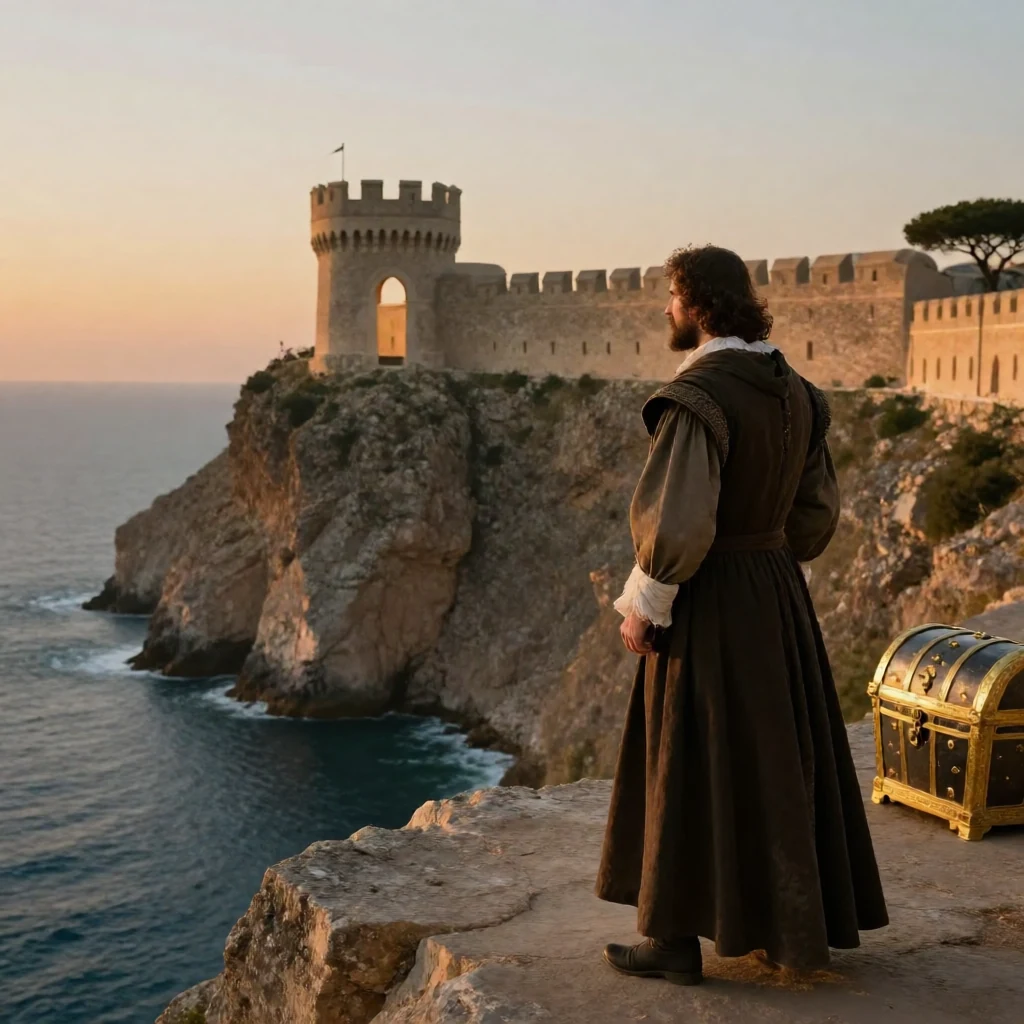
The Fate of Assunta Bertuccio describes the horrifying scene at Rogliano where Benedetto, alongside two dissolute companions, tortured his sister Assunta in an attempt to extract the location of her money. When Assunta’s clothing caught fire, she fled screaming to the barred doors and windows, succumbing to her burns. The house was ransacked and the money stolen, and she was found still breathing by neighbors the following morning.
Benedetto’s Disappearance
Benedetto’s Disappearance After the brutal murder, Benedetto vanished from Rogliano, never to be seen or heard from again. Bertuccio confesses he has no desire to trace the villain, hoping and believing him to be dead.
Judgment at Auteuil
Judgment at Auteuil Bertuccio views the murder scene as divine punishment for his own crime against the Villeforts, a sentiment the Count echoes in a lugubrious tone. Standing in the garden where he committed his crime and possibly where Villefort lies buried, Bertuccio is consumed by gloom and shuddering reflections.
The True Crime
The True Crime The Count presses Bertuccio on his true culpability—not the murder itself, but the failure to restore the rescued infant to its mother. Bertuccio confesses his cowardice, explaining that he clung to life out of pride, love for his sister, instinctive self-preservation, and lack of his brother’s bravery.
Remedies for All Evils
Remor Remedies for All Evils The Count offers words attributed to Abbé Busoni: for all evils there are two remedies—time and silence. He dismisses Bertuccio with the assurance that he will not fear ghosts, asserting that the living cause far more harm in a single day than the dead have in six thousand years.
Shadows in the Garden
Shadows in the Garden Left alone, Monte Cristo walks through the garden, murmuring about the location of the infant’s grave beneath a plane-tree and the private staircase connecting to sleeping chambers. He surveys the grounds, appreciating the shadows and the scope they offer his imagination, before taking his carriage back toward Paris.
The Count’s New Domain
The Count’s New Domain Upon reaching his abode in the Champs-Élysées, the Count inspects the entire building with familiarity, never mistaking a door or corridor. He issues instructions to Bertuccio regarding improvements and orders Ali to ensure the French attendants greet the new mistress discreetly without communication with the Greek servants.
Arrival of Haydée
Arrival of Haydée A carriage arrives at the gate, and the Count descends to greet a young woman enveloped in a green silk mantle embroidered with gold—the lovely Greek who had been his companion in Italy. After exchanging tender words in Homeric language, Ali conducts her to her concealed apartments by rose-colored flambeau, and within the hour all lights in the house are extinguished.
CAPÍTULO 46. Unlimited Credit
Baron Danglars visits Monte Cristo’s mansion and is refused entry. The count then acquires Danglars’s horses, instructs his steward to secure a seaside estate, and departs for the banker’s home on the Rue de la Chaussée d’Antin. There the two men meet, and an exchange of titles and barbs commences over the matter of Monte Cristo’s unlimited credit. Chapter 46. Unlimited Credit In this chapter, the Count of Monte Cristo visits Baron Danglars to settle the terms of the unlimited credit extended to him by Thomson & French. Through a series of escalating exchanges, Monte Cristo disarms the banker’s skepticism, secures a generous first-year allowance of six million francs, deflects questions about his fortune with hints of a long-dormant family treasure, and is ultimately led toward a formal introduction to the Baroness Danglars, where Lucien Debray and a connection to the Morcerfs also surface.
CAPÍTULO 46. Unlimited Credit
Baron Danglars visits Monte Cristo’s mansion and is refused entry. The count then acquires Danglars’s horses, instructs his steward to secure a seaside estate, and departs for the banker’s home on the Rue de la Chaussée d’Antin. There the two men meet, and an exchange of titles and barbs commences over the matter of Monte Cristo’s unlimited credit.
The original text of this work is in the public domain. This page focuses on a guided summary article, reading notes, selected quotes, and visual learning materials for educational purposes.