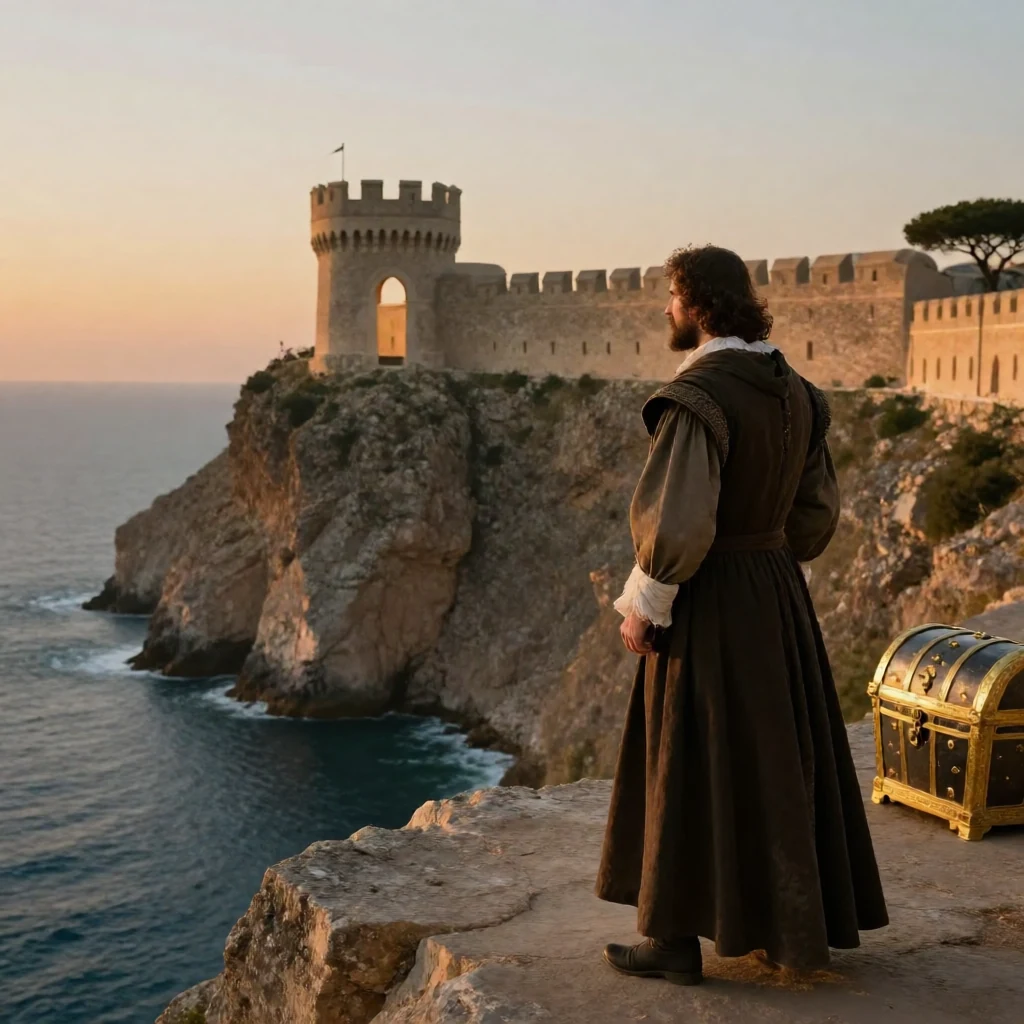
The Count of Monte Cristo in Paris
Château-Renaud, addressing the countess, insists that the count is Morcerf’s friend and is to be treated accordingly, refusing to believe Albert’s claim that the Parisian sensation caused by the Count of Monte Cristo has abated. He declares that the interest is as strong as ever, citing the count’s first astounding act upon arriving—presenting a pair of horses worth 32,000 francs to Madame Danglars—his second, the almost miraculous preservation of Madame de Villefort’s life, and now the carrying off of the Jockey Club prize. He maintains that not only is the count the object of interest at the present moment, but that he will continue to be so for a month longer if he pleases to exhibit an eccentricity of conduct which, after all, may be his ordinary mode of existence. Albert allows that perhaps Château-Renaud is right.
The Russian Ambassador’s Box
The conversation turns as Albert asks who is in the Russian ambassador’s box, pointing to the one between the pillars on the first tier, which seems to have been fitted up entirely afresh. The countess asks which box he means, and Château-Renaud inquires whether she observed anyone in it during the first act, but the countess replies that it was certainly empty. The freshly appointed box, conspicuous for its newness amid the established splendor around it, becomes a small mystery hovering at the edge of the evening’s social observation.
The Countess’s Saturday Evenings
Resuming the subject of their previous conversation, the countess admits that she does not know the count and has a great mind to return the cup, but Albert dissuades her, warning that the count would only send another formed of a magnificent sapphire or hollowed out of a gigantic ruby. The bell rings to announce the drawing up of the curtain for the second act, and Albert rises to return to his place. The countess asks whether she will see him again, and Albert promises that at the end of the next act, with her permission, he will come and inquire whether there is anything he can do for her in Paris. She takes notice that her present residence is 22 Rue de Rivoli, and that she is at home to her friends every Saturday evening, so that both young men are duly forewarned.
CAPÍTULO 53. Robert le Diable
Chapter 53, “Robert le Diable,” unfolds at the Paris Opera during a performance of the eponymous opera. The Count of Monte Cristo arrives with Haydée, stunning the audience with her beauty and jewels. During an intermission, Albert de Morcerf is beckoned to Madame Danglars’s box, where the company debates the mysterious count’s wealth, origins, and rumored pallor. Monte Cristo then encounters Albert in the lobby for a pointed conversation about fame, opera, and Rome. During the third act, Monte Cristo pays his respects in the Danglars box and is introduced to Eugénie, but the chapter climaxes when Haydée glimpses Morcerf at his side, recoils in horror, and denounces him as the traitor who sold her father, Ali Pasha, to the Turks.
Monte Cristo and Haydée’s Opera Arrival
Monte Cristo and Haydée’s Opera Arrival A man of thirty-five to forty, dressed in deep black, enters the former Russian ambassador’s box accompanied by a young woman in Eastern dress. Her surpassing beauty and magnificent diamonds draw the attention of the entire parterre and the occupants of neighboring boxes. Albert identifies the pair as Monte Cristo and “his Greek.” Throughout the second act, the audience buzzes with whispered speculation about the striking couple.
Madame Danglars Invites Albert to Her Box
Madame Danglars Invites Albert to Her Box At the close of the second act, Madame Danglars makes an unmistakable sign requesting Albert’s presence in her box. Obliging the unequivocal invitation, Morcerf joins the baroness, Eugénie, and Lucien Debray. The baroness greets him graciously while Eugénie receives him coolly, and Debray explains that Madame Danglars has been pressing him for details about the Count of Monte Cristo’s birth, education, and parentage—questions he has been unable to answer.
The original text of this work is in the public domain. This page focuses on a guided summary article, reading notes, selected quotes, and visual learning materials for educational purposes.