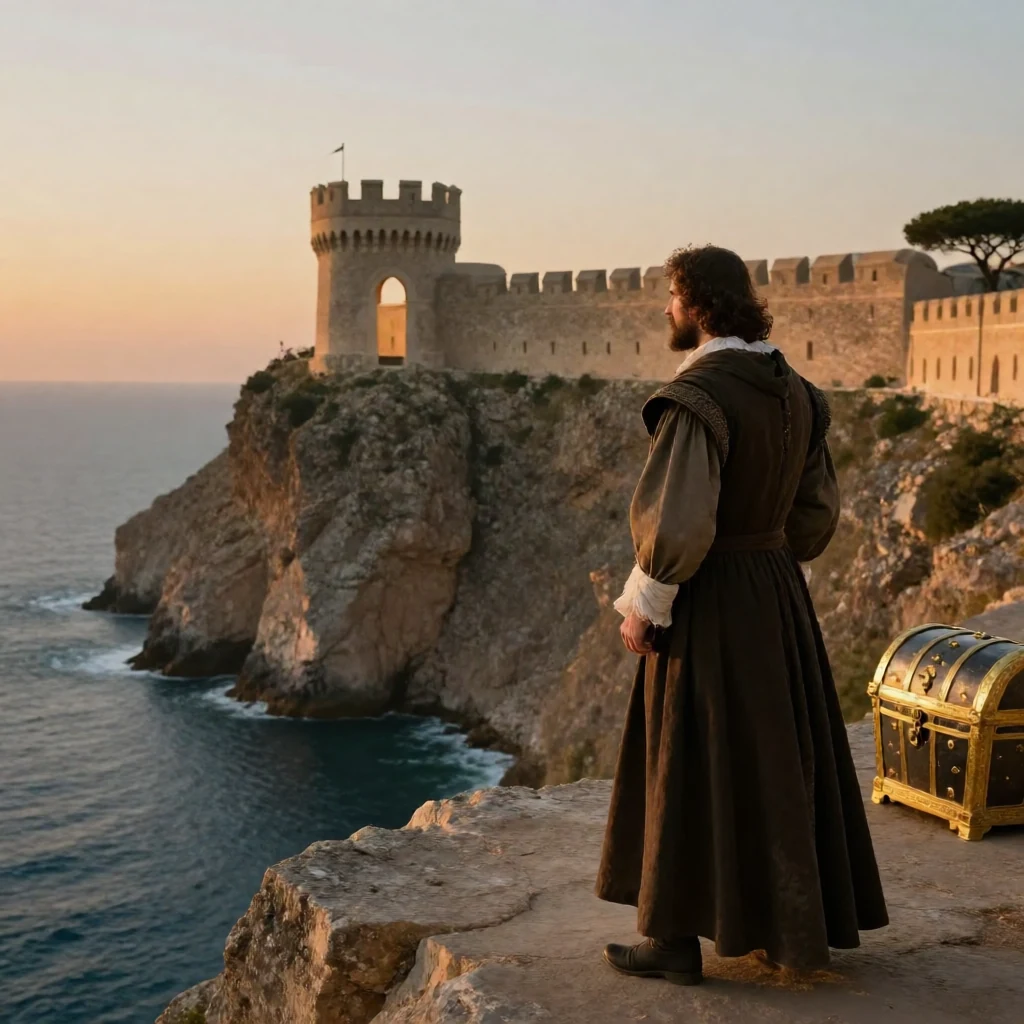
The Closed Room
One chamber alone was left untouched by Bertuccio despite his otherwise magnificent renovations. Servants pass this room with curiosity, while Bertuccio approaches it with visible terror. The room can be reached via the grand staircase but exited through a back staircase, suggesting its special significance in the house’s design.
The Count’s Arrival
Monte Cristo arrives at precisely five o’clock with his servant Ali. Bertuccio awaits with mixed impatience and unease, hoping for compliments while fearing disapproval. The count walks through the entire house without showing pleasure or displeasure until he reaches his bedroom. There he notices a rosewood furniture piece and correctly guesses it holds gloves. Finding everything as he requires—smelling-bottles, cigars, and various knick-knacks—he simply says “Good,” leaving Bertuccio enraptured by his master’s powerful influence.
Morrel and Médéah
Captain of Spahis Maximilian Morrel arrives at six o’clock on his horse Médéah, claiming to be first intentionally to have a private moment with the count. He speaks of his horse’s exceptional pace, having distanced both M. de Château-Renaud and M. Debray who rode the minister’s Arabians. Monte Cristo notes the horse cost 5,000 francs and discusses with Morrel the wager that required taming Médéah within six months.
The Danglars Arrive
Madame Danglars and her husband arrive in a carriage with smoking horses. Debray assists the baroness from the carriage while Monte Cristo observes her pass a note to the secretary with practiced ease. The banker descends looking pale, and the baroness surveys the courtyard with a rapid inquiring glance. She asks Morrel if he would sell his horse, and Monte Cristo extricates his friend from the awkward position by explaining the wager that binds Morrel to keep the animal.
The Porcelain Jars
Monte Cristo shows Madame Danglars two immense porcelain jars over which marine plants wind. She marvels that a chestnut tree from the Tuileries could be planted inside one. Monte Cristo recounts that a Chinese emperor had them made specially: of twelve jars baked in a special oven, two broke and ten were sunk three hundred fathoms deep into the sea. Two hundred years later, divers recovered only three intact jars, encrusted with coral and shells. The count expresses fondness for these jars, imagining the creatures that may have fixed their eyes upon them and the small fish that sought refuge within.
The Art Collection
Monte Cristo directs attention to his paintings, which he offers to show despite knowing Danglars possesses splendid collections himself. He mentions works by Hobbema, Paul Potter, Mieris, Gerard Douw, Raphael, Van Dyck, Zurbaran, and several by Murillo. Debray recognizes the Hobbema, noting it had been proposed for the Museum which refused to purchase it, claiming government was not wealthy enough—a point Château-Renaud says he has heard for eight years without understanding.
The Cavalcantis
Major Bartolomeo Cavalcanti and Count Andrea Cavalcanti arrive, the father distinguished by a black satin stock, gray moustaches, bold eye, and a major’s uniform with three medals and five crosses. The son, dressed in entirely new clothes, advances smilingly. The young men observe them critically, Château-Renaud noting they are well named but badly dressed, while Debray defends the quality of their new attire. Monte Cristo explains the Cavalcanti are descended from Italian princes, possess an enormous fortune, and have business with Danglars.
The Villeforts
M. and Madame de Villefort arrive, and despite his self-control, Villefort appears visibly affected. When Monte Cristo touches his hand, he feels it tremble. The count observes Madame Danglars smiling on the procureur and embracing his wife, musing that women alone know how to dissimulate.
Bertuccio’s Terror
Bertuccio, occupied on the other side of the house, glides into an adjoining room where the count follows. When the count asks what Bertuccio wants, the steward is unable to answer until he sees through the ajar door the guests assembled. He exclaims in horror at recognizing a woman—Madame Danglars—whom he identifies as the one from the garden who was pregnant. Bertuccio’s hair stands on end and his eyes start from his head as he points toward Villefort, muttering that he believed he had killed him. The count dismisses this as nightmare and imagination, directing Bertuccio to count the guests: two Villeforts, four Danglars, three others, plus Major Cavalcanti and young Andrea Cavalcanti, making eight.
The original text of this work is in the public domain. This page focuses on a guided summary article, reading notes, selected quotes, and visual learning materials for educational purposes.