Monte Cristo’s Travel Proposal
Monte Cristo invites Albert to accompany him to sea, describing his deep connection to the ocean as both nursemaid and mistress. The Count claims to have been rocked in infancy by old Ocean himself, and he loves the sea’s soothing qualities. He emphasizes the trip will offer pure air, solitude, and the humiliation of nature that humbles even the proudest spirit. Beauchamp declines, explaining he must remain in Paris to watch over newspaper matters that require his attention. After Beauchamp departs, Albert expresses concern about whether his mother will permit the journey, prompting Monte Cristo to quote Francis I and Shakespeare on woman’s fickle nature. Albert defends his mother as exceptional among women, noting she takes deep interest in the Count and has encouraged Albert to gain his esteem. They settle on meeting at five o’clock, with Albert promising to inform his mother and return promptly.
Departure for Normandy
Albert is punctual to the appointment. Monte Cristo dispatches Bertuccio to notify grooms along the route, and express messengers coordinate horse changes across six stages between Paris and Normandy. Before departing, the Count visits Haydée to inform her of his plans and entrusts his affairs to her care. The journey commences with Albert’s initial anticipation of the expedition, establishing the framework for their rapid departure toward the seaside.
The Rapid Carriage Ride
The journey proves extraordinarily swift, with post-horses maintaining a pace of two leagues per hour. Monte Cristo explains his method bypasses frustrating traffic laws requiring travelers to request permission to pass one another, which would otherwise allow slow or ill-tempered riders to obstruct faster travelers. By maintaining his own postilion and horses, the Count avoids such delays. Ali drives the carriage, exhibiting remarkable skill that makes the horses appear to fly. Monte Cristo reveals the thirty-two horses are progeny of a Hungarian horse purchased six years prior, all black except for a star on the forehead. When Albert expresses amazement at such resources, the Count explains he travels with them and will sell them through Bertuccio for thirty to forty thousand francs, likely to Eastern viziers who will drain their treasuries to purchase them. The conversation turns to Bertuccio himself, whom Albert suspects must be the richest man in Europe after the Count. Monte Cristo corrects this assumption—Bertuccio possesses almost nothing—explaining that he keeps such servants through absolute power over their fates. When Albert questions whether Monte Cristo truly holds life-and-death power over Bertuccio, the Count answers simply: “Yes.”
Arrival at Tréport
The party arrives at midnight at a beautiful estate enclosed by a park. A porter, having been warned by the groom at the last stage, awaits them. By half past two in the morning, Albert is shown to his apartments where a bath and supper have been prepared. Baptistin, who rode at the front of the carriage, attends the Count, while another servant who traveled behind tends to Albert. The swift journey has covered forty-eight leagues in eight hours, and the stage is set for the anticipated respite at this coastal retreat.
A Morning at the Seaside Villa
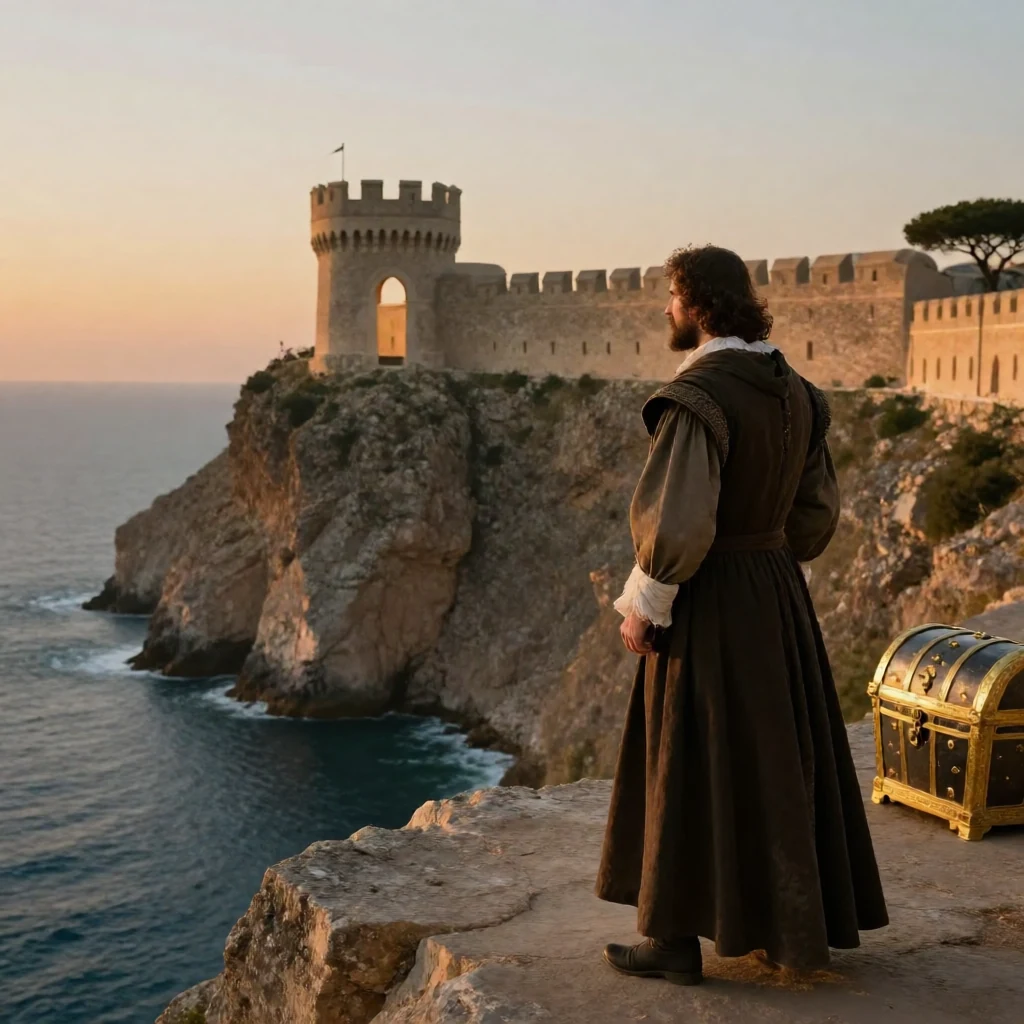
Albert’s chambers open onto a terrace overlooking the sea, with a small forest and attractive park behind. The Count’s sloop, bearing his arms—a golden mountain on azure sea with a red cross in chief—rests in a nearby creek, surrounded by humble fishing boats awaiting orders like subjects before their queen. Albert discovers his anteroom equipped with hunting guns and accoutrements, while a ground-floor room contains fishing equipment invented by the patient English. The three days pass in hunting and fishing—twelve pheasants killed in the park, as many trout from the stream. They dine in a summer-house overlooking the ocean and take tea in the library. The Count continues designing a conservatory plan with his architect while Albert, exhausted by the invigorating exercises that the Count handles with ease, dozes in an armchair near the window.
The Courier from Paris
On the third evening, the sound of a horse at full gallop announces a messenger. Albert is startled to recognize his own valet de chambre, Florentin, whom he had not brought to avoid inconveniencing Monte Cristo. Fearing his mother is ill, Albert rushes forward. Florentin produces a sealed parcel containing a newspaper and letter from Beauchamp. Albert opens the letter with apprehension and cries out upon reading its contents; his sight dims and legs buckle, requiring Florentin’s support. Monte Cristo observes from nearby and remarks, apparently to himself, that “the sin of the father shall fall on the children to the third and fourth generation.” The Count’s knowing comment suggests awareness of what devastates the young man. Florentin confirms he came in fifteen hours, having been summoned by Beauchamp, given money for the journey, and instructed not to stop until he reached Albert. When Albert asks about the house, Florentin reports that everything was quiet, though he found Madame Morcerf in tears. She sent for him to inquire about Albert’s return, and though she initially reached out to prevent his departure, she ultimately said, “Yes, go, Florentin, and may he come quickly.”
The original text of this work is in the public domain. This page focuses on a guided summary article, reading notes, selected quotes, and visual learning materials for educational purposes.