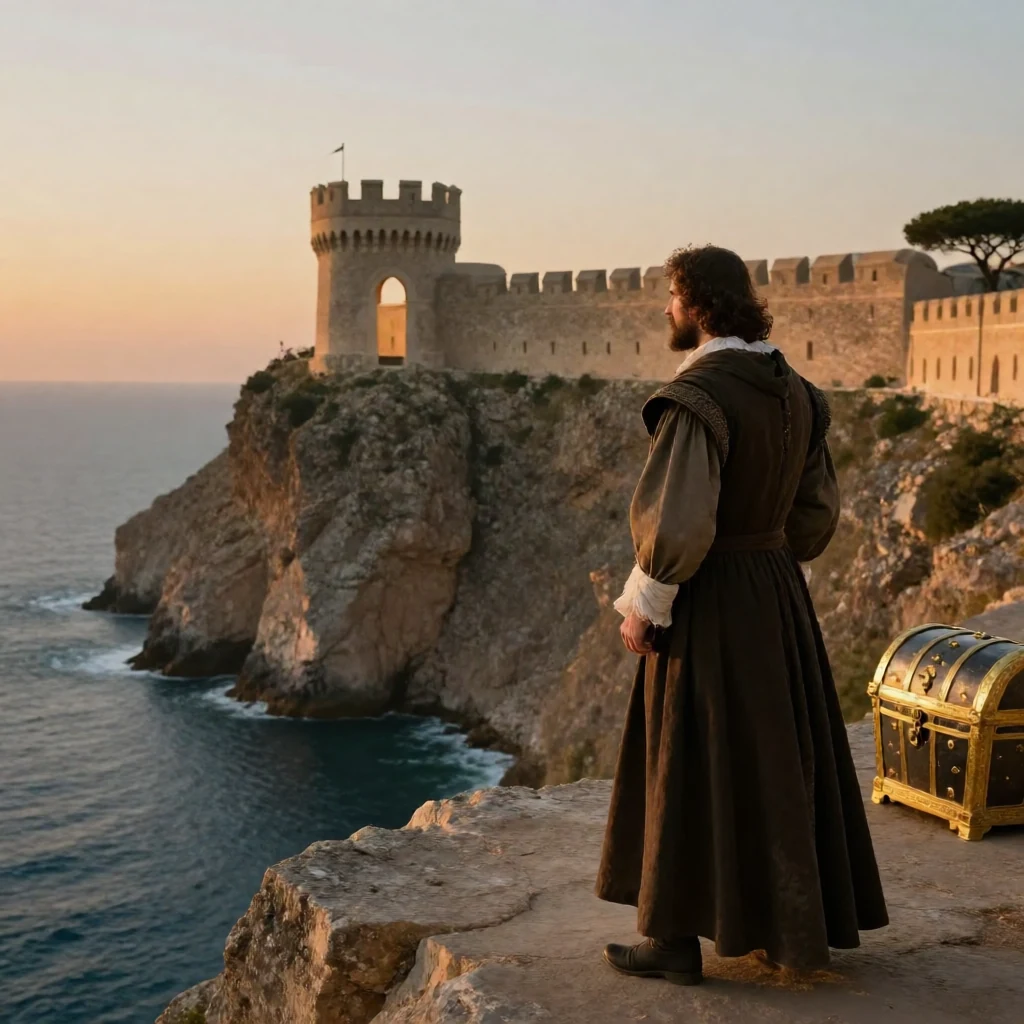
Morrel’s Arrival
Maximilian Morrel departs from Monte Cristo’s residence and makes his way slowly toward Villefort’s house, having hurried through his farewell because he wished to be alone with his thoughts. He is permitted to visit Noirtier and Valentine twice weekly, and arrives to find Valentine expecting him. She seizes his hand with evident uneasiness, nearly crazed with worry, leading him to her grandfather. Her anxiety stems from the widespread news of Morcerf’s adventure at the Opera, for the affair has become generally known. Valentine fears Morrel may serve as Monte Cristo’s second in a duel, and knowing his courage and devotion to the count, she dreads he might not remain merely passive. When Morrel assures her the affair has concluded happily and unexpectedly, Valentine reads joy in his eyes. She then raises the subject of Noirtier’s desire to leave the house, mentioning that her grandfather wishes to take separate apartments, and Morrel approves of the plan.
Valentine’s Mysterious Illness
Valentine explains that Noirtier believes the air of the Faubourg Saint-Honoré is harmful to her. Morrel observes that she has not seemed well for a fortnight, and Valentine admits to feeling general uneasiness, having lost her appetite and experiencing stomach discomfort as if her body is struggling to accommodate something. Noirtier watches every word she speaks. When Morrel inquires about her treatment, Valentine reveals she swallows a spoonful each morning of the mixture prepared for her grandfather—she began with one spoonful but now takes four. She speaks of it as a panacea, though her smile cannot conceal that she is suffering. Maximilian gazes at her in devoted silence, noting that her usual pallor has increased, her eyes are more brilliant than ever, and her hands—normally white as mother-of-pearl—now resemble wax tinged with yellow.
Signs of Poisoning
Morrel questions why Valentine takes medicine prepared for Noirtier. Valentine acknowledges it is very bitter, so much so that everything she drinks afterward tastes the same. Noirtier turns pale at this statement and signals his desire to speak urgently. Valentine rises to fetch the dictionary for communication, but by this time the blood is rushing to her head and her cheeks are becoming red. She passes off her symptoms cheerfully, noting the peculiarity of her vision as if the sun had shone in her eyes, though she leans against the window. Morrel grows more alarmed by Noirtier’s expression than by Valentine’s slight indisposition.
The Empty Decanter
Once Valentine departs to greet the Danglars’ carriage, Noirtier signals Morrel to bring the dictionary. Through the laborious process of finding each word—requiring ten minutes of letter-by-letter translation—the old man’s message emerges: “Fetch the glass of water and the decanter from Valentine’s room.” Morrel sends the servant immediately. When the servant returns, both the decanter and glass are completely empty. Noirtier asks why they are empty when Valentine said she only drank half the glassful. The servant explains that the housemaid had been in Valentine’s room, and when Valentine passed through earlier, she drank what remained. As for the decanter, Master Edward had emptied it to make a pond for his ducks. Noirtier raises his eyes to heaven like a gambler staking everything on one final throw. From that moment, his eyes remain fixed on the door.
The Danglars’ Visit
The carriage belongs to Madame Danglars and her daughter Eugénie, who have come for a formal visit. They are received in Madame de Villefort’s room with official stiffness that presages a formal communication. Valentine enters as the formalities resume. Madame Danglars announces that she and Eugénie have come to be the first to announce the approaching marriage of her daughter with Prince Cavalcanti—the banker insists on the princely title as it serves him better than count.
Eugénie’s Engagement
Madame Danglars describes Prince Cavalcanti as having a foreign manner recognizable to French people as Italian or German nobility, possessing great kindness and keen wit. M. Danglars assures that his fortune is “majestic.” Eugénie, turning over leaves in Madame de Villefort’s album, adds that her parents have taken a great fancy to the young man. When asked if she shares this fancy, Eugénie responds with her usual candor that she has not the least interest in the man. She declares her wish was never to confine herself to domestic cares or any man’s caprices, but to be an artist, and consequently free in heart, person, and thought. She pronounces these words with such firm resolve that the color mounts to Valentine’s cheeks.
The original text of this work is in the public domain. This page focuses on a guided summary article, reading notes, selected quotes, and visual learning materials for educational purposes.