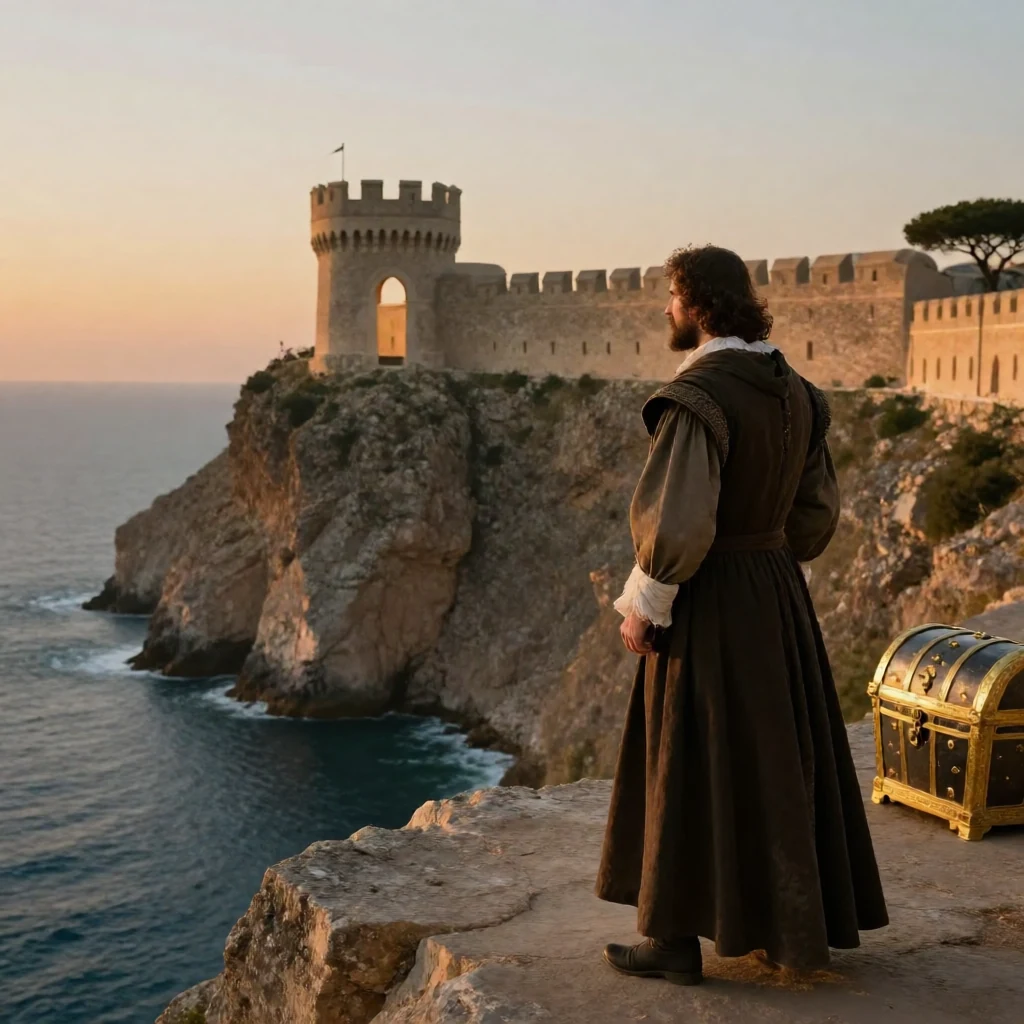
Mercédès and Albert
Above Debray’s room, Mercédès and Albert de Morcerf occupy a modest apartment into which poverty has cast the fallen countess. Though she does not display the trappings of misery, Mercédès’s eyes no longer sparkle and her lips no longer smile; she has become like a queen reduced to a hovel, unable to reconcile herself to her humble surroundings. Albert, too, is ill at ease, his fair hands and polished boots marking him as unsuited to his reduced state. Yet united by maternal and filial love, the two have tacitly arranged their straitened life, with Albert able to speak to his mother about their situation without causing her to change expression.
CAPÍTULO 106. Dividing the Proceeds
Chapter 106, “Dividing the Proceeds,” follows Albert de Morcerf and his mother Mercédès as they confront their poverty in Paris after the scandal of his father’s treachery. Albert itemizes the 3,000 francs hidden in the garden of the Allées de Meilhan house in Marseilles, calculates travel costs, and reveals that he has enlisted as a substitute in the Spahis for 2,000 francs, half already paid. After a tender farewell, the two encounter Debray on the staircase, and Mercédès departs for Marseilles. An unseen observer in Lafitte’s banking house laments the happiness he has inadvertently destroyed.
Mother, We Have No More Money
Albert opens the chapter with the stark declaration, “Mother, we have no more money.” With Madame Danglars having just descended the stairs, Albert asks Mercédès to take stock of their resources so he can build his plans upon a clear foundation. Mercédès responds with a mournful smile, “Capital—nothing!” but Albert insists their capital amounts to 3,000 francs, hidden in the garden of the little house in the Allées de Meilhan at Marseilles.
Mercédès Contrasts Past and Present Hardship
The narrator reflects on how Mercédès had never truly known want. As a young Catalan girl, she wished for a thousand things but never genuinely needed any, living contentedly as long as the nets caught fish. Now, however, there are two to support and nothing to live upon. Winter approaches, and Mercédès, once accustomed to stoves heating the house and a conservatory of costly exotics, has no fire in her cold, naked room and not even a single flower. The initial excitement of fulfilling a duty has faded, obliging mother and son to descend from dreams to reality and speak of actual, pressing matters.
Albert Proposes Dividing Their Remaining Funds
Albert announces his plan to “reckon our riches” and to divide their remaining resources. He maintains that their 3,000 francs are an enormous sum and intends to build upon it a “miraculous certainty for the future.” When Mercédès questions whether they ought to accept this buried money, coloring slightly, Albert answers firmly in the affirmative. He outlines that 200 francs will be sufficient to reach Marseilles, and with a smile, he presents a careful itemization of the journey to reassure her.
Albert Details Travel Expenses and Budget
Albert produces a written breakdown of travel costs: 35 francs for the coupé to Châlons, 6 francs by steamboat from Châlons to Lyons, 16 francs from Lyons to Avignon, and 7 francs from Avignon to Marseilles, plus 50 francs for expenses on the road. He rounds the total up to 120 francs, joking that he is being generous. For himself, he reserves 80 francs, and he has already arranged the 200 francs by selling his watch for 100 francs and the guard and seals for 300. After deducting 30 francs owed to the landlord, he shows that they actually possess 250 francs for a journey that requires only 114—proof, he claims, that they are rich.
Albert Reveals Extra Funds and Enlistment in the Spahis
Albert then draws from a golden-clasped pocketbook—a remnant of old fancies—a note of 1,000 francs, which leaves Mercédès astonished. He explains that the day before he engaged himself as a substitute in the Spahis, selling his person for 2,000 francs, of which this 1,000 is the first half, the remainder to be paid in a year. He lightens the gravity of the moment with banter about looking magnificent in an embroidered uniform, naming Lamoricière, Changarnier, Bedeau, and Morrel as soldiers who survived their service. Moved, Mercédès sighs and smiles, recognizing that she must not allow all the weight of the sacrifice to fall upon her son.
The original text of this work is in the public domain. This page focuses on a guided summary article, reading notes, selected quotes, and visual learning materials for educational purposes.