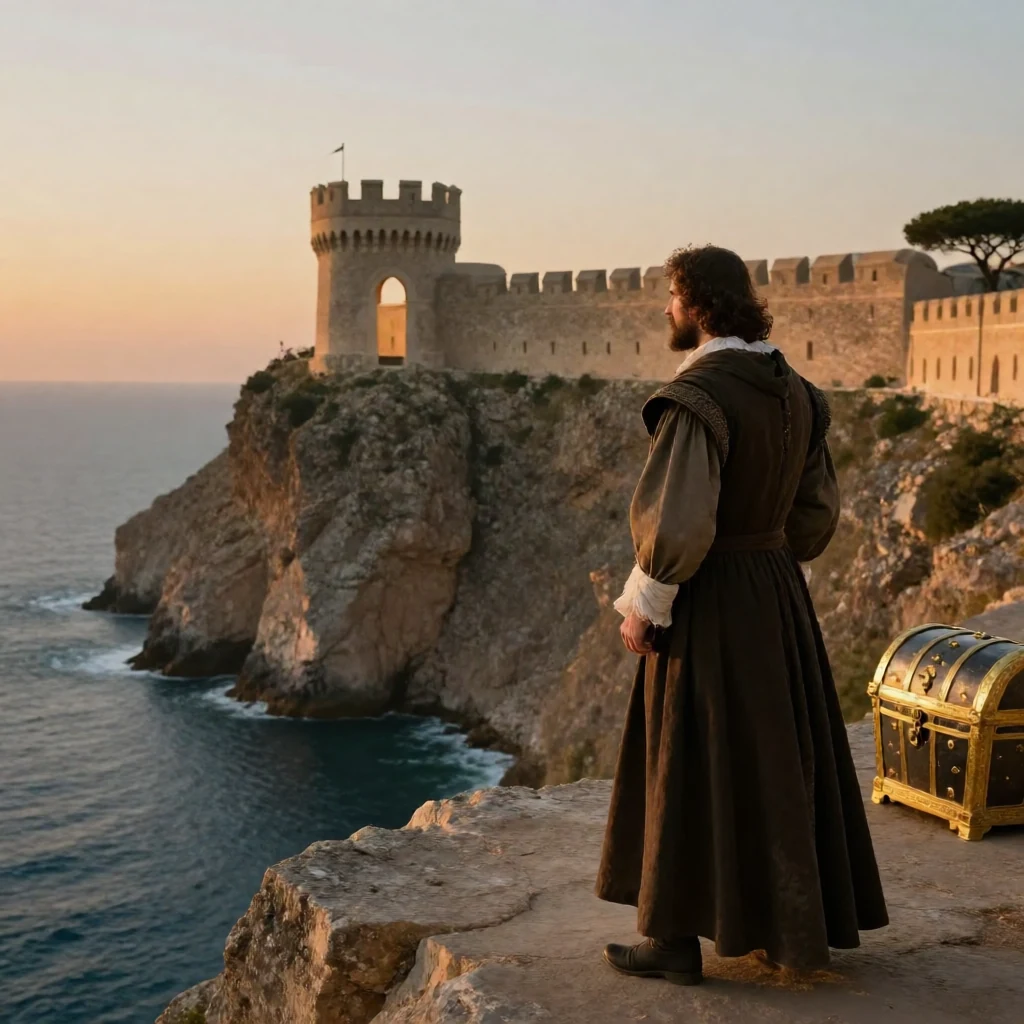
Mercédès Declines Financial Aid
Mercédès Declines Financial Aid Asked if she has any request for herself, Mercédès says she wants nothing and lives between two graves—that of Edmond Dantès, whom she once loved, and that of her husband, killed by Dantès, whose death she approves but for whose soul she must pray. She plans to live quietly in prayer using the small sum the Count buried for her. When the Count suggests she made an unnecessary sacrifice in relinquishing Morcerf’s fortune and that half of it rightfully belonged to her, she refuses, saying her son would not permit it. If Albert consents, however, she will not oppose it, accepting whatever succor heaven sends.
Mercédès Bids Farewell to the Count
Mercédès Bids Farewell to the Count Declaring she is no longer a reasoning creature with a will of her own, Mercédès says she has become passive in the hands of the Almighty, living only because she is not yet ordained to die. When the Count asks if she will not see him again, she solemnly points to heaven and says they shall meet again, proving she still hopes. Pressing her trembling hand upon his, she rushes up the stairs and disappears. The Count slowly leaves the house and turns toward the quay.
Mercédès Watches Her Son’s Ship Depart
Mercédès Watches Her Son’s Ship Depart Though the Count departs slowly toward the quay, Mercédès does not witness his leaving, for she is seated at the little window of the room once occupied by old Dantès. Her eyes strain to see the ship carrying her son across the vast sea. Yet her voice involuntarily murmurs softly, again and again, the name: “Edmond, Edmond, Edmond!”
CAPÍTULO 113. The Past
Chapter 113, titled “The Past,” follows the Count of Monte Cristo as he returns to Marseille, the city of his original imprisonment. Haunted by doubt after achieving his vengeance and by a poignant farewell to Mercédès, the Count resolves to revisit the sites of his former suffering. He retraces the route of his arrest through the streets, takes a boat to the Château d’If, and tours the abandoned prison, where he hears his own story recounted as the tale of “Prisoner No. 34.” In his old dungeon, he recognizes his personal marks, and in Abbé Faria’s adjoining cell, he discovers the manuscript of the great work his mentor had written. The chapter is an interior pilgrimage that rekindles both anguish and gratitude as Monte Cristo confronts the memories of his past. Chapter 113, titled “The Past,” follows the Count of Monte Cristo as he departs Marseilles for Italy after a profound encounter with the grief-stricken Maximilian Morrel. The chapter weaves together the Count’s own tragic history with his effort to console Morrel, ultimately arranging a future meeting on the Island of Monte Cristo and leaving the young man to face his sorrow alone.
CAPÍTULO 113. The Past
Chapter 113, titled “The Past,” follows the Count of Monte Cristo as he returns to Marseille, the city of his original imprisonment. Haunted by doubt after achieving his vengeance and by a poignant farewell to Mercédès, the Count resolves to revisit the sites of his former suffering. He retraces the route of his arrest through the streets, takes a boat to the Château d’If, and tours the abandoned prison, where he hears his own story recounted as the tale of “Prisoner No. 34.” In his old dungeon, he recognizes his personal marks, and in Abbé Faria’s adjoining cell, he discovers the manuscript of the great work his mentor had written. The chapter is an interior pilgrimage that rekindles both anguish and gratitude as Monte Cristo confronts the memories of his past.
Departure from Mercédès’ Home
The Count departs Mercédès’ home with a heavy heart, realizing he may never see her again. Since the death of little Edward, a profound change has come over Monte Cristo. Having reached the summit of his vengeance through a long and tortuous path, he is now troubled by an abyss of doubt. The conversation with Mercédès has awakened so many recollections that he feels compelled to wrestle with them, suspecting he may have erred in his calculations and that he is now dissatisfied because he no longer views the past clearly.
The original text of this work is in the public domain. This page focuses on a guided summary article, reading notes, selected quotes, and visual learning materials for educational purposes.