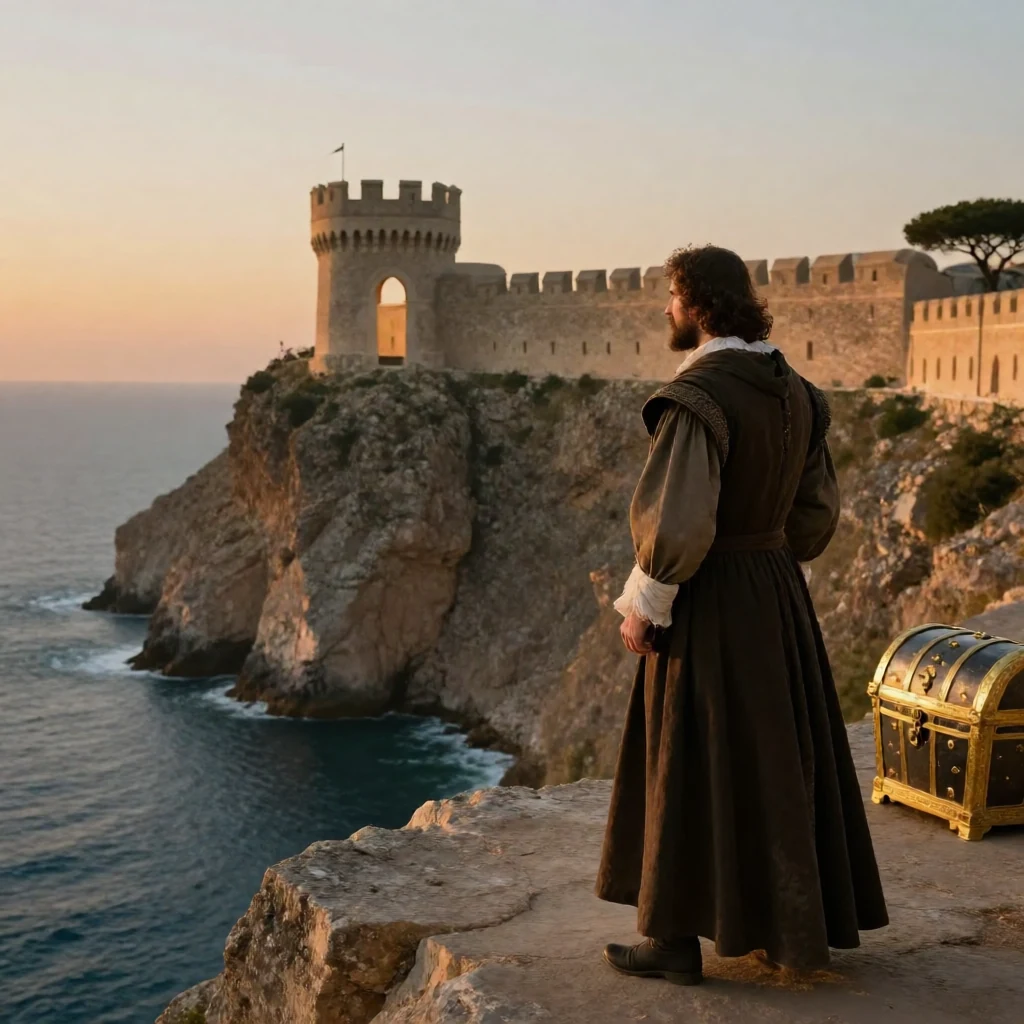
Conversation with the Countess G——
The countess teases Franz about his close friendship with the mysterious Count of Monte Cristo, referring to him as a “vampire” and asking for details about his background. Franz and Albert explain they met him through their hotel landlord, that he is a Tuscan count who owns the island of Monte Cristo, is fabulously wealthy and eccentric, and has been extremely generous to them during their stay. The countess also asks about the beautiful Greek woman Franz saw the previous night, and Albert mentions the blue domino he spotted at the Rospoli Palace, which the countess did not notice during her own time at the Carnival. The conversation is interrupted by another visitor, and the friends return to their hotel later.
The Greek and the Blue Domino
Albert describes the windows of the Rospoli Palace he saw the count occupying: two hung with yellow damask, and one with white damask with a red cross, where he spotted the blue domino. Franz and Albert identify this blue domino as the Greek woman they saw playing the guzla the previous night, linking her to the count’s accommodations at the palace.
Procuring Peasant Costumes
The next morning, Signor Pastrini arrives with a tailor carrying ready-made Roman peasant costumes, as no tailor could complete new outfits in such a short timeframe. Franz and Albert select identical peasant ensembles, and the tailor adds long ribbons to their hats and colorful silk sashes to complete the traditional festive attire. Albert tries on his blue velvet peasant outfit, is very pleased with his appearance, and the pair are admiring their reflections when the Count of Monte Cristo enters.
CAPÍTULO 36. The Carnival at Rome
This chapter covers events during the Roman Carnival, centered on the Count of Monte Cristo and his interactions with young travelers Franz and Albert. It details the count’s generous gifts to the pair, Albert’s romantic pursuit of a mysterious masked peasant, Franz’s choice to attend a papal audience instead of joining Carnival festivities, the count’s enigmatic, Byronic personality, and the climactic events of the final Carnival Tuesday, including horse races and the traditional moccoli candle celebration.
Count of Monte Cristo Offers Carnival Carriage
The Count of Monte Cristo informs Franz and Albert that he places his carriage fully at their disposal for the remainder of the Carnival, noting he has several other carriages available so they will not inconvenience him. The young men initially try to decline the generous offer but ultimately accept it, and the count converses with them easily on a wide range of topics before departing.
Count Displays Broad Intellectual Knowledge
During his visit, the Count of Monte Cristo displays broad, deep expertise across multiple fields: Franz and Albert note from the art on his salon walls that he is a skilled art connoisseur, his casual remarks show he is well-versed in the sciences with a particular interest in chemistry, and his effortless conversation confirms he is familiar with the literature of countries around the world. The young men do not attempt to reciprocate his earlier generous breakfast, as their own far inferior fare would be a poor exchange, and the count receives their polite refusal graciously.
Albert’s Carnival Flirtation with Masked Peasant
Albert is especially pleased to have access to the count’s carriage, as it allows him to match the elegant carriage of the masked peasant women he has been flirting with. During a Carnival procession, a fresh bouquet of violets thrown from a carriage of harlequins signals to Albert that the peasant women have adopted his costume just as he adopted theirs. He presses the faded violets he already carries to his lips when he passes their calash, delighting the women and their companions, and their flirtation continues for the rest of the day.
Franz Attends Papal Audience, Skips Carnival
When Franz returns to their lodgings that evening, he receives a letter from the embassy informing him he will be granted a papal audience with Pope Gregory XVI the next day. Driven by both religious reverence and gratitude for the repeated favor, Franz chooses to skip the next day’s Carnival activities, spending his time after the Vatican visit reflecting on pious thoughts rather than joining the rowdy masked celebrations.
The original text of this work is in the public domain. This page focuses on a guided summary article, reading notes, selected quotes, and visual learning materials for educational purposes.