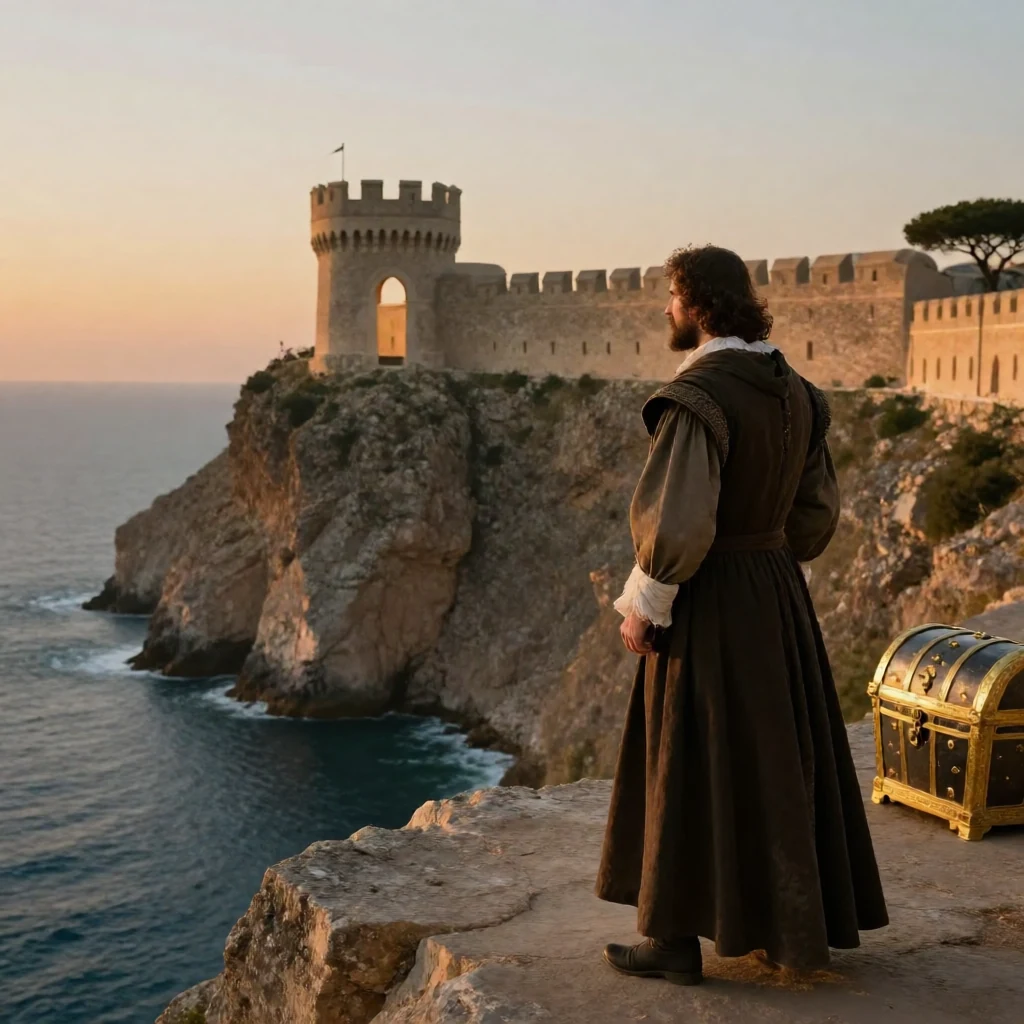
Monte Cristo’s Carriage Awaits Him
Albert accompanies Monte Cristo to the door to observe how the Count’s orders have been carried out in his absence. A footman who had previously served the Count in Rome announces the Count’s appearance, and a magnificent coupé built by Koller, drawn by horses and harness for which Drake had refused seven hundred guineas the day before, awaits him in the vestibule. The Count notes the almost imperceptible movement behind the curtains of the apartment where he left Madame de Morcerf, suggesting she was watching his departure.
Monte Cristo Defers Inviting Albert to His Home
Before departing, Monte Cristo tells Albert that he will not invite him to his home yet, as he can only show a habitation fitted up in haste. He wishes to maintain his reputation for never being taken by surprise and asks Albert for one more day. Albert responds that he knows what to expect from such a request—not merely a house, but a palace, given the Count’s evident resources. Monte Cristo, putting his foot on the velvet-lined steps of his carriage, encourages Albert to spread this idea among the ladies of Paris.
Albert Reunites with Mercédès
Albert returns to find his mother reclining in a large velvet armchair in the boudoir, the room so dimly lit that only the spangles on the drapery and gilded picture frames catch the light. The Countess’s face is covered with a thin veil, and Albert senses an alteration in her voice. He notices the sharp odor of volatile salts amid the perfumes of the flowers, and the Countess’s smelling-bottle lies open on the mantlepiece. Alarmed, Albert asks if she has been ill. The Countess attributes her discomfort to the violent perfumes of the roses, tuberoses, and orange-flowers. Albert orders a servant to remove the flowers, and a long silence follows.
Mercédès Inquires About the Count’s Identity
Once the flowers have been removed, the Countess inquires about the name “Monte Cristo”—whether it is a family name, the name of an estate, or a mere title. She asks the question as a mother eager to understand the man who has entered her son’s life and her own home.
Albert Shares His Observations of the Count
Albert offers his observations of the Count. He explains that “Monte Cristo” is merely a title, derived from an island the Count purchased in the Tuscan archipelago, where he founded a commandery in the manner of various European orders. While the Count claims no noble ancestry and calls himself a chance count, opinion at Rome holds him to be a man of very high distinction. Albert praises the Count’s manners as surpassing those of the English, Spanish, and German aristocracy. He ventures no decided opinion on the Count’s origins, suggesting perhaps that he is a Maltese, or perhaps one of Byron’s romantic heroes—a Manfred, Lara, or Werner—who has rebuilt his fortunes through adventurous genius. He estimates the Count’s age at thirty-five or thirty-six, supported by incidental remarks the Count has made about his childhood. Albert describes the Count’s remarkable physical vitality: vivid eye, raven-black hair, unwrinkled brow.
Mercédès Expresses Concerns About the Count
The Countess questions Albert further, asking whether the Count has shown friendship for him and whether Albert likes him. After Albert admits that he does, the Countess, in a voice altered by emotion, reminds him of her longstanding caution about new acquaintances and urges him anew to be prudent. The conversation turns briefly to how M. de Morcerf received the Count, and Albert assures his mother that his father’s demeanor was impeccable and that the two parted the best of friends.
Albert Reassures His Mother
Albert gently pushes back against his mother’s concerns, arguing that the Count never plays, drinks only water tinged with sherry, and is too wealthy to need to borrow money, so there is nothing to fear from him. The Countess concedes that her fears may be weakness, especially directed against a man who saved Albert’s life. The Countess gradually falls into a deep reverie until her eyes close, and Albert, believing she has dropped asleep, leaves the apartment on tiptoe. Afterward, he reflects privately that his mother has been struck by the Count and that he must indeed be a remarkable man. He descends to the stables, slightly annoyed that the Count’s “turnout” has displaced his own bays in the estimation of connoisseurs, and muses that men are decidedly not equal.
The original text of this work is in the public domain. This page focuses on a guided summary article, reading notes, selected quotes, and visual learning materials for educational purposes.