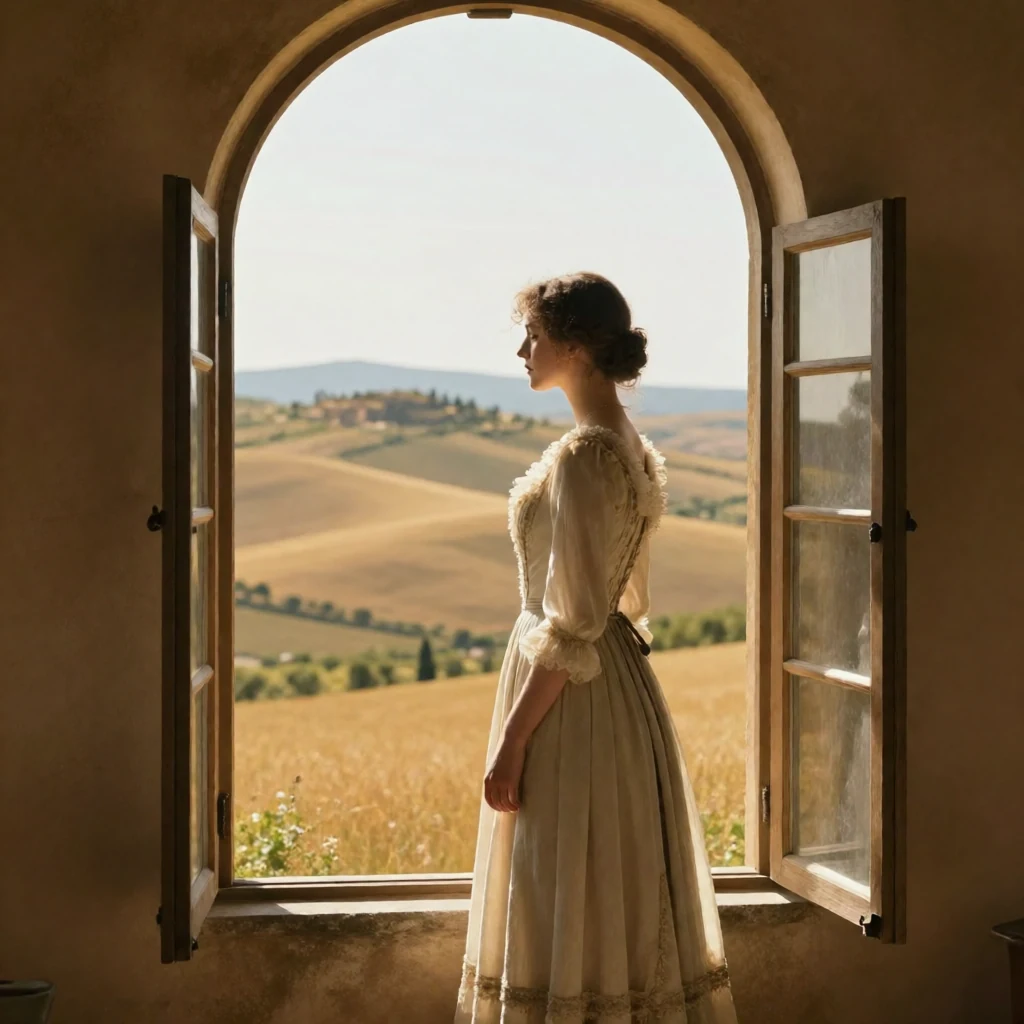
Cecil accepts the truth of her words with emotion
Cecil accepts Lucy’s accusations with profound emotion, declaring her words true. He admits he fell to pieces on the very first day of their engagement and behaved like a cad. He thanks Lucy for showing him what he really is and for revealing a true woman to him. He acknowledges that he used her as a peg for his silly notions of what a woman should be, and he thanks her for the revelation that has transformed his understanding.
Lucy angrily denies loving someone else
Cecil’s mention of a new force in Lucy prompts Lucy to explosively deny that she is in love with someone else. She is furious at the suggestion, calling it an old idea that has kept Europe back—the assumption that women are always thinking of men. She declares it is disgusting and brutal to assume a girl must have someone else in mind when breaking an engagement. Cecil respectfully apologizes, acknowledging she has taught him better, but Lucy remains angry and uncomfortable with the entire exchange.
Cecil’s noble farewell and departure
Cecil offers a graceful, almost noble farewell. He thanks Lucy sincerely for what she has done, viewing it as a gift that has shown him his true self. He shakes her hand and lights her candle before they move to the hall. His final words are a blessing: “God bless you, Lucy.” As he ascends the stairs, he pauses on the landing and gives her a look of memorable beauty. For all his culture, Cecil proves to be an ascetic at heart, and nothing in his love becomes him like the leaving of it.
Lucy resolves never to marry
In the tumult following Cecil’s departure, Lucy stands firm in her resolve that she could never marry. She recognizes that Cecil believes in her, and she must someday believe in herself. She feels she must become one of the women she praised so eloquently—those who care for liberty rather than men. The thought of George and his role in this release troubles her, but she pushes it away, deciding it does not do to think or even to feel.
Lucy joins the self-deceived who sin against passion and truth
The chapter concludes with Lucy surrendering her attempt to understand herself and joining “the vast armies of the benighted, who follow neither the heart nor the brain, and march to their destiny by catch-words.” Forster suggests that those who yield to the enemy within—their own self-deception—have “sinned against passion and truth.” These pleasant and pious people will face vengeance from Eros and Pallas Athene, the allied deities of love and wisdom. Lucy entered this army when she pretended to George that she did not love him and pretended to Cecil that she loved no one. The night receives her as it once received Miss Bartlett thirty years before.
CHAPITRE XVIII.
This chapter centers on Mr. Beebe’s visit to Windy Corner, where he first shares gossip about the Miss Alans scrapping their original travel plans to visit Cissie Villa, opting instead for a trip to Greece. He learns from Freddy Honeychurch that Lucy has broken off her engagement to Cecil Vyse the night prior, and feels relieved by the news. Upon arriving at the house, he finds the household in disarray after a storm destroyed the dahlia garden, with family members on edge. He speaks with Lucy, who reveals she ended the engagement because Cecil was overly controlling, and expresses a desperate desire to travel abroad with the Miss Alans to escape the tension at home. The chapter closes with Mr. Beebe and Miss Bartlett discussing the importance of avoiding local gossip about the broken engagement.
Mr. Beebe’s Impression of Windy Corner
Mr. Beebe observes Windy Corner’s dramatic natural placement: it sits a few hundred feet down the southern slope of the ridge, at the base of a large hill buttress, flanked by fern and pine-filled ravines with a highway running into the Weald. He finds the house’s plain, cube-shaped design (with a small rhinoceros-horn turret added by Mrs. Honeychurch for watching the road in wet weather) impertinent against the glorious landscape, but notes it feels as natural and inevitable as a naturally occurring feature of the countryside, unlike the overly designed, temporary-feeling homes of other local families.
The original text of this work is in the public domain. This page focuses on a guided summary article, reading notes, selected quotes, and visual learning materials for educational purposes.