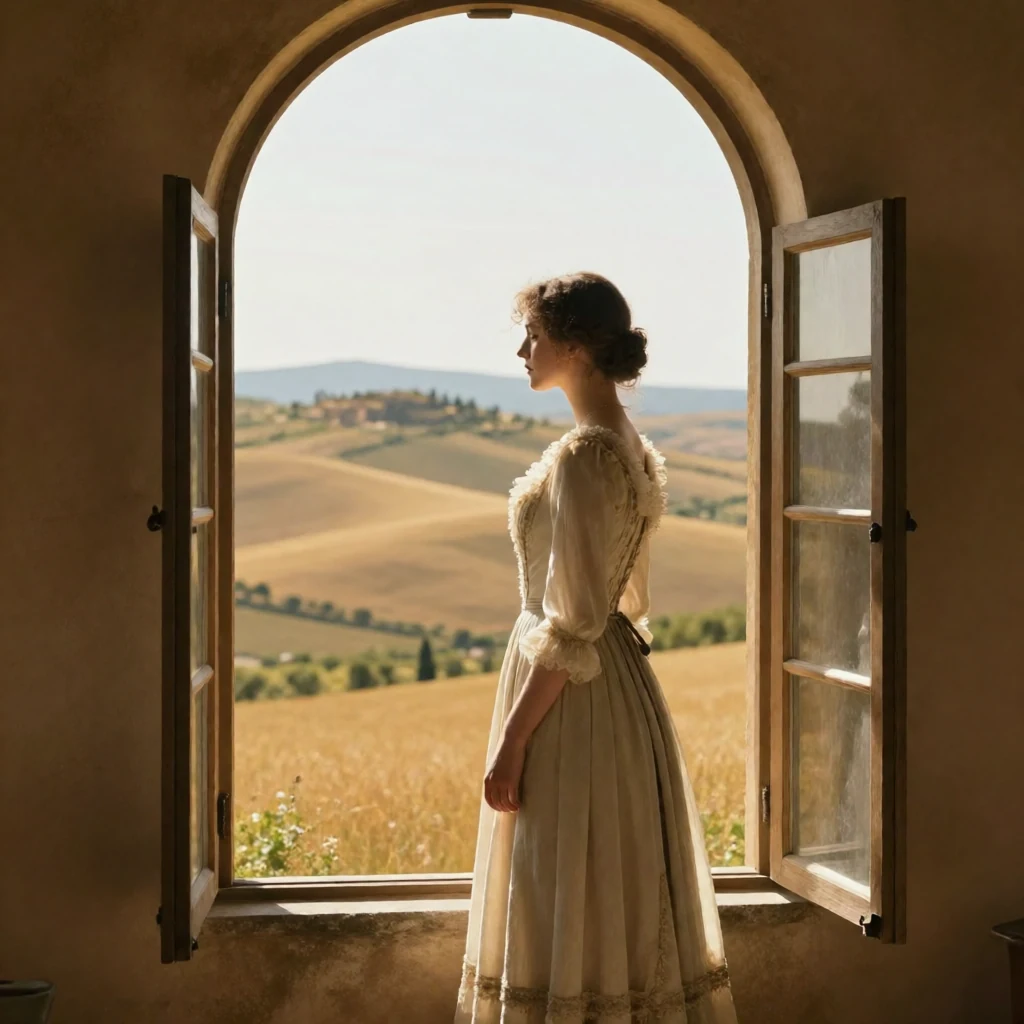
Reuniting with Miss Bartlett
George spots Miss Bartlett in the nave and informs Lucy. Lucy collapses at this news, realizing the gossiping Miss Alans must have informed her. Mr. Emerson pities her, but Lucy objects to this pity, declaring herself “thoroughly happy” and “having a splendid time.” She thanks the Emersons for their kindness and hurries to join her cousin. Miss Bartlett’s arrival in Santa Croce marks the end of Lucy’s encounter with the unconventional Emersons and restores her to the familiar world of propriety and cousinly supervision she knows best.
CHAPITRE III. : Music, Violets, and the Letter “S”
This chapter centers on Lucy’s musical nature, the social dynamics at the Pension Bertolini, and the mysterious “S” that caused tension during dinner. The narrative interweaves Lucy’s piano performance with gossip about Miss Lavish’s novel-writing, the Emersons’ social missteps, and Lucy’s desire for independence as shown in her plan to ride the circular tram alone.
Lucy’s Piano Performance and Mr. Beebe’s Tunbridge Wells Recollection
Lucy finds solace and transformation through piano playing, entering what Forster describes as “a more solid world” when she opens the instrument. Unlike a dazzling executante, she possesses a quieter passion that slips between emotions like love, hatred, and jealousy. She chooses Beethoven sonatas and decides they shall triumph rather than despair.
Mr. Beebe watches Lucy play at the Bertolini and recalls discovering her talent at Tunbridge Wells, where she performed the first movement of Opus 111—a choice the vicar considered “perversity” but which Mr. Beebe recognized as extraordinary. He initiated the stamping that followed her performance. When introduced, he found Lucy off the piano stool to be merely a young lady who loved concerts, iced coffee, and meringues. He later told her that if she ever lived as she played, it would be exciting both for them and for her.
Lucy mentions her mother’s disapproval of her getting excited about music, recalling that she once said she liked her own playing better than anyone’s—a statement her mother never forgave.
Gossip on Miss Lavish, the Emersons, and the Santa Croce Incident
Miss Alan reveals that Miss Lavish is writing a novel about modern Italy, having lost her first attempt in a landslip at the Grotto of the Calvary in Amalfi. The historical novel was nearly finished when the grotto collapsed, and Miss Lavish can no longer remember what she wrote. She subsequently took up cigarettes in despair. Mr. Beebe refers to her as “a good fellow” who should start a pipe instead.
The conversation turns to the Emersons, who have been socially unacceptable at the Bertolini. Old Mr. Emerson mentioned “S”—stomach acidity—to Miss Pole, causing embarrassment. At dinner, Miss Lavish, believing the Emersons to be commercial travelers (“drummers”), engaged them in conversation about commerce, claiming England rests on nothing but trade. Miss Alan, an early Victorian who defended Queen Victoria’s Irish visit, and Mr. Emerson, who agreed with her, caused further social confusion.
The Santa Croce incident involved the Emersons attempting to “annex” Lucy, showing her the world from their viewpoint and interesting her in their private matters—something Mr. Beebe found impertinent. Society has largely rejected the Emersons: Miss Lavish (intellect) is hostile, the Miss Alans (good breeding) follow suit, and Miss Bartlett is uncivil due to obligation. Only Mr. Beebe remains friendly, and Lucy admits she finds them nice though she rarely sees them now.
Lucy’s Tram Ride Plan and Mr. Beebe’s Concerns
Lucy announces her intention to ride the circular tram around town, standing on the platform by the driver. Both Mr. Beebe and Miss Alan look grave at this proposal. Mr. Beebe, responsible for Lucy in Miss Bartlett’s absence, suggests she stay on her feet within tourist streets instead. Miss Alan invokes “Italians, dear, you know” as a warning. Lucy quips that perhaps she’ll meet someone who reads her through and through, but ultimately concedes to a short walk on frequented tourist streets.
After Lucy departs, Mr. Beebe observes to Miss Alan that she really shouldn’t go out alone at all—and that she knows it. He attributes this rebellious impulse to “too much Beethoven,” suggesting her musical passion is pushing her toward independence beyond what is socially acceptable for a young lady.
The original text of this work is in the public domain. This page offers a compressed quick-read summary for educational purposes.