Years of Searching
The Spada family remained in obscurity for generations, with descendants serving as soldiers, diplomatists, churchmen, and bankers. The celebrated breviary with gold corners was preserved as a family relic. As secretary to the last Count of Spada, Faria examined all family documents for three hundred years’ worth of records, calculating income and expenditure thousands of times, but could find no trace of the hidden fortune.
The Unfound Treasure
Faria concludes his account of the Count of Spada’s poverty and the family’s failure to locate the inheritance. Despite exhaustive research into the Borgia family history and the Spada archives, Faria remained in ignorance of the treasure’s location, much like the legendary fortunes from the Arabian Nights that remained hidden in the earth. The treasure was neither possessed by the Borgias nor recovered by the family, preserving the mystery that Faria believes he has finally solved.
CHAPITRE 18. The Treasure
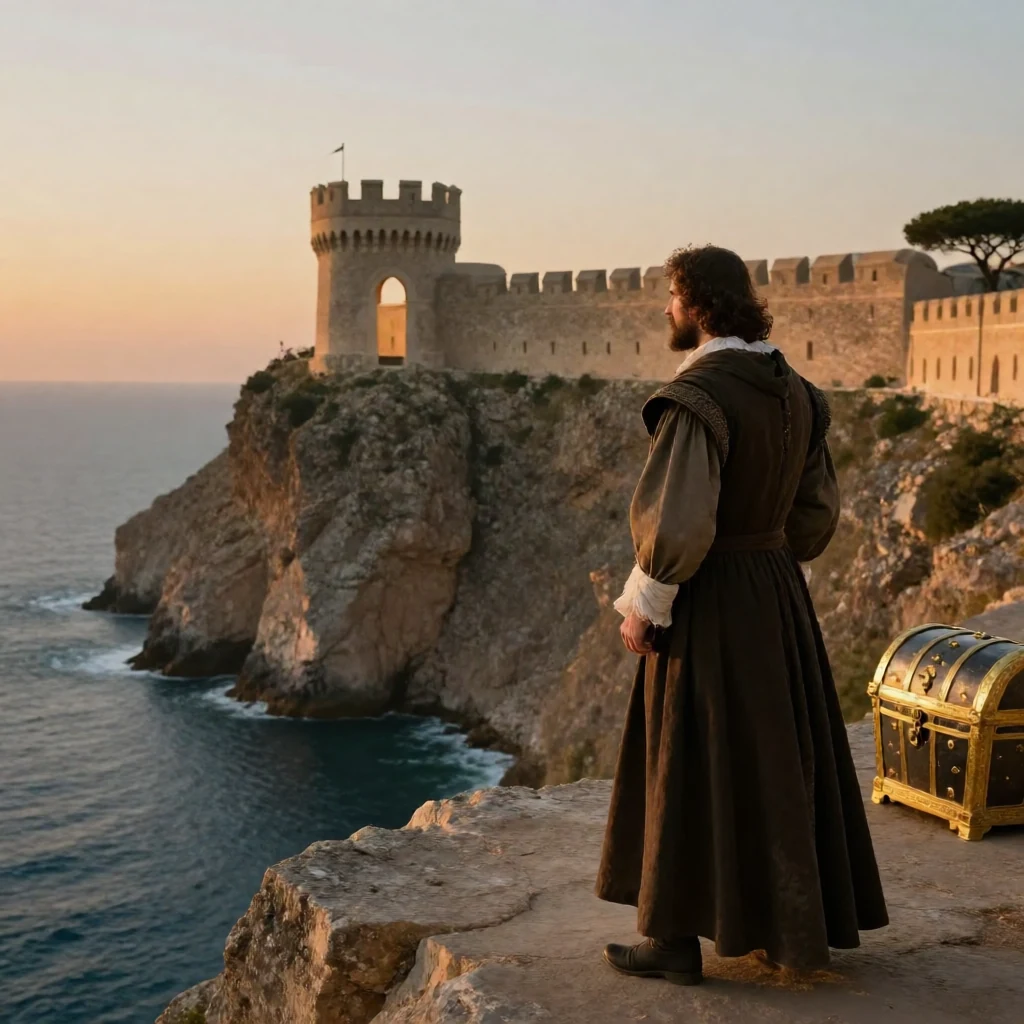
In this chapter, the Abbé Faria recounts the remarkable circumstances by which he came upon Cardinal Spada’s hidden will: while preparing to leave Rome in 1807, he had dozed off over his late patron’s papers and, upon waking in darkness, used an old yellowed marker from the famous breviary to light his candle—only to watch mysterious characters appear on the page in sympathetic ink as the flame climbed it. By fitting together the burned fragment with a second leaf he had preserved, Faria reconstructed the cardinal’s 1498 declaration, which bequeathed an immense fortune in gold, jewels, and Roman crowns to his nephew Guido Spada, concealed in the furthest angle of a cave on the small Island of Monte Cristo. Faria thereupon offers Edmond Dantès a partnership in the treasure—half if they escape together and the whole if Faria dies in captivity—assuring him that the Spada line is extinct and that his hesitation can be set aside. Touched by the old man’s faith, Dantès resists the offer on the grounds that he is no blood relation, but Faria, who regards him as the son of his captivity, embraces him with the one arm still at his command, and the two weep together over the bond that the promise of Monte Cristo has sealed between them.
Patron’s Bequest and Fulfilled Obligations
Faria explains that his patron left him family papers, a five-thousand-volume library, a famous breviary, and a thousand Roman crowns on the condition that he arrange anniversary masses and compile a genealogical history of the house. He carried out these duties faithfully, and as the palace was being sold, he prepared to relocate to Florence with his possessions before his arrest.
Hidden Breviary Document Discovery
On December 25, 1807, Faria awoke in darkness and searched for a means to light a candle. He tore a yellowed paper from the famous breviary—kept by request of the heirs—and as the flame caught, yellowish characters magically appeared. Recognizing sympathetic ink revealed by fire, he extinguished the flame, only to find nearly a third of the document already consumed.
Partial Burned Will Reading
Faria hands the surviving fragment to Dantès, who reads cryptic phrases dated April 25, 1498, mentioning Pope Alexander VI., fears for his life like Cardinals Caprara and Bentivoglio who were poisoned, his nephew Guido Spada as sole heir, and a treasure on the Island of Monte Cristo possibly worth two million crowns, concealed near the twentieth rock from a small creek to the east, in the furthest angle of the second opening. The document is signed “Cæs…” (Cæsar Spada).
Split Will Fragment Assembly
Faria presents a second leaf bearing the remaining fragments, and Dantès combines the two pieces. The completed text reveals Cardinal Spada’s full will: fearing Alexander VI.’s greed and poisoned fate of his cardinals, he bequeathed his entire hidden fortune—ingots, gold, money, jewels, diamonds, and gems—to his nephew Guido Spada, to be found in the furthest angle of the second cave opening on Monte Cristo.
Faria’s Arrest Before Treasure Retrieval
Having deduced the treasure’s location, Faria immediately resolved to depart, carrying with him his manuscript on Italian unification. However, the imperial police—seeking territorial partition contrary to Napoleon’s wishes—grew suspicious of his hasty departure. He was arrested at Piombino at the very moment of leaving, thwarting his plans for retrieval.
The original text of this work is in the public domain. This page focuses on a guided summary article, reading notes, selected quotes, and visual learning materials for educational purposes.