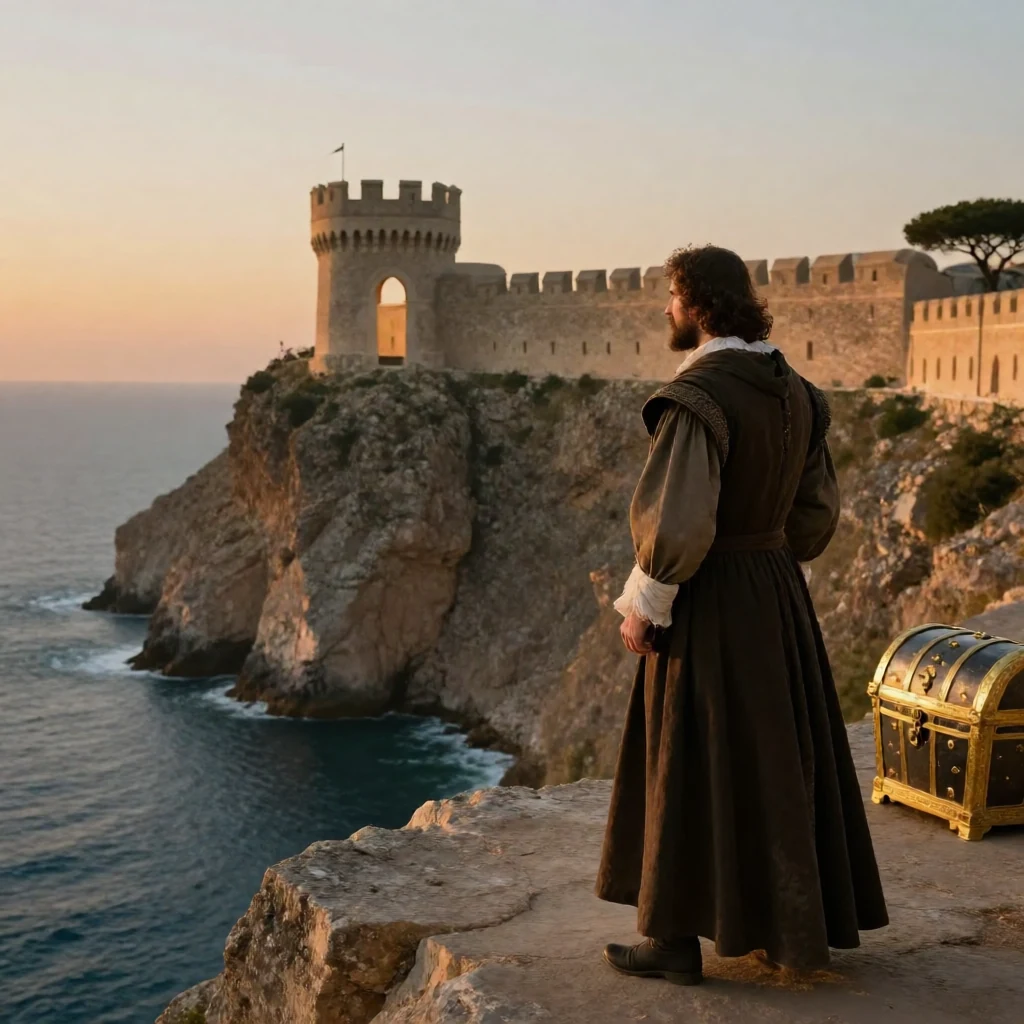
Chapter 62. Ghosts
The Auteuil house revealed nothing of its splendor from the road. Within, Bertuccio had worked miracles in three days—poplars, sycamores, a fresh lawn—reviving the long-shuttered house with perfume, books, dogs, birdsong, and staff moving like longtime residents. One room he had not touched; servants passed its door with curiosity, Bertuccio with terror.
At five Monte Cristo arrived, walked the grounds in silence, tested a rosewood glove cabinet, said “Good,” and dismissed a blissful Bertuccio. At six guests arrived: Morrel first on Médéah for a private word, then the Danglars by carriage, Debray and Château-Renaud on horseback. Monte Cristo noted Madame Danglars’s covert note to Debray, the baron’s pallor, the baroness’s rapid sweep of the courtyard. The Cavalcantis and Villeforts followed.
When Bertuccio came to confirm dinner, through a half-open door he saw Madame Danglars in white silk and diamonds—and recognized her as the pregnant woman from the garden. Trembling, he pointed at Villefort. “Then I did not kill him?” he muttered. Monte Cristo watched with stern displeasure. “You see plainly he is not dead,” he said coldly. “You must have struck higher or lower; life is tenacious in these lawyers—or your story was a nightmare.” He listed the guests. Bertuccio went grey at Benedetto but was silenced with a look. Dinner at half-past six; the count did not like to wait.
Chapter 63. The Dinner
A strange sentiment united the guests—each had wondered what brought them, yet none would willingly have missed it. Villefort felt Madame Danglars’s arm tremble; she started when Monte Cristo invited him to escort her. The count had arranged seating to maximize such tensions.
The Oriental feast offered fruits from every quarter, rare birds in plumage, fish from distant seas, wines from the Archipelago. The count told how a sterlet arrived alive from the Volga in a cask of weeds, a lamprey from Lake Fusaro in rushes. When Danglars expressed skepticism, the still-living backup fish were produced.
Château-Renaud noted the house had belonged to M. de Saint-Méran. The count led the company into a room of red damask—dramatic bed, staring portraits, hidden staircase winding into darkness. Madame Danglars nearly fainted; Villefort braced himself. The descriptions grew pointed until she collapsed. Madame de Villefort’s smelling-salts revived her, and he led the party into the garden.
Where fresh earth lay, the count announced: digging had unearthed an iron-bound box with a newborn’s skeleton. Villefort’s arm trembled; Madame Danglars went rigid. The Cavalcantis leaned forward. A crime, declared the count—and the king’s attorney was present to hear it. Monte Cristo smiled at his prey.
Chapter 64. The Beggar
After dinner, Villefort’s carriage bore Madame Danglars home with his wife; Morrel, Château-Renaud, and Debray rode to Paris. Danglars bore the charmed Major Cavalcanti to the Hôtel des Princes. Andrea approached his tilbury, where a groom waited in proper English fashion, when a hand touched his shoulder.
A sunburnt man with red handkerchief asked to be taken up. When Andrea dismissed him, the man addressed him as Benedetto. Andrea’s color drained. He sent his groom ahead, then drove to a shaded spot. The man was Caderousse of the Pont du Gard.
Caderousse proposed 150 francs monthly plus the ten gold louis Andrea pressed into his hand. He confided his dream: a respectable room, decent coat, daily shave, café papers, evening theatre—life like some retired baker. When Andrea told him to jump down at the city barrier, Caderousse refused: his appearance and lack of papers would see him arrested as a Toulon fugitive, he’d become convict No. 106 again. He stripped off the groom’s greatcoat and Andrea’s hat, donned them, and passed the checkpoint as a servant. Inside Paris, he leapt down at the first cross street and vanished into a courtyard. Andrea sat bareheaded and sighed: one cannot be completely happy in this world.
Chapter 65. A Conjugal Scene
At Place Louis XV the riders separated, but Debray crossed the Carrousel and reached the Danglars house as Villefort’s landau left the baroness. He helped her down; she insisted she was out of sorts. In her apartments, he stretched on the couch until Danglars himself appeared and coolly dismissed him on pretext of serious business with his wife. Debray left, knocking against the door like the doomed Nathan in Athalie.
Alone with his wife, Danglars dropped his civility. He had lost 700,000 francs on the Spanish loan, counseled by her and Debray. He catalogued her profitable tips—400,000 from Haiti, a million from a railway, Spanish profits—then the ruinous Don Carlos rumor. He demanded a quarter: 175,000 francs.
She defended herself; he grew crueler. He knew of Debray, the half-million francs, and “the king’s attorney.” Her first husband M. de Nargonne, a banker, had known the limits of patience. “Why did he kill himself instead of you? Because he had no cash to save. My life belongs to my cash.” He forbade Debray the house unless the diplomatist gave his lessons gratis. Madame Danglars sank faint into a chair; Danglars shut the bedroom door and left her to her half-dream.
The original text of this work is in the public domain. This page focuses on a guided summary article, reading notes, selected quotes, and visual learning materials for educational purposes.