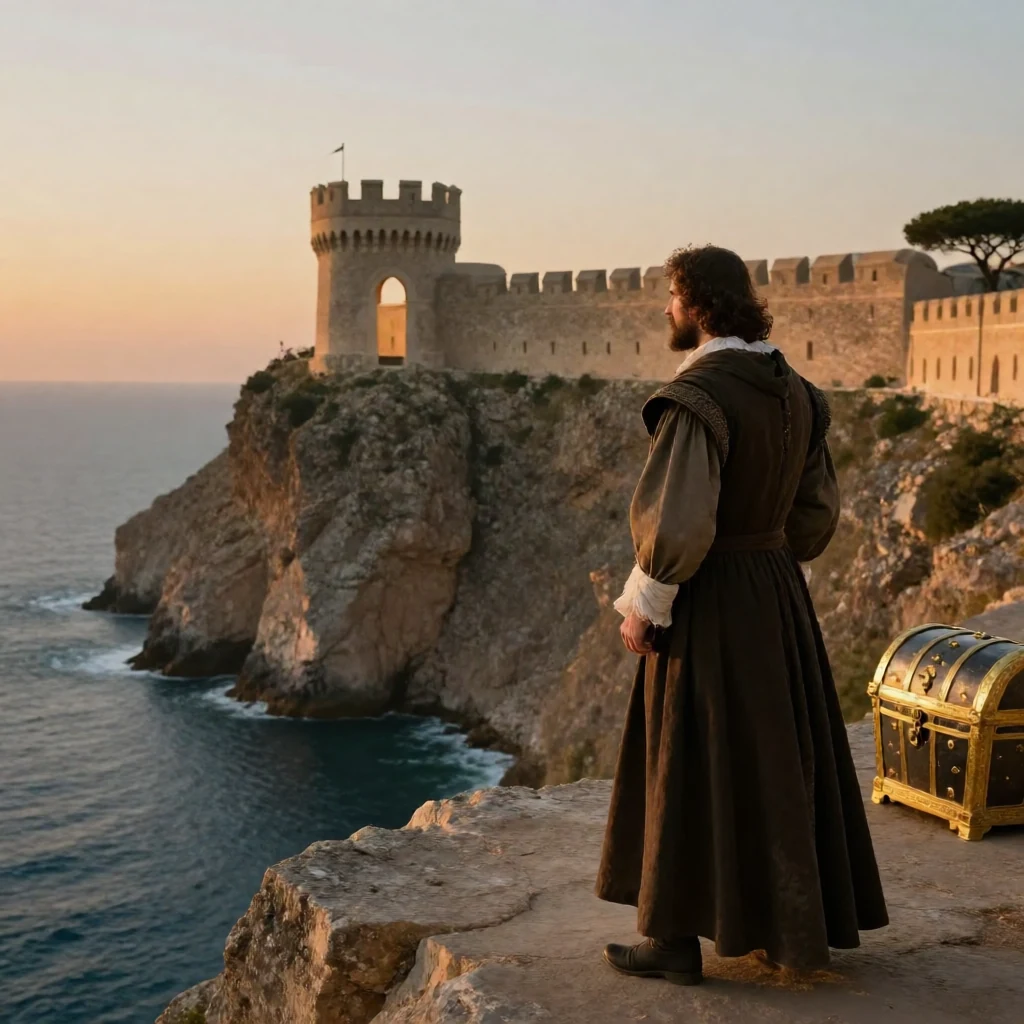
Flight Into the Forest
Flight Into the Forest. Vampa and Teresa set off toward the forest, which he enters without hesitation along paths known to him through familiarity with the trees and bushes. After an hour and a half, they reach the thickest part of the forest and follow a dry torrent bed into a deep gorge, a path shaded by pines and resembling Virgil’s road to Avernus. Though alarmed by the wild surroundings, Teresa presses close to her composed guide in silence and tries to master her fear.
Encounter with the Bandit Sentry
Encounter with the Bandit Sentry. A man steps from behind a tree and levels a weapon at Vampa, warning him to stop or die. Vampa raises his hand in disdain, remarking that wolves do not rend each other, and identifies himself as Luigi Vampa, shepherd of the San-Felice farm. The sentinel, learning that Vampa wishes to speak with the bandits at Rocca Bianca, offers to lead him there. Vampa smiles disdainfully at the sentry’s caution, takes the lead with Teresa, and after ten minutes stops at another signal, imitating and answering the cry of a crow.
Rocca Bianca
Rocca Bianca. Teresa and Luigi press on through the forest, with Teresa trembling at the sight of weapons and the glint of carbines among the trees. Rocca Bianca is described as a retreat perched on the summit of a small mountain, likely the cone of an extinct volcano predating the founding of Rome by Romulus and Remus. When they reach the top, they are suddenly confronted by twenty bandits.
Vampa Demands to Be Captain
Vampa Demands to Be Captain. The sentinel announces the visitor to the lieutenant in command in the chief’s absence, and the bandits from Ferrusino, Pampinara, and Anagni recognize Luigi Vampa and welcome him. Vampa declares that he is tired of a shepherd’s life, but he asks for more than admission into their ranks: he demands to be their captain. When the lieutenant incredulously asks what he has done to merit such honor, Vampa coolly replies that he has killed their chief Cucumetto, whose dress he now wears, and burned the Villa San-Felice to obtain a wedding-dress for his betrothed.
Vampa Chosen as Chief
Vampa Chosen as Chief. Within an hour of his audacious demand, Luigi Vampa is unanimously chosen as the new captain of the band, succeeding the deceased Cucumetto.
Franz and Albert Discuss Vampa
Franz and Albert Discuss Vampa. Franz turns to Albert and asks what he thinks of citizen Luigi Vampa, prompting Albert to declare that Vampa is a myth with no real existence. Franz and Pastrini then discuss how Vampa operates boldly around Rome, evading police through his understanding with shepherds of the plains, fishermen of the Tiber, and smugglers of the coast, slipping between mountains, waters, open sea, and islands such as Giglio, Giannutri, and Monte Cristo. Franz explains Vampa’s merciless ransom system—giving travellers eight, twelve, or twenty-four hours to pay, with a one-hour grace period, after which a pistol-shot or dagger-blow settles the account.
Departure for the Colosseum
Departure for the Colosseum. Franz asks Albert if he is still determined to reach the Colosseum by the outer wall, and Albert agrees as long as the route is picturesque. When the clock strikes nine, the coachman announces that the carriage is ready, and when he asks whether to go by the Porta del Popolo or through the streets, Franz emphatically chooses the streets. Albert, lighting his third cigar, teases Franz for showing a lack of courage, and the two young men descend the staircase and step into the carriage.
CHAPITRE 34. The Colosseum
Chapter 34. The Colosseum Franz and Albert travel to the Colosseum by a deliberately circuitous route that avoids all other ancient ruins, allowing Franz to reflect on Pastrini’s story. Upon arrival, they engage guides, and Albert is awed by his first sight of the monument by moonlight. Franz separates from the group to sit in solitude behind a column, where he witnesses a clandestine meeting between a cloaked stranger and a Transteverine accomplice. The two conspire to save Peppino, a condemned prisoner, with the stranger offering a plan involving bribery and a window-signal arrangement using draperies at the Café Rospoli. After the conspirators depart, Franz rejoins Albert and they leave the Colosseum. In this chapter, Franz reflects on the mysterious encounter he witnessed in the Colosseum, becoming increasingly convinced that one of the cloaked figures is none other than his former host, “Sinbad the Sailor,” whose deep, sonorous voice he recognizes from their earlier meeting in the grotto of Monte Cristo, and he passes a sleepless night wrestling with the connection between the two identities. The following day, Albert busies himself with social arrangements in Rome, securing a box at the Teatro Argentina and collecting numerous invitations, though he confides in Franz his growing frustration at having attracted no romantic adventures in Italy despite his fashionable attire and considerable personal charms. That evening at the opera, where Donizetti’s Parisina is being performed by Coselli, Moriani, and La Specchia, Franz and Albert are presented to the Venetian Countess G——, with whom Franz shares a taste for moonlit visits to ancient ruins, and Franz soon becomes entranced by a strikingly beautiful woman in Greek dress seated in an opposite box, accompanied by a shadowed male figure who shows no reaction even to the loudest passages of the ballet Poliska that follows. After the ballet concludes and the second act of Parisina begins, Franz finally recognizes the pale, mysterious figure in the opposite box as the Count of Monte Cristo, the strange inhabitant he had encountered the previous evening in the Colosseum ruins. Alarmed by the count’s ghastly appearance and unsettling manner, the countess urges Franz to escort her home, where she confesses her superstitious fears and persuades him to abandon his pursuit of the mysterious stranger for the night. Upon returning to the hotel, Franz finds Albert arranging a fanciful disguise as Neapolitan reapers with a gilded ox-cart for the carnival, and their host Pastrini soon interrupts with the startling news that the Count of Monte Cristo himself, their neighbor on the same floor, has offered them seats in his carriage and places at the Palazzo Rospoli windows, followed by a liveried servant delivering the count’s formal calling cards. Franz and Albert accept Count Monte Cristo’s invitation to visit him, with Franz drawn especially by the promise of viewing the executions from the windows of the Palazzo Rospoli, since the details of the condemned recall the conversation he overheard the night before in the Colosseum. The following morning Franz questions his landlord, Signor Pastrini, about the day’s executions, learning from a tavoletta that Andrea Rondolo will be mazzolato and Peppino, an accomplice of the bandit Luigi Vampa, will be decapitato, confirming Franz’s suspicion that the cloaked stranger from the Colosseum and the figure from the Teatro Argentina is none other than their mysterious host. After being shown into the Count’s richly appointed rooms, where they marvel at the luxurious furnishings and briefly hear the sound of a guzla, the two friends finally meet the Count in person, and Franz instantly recognizes him as the man from both prior encounters.
The original text of this work is in the public domain. This page focuses on a guided summary article, reading notes, selected quotes, and visual learning materials for educational purposes.