Hidden Breviary Document Discovery
On December 25, 1807, Faria awoke in darkness and searched for a means to light a candle. He tore a yellowed paper from the famous breviary—kept by request of the heirs—and as the flame caught, yellowish characters magically appeared. Recognizing sympathetic ink revealed by fire, he extinguished the flame, only to find nearly a third of the document already consumed.
Partial Burned Will Reading
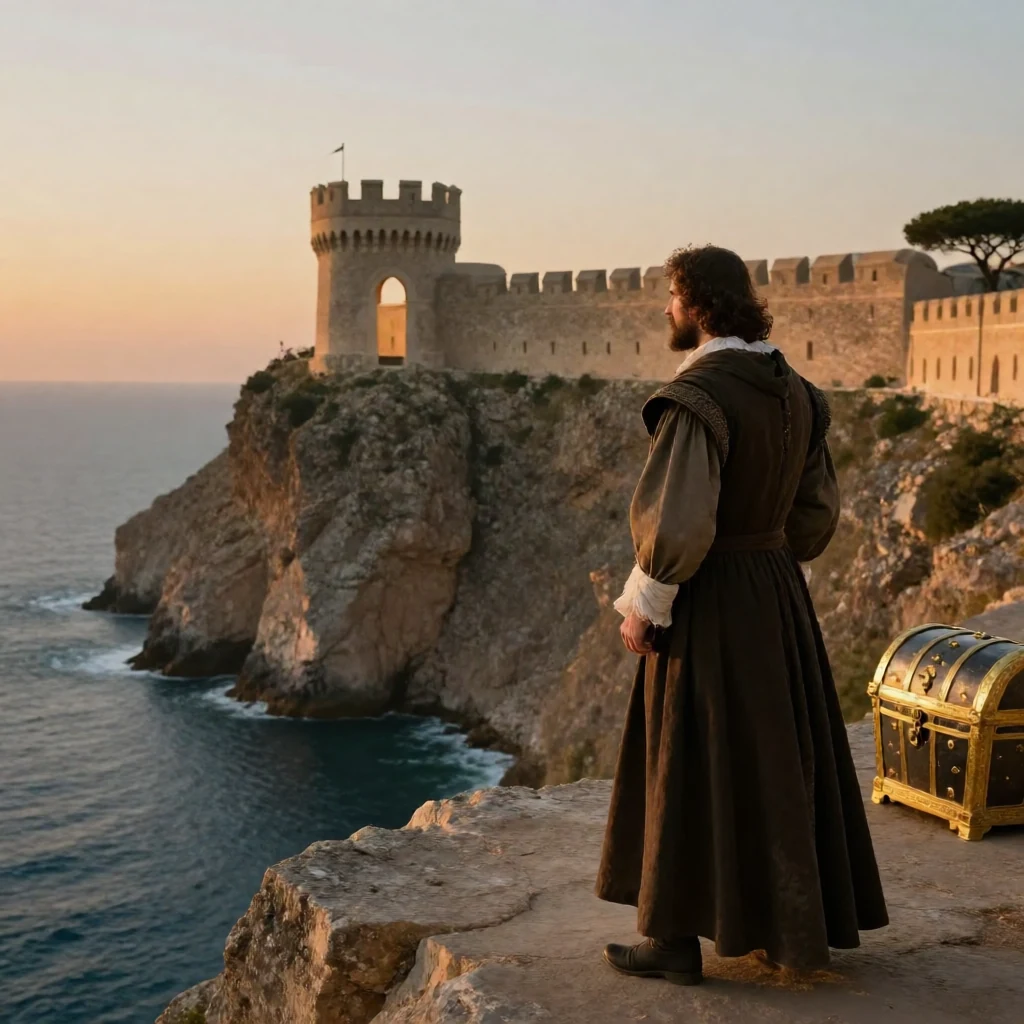
Faria hands the surviving fragment to Dantès, who reads cryptic phrases dated April 25, 1498, mentioning Pope Alexander VI., fears for his life like Cardinals Caprara and Bentivoglio who were poisoned, his nephew Guido Spada as sole heir, and a treasure on the Island of Monte Cristo possibly worth two million crowns, concealed near the twentieth rock from a small creek to the east, in the furthest angle of the second opening. The document is signed “Cæs…” (Cæsar Spada).
Split Will Fragment Assembly
Faria presents a second leaf bearing the remaining fragments, and Dantès combines the two pieces. The completed text reveals Cardinal Spada’s full will: fearing Alexander VI.’s greed and poisoned fate of his cardinals, he bequeathed his entire hidden fortune—ingots, gold, money, jewels, diamonds, and gems—to his nephew Guido Spada, to be found in the furthest angle of the second cave opening on Monte Cristo.
Faria’s Arrest Before Treasure Retrieval
Having deduced the treasure’s location, Faria immediately resolved to depart, carrying with him his manuscript on Italian unification. However, the imperial police—seeking territorial partition contrary to Napoleon’s wishes—grew suspicious of his hasty departure. He was arrested at Piombino at the very moment of leaving, thwarting his plans for retrieval.
The original text of this work is in the public domain. This page focuses on a guided summary article, reading notes, selected quotes, and visual learning materials for educational purposes.