The Forest Path
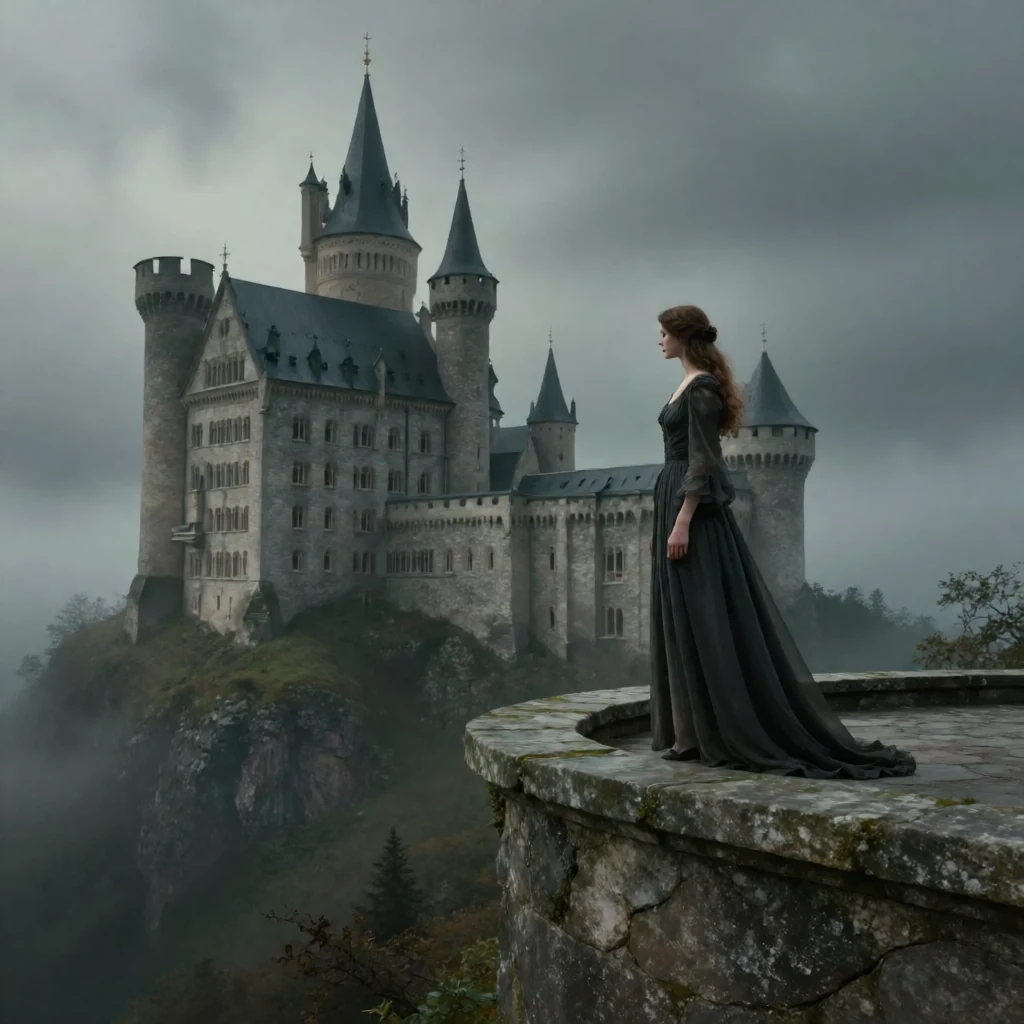
Outside the castle the Baron shivers in a strong wind, watching his wavering lamp with anxiety as he looks up at the lights of retiring guests and reflects on the warmth of his chamber. The Knight leads him in silence along an obscure and intricate forest path, sighing deeply but refusing to speak. At length they reach a deep recess where lofty chestnuts shut out the sky and dense underwood makes progress difficult.
The Corpse Revealed
In this gloomy recess the Knight turns with a terrific look and points to the ground, where the Baron sees the body of a man stretched out and weltering in blood, with a ghastly wound on the forehead and features already fixed in death. As the Baron moves to raise and examine the corpse, the Knight waves his hand with so earnest and mournful a gaze that the Baron desists.
The Spectre Vanishes
When the Baron holds his lamp close to the corpse’s face, he discovers it bears the exact resemblance of his conductor. Gazing up in astonishment, he perceives the Knight’s countenance change and fade until his entire form gradually vanishes from sight, leaving the Baron rooted to the spot in awe.
The Voice’s Command
A disembodied voice then proclaims that the body is that of Sir Bevys of Lancaster, an English knight waylaid and murdered that very night as he journeyed from the Holy City. The voice commands the Baron, in the name of knighthood and humanity, to inter the body in Christian ground and bring the murderers to justice, declaring that peace and happiness or war and misery shall fall upon him and his house for ever according to his compliance or neglect.
The Knight’s Burial
Recovering from his astonishment, the Baron returns to his castle and has Sir Bevys’s body removed. On the following day the knight is interred with the honours of chivalry in the castle chapel, in a ceremony attended by all the noble knights and ladies of the court of Baron de Brunne.
The Reader’s Dream
With the story finished, Ludovico feels drowsy and, after adding wood to the fire and taking another glass of wine, reposes in his arm-chair. In his dream he still sees the chamber around him, and once or twice starts up imagining he sees a man’s face peering over the high back of his chair. The impression is so strong that he rises and looks behind the chair before being fully convinced that no one is there, and so the hour closes.
CHAPITRE VII.
Chapter VII opens with a Shakespeare epigraph on slumber and proceeds through an autumnal morning in which Count De Villefort, Emily St. Aubert, and the household confront the lingering mysteries of Château-le-Blanc. The narrative weaves Emily’s unresolved grief over Valancourt, her discovery of his poem at the watch-tower, and the baffling disappearance of the servant Ludovico from the locked north chambers. The Count’s investigation yields no explanation, deepening the château’s atmosphere of the supernatural. The chapter also advances several social and personal plots: Dorothée recounts the Marchioness de Villeroi’s death to the Count, the advocate’s silence on Madame Montoni’s estates frustrates Emily’s hopes, Mons. Du Pont renews his unwelcome suit, and Emily resolves to withdraw to her convent. The chapter closes with the Count counseling Emily against the indulgence of sorrow.
Shakespeare Slumber Epigraph
The chapter opens with an epigraph from Shakespeare, drawn from Julius Caesar, praising sleep as a balm free from the fantasies and cares that trouble waking minds.
The Count Searches for Ludovico
Having slept little during the night, the Count rises early and goes to the north apartment in search of Ludovico. Finding the outer door fastened from the night before, he knocks loudly but receives no answer. Reasoning that the door’s distance from the bedroom and Ludovico’s exhaustion from a night of watching explain the silence, the Count departs to walk in his grounds, leaving the matter unresolved.
The original text of this work is in the public domain. This page focuses on a guided summary article, reading notes, selected quotes, and visual learning materials for educational purposes.