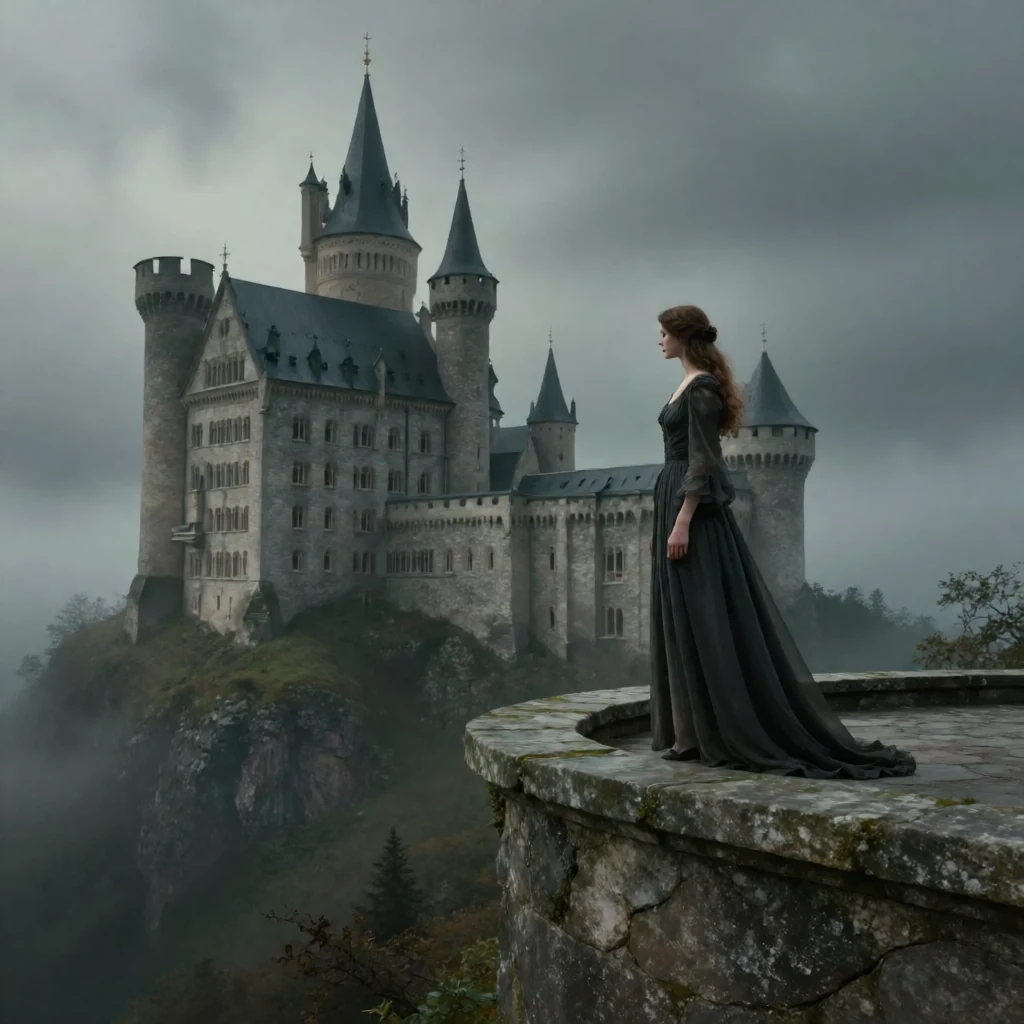
The Distant Watch-Dog
The Distant Watch-Dog. As Blanche sits attentive, her solemn reverie on ground once polluted by these events is suddenly broken by the distant bark of a watch-dog carried on the wind. The travelers listen with eager hope; the guides, confident the sound proceeds from the inn, persuade the Count to resume the journey, the moon’s uncertain light through broken clouds supplemented by a single torch—since the guides had expected to reach the inn soon after sunset and neglected to provide more. The party follows the bark along the brow of the precipice in silent caution, but the sound is heard only at intervals and eventually ceases altogether, leaving them to point their course toward the quarter from which it had issued.
The Lost Path
The Lost Path. Following the vanished bark, the guides’ attention is seized by the deep roaring of a torrent, and they soon arrive at a tremendous chasm in the mountain that seems to forbid further progress. Blanche, the Count, and St. Foix dismount from their mules while the guides traverse the edge in search of a bridge, however rude, to the opposite side. They at length confess what the Count had begun to suspect: that they had been doubtful of their way for some time and are now certain only that they have lost it.
CHAPITRE XII.
The party crosses a perilous alpine bridge by torchlight, follows distant sounds and a glimmering light through a mountain pass, discovers what they believe to be a Pyrenean watch-tower, and ultimately ascends to a ruined fortress where they are admitted by suspicious hunters and led into a great hall warmed by a blazing fire. As shelter is shared, the Count converses with his hosts while Blanche quietly observes one of the men studying St. Foix with steady intent.
The Alpine Bridge
The Alpine Bridge
The travellers discover a rude passage formed by an enormous felled pine thrown across the chasm, likely cut by a hunter pursuing the izard or wolf. All but the guides shudder at the prospect of crossing a bridge offering no defence, from which a fall would mean death. The guides lead the mules over with instinctive caution, undeterred by the cataract’s noise or the gloom cast by the overhanging foliage. A solitary torch becomes invaluable as Blanche, terrified yet summoning her firmness, follows its red gleam to safety on the opposite cliff, preceded by her lover and supported by her father.
A Distant Light
A Distant Light
As the heights contract into a narrow pass, the travellers are cheered by the bark of a dog, perhaps guarding flocks from nocturnal wolves. A light soon glimmers at a height above their path, appearing and disappearing as if branches alternately obscured and revealed it. The guides halloo with full strength and fire a pistol, but no human voice answers, and the explosion’s echo fades into unbroken silence. The light becomes plainer and indistinct voices are caught on the wind, yet when the guides repeat their call the voices cease and the light vanishes, deepening the party’s unease.
The Watch-Tower
The Watch-Tower
With Blanche nearly overcome by anxiety, fatigue, and apprehension, an object is perceived on a point of rock above, its form caught by the moon’s strong rays. The Count recognises it as a watch-tower and believes the earlier light came from it. Seeking to lift his daughter’s spirits, he points out the near prospect of shelter and repose, however rude the accommodation a ruined tower may provide.
Pyrenean Watch-Towers and Smugglers
Pyrenean Watch-Towers and Smugglers
The Count describes the numerous watch-towers erected among the Pyrenees, explaining how fires kindled on their summits conveyed intelligence of enemy movements along frontier lines of several hundred miles. He recounts how lurking armies emerge from fortresses and forests to defend grand passes, assailing enemies from the heights with shattered rock. While the ancient forts overlooking grand passes are preserved, those in inferior stations have fallen into ruin and now shelter hunters and shepherds. Asked if they are always peacefully inhabited, the Count admits they sometimes serve as the asylum of French and Spanish smugglers, who travel in large, well-armed parties to evade the king’s troops, leading to desperate and bloody conflicts when engagements do occur.
The original text of this work is in the public domain. This page focuses on a guided summary article, reading notes, selected quotes, and visual learning materials for educational purposes.