Resolution of Emily’s Parentage Doubts
Upon discovering that the Marchioness de Villeroi was the sister of Monsieur St. Aubert, Emily was variously affected. While she mourned the Marchioness’s untimely death, she was relieved of the anxious and painful conjecture arising from Laurentini’s rash assertion about her birth and her parents’ honor. Her faith in St. Aubert’s principles scarcely allowed her to suspect he had acted dishonorably, and she felt such reluctance to believe herself the daughter of anyone other than the mother she had always known and loved that she could hardly admit such a possibility. Yet the likeness she bore to the late Marchioness, the former behavior of the old housekeeper Dorothée, Laurentini’s assertion, and St. Aubert’s mysterious attachment to the Marchioness had awakened doubts about his connection with her that her reason could neither vanquish nor confirm. From these doubts she was now relieved, and all the circumstances of her father’s conduct were fully explained.
Reflection on the Nun’s Tragic Downfall
Although Emily’s parentage doubts were resolved, her heart was oppressed by the melancholy fate of her amiable relative and by the solemn lesson presented in the history of the nun. The indulgence of Laurentini’s passions had gradually led her to commit a crime from the very prophecy of which, in her early years, she would have recoiled in horror and declared impossible. Whole years of repentance and the severest penance had proved unable to obliterate that crime from her conscience.
CHAPITRE XVIII.
The chapter opens with a Shakespearean epigraph evoking tears and faded beauty, setting a melancholic tone. The narrative continues Emily St. Aubert’s emotional journey at Château-le-Blanc, culminating in her reunion with Valancourt amid preparations for Lady Blanche’s wedding.
Opening Shakespeare Epigraph
A poignant verse from Shakespeare’s The Tempest introduces the chapter: “Then, fresh tears Stood on her cheek, as doth the honey-dew Upon a gather’d lily almost wither’d.” This epigraph establishes the chapter’s emotional register of sorrow and delicate beauty that will frame Emily’s experiences throughout the section.
Emily as Villeroi Relative at the Château
Following the late discoveries about her lineage, Emily is now recognized at the château as a relative of the house of Villeroi. The Count and his family extend to her an even friendlier attention than before, acknowledging her noble heritage and welcoming her more fully into their circle.
Count’s Concerns Over Valancourt’s Letter
Count De Villefort experiences mingled surprise and satisfaction regarding the delayed response to his letter addressed to Valancourt at Estuvière. His concern is tempered by the prudence that has spared Emily from sharing his anxiety, yet seeing her still affected by his former error tests his resolve to maintain silence about truths that might offer her relief.
Preparations for Blanche’s Nuptials
The inhabitants of the château are occupied with preparations for Lady Blanche’s approaching wedding. The Count’s attention is divided between this festive occasion and his anxiety about Valancourt, while Mons. St. Foix’s arrival is expected daily to join the celebration.
Emily’s Melancholy Over Valancourt’s Fate
Emily cannot participate in the gaiety surrounding her despite attempting to engage her spirits. Her depression stems from the late discoveries and anxiety concerning Valancourt’s fate, particularly the description of his manner when delivering the ring, which seemed to carry the gloomy wildness of despair. She fears what that despair might have driven him to do, and the suspense regarding his safety becomes insupportable.
Emily’s Solitary Watch-Tower Visits
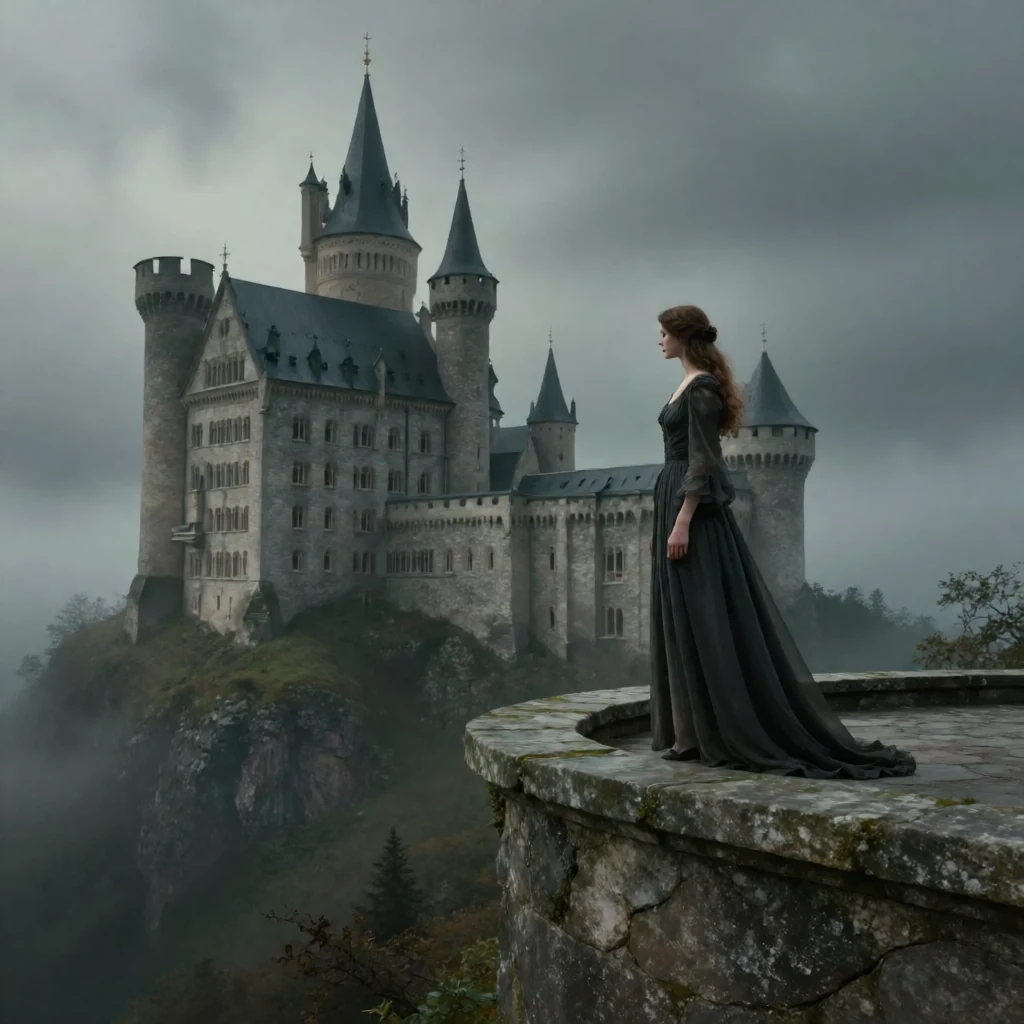
Emily often abruptly leaves company to seek solace in the deep solitudes of the woods overlooking the shore. The faint roar of foaming waves below and the sullen wind among the branches harmonize with her troubled state. She sits on cliffs or the broken steps of her beloved watch-tower, observing the changing evening clouds and the gloom of twilight settling over the sea until the white tops of advancing billows can barely be discerned against the darkened waters.
Emily’s Evening Lute Performance at the Tower
Wandering to the watch-tower with her lute one evening, Emily ascends the winding staircase to a less decayed chamber with a small grated window. Watching the sun set over the Pyrenees, she plays her lute in solemn symphony and accompanies it with her voice, singing an air adapted to verses titled “TO MELANCHOLY.” The poem invokes the spirit of love and sorrow, describing journeys through moonlit cloisters, pine-wood forests, mountain heights, and pebbly shores where the moonlight plays upon foaming seas. The tranquil scene below, with its evening breeze and distant sail, combines with her tender melody to lull her into gentle sadness, though her voice eventually trembles and she weeps upon her lute.
The original text of this work is in the public domain. This page focuses on a guided summary article, reading notes, selected quotes, and visual learning materials for educational purposes.