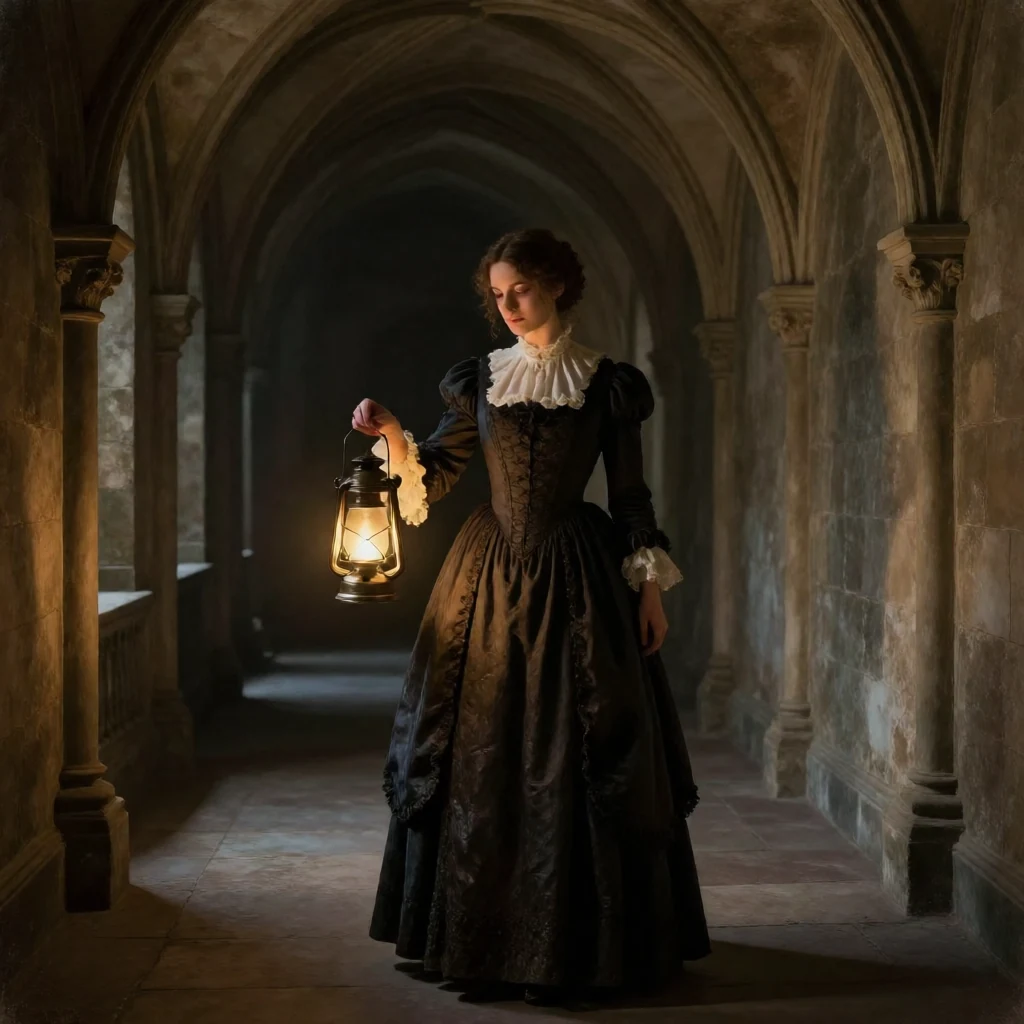
Jane Eyre: An Autobiography
Charlotte Brontë
Overview
Jane Eyre: An Autobiography follows the life of Jane Eyre from childhood through adulthood, chronicling her journey through oppression, education, love, and self-discovery. The novel spans approximately thirty years, moving through three primary settings: Gateshead Hall, Lowood School, and Thornfield Hall, before culminating in the moorlands of Morton and finally Ferndean.
Subjects: Bildungsromans, Governesses—Fiction, England—Fiction, Love stories, Orphans—Fiction, Young women—Fiction, Mentally ill women—Fiction
Bookshelves: British Literature, Classics of Literature, Novels, Romance
Part One: Gateshead Hall (Chapters I–IV)
Chapter I: Excluded from the Drawing-Room
Young Jane Eyre, ten years old, is excluded from the family circle by her aunt, Mrs. Reed, and relegated to the window-seat where she reads Bewick’s History of British Birds. Her cousin John Reed attacks her unprovoked, calling her a “wretched orphan” and “dependent,” and hurls the book at her head. When Jane defends herself, Mrs. Reed locks her in the red-room as punishment. This chapter establishes Jane as an outsider, a ward of the Reed family with no inheritance or protection.
Chapter II: The Red-Room
The red-room becomes the symbolic heart of Jane’s early trauma. It is the largest chamber at Gateshead, hung with deep red damask, and serves as the room where her uncle Mr. Reed died nine years prior. Jane’s mounting terror in this cold, silent, haunted space reaches a breaking point when superstitious fears overwhelm her. She screams, is found by servants, and collapses into unconsciousness. The chapter foreshadows Jane’s lifelong struggle between defiance and endurance.
Chapter III: The Aftermath
Jane wakes attended by Bessie the nursemaid and Mr. Lloyd, the apothecary. During his visit, Jane reveals she has no family and is cruelly treated by her aunt and cousins. Mr. Lloyd recommends a “change of air and scene,” which Jane interprets as school. That night, servants Bessie and Abbot discuss Jane’s background while believing her asleep: her father was a poor clergyman who died of typhus, her mother caught the infection from him, and her grandfather Reed disinherited her mother for the marriage, leaving Jane entirely orphaned.
Chapter IV: Confrontation and Departure
After weeks of increased isolation under Mrs. Reed’s stricter regime, Jane confronts her aunt directly, declaring she will never call her “aunt” again and will tell everyone the truth about her treatment. This defiant outburst marks a pivotal psychological turning point—she experiences liberation followed immediately by remorse. Bessie offers comfort, and news arrives that Jane will soon depart for school.
Mr. Brocklehurst, a board member of Lowood school, visits Gateshead. Mrs. Reed denounces Jane as deceitful and wicked, poisoning the well before Jane even arrives. She sends Jane to Lowood primarily to be rid of her. Before departure, Jane’s parting words to Mrs. Reed are those of open defiance and condemnation.
Part Two: Lowood School (Chapters V–X)
Chapter V: Arrival at Lowood
On January 19th, Jane departs Gateshead and travels fifty miles to Lowood Institution, a charity school for orphaned children. She is met by Miss Temple, the kind superintendent, who notices Jane looks tired and asks if she is hungry. The schoolroom holds about eighty girls in brown frocks and long pinafores. Breakfast consists of burnt porridge, which none of the girls can eat. Miss Temple, showing compassion, orders bread and cheese for all—an act of defiance against the school’s harsh conditions.
Chapter VI: Endurance and Friendship
Jane observes Miss Scatcherd’s cruel punishment of Helen Burns, a fellow student, during an English history lesson. Helen is publicly flogged for minor infractions she cannot remedy due to frozen water. That evening, Jane finds Helen reading by the fire, and the two form a profound friendship. Helen explains her philosophy of patient endurance, forgiveness, and her belief in an afterlife where the pure soul returns to God. Jane struggles to understand how Helen can accept such unjust treatment without resentment.
Chapter VII: Mr. Brocklehurst’s Humiliation
This chapter covers the brutal winter hardships at Lowood: children lack proper boots, snow melts in their shoes, hands are covered in chilblains, and food rations are insufficient. Mr. Brocklehurst arrives for inspection and condemns a student’s curly hair as vanity. His own family arrives dressed in expensive velvet and silk, directly contradicting his austere rules. Jane’s slate slips and crashes to the floor, and Brocklehurst publicly brands her a liar, ordering her to stand on a stool for half an hour while the entire school watches.
Chapter VIII: Vindication
Jane’s grief is so profound she wishes to die. Helen Burns offers spiritual comfort, and Miss Temple invites Jane and Helen to her apartment. Jane tells her full story of childhood abuse. Miss Temple believes her and, a week later, receives a corroborating letter from Mr. Lloyd. Miss Temple announces Jane is completely cleared of all charges. Jane is promoted to a higher class within weeks and begins French and drawing lessons.
Chapter IX: Typhus and Helen’s Death
Spring arrives at Lowood, with flowers blooming and conditions improving—but so does a typhus epidemic that infects forty-five of eighty pupils. Classes are suspended, and healthy pupils roam freely in the woods. Helen Burns, suffering from consumption rather than typhus, is dying. Jane visits her bedside on a June night. Helen speaks of her unwavering Christian faith and her unafraid acceptance of death, telling Jane they will meet again in heaven. Helen dies with Jane beside her. Her grave in Brocklebridge churchyard is eventually marked with a grey marble tablet inscribed with her name and the word Resurgam (“I shall rise”).
Chapter X: Departure from Lowood
Jane summarizes eight years at Lowood, during which the typhus outbreak exposed the school’s deplorable conditions. Public inquiry leads to reform: a new building, improved food and clothing, and better management. Miss Temple’s marriage to a clergyman devastates Jane; with her mentor gone, Lowood no longer feels like home. Jane advertises for a new position and secures a post as governess at Thornfield Hall, thirty pounds per annum. Bessie Leaven visits to share family news, including the revelation that Jane’s uncle Eyre once came seeking her at Gateshead but was turned away by Mrs. Reed.
Part Three: Thornfield Hall (Chapters XI–XXVI)
Chapter XI: First Impressions
Jane arrives at Thornfield Hall, a fine manor surrounded by a rookery, and is welcomed by Mrs. Fairfax, a kindly widow who is actually the housekeeper rather than the owner. She learns her pupil is Adèle Varens, a young French girl and ward of Mr. Rochester, the mysterious proprietor. During a house tour, Jane hears a strange, mirthless laugh from the third-storey corridor. Mrs. Fairfax explains it belongs to Grace Poole, a seamstress and housemaid. Jane’s first impressions of Thornfield are favorable, and she finds comfort in the domestic warmth after her lonely journey.
Chapter XII: The Mysterious Horseman
Jane settles into her role as governess but feels restless, longing for a wider world. During a winter walk to Hay to post a letter, she encounters a stranger on horseback who falls on the icy road. She helps him to his horse, identifying herself only as the governess at Thornfield Hall. Upon returning home, she discovers this stranger is Mr. Rochester himself, who has arrived with an injured ankle from the very accident Jane witnessed.
Chapter XIII: The First Drawing-Room Scene
Jane is summoned to take tea with Mr. Rochester in the drawing-room. He subjects her to a probing interrogation about her origins and education, then commands her to play piano. He finds her skill merely adequate. More significantly, he examines her portfolio of watercolour paintings—three unusual compositions depicting a stormy sea with a drowned corpse, an Evening Star with a mysterious woman’s face, and an Arctic landscape with a colossal veiled head. He calls her drawings “elfish” but strangely compelling. That evening, Mrs. Fairfax reveals Mr. Rochester has an elder brother named Rowland and has led an unsettled life since their father’s death.
Chapter XIV: Provocative Conversation
Mr. Rochester invites Jane and Adèle to dinner, sparking a candid conversation about appearance, authority, and moral choice. He reveals he once had a tender, empathetic disposition before life’s hardships hardened him, envying Jane her untroubled conscience. He confesses to past moral failings and hints at a “new idea”—a desire for change—that Jane warns may bring him more misery. Rochester admits he keeps Adèle as penance for his past sins, per a Catholic principle of atoning for wrongdoing with a single good deed.
Chapter XV: Adèle’s Parentage and the Fire
Rochester discloses that Adèle is the daughter of Céline Varens, a French opera-dancer with whom he once had a passionate involvement in Paris. He discovered Céline unfaithful and dismissed her from his protection. He then took in Adèle when Céline abandoned her child. That night, Jane awakens to find Rochester’s room on fire. Without hesitation, she rushes inside, extinguishes the flames with water, and saves his life. Rochester grips her hand with emotional intensity, acknowledging the immense debt he owes.
Chapter XVI: Jane’s Self-Discipline
Jane cannot stop thinking about the fire and Grace Poole’s inexplicable presence at Thornfield. She subjects herself to a trial of self-control: she must not imagine she could be a favourite of Mr. Rochester, who cannot intend to marry her. She sketches her own portrait as “Portrait of a Governess, disconnected, poor, and plain” and paints an ivory miniature of imaginary Blanche Ingram as a reminder of her station.
Chapter XVII: The Fashionable Guests
Mr. Rochester departs for a visit to the Leas, where he is surrounded by fashionable company including the beautiful Blanche Ingram. When he returns with the party, Jane watches from afar as Blanche and Rochester converse and flirt. She overhears Blanche disparage governesses as “detestable” or “ridiculous.” Jane retreats to the schoolroom but encounters Rochester in the passage. He notices her tears and commands her to appear in the drawing-room every evening while his guests remain.
Chapter XVIII: Charades and the Fortune-Teller
Thornfield bustles with activity as guests fill every room. A charade game provides entertainment, and Blanche flirtatiously performs at the piano while Rochester sings. A fortune-teller arrives from the servants’ hall, and guests排队 to have their fortunes told. Jane is finally summoned and enters the library, where she encounters a mysterious gipsy woman who reads her face and delivers uncanny predictions.
Chapter XIX: The Fortune-Teller Unmasked
The fortune-teller questions Jane about her interest in Mr. Rochester and reads her face in detail, describing her “soft and full of feeling” eyes and her “strong independent spirit.” She tells Jane she is “very near happiness” and that materials for her bliss have been prepared. Jane removes the gipsy’s bonnet and discovers Mr. Rochester himself—he has orchestrated this scheme to test her reactions. Rochester reveals that Mr. Mason has arrived from the West Indies, causing him visible alarm.
Chapter XX: The Night Alarm
Jane is awakened by a violent shriek from the third storey. She hears a struggle and a voice calling “Rochester! Rochester!” before falling silent. The household is thrown into confusion. Rochester dismisses the incident as a servant’s nightmare. Before dawn, he summons Jane to the third storey, where she tends to a wounded Mr. Mason while Grace Poole remains on the other side of a locked door. The next morning, Rochester leads Jane to the orchard and shares cryptic hints about a past error that “must follow you through life and taint all your existence.”
Part Four: Gateshead and Return (Chapters XXI–XXII)
Chapter XXI: Mrs. Reed’s Death
Jane receives news that her cousin John Reed has died—apparently by suicide—and that Mrs. Reed has suffered a stroke and is calling for her. Rochester gives her money for the journey and shares a tense farewell. At Gateshead, Jane encounters her cousins Eliza and Georgiana, who have become very different women—Eliza austere and detached, Georgiana vain and beautiful. During Mrs. Reed’s final days, Jane keeps vigil and the dying woman finally confesses her cruelty: she intercepted a letter from Jane’s uncle John Eyre in Madeira, who wished to adopt Jane and leave her his inheritance. Mrs. Reed wrote back claiming Jane had died of typhus fever, destroying Jane’s chance at security. Mrs. Reed dies at midnight without Jane present to close her eyes.
Chapter XXII: Return to Thornfield
Jane returns to Thornfield and encounters Mr. Rochester at the stile, declaring she is “strangely glad to get back again” and that “wherever you are is my home—my only home.” A fortnight of calm follows where Rochester appears unusually cheerful and calls Jane to his presence more frequently than ever.
Part Five: The Proposal and Ruin (Chapters XXIII–XXVII)
Chapter XXIII: The Midsummer Proposal
On a luminous midsummer evening, Jane encounters Rochester in the orchard. He announces devastating news: she must leave, as he will soon wed Miss Ingram and Adèle must go to school. Jane’s involuntary response reveals her deeper attachment: “From England and from Thornfield—and—from you, sir.” Rochester then confesses his love for her “as his own flesh” despite her poverty and plainness. He proposes, and Jane accepts. They sit beneath the horse-chestnut tree as a violent storm erupts; the next morning, Adèle reports the tree was struck by lightning and split in half.
Chapter XXIV: Courtship and Self-Command
The morning after the proposal, Jane experiences hope and joy, though Mrs. Fairfax cautions her to be careful. Rochester insists on buying her expensive clothes and jewels, but Jane refuses, declaring she would become “an ape in a harlequin’s jacket.” Rochester confesses he deliberately feigned courtship of Miss Ingram to make Jane jealous. During their probationary month, Jane maintains her dignity by setting boundaries—she will continue as governess, earning her own keep, and will not dine with him. She subjects him to alternating resistance and deference, calling herself “hard” and “flinty.”
Chapter XXV: The Eve of Betrothal
On the eve of her wedding, Jane cannot bring herself to address trunks to “Mrs. Rochester”—the woman does not yet exist. That night, she dreams she follows an unknown road carrying a child, unable to overtake Rochester. She wakes to find a tall woman with disheveled hair examining her wedding veil, then tearing it in two and approaching her bedside. Rochester dismisses this as nightmare and Grace Poole, but the torn veil on the carpet proves the visit was real. Jane spends the night watching Adèle sleep, waiting for the dawn of her wedding day.
Chapter XXVI: The Interrupted Wedding
At the church, the ceremony proceeds until a solicitor interrupts, declaring an “insuperable impediment.” Mr. Briggs produces documents proving Edward Fairfax Rochester was married to Bertha Antoinetta Mason fifteen years prior in Jamaica. Rochester admits the truth but claims his wife is dead. Mason confirms she is alive and was seen at Thornfield in April—he is her brother. Rochester leads the men to the third storey, where a locked door opens to reveal Bertha Mason, groveling on all fours like a wild animal. He explains she comes from “a mad family—idiots and maniacs through three generations.” Jane retreats to her room, and her hopes are “dead—struck with a subtle doom.”
Chapter XXVII: The Parting
Rochester finds Jane weak and faint and carries her downstairs. He begs forgiveness and proposes an unconventional arrangement: she shall be his wife in name and spirit while he remains technically unmarried. Jane refuses, declaring she must depart. Rochester reveals his tragic history: his father and brother deceived him into marrying Bertha Mason for her thirty-thousand-pound fortune without disclosing her family’s history of madness. He brought Bertha to England and confined her at Thornfield, then wandered Europe for ten years seeking a suitable woman to love. He returned to England determined to marry Jane despite already having a wife. Jane refuses his advances, declaring she will “respect herself” and “keep the law given by God.” That night, Jane dreams of a white human form telling her “My daughter, flee temptation.” She slips out at dawn and hires a coach for twenty shillings—her entire fortune—to take her to a distant place where Rochester has no connections.
Part Six: The Moors (Chapters XXVIII–XXXVI)
Chapter XXVIII: Whitcross and Moor House
Jane finds herself abandoned at Whitcross, a desolate crossroads with no money. She spends a cold night sheltered by a granite crag, sustained only by wild bilberries and prayer. The next day, she seeks employment in a nearby village but encounters only rejection. Reduced to begging, she receives bread from a sympathetic farmer. As evening falls, she sees a distant light flickering across the moorland and forces her exhausted body toward it. She finds Moor House and peers through the window at Diana and Mary Rivers studying German by firelight. Hannah the servant refuses her admission, but St. John Rivers returns home and admits her. She collapses inside, is tended by the sisters, and put to bed.
Chapter XXIX: Recovery and Kinship
Jane drifts in semi-consciousness for three days, then recovers. Through conversation, she learns the Rivers family—Diana, Mary, and St. John—are her cousins, children of her father’s sister. St. John offers her a position as mistress of a girls’ school in Morton, which she accepts.
Chapter XXX: The Rivers Siblings
Jane forms a close bond with Diana and Mary, sharing their love of the moors and intellectual pursuits. St. John proves reserved and brooding, his sermons revealing “bitter Calvinistic” intensity. Diana and Mary prepare to leave for positions as governesses. St. John reveals their Uncle John has died and left his fortune to a distant relative, leaving only thirty guineas each for the Rivers siblings.
Chapter XXXI: The Village Schoolmistress
Jane settles into her modest cottage and village school at Morton, finding dignity in honest work despite the coarse surroundings. She reflects on her moral choice to reject Rochester’s proposal. St. John visits with art supplies and reveals his struggle: he burned for worldly success but has found his calling as a missionary bound for the East. The visit is interrupted by Rosamond Oliver, a beautiful young heiress whose presence visibly moves St. John, though he cruelly restrains himself.
Chapter XXXII: Hidden Passions
Jane is plagued by vivid dreams of Rochester while laboring happily at the village school. Rosamond Oliver becomes a frequent visitor, and Jane observes the unspoken tension between her and St. John. Through careful questioning, Jane draws out St. John’s feelings, and he admits his “wild love” for Rosamond while acknowledging her unsuitability as a wife for a missionary.
Chapter XXXIII: Revelation and Inheritance
During a fierce snowstorm, St. John reveals that Jane’s uncle John Eyre of Madeira has died and left her a fortune of twenty thousand pounds. He also discloses that she is his cousin—her father’s sister had two brothers, one a clergyman (Jane’s father) and one a merchant (the deceased uncle). Jane insists on dividing the inheritance equally among the four cousins, giving each five thousand pounds. She writes to Diana and Mary to bring them home.
Chapter XXXIV: The Missionary Proposal
As Christmas approaches, Diana and Mary return to Moor House. St. John reveals he will depart for India in six weeks and proposes that Jane accompany him as his wife and fellow labourer. Jane refuses the marriage but offers to go as his sister. St. John rejects this compromise and departs for Cambridge, warning her that rejecting his offer means denying God.
Chapter XXXV: The Week of Trial
St. John delays his departure and punishes Jane through cold, withdrawn manner rather than open rebuke. She suffers under this refined torture but refuses to yield. In the garden, she tells him she would “almost hate him” if she married him—she could not be his wife. St. John departs for Cambridge, leaving Jane to decide.
Chapter XXXVI: The Supernatural Call
Jane stands at a moment of temptation, nearly yielding to St. John’s demands. Then she hears a voice cry “Jane! Jane! Jane!”—the voice of Edward Fairfax Rochester, speaking in pain and urgency. She cries “I am coming! Wait for me!” and breaks from St. John, declaring she must and will be alone. She resolves to return to Thornfield to discover what has become of Rochester.
Chapter XXXVII: Thornfield’s Ruin
Jane discovers that Thornfield Hall has been reduced to a blackened ruin. The innkeeper (formerly Rochester’s butler) tells the tragic story: Bertha Mason set the house ablaze. Rochester attempted to save her from the roof, but she threw herself to her death. The fire claimed the mansion but spared Rochester’s life, though he was left blind and maimed—having lost one eye and one hand. He now lives in exile at Ferndean, thirty miles away.
Part Seven: Ferndean and Resolution (Chapter XXXVII–Conclusion)
The Reunion at Ferndean
Jane journeys through the dark forest to Ferndean, a desolate manor deep in the woods. She finds Rochester blind, standing at the door, his strong form unchanged but his countenance desperate and brooding. She enters and reveals herself. Rochester seizes her hand, recognizing her fingers, and declares “This is my living Kate!” He questions whether she is truly real or a dream.
Jane explains she is now an independent woman—her uncle in Madeira has died and left her five thousand pounds. She proposes to stay with him as his companion, nurse, housekeeper, and eyes. Rochester confesses his undiminished devotion, framing all joy, melody, and sunlight in his life as entirely tied to her presence.
They marry in a small, private ceremony with only the parson and clerk present. Diana and Mary Rivers approve of the match; St. John maintains a distant correspondence. After ten years of marriage, Jane reflects on their profound connection—they are precisely suited in character, and their confidence is entirely mutual.
The Fates of Others
- Adèle: Jane brings her from a too-strict school and places her in a gentler establishment. As she matures, Adèle becomes a pleasing, obliging companion through grateful attention.
- Diana and Mary: Both marry happily—Diana to a gallant naval captain, Mary to a worthy clergyman.
- St. John Rivers: He departs for India, laboring to improve conditions and combat prejudices of creed and caste. He dies unmarried, having completed his missionary work. His final letter anticipates his reward: “My Master has forewarned me. Daily He announces more distinctly—‘Surely I come quickly!’”
- Rochester’s Sight: After two years of blindness, an oculist helps him recover sight in one eye. When their first son is born with Rochester’s former brilliant black eyes, he acknowledges God’s mercy.
Closing Reflection
Jane Eyre concludes with Jane’s reflection that her lot is “blessed indeed” if she is “exempt from the plagues of the millions.” She is wed to the man she loves, her heart and him “exactly suited to each other.” The narrative ends with the words of St. John: “ ‘My Master,’ says St. John, ‘has forewarned me. Daily He announces more distinctly—’ Surely I come quickly!’ ‘Amen; even so come, Lord Jesus!’ “
Themes and Motifs
Independence vs. Passion: Jane’s arc demonstrates the tension between self-respect and love. She refuses to become Rochester’s mistress despite her devotion, insisting on the “law given by God and sanctioned by man.” Her reunion with Rochester is possible only when she achieves economic independence through her inheritance, allowing them to marry as equals.
Social Class and Women’s Agency: Throughout the novel, Brontë critiques the limited options available to women—particularly governesses occupy an uncomfortable middle ground, neither servants nor family. Jane’s refusal to accept a position of dependency at Thornfield prefigures modern discussions of agency and self-determination.
The Double: Rochester is a dark double for Jane—he too has transgressed social and moral boundaries, and his first marriage stands as a mirror to her orphan status. Both characters must undergo suffering before they can be united.
Religious Hypocrisy: Mr. Brocklehurst’s austere policies at Lowood and St. John Rivers’s cold pursuit of missionary glory represent corrupted forms of religion. True faith is embodied by Helen Burns’s gentle endurance and Miss Temple’s practical compassion.
Fire and Light: Fire imagery recurs throughout—the red-room terror, Rochester’s burning bedchamber, Bertha’s destruction of Thornfield, and the fire at Ferndean that seems to purify rather than destroy. Light represents both hope and revelation.
This reading of Jane Eyre reveals Charlotte Brontë’s revolutionary insistence that women’s emotional and intellectual lives deserve serious literary treatment.