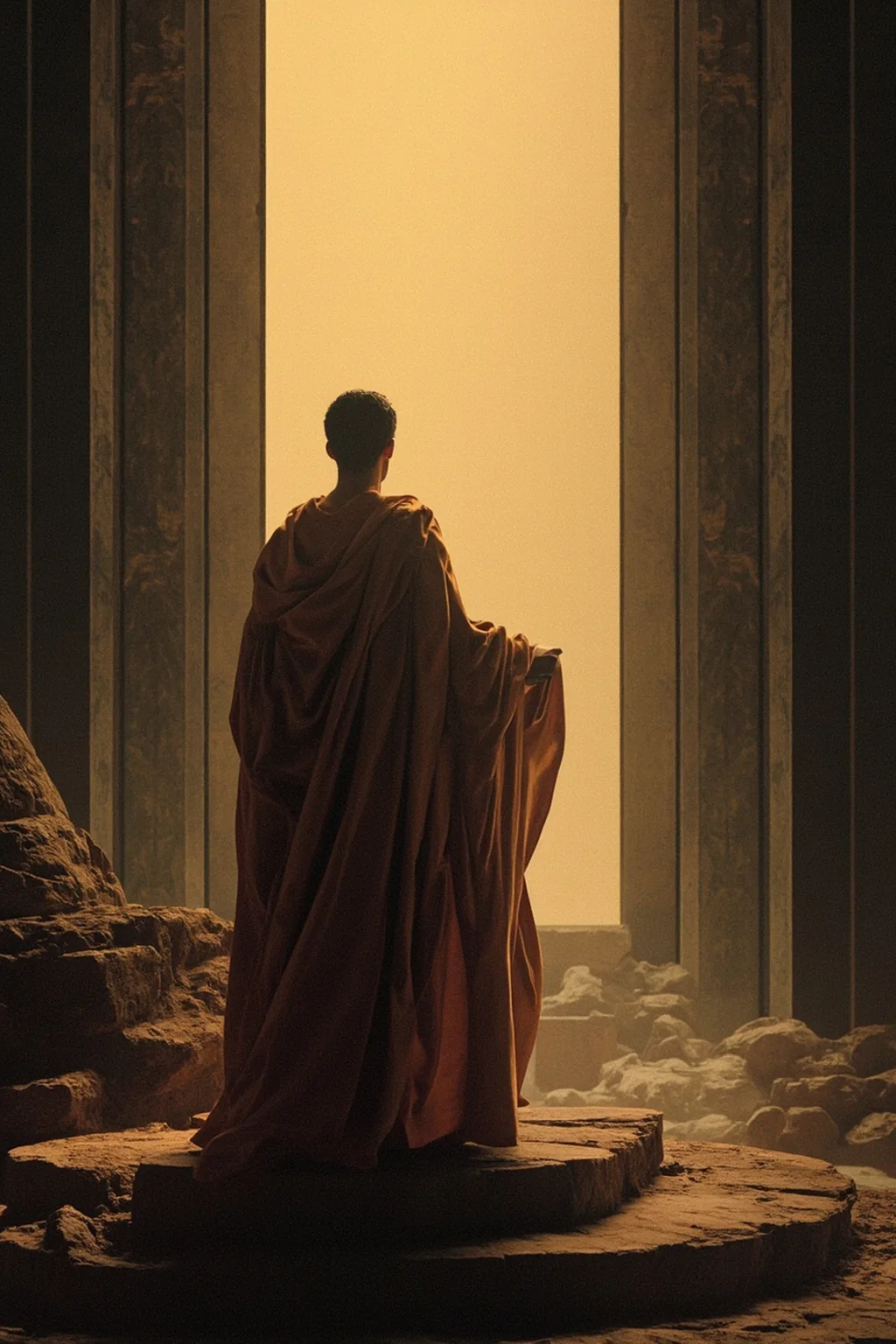
Written during military campaigns at the edges of the empire, the *Meditations* represent a private dialogue between a ruler and his conscience. Marcus Aurelius does not seek to teach a system, but to fortify his own mind against the corruption of power and the fear of death. The work moves from a catalog of gratitude to his teachers to a rigorous metaphysical examination of change, duty, and the rational soul, ultimately concluding that the good life consists in acting justly and accepting fate as a necessary part of the cosmic whole.
From this observation of the world, Marcus turns inward to examine the power of his own mind. He asserts that it is within his power to conceive of every event as right and true, thereby preventing his philosophical resolutions from losing their vitality. As long as he maintains the proper representations of things, his reason remains sufficient for his happiness. He argues that things outside his understanding are irrelevant to his soul, and if he conceives of an occurrence as correct, he has no cause for trouble. This self-sufficiency extends to his actions; if his reason is adequate for a task, he will perform it as an instrument of nature without seeking applause. If the task is beyond his individual capacity, he will seek assistance without shame, just as a soldier might need help to scale a wall. The goal is always the common good, not personal praise, which is fleeting and forgotten.
Marcus then addresses the anxiety of the future, advising himself not to be troubled by what is to come. He posits that if future events are necessary, the same reason that makes the present tolerable will handle them when they arrive. He expands this into a vision of universal interconnection, describing the world as a sacred knot where all things are linked together. There is one common reason, one truth, and one law belonging to all reasonable creatures, creating a unified cosmos. Material things vanish into the common substance, and formal things return to the common reason, meaning that change is the very nature of the universe. He uses the analogies of heating baths and digesting food to illustrate that change is necessary for useful and profitable outcomes; therefore, death, as a necessary transformation, should not be feared. Just as the body is composed of elements that are constantly being reshaped, the universe re-forms matter from horse to tree to man, and dissolution is no more grievous than composition.
The original text of this work is in the public domain. This page focuses on a guided summary article, reading notes, selected quotes, and visual learning materials for educational purposes.