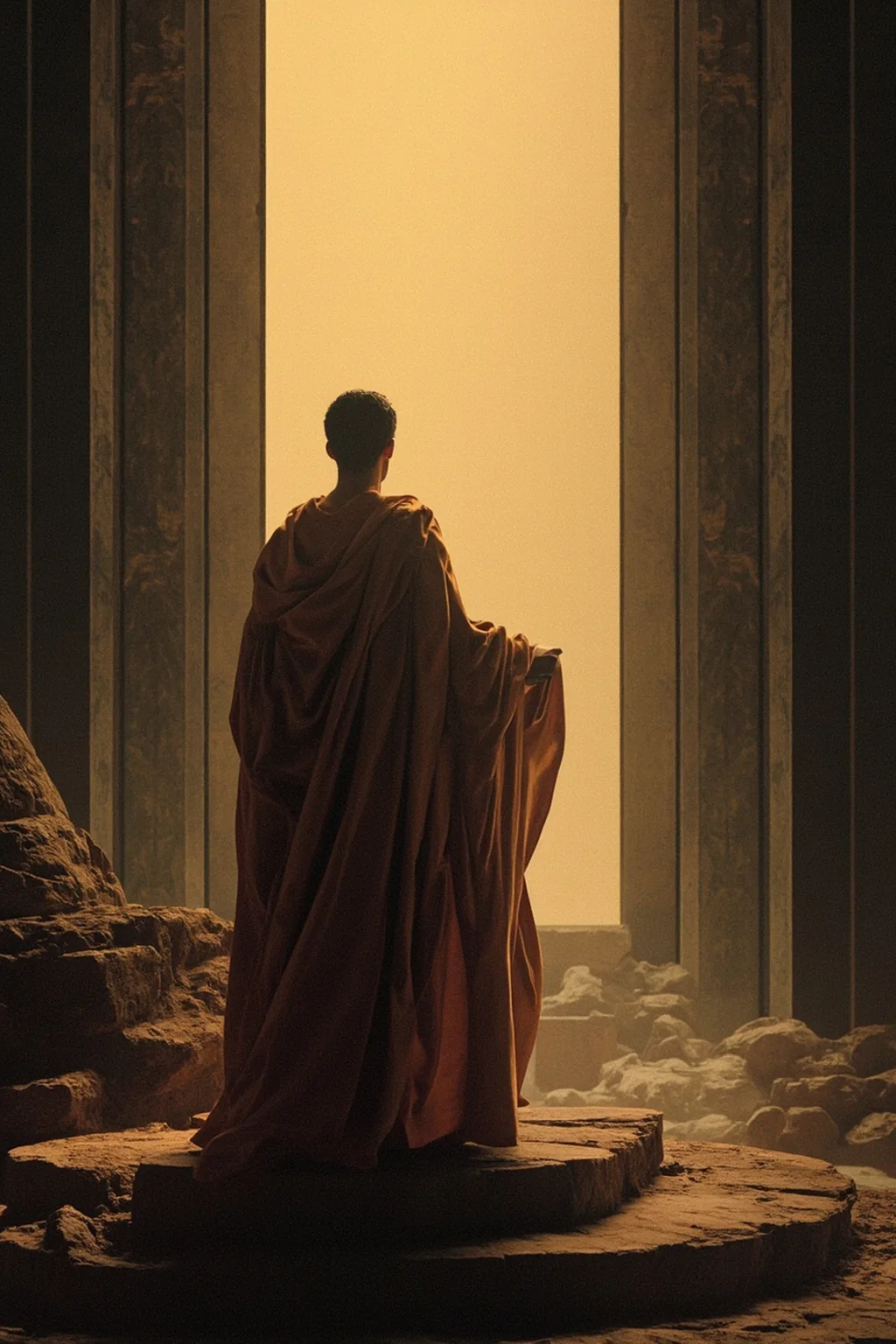
Written during military campaigns at the edges of the empire, the *Meditations* represent a private dialogue between a ruler and his conscience. Marcus Aurelius does not seek to teach a system, but to fortify his own mind against the corruption of power and the fear of death. The work moves from a catalog of gratitude to his teachers to a rigorous metaphysical examination of change, duty, and the rational soul, ultimately concluding that the good life consists in acting justly and accepting fate as a necessary part of the cosmic whole.
Aurelius then confronts the inevitability of hardship through a lens of Stoic resilience. He argues that whatever happens must be borne according to one’s natural capacity. If one is able to endure it, one should do so without offense; if not, one may exit life, but one should never be angry at the event itself. He grounds this endurance in the belief that the universe is a single, coherent causal chain. Just as one’s own birth and composition were fated, so too are the events that follow; they are woven into the same fabric of reality. Rejecting the Epicurean notion of random atoms, Aurelius asserts a unified nature where the individual is a citizen of the cosmos. As a part of the whole, one cannot be harmed by what benefits the whole, and as a kinsman to other rational beings, one is obligated to work for the common good.
The text proceeds to a philosophical examination of change and decay, addressing the apparent evil of corruption. Aurelius contends that it is contradictory to accept that parts of the whole must change, yet be surprised or angry when individuals fall sick or die. Nature does not act to afflict her parts maliciously. Dissolution is merely a transformation into elements or a change into earth and air; nothing is truly lost but is recycled back into the generative seeds of the universe. He illustrates the constant flux of the self by comparing the body to a river, constantly renewed by food and air. The substance from one’s mother is long gone; one is constantly changing, making the fear of personal dissolution irrational.
Aurelius further defines the attributes of the wise man through three specific names: emphron, denoting intent consideration; symphron, signifying contented acceptance of the common lot; and hyperphron, representing a transcendent disregard for bodily pains and pleasures. He urges the reader to embody these virtues or abandon life rather than live hypocritically. If one cannot maintain these standards in public, one should retreat to privacy or even choose voluntary death over a life of distraction, departing with modesty and reason. He emphasizes that the Gods require not flattery but that we become like them, just as a fig tree acts according to its nature.
The Emperor then critiques the vanity of worldly ambition, mocking the “toys and fooleries” of daily life. He compares the pride of conquerors and hunters to the pride of a spider catching a fly, noting that their minds are fixed on prey and external validation rather than true magnanimity. Without vigilance, he warns, the sacred principles of philosophy will be blotted out by these trivial pursuits.
The original text of this work is in the public domain. This page focuses on a guided summary article, reading notes, selected quotes, and visual learning materials for educational purposes.