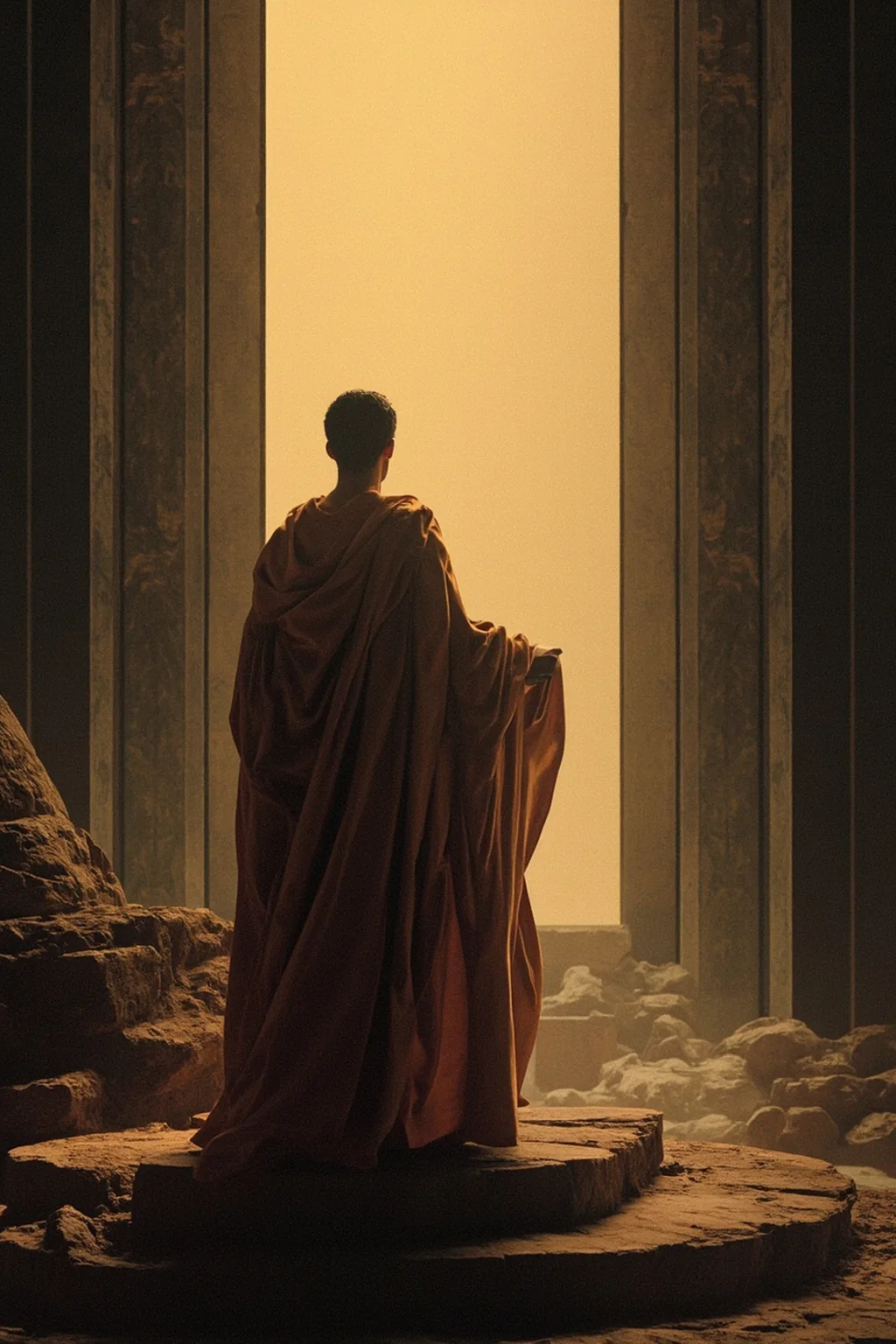
La dette de gratitude et le souverain idéal
From my brother Severus, to be kind and loving to all them of my house and family; by whom also I came to the knowledge of Thrasea and Helvidius, and Cato, and Dio, and Brutus. He it was also that did put me in the first conceit and desire of an equal commonwealth, administered by justice and equality; and of a kingdom wherein should be regarded nothing more than the good and welfare of the subjects.
In my father, I observed his meekness; his constancy without wavering in those things, which after a due examination and deliberation, he had determined. How free from all vanity he carried himself in matter of honour and dignity, (as they are esteemed:) his laboriousness and assiduity, his readiness to hear any man, that had aught to say tending to any common good: how generally and impartially he would give every man his due; his skill and knowledge, when rigour or extremity, or when remissness or moderation was in season; how he did abstain from all unchaste love of youths; his moderate condescending to other men’s occasions as an ordinary man, neither absolutely requiring of his friends, that they should wait upon him at his ordinary meals, nor that they should of necessity accompany him in his journeys; and that whensoever any business upon some necessary occasions was to be put off and omitted before it could be ended, he was ever found when he went about it again, the same man that he was before.
Lire l'interprétation
Cet hommage à Antonin le Pieux sert d’exemple pratique de la vertu stoïcienne dans la gouvernance. Il met en lumière la douceur, l’absence de vanité et la constance émotionnelle du souverain idéal, illustrant comment on peut détenir un pouvoir absolu sans être corrompu par l’orgueil, la colère ou le besoin de flatterie.
L'urgence du présent
Remember how long thou hast already put off these things, and how often a certain day and hour as it were, having been set unto thee by the gods, thou hast neglected it. It is high time for thee to understand the true nature both of the world, whereof thou art a part; and of that Lord and Governor of the world, from whom, as a channel from the spring, thou thyself didst flow: and that there is but a certain limit of time appointed unto thee, which if thou shalt not make use of to calm and allay the many distempers of thy soul, it will pass away and thou with it, and never after return.
Lire l'interprétation
Cette déclaration liminaire établit le ton urgent du deuxième livre, marquant la transition de la gratitude vers l’auto-discipline active. Marc souligne la brièveté de la vie et la nécessité de comprendre sa place dans l’ordre cosmique avant que l’occasion de s’améliorer ne soit perdue à jamais.
Let it be thy earnest and incessant care as a Roman and a man to perform whatsoever it is that thou art about, with true and unfeigned gravity, natural affection, freedom and justice: and as for all other cares, and imaginations, how thou mayest ease thy mind of them. Which thou shalt do; if thou shalt go about every action as thy last action, free from all vanity, all passionate and wilful aberration from reason, and from all hypocrisy, and self-love, and dislike of those things, which by the fates or appointment of God have happened unto thee.
Lire l'interprétation
Ici, Marc définit la discipline stoïcienne de l’action, s’exhortant à aborder chaque tâche comme si c’était la dernière. Cette formulation dépouille la vanité et la peur de l’avenir, se concentrant entièrement sur l’accomplissement de l’action présente avec justice, gravité et acceptation du destin.
If thou shouldst live three thousand, or as many as ten thousands of years, yet remember this, that man can part with no life properly, save with that little part of life, which he now lives: and that which he lives, is no other, than that which at every instant he parts with. That then which is longest of duration, and that which is shortest, come both to one effect.
Lire l'interprétation
Cette citation offre une profonde analyse métaphysique du temps, affirmant que le passé et le futur sont inappropriables et donc sans pertinence pour l’individu. En réduisant la vie au présent immédiat, Marc soutient que la durée d’une vie importe moins que la qualité de l’attention portée au moment actuel.
L'esthétique de la nature et du changement
This also thou must observe, that whatsoever it is that naturally doth happen to things natural, hath somewhat in itself that is pleasing and delightful: as a great loaf when it is baked, some parts of it cleave as it were, and part asunder, and make the crust of it rugged and uneven, and yet those parts of it, though in some sort it be against the art and intention of baking itself, that they are thus cleft and parted, which should have been and were first made all even and uniform, they become it well nevertheless, and have a certain peculiar property, to stir the appetite.
Lire l'interprétation
Ici, Marc recadre la perception des processus naturels, utilisant la métaphore de la cuisson du pain pour illustrer que les imperfections apparentes font partie d’un ordre beau et fonctionnel. Il suggère que pour l’esprit profond, même la décomposition et l’irrégularité possèdent une valeur esthétique unique car elles sont inhérentes à la nature.
Whatsoever doth happen in the world, is, in the course of nature, as usual and ordinary as a rose in the spring, and fruit in summer. Of the same nature is sickness and death; slander, and lying in wait, and whatsoever else ordinarily doth unto fools use to be occasion either of joy or sorrow.
Lire l'interprétation
En comparant la maladie, la mort et la calomnie à l’éclosion naturelle des roses ou aux fruits en été, Marc banalise les épreuves de la vie. Il soutient que ces événements ne sont pas des maux mais des parties nécessaires de la séquence naturelle.
La résilience de l'âme rationnelle
That inward mistress part of man if it be in its own true natural temper, is towards all worldly chances and events ever so disposed and affected, that it will easily turn and apply itself to that which may be, and is within its own power to compass… Even as the fire when it prevails upon those things that are in his way; by which things indeed a little fire would have been quenched, but a great fire doth soon turn to its own nature, and so consume whatsoever comes in his way: yea by those very things it is made greater and greater.
Lire l'interprétation
Marc ouvre le livre en définissant la résilience essentielle de l’âme rationnelle. Plutôt que d’être brisée par les obstacles, la raison directrice s’y adapte, utilisant la célèbre analogie d’un grand feu qui consomme le très combustible qu’on lui jette pour grandir plus fort.
At what time soever thou wilt, it is in thy power to retire into thyself, and to be at rest, and free from all businesses. A man cannot any whither retire better than to his own soul; he especially who is beforehand provided of such things within, which whensoever he doth withdraw himself to look in, may presently afford unto him perfect ease and tranquillity.
Lire l'interprétation
Ici, Marc soutient que la véritable retraite n’est pas un lieu physique mais un état intérieur de l’âme. En se retirant dans sa propre raison et en maintenant des pensées ordonnées, on peut trouver une tranquillité immédiate quel que soit le chaos extérieur.
Thou must be like a promontory of the sea, against which though the waves beat continually, yet it both itself stands, and about it are those swelling waves stilled and quieted.
Lire l'interprétation
Cette image puissante sert de modèle à la stabilité stoïcienne. Tout comme un promontoire résiste aux vagues déferlantes sans être ébranlé, l’esprit rationnel doit rester immuable face au tumulte des événements extérieurs.
Cosmopolitisme et devoir social
If to understand and to be reasonable be common unto all men, then is that reason, for which we are termed reasonable, common unto all. If reason is general, then is that reason also, which prescribeth what is to be done and what not, common unto all. If that, then law. If law, then are we fellow-citizens. If so, then the world is as it were a city.
Lire l'interprétation
Marc construit un argument logique en faveur du cosmopolitisme, affirmant que parce que la raison et la compréhension de la justice sont partagées par tous les humains, tous les hommes sont citoyens d’une seule cité universelle gouvernée par des lois communes.
The form of the Athenians’ prayer did run thus: ‘O rain, rain, good Jupiter, upon all the grounds and fields that belong to the Athenians.’ Either we should not pray at all, or thus absolutely and freely; and not every one for himself in particular alone.
Lire l'interprétation
Marc invoque la prière athénienne pour illustrer la nature expansive de l’âme rationnelle, qui doit s’aligner sur le bien commun plutôt que sur l’intérêt privé. Cela sert de rappel que l’individu fait partie d’un tout plus grand et que les désirs doivent être orientés vers le bien-être de la communauté.
As we say commonly, The physician hath prescribed unto this man, riding; unto another, cold baths; unto a third, to go barefoot: so it is alike to say, The nature of the universe hath prescribed unto this man sickness, or blindness, or some loss, or damage or some such thing.
Lire l'interprétation
Cette section fournit une analogie cruciale pour accepter le destin : l’univers agit comme un médecin pour le tout. Tout comme un patient accepte des remèdes durs pour sa santé, l’esprit rationnel doit accepter la souffrance personnelle comme une prescription nécessaire pour la santé et la cohérence de l’ensemble du cosmos.
La nature du mal et l'esprit invincible
What is wickedness? It is that which many time and often thou hast already seen and known in the world. And so oft as anything doth happen that might otherwise trouble thee, let this memento presently come to thy mind, that it is that which thou hast already often Seen and known. Generally, above and below, thou shalt find but the same things. The very same things whereof ancient stories, middle age stories, and fresh stories are full whereof towns are full, and houses full. There is nothing that is new. All things that are, are both usual and of little continuance.
Lire l'interprétation
Marc ouvre le livre en ancrant le lecteur dans la nature cyclique de l’histoire et du comportement humain. En reconnaissant que la méchanceté et le chaos ne sont pas des phénomènes nouveaux mais des motifs récurrents à travers le temps, il soutient que nous ne devrions pas être surpris ou troublés par les événements présents.
That which is a hindrance of the senses, is an evil to the sensitive nature… And so likewise, whatsoever is a hindrance unto the mind and understanding, must needs be the proper evil of the reasonable nature. Now apply all those things unto thyself… For in those things that properly belong unto the mind, she cannot be hindered by any man. It is not fire, nor iron; nor the power of a tyrant nor the power of a slandering tongue; nor anything else
Lire l'interprétation
Ce passage est crucial car il définit l’idéal politique de Marc Aurèle. À travers son frère Sévère, il relie son règne personnel aux figures de l’opposition stoïcienne du passé (Caton, Brutus), établissant une vision d’un État gouverné uniquement par la justice et le bien-être du peuple plutôt que par la gloire du souverain.