Crossing the Rubicon
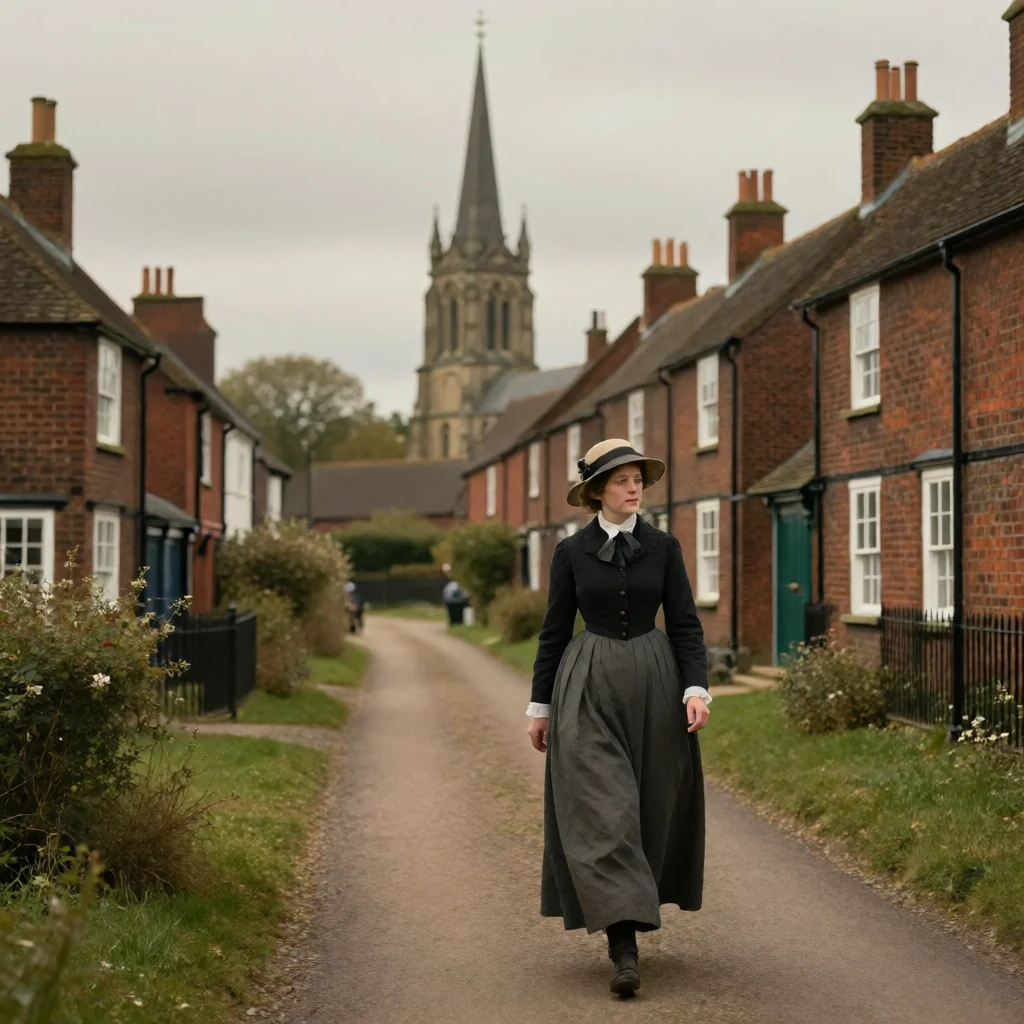
Thus he did nothing more decided than taking the Riverston coach. He came back again by it while it was still daylight, having made up his mind that he must go to Lydgate’s that evening. The Rubicon, we know, was a very insignificant stream to look at; its significance lay entirely in certain invisible conditions. Will felt as if he were forced to cross his small boundary ditch, and what he saw beyond it was not empire, but discontented subjection.
The Saving Influence of a Noble Nature
But it is given to us sometimes even in our every-day life to witness the saving influence of a noble nature, the divine efficacy of rescue that may lie in a self-subduing act of fellowship. If Dorothea, after her night’s anguish, had not taken that walk to Rosamond—why, she perhaps would have been a woman who gained a higher character for discretion, but it would certainly not have been as well for those three who were on one hearth in Lydgate’s house at half-past seven that evening.
A Tense Reunion
Rosamond had been prepared for Will’s visit, and she received him with a languid coldness which Lydgate accounted for by her nervous exhaustion, of which he could not suppose that it had any relation to Will. And when she sat in silence bending over a bit of work, he innocently apologized for her in an indirect way by begging her to lean backward and rest. Will was miserable in the necessity for playing the part of a friend who was making his first appearance and greeting to Rosamond, while his thoughts were busy about her feeling since that scene of yesterday, which seemed still inexorably to enclose them both, like the painful vision of a double madness. It happened that nothing called Lydgate out of the room; but when Rosamond poured out the tea, and Will came near to fetch it, she placed a tiny bit of folded paper in his saucer. He saw it and secured it quickly, but as he went back to his inn he had no eagerness to unfold the paper.
Rosamond’s Confession
What Rosamond had written to him would probably deepen the painful impressions of the evening. Still, he opened and read it by his bed-candle. There were only these few words in her neatly flowing hand:—“I have told Mrs. Casaubon. She is not under any mistake about you. I told her because she came to see me and was very kind. You will have nothing to reproach me with now. I shall not have made any difference to you.”
A Lasting Flaw
The effect of these words was not quite all gladness. As Will dwelt on them with excited imagination, he felt his cheeks and ears burning at the thought of what had occurred between Dorothea and Rosamond—at the uncertainty how far Dorothea might still feel her dignity wounded in having an explanation of his conduct offered to her. There might still remain in her mind a changed association with him which made an irremediable difference—a lasting flaw. With active fancy he wrought himself into a state of doubt little more easy than that of the man who has escaped from wreck by night and stands on unknown ground in the darkness. Until that wretched yesterday—except the moment of vexation long ago in the very same room and in the very same presence—all their vision, all their thought of each other, had been as in a world apart, where the sunshine fell on tall white lilies, where no evil lurked, and no other soul entered. But now—would Dorothea meet him in that world again?
CHAPTER LXXXIII.
The passage opens with Dorothea at Lowick, restless and unable to concentrate on serious reading about political economy, so she turns instead to the geography of Asia Minor as a means of disciplining her wandering thoughts. Miss Noble arrives with a message from Will Ladislaw, who has come seeking a meeting, and though Dorothea feels the weight of Casaubon’s prohibition against receiving him in the library, she agrees to see him. In a scene charged with emotional tension, Will explains his painful parentage and his principled refusal of an income from Bulstrode, while Dorothea insists that nothing about his birth could prejudice her against him. As a storm breaks outside—lightning illuminating them, wind tossing the trees, rain pouring down—they stand together holding hands, share a tremulous kiss, and sit in wordless communion. Will protests that their situation is hopeless, that he is destined to poverty, but Dorothea, overwhelmed by emotion and unable to bear the parting, declares that she hates her wealth and offers to live on her own fortune of seven hundred a year, willing to learn the cost of everything and go without new clothes rather than lose him.
The original text of this work is in the public domain. This page focuses on a guided summary article, reading notes, selected quotes, and visual learning materials for educational purposes.