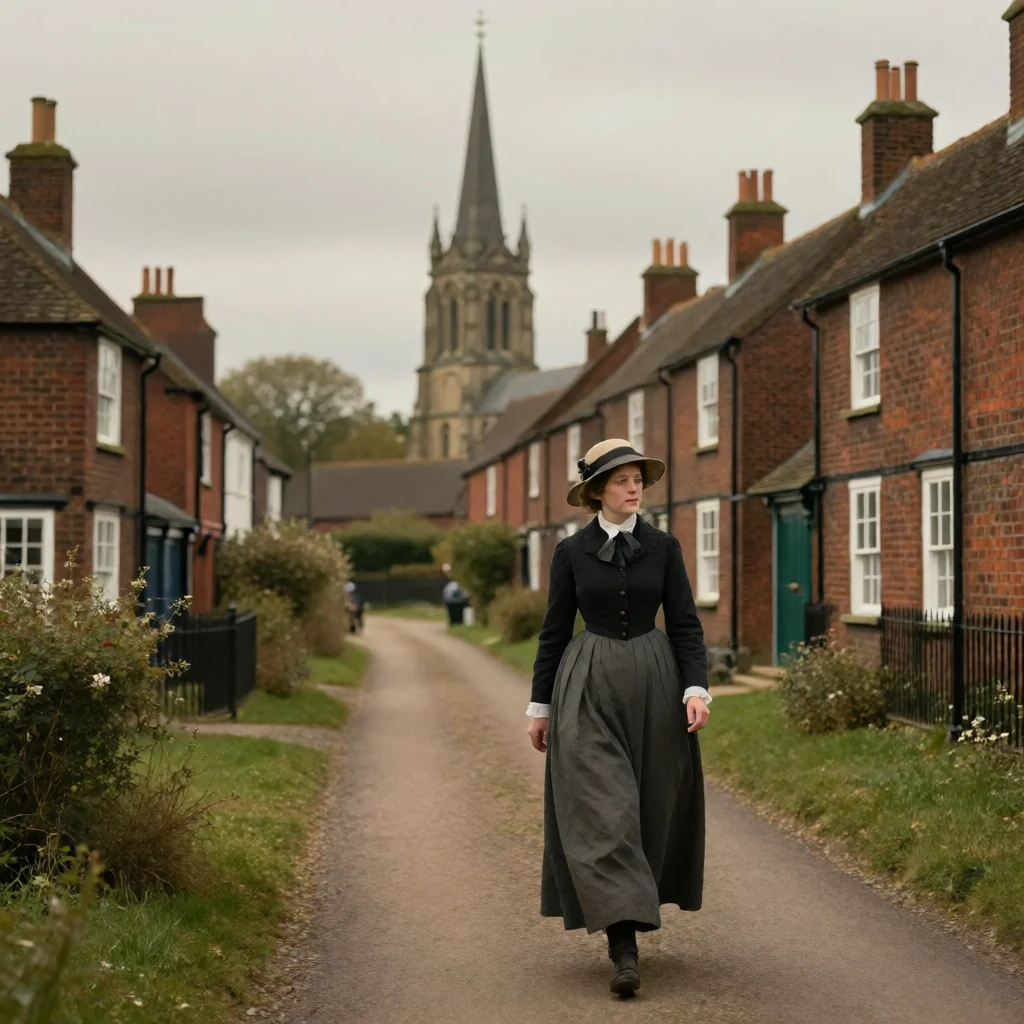
Dorothea’s Restless Morning
After two nights of sound sleep following her visit to Rosamond, Dorothea finds herself filled with restless energy she cannot manage to direct toward any occupation. She attempts to study political economy to understand the best way to spend money for the benefit of others, but her mind wanders for an entire hour. Unable to concentrate on serious subjects, she resolves to distract herself with geography—specifically, the mapping of Asia Minor, which Mr. Casaubon had often rebuked her for neglecting. She bends over a map, uttering place names in a hushed, rhythmic tone, occasionally pausing to press her hands to her face in frustration at her own inability to focus. The scene amuses in its contrast between her deep experience and her girlish behavior, marking the passage of time until an interruption arrives.
Miss Noble’s Errand
The small Miss Noble enters the library, barely reaching Dorothea’s shoulder, and clasps a tortoise-shell lozenge-box nervously in her small basket. After Dorothea welcomes her warmly, Miss Noble explains she has left a friend waiting in the churchyard and makes her difficult request: Will Ladislaw fears he has offended Dorothea and has asked her to inquire whether she will see him for a few minutes. Dorothea hesitates, acutely aware that receiving Will in this library—where her husband’s prohibition seems to linger—would be problematic. She considers meeting him in the grounds, but the heavy sky and shivering trees presage an approaching storm, and she shrinks from going out to him. When Miss Noble pleads that a refusal would hurt him, Dorothea agrees to see him, though she experiences a “throbbing excitement like an alarm” and a sense that she is doing something “defiant” for his sake.
Will’s Confession
Will enters with more timidity than Dorothea has ever seen in him, uncertain whether his look or word might condemn him to new distance from her. After a moment’s hesitation, he begins explaining why he has returned to Lowick so soon. He reveals that everyone now knows the painful story of his parentage, which he had always intended to tell her if they ever met again. He explains that his return was connected to an attempt to get Bulstrode to apply money to a public purpose—money Bulstrode had thought to give him as compensation for an old injury, offering him a good income to make amends. Will did not choose to accept income from such a source, believing Dorothea would not think well of him if he did. Dorothea’s face brightens at this, saying he has acted as she would have expected. Will adds that he is certain she would not let circumstances of his birth create prejudice against him, even though others would certainly hold such prejudices.
The Approaching Storm
As they speak, the sky darkens and the evergreens toss in the wind, showing pale undersides of their leaves against a blackening sky. Will feels an unusual enjoyment of the storm, which delivers him from the necessity of leaving. Lightning flashes and they look at each other, smiling. Dorothea speaks of finding meaning even in personal suffering—how when she was most wretched, she saw that other people’s good remains worth trying for. Will responds that he has felt the misery of knowing she must despise him. When she says she no longer doubts him, she puts out her hand, and he raises it to his lips with something like a sob. She withdraws it in confusion, moving toward the window, and he follows, leaning against a tall leather chair where he places his hat and gloves. They stand silent, not looking at each other but watching the storm, until a vivid flash of lightning illuminates them both—the light seeming to embody “the terror of a hopeless love.”
A Momentary Kiss
Dorothea darts from the window, and Will follows, seizing her hand with a spasmodic movement. They stand with hands clasped, like children, watching the storm as thunder cracks above them and rain begins to pour. When they turn to face each other, they do not release each other’s hands. Will declares there is no hope for him—even if she loved him as much as he loves her, he will likely always be very poor, with “nothing but a creeping lot.” He insists it is impossible for them ever to belong to each other. Dorothea says she would rather share all the trouble of their parting, and they lean toward each other in a trembling kiss—the first to move is never known. The rain dashes against the window-panes, and for a moment both the busy and the idle pause with “a certain awe.”
The original text of this work is in the public domain. This page focuses on a guided summary article, reading notes, selected quotes, and visual learning materials for educational purposes.