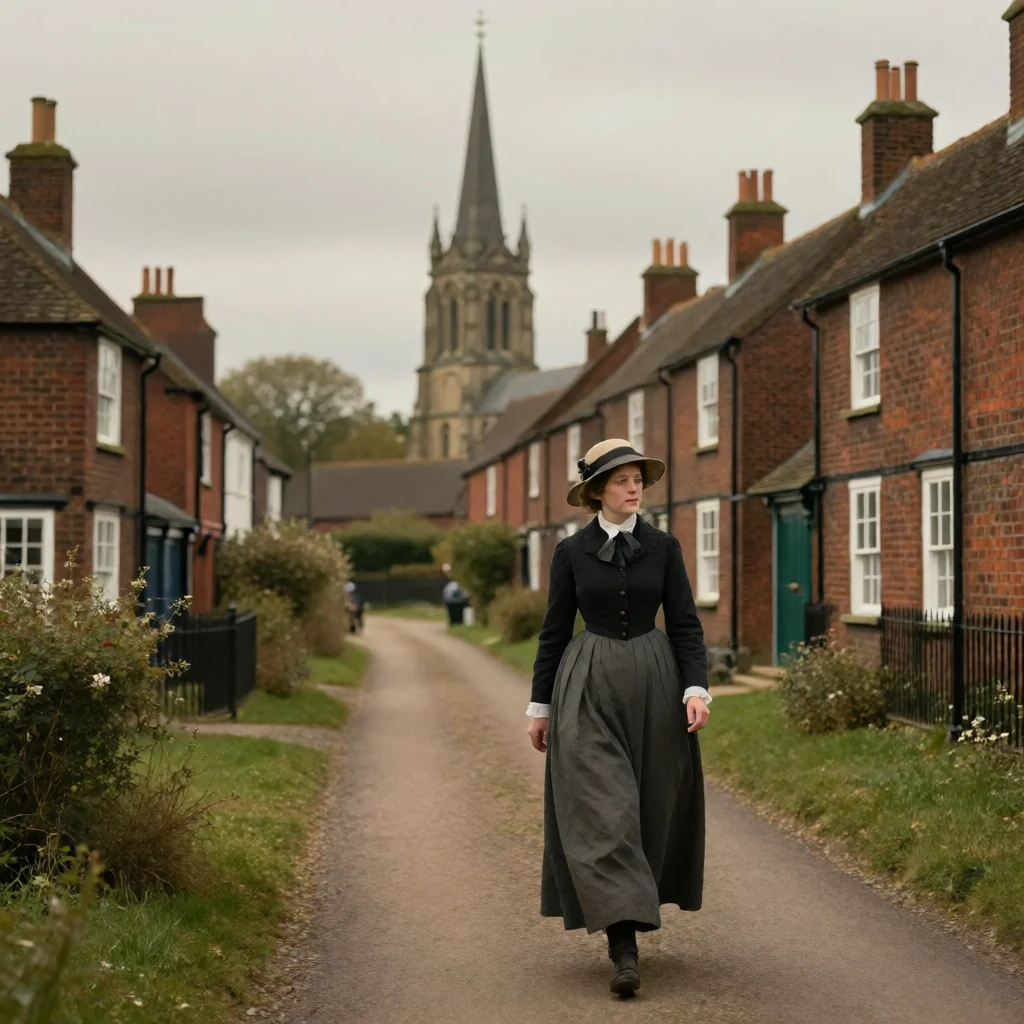
CHAPTER XXIV.
Three days after the propitious events at Houndsley, Fred Vincy was in worse spirits than he had known in his life. Diamond, in which hope to the amount of eighty pounds had been invested, had in the stable exhibited a most vicious energy in kicking, had just missed killing the groom, and had ended by laming itself severely. There was no more redress for this than for the discovery of bad temper after marriage. Fred had fifty pounds, the bill for a hundred and sixty would be presented in five days, and his father, angry already, would only storm about the vicious brute being brought into his stable. Fred framed no other project than to go straight to Mr. Garth, tell him the sad truth, hand over the fifty, and then ride to Stone Court and confess all to Mary. He felt smartingly that his father would refuse to rescue Mr. Garth, but in fact it was probably Mary who kept his conscience so active. Even much stronger mortals than Fred Vincy hold half their rectitude in the mind of the being they love best.
Mr. Garth was not at the office, so Fred rode on to his house outside the town—a rambling, old-fashioned, half-timbered building, once a farm-house, with an orchard in front. The Garth family was rather a large one: Mary had four brothers and one sister. Fred’s heart beat uneasily with the sense that he might have to make his confession before Mrs. Garth, of whom he was rather more in awe than of her husband. Mrs. Garth was not given to sarcasm or impulsive sallies; she had that rare sense which discerns what is unalterable, and submits to it without murmuring. Adoring her husband’s virtues, she had very early made up her mind to his incapacity of minding his own interests. She had renounced all pride in teapots and children’s frilling, and never poured pathetic confidences into the ears of her feminine neighbors concerning Mr. Garth’s want of prudence. The fair neighbors thought her either proud or eccentric, and called her “your fine Mrs. Garth.” She was a trifle too emphatic in her resistance to what she held to be follies: the passage from governess into housewife had wrought itself too strongly into her consciousness. She thought it good for her pupils to see that she could make an excellent lather while she corrected their blunders. When she made remarks to this edifying effect, she had a firm little frown on her brow which yet did not hinder her face from looking benevolent, and her words came forth like a procession, in a fervid agreeable contralto.
Fred found her in the kitchen, sleeves turned above her elbows, deftly handling pastry, observing Sally at the oven through an open door, and giving lessons to her youngest boy and girl. The scene was agreeably amusing: Ben was supposed to be learning the concord of verbs and pronouns with “nouns of multitude or signifying many,” and Letty was contending for the right to tell the story of Cincinnatus. “Now, Ben, he was a Roman—let me tell,” said Letty, using her elbow contentiously. “You silly thing, he was a Roman farmer, and he was ploughing.” “Yes, but before that—that didn’t come first—people wanted him.” The knock at the door was Fred’s. Mrs. Garth said quietly, continuing her work, “You, Fred, so early in the day? You look quite pale. Has anything happened?” Fred said he wanted to speak to Mr. Garth—and to Mrs. Garth also.
When Caleb returned, Fred burst out with the plain fact: he could not meet the bill. He had only fifty pounds towards the hundred and sixty. Caleb, after a little pause, said to his wife, “Oh, I didn’t tell you, Susan: I put my name to a bill for Fred; it was for a hundred and sixty pounds. He made sure he could meet it himself.” There was an evident change in Mrs. Garth’s face, but it was like a change below the surface of water which remains smooth. “I suppose you have asked your father for the rest of the money and he has refused you,” she said, fixing her eyes on Fred. Fred bit his lip. “It has come at an unfortunate time,” said Caleb, looking down at the notes and nervously fingering the paper, “Christmas upon us—I’m rather hard up just now. We wanted a hundred and ten pounds; your mother has ninety-two, and I have none to spare in the bank; and she thinks that you have some savings.” Mrs. Garth said, gravely and decisively, “I must give you the ninety-two pounds that I have put by for Alfred’s premium. And I have no doubt that Mary has twenty pounds saved from her salary by this time. She will advance it.” She had not been in the least calculating what words she should use to cut him the most effectively. She was at present absorbed in considering what was to be done. But she had made Fred feel, for the first time, something like the tooth of remorse. He saw himself as a pitiful rascal who was robbing two women of their savings. “I shall certainly pay it all, Mrs. Garth—ultimately,” he stammered. “Yes, ultimately,” said Mrs. Garth, who had a special dislike to fine words on ugly occasions. “But boys cannot well be apprenticed ultimately: they should be apprenticed at fifteen.” She had never been so little inclined to make excuses for Fred. “I am disappointed in Fred Vincy,” she said after he had gone. “I would not have believed beforehand that he would have drawn you into his debts.”
The original text of this work is in the public domain. This page focuses on a guided summary article, reading notes, selected quotes, and visual learning materials for educational purposes.