CHAPTER XXVIII.
“All times are good to seek your wedded home Bringing a mutual delight.” “Why, true. The calendar hath not an evil day For souls made one by love, and even death Were sweetness, if it came like rolling waves While they two clasped each other, and foresaw No life apart.”
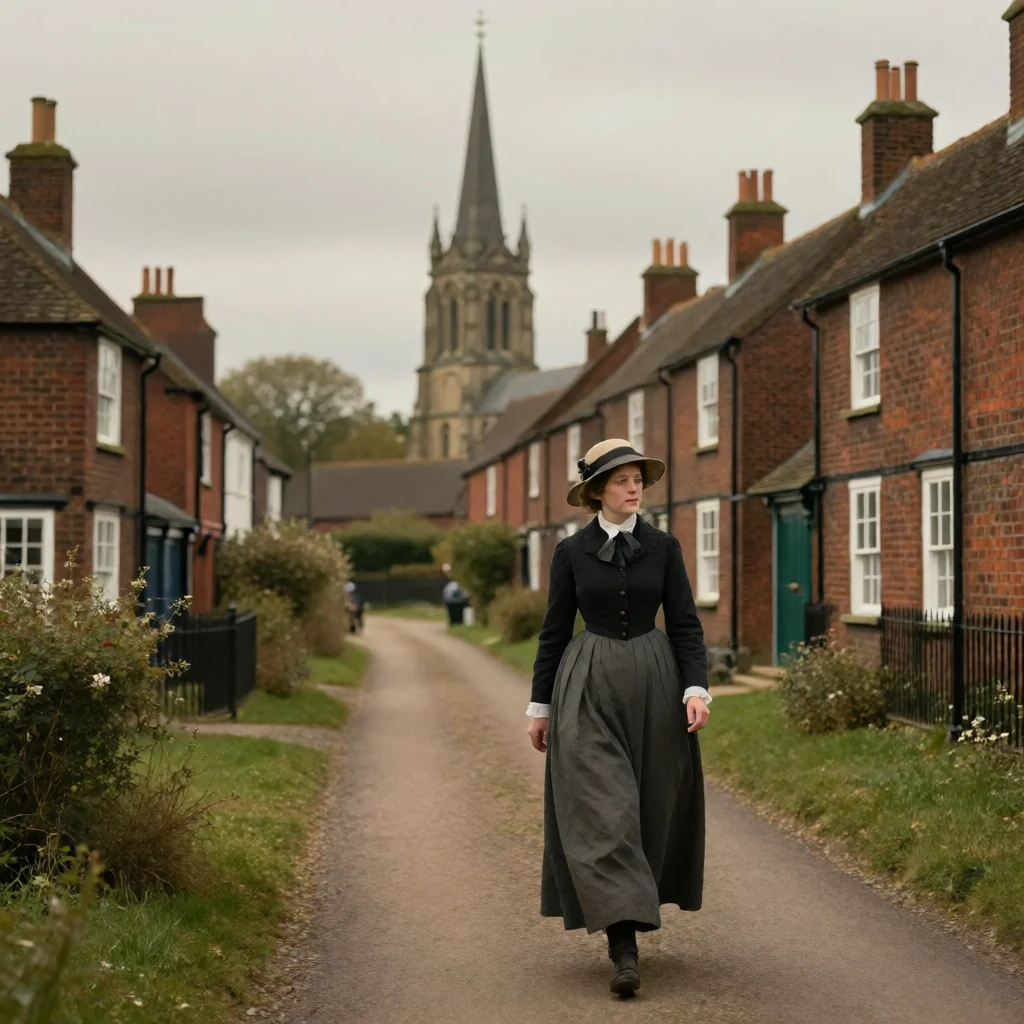
Mr. and Mrs. Casaubon, returning from their wedding journey, arrived at Lowick Manor in the middle of January. A light snow was falling as they descended at the door, and in the morning, when Dorothea passed from her dressing-room into the blue-green boudoir, she saw the long avenue of limes lifting their trunks from a white earth, and spreading white branches against the dun and motionless sky. The very furniture in the room seemed to have shrunk since she saw it before: the stag in the tapestry looked more like a ghost in his ghostly blue-green world. The bright fire of dry oak-boughs burning on the logs seemed an incongruous renewal of life and glow—like the figure of Dorothea herself as she entered carrying the red-leather cases containing the cameos for Celia.
She was glowing from her morning toilet as only healthful youth can glow: there was gem-like brightness on her coiled hair and in her hazel eyes; there was warm red life in her lips. As she laid the cameo-cases on the table in the bow-window, she unconsciously kept her hands on them, immediately absorbed in looking out on the still, white enclosure which made her visible world. The duties of her married life, contemplated as so great beforehand, seemed to be shrinking with the furniture and the white vapor-walled landscape. The clear heights where she expected to walk in full communion had become difficult to see even in her imagination. Marriage, which was to bring guidance into worthy and imperative occupation, had not yet freed her from the gentlewoman’s oppressive liberty.
In the first minutes when Dorothea looked out she felt nothing but the dreary oppression; then came a keen remembrance, and turning away from the window she walked round the room. All existence seemed to beat with a lower pulse than her own, and her religious faith was a solitary cry. Each remembered thing in the room was disenchanted, deadened as an unlit transparency, till her wandering gaze came to the group of miniatures, and there at last she saw something which had gathered new breath and meaning: it was the miniature of Mr. Casaubon’s aunt Julia, who had made the unfortunate marriage—of Will Ladislaw’s grandmother. Was it only her friends who thought her marriage unfortunate? The vivid presentation came like a pleasant glow to Dorothea: she felt herself smiling, and turning from the miniature sat down and looked up as if she were again talking to a figure in front of her. But the smile disappeared as she went on meditating, and at last she said aloud, “Oh, it was cruel to speak so! How sad—how dreadful!” She rose quickly and went out of the room, hurrying along the corridor, with the irresistible impulse to go and see her husband and inquire if she could do anything for him.
But when she reached the head of the dark oak there was Celia coming up, and below there was Mr. Brooke, exchanging welcomes and congratulations with Mr. Casaubon. “I need not ask how you are, my dear,” said Mr. Brooke. “Rome has agreed with you, I see—happiness, frescos, the antique—that sort of thing. But Casaubon is a little pale, I tell him—a little pale, you know.” Dorothea’s eyes also were turned up to her husband’s face with some anxiety.
“Do you think it nice to go to Rome on a wedding journey?” said Celia. “Mrs. Cadwallader says it is nonsense, people going a long journey when they are married. She says they get tired to death of each other.” Celia’s color changed again and again. “Celia! has something happened?” said Dorothea, in a tone full of sisterly feeling. “It was because you went away, Dodo. Then there was nobody but me for Sir James to talk to.” “I understand. It is as I used to hope and believe,” said Dorothea, taking her sister’s face between her hands. “It was only three days ago. And Lady Chettam is very kind.” “And you are very happy?” “Yes. We are not going to be married yet. Because every thing is to be got ready. And I don’t want to be married so very soon, because I think it is nice to be engaged.” “I do believe you could not marry better, Kitty. Sir James is a good, honorable man.” “He has gone on with the cottages, Dodo. He will tell you about them when he comes. Shall you be glad to see him?” “Of course I shall. How can you ask me?” “Only I was afraid you would be getting so learned,” said Celia, regarding Mr. Casaubon’s learning as a kind of damp which might in due time saturate a neighboring body.
The original text of this work is in the public domain. This page focuses on a guided summary article, reading notes, selected quotes, and visual learning materials for educational purposes.