CHAPTER XLVII.
It happened to be on a Saturday evening that Will had that little discussion. He sat up half the night thinking it over, asking whether he was not making a fool of himself in being harnessed to Brooke, and for what end. He had his bypaths where there were little joys of his own choosing — for the ordinary vulgar vision in which Mr. Casaubon suspected him, of Dorothea becoming a widow and accepting him, had no tempting, arresting power over him; he could not bear the thought of any flaw appearing in his crystal. To have within him such a feeling as he had towards Dorothea was like the inheritance of a fortune. He ended, as he had done before, only by getting a livelier sense of what her presence would be to him; and suddenly reflecting that the morrow would be Sunday, he determined to go to Lowick Church and see her. He walked to Lowick across Halsell Common and through the budding wood, chanting a little, fitting some words of his own to ready-made melodies:
“O me, O me, what frugal cheer My love doth feed upon! A touch, a ray, that is not here, A shadow that is gone…”
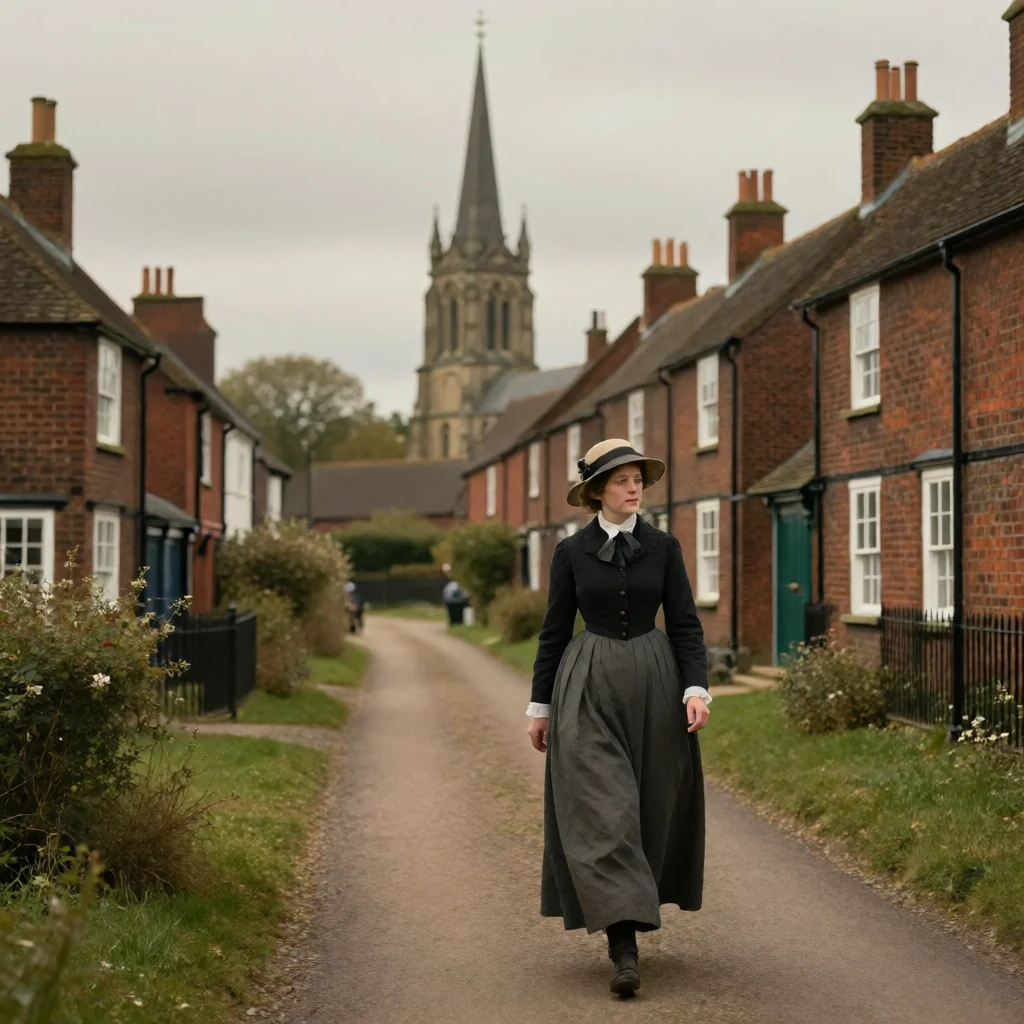
The bells were still ringing when he went into the curate’s pew. The congregation gathered — Mr. Rigg’s frog-face, brother Samuel’s purple cheek, three generations of decent cottagers. Dorothea at last came up the short aisle in her white beaver bonnet and grey cloak, the same she had worn in the Vatican; she discerned Will, and there was no outward sign except a slight paleness and a grave bow. Two minutes later Mr. Casaubon came out of the vestry and seated himself in face of Dorothea. Will, to his own surprise, felt suddenly uncomfortable, and dared not look at her. He sat through the long morning service like a school-mistress. The clerk observed with surprise that Mr. Ladislaw did not join in the tune of Hanover, and reflected that he might have a cold. When the blessing had been pronounced, Will looked straight at Mr. Casaubon. But that gentleman’s eyes were on the button of the pew-door, which he opened, allowing Dorothea to pass, and followed her immediately without raising his eyelids. Will’s glance had caught Dorothea’s as she turned, and again she bowed, but with a look of agitation, as if she were repressing tears. Will walked out after them; but they went on towards the little gate leading into the shrubbery, never looking round. He walked back sadly at midday along the same road he had trodden hopefully in the morning. The lights were all changed for him, both without and within.
CHAPTER XLVIII.
Dorothea’s distress came chiefly from the perception that Mr. Casaubon was determined not to speak to his cousin, and that Will’s presence had served to mark more strongly the alienation between them. He had not preached that morning — some difficulty in breathing — and at luncheon he was nearly silent. She spent the afternoon alone in the bow-window with her little heap of books — Herodotus, Pascal, Keble’s Christian Year — opening one after another and reading none. Today she had stood at the door of the tomb and seen Will Ladislaw receding into the distant world of warm activity and fellowship, turning his face towards her as he went. After dinner Casaubon proposed the library. He had newly arranged a row of his note-books and put into her hand a volume that was a table of contents to all the others: “You will oblige me, my dear, if instead of other reading this evening, you will go through this aloud, pencil in hand, and at each point where I say ‘mark,’ will make a cross with your pencil.” She read and marked for two hours, and they took the volume upstairs to continue by candlelight. In the night she awoke to find him wrapped in his gown, seated in the armchair near the fire. “Are you ill, Edward?” “I felt some uneasiness in a reclining posture.” She read for an hour or more while he marked and anticipated with bird-like speed. At last he said, “Close the book now, my dear. We will resume our work tomorrow.” She answered tremulously, feeling sick at heart. She lay down; there was no more sleep for her. Casaubon spoke again in the dark: “Before I sleep, I have a request to make, Dorothea. It is that you will let me know, deliberately, whether, in case of my death, you will carry out my wishes: whether you will avoid doing what I should deprecate, and apply yourself to do what I should desire.” She did not answer immediately. “You refuse?” said Casaubon, with more edge in his tone. “No, I do not yet refuse,” said Dorothea; “but it is too solemn — I think it is not right — to make a promise when I am ignorant what it will bind me to. Whatever affection prompted I would do without promising.” “Grant me till tomorrow,” she said at last, beseechingly. She lay for four hours in this conflict. It was clear enough to her that he would expect her to devote herself to sifting those mixed heaps of material which were to be the doubtful illustration of principles still more doubtful. The poor child had become altogether unbelieving as to the trustworthiness of that Key which had been the labour of her husband’s life. Was it right — would it be possible, even if she promised — to work as in a treadmill fruitlessly? In the morning she woke late and ill. Tantripp told her that Mr. Casaubon had read prayers, breakfasted, and was in the library. Dorothea went down, feeling sure she should promise, but later in the day. He said he was going to take a turn in the shrubbery; she asked whether she might come out presently; he would be in the Yew-tree Walk for the next half-hour, he said, and left her. She sat still and let Tantripp put on her bonnet and shawl, a passivity unusual with her. Tantripp said, “God bless you, madam!” and Dorothea burst into tears against her arm. She lingered among the nearer clumps of trees, then entered the Yew-tree Walk, expecting to see her husband in his blue cloak and velvet cap. Turning the angle towards the summer-house, she could see him seated on the bench, his arms resting on the stone table, his brow bowed down upon them, the blue cloak screening his face on each side. She went into the summer-house and said, “I am come, Edward; I am ready.” He took no notice. She laid her hand on his shoulder and repeated, “I am ready!” Still he was motionless. With a sudden confused fear she took off his velvet cap and leaned her cheek close to his head, crying in a distressed tone, “Wake, dear, wake! Listen to me. I am come to answer.” But Dorothea never gave her answer. Later in the day Lydgate was seated by her bedside, and she was talking deliriously, thinking aloud. She knew him and called him by his name, but appeared to think it right that she should explain everything to him, and again and again begged him to explain everything to her husband. “Tell him I shall go to him soon: I am ready to promise. Only, thinking about it was so dreadful — it has made me ill. Not very ill. I shall soon be better. Go and tell him.” But the silence in her husband’s ear was never more to be broken.
The original text of this work is in the public domain. This page focuses on a guided summary article, reading notes, selected quotes, and visual learning materials for educational purposes.