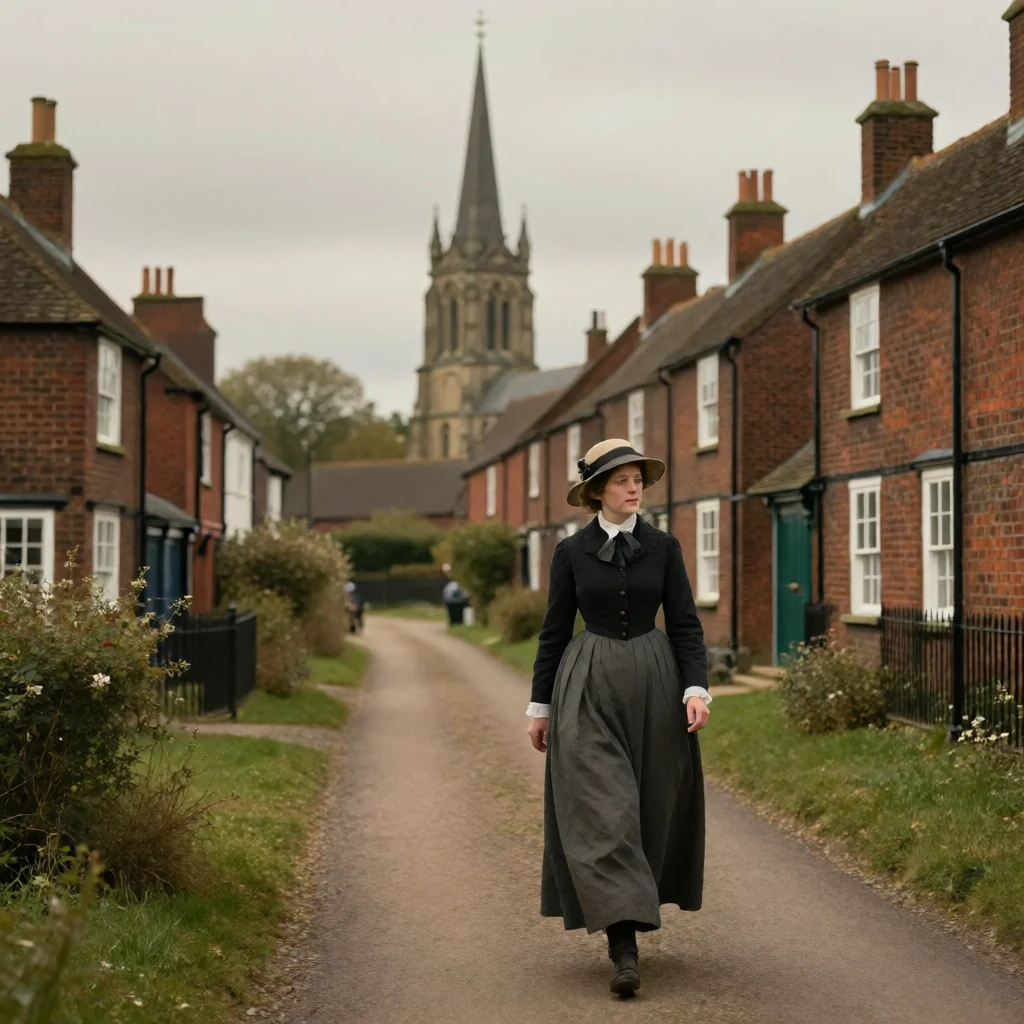
CHAPTER XLIX.
“A task too strong for wizard spells / This squire had brought about; / ’Tis easy dropping stones in wells, / But who shall get them out?” The morning after Mr. Casaubon’s burial, in the library at Lowick Grange, two men faced each other across a question neither could settle. Sir James Chettam stood on the hearth-rug, his brow furrowed and his mouth twisted with disgust. “I wish to God we could hinder Dorothea from knowing this,” he said.
Mr. Brooke fumbled with his eye-glasses, exploring the edges of a folded paper as though it contained answers. “That would be difficult, you know, Chettam. She is an executrix, and she likes to go into these things—property, land, that kind of thing. She has her notions.” He insisted that Dorothea had turned twenty-one last December and could not be hindered.
Sir James stared at the carpet, then fixed his brother-in-law with a hard look. “Until Dorothea is well, all business must be kept from her. As soon as she is able to be moved, she must come to us. Being with Celia and the baby will be the best thing in the world for her. And meanwhile you must get rid of Ladislaw: you must send him out of the country.”
“That is easily said, Chettam, easily said, you know.”
Sir James’s indignation rose within respectable forms. “It was you who brought him here, and you who keep him here—I mean by the occupation you give him.”
“Yes, but I can’t dismiss him in an instant without assigning reasons, my dear Chettam. Ladislaw has been invaluable, most satisfactory. I consider that I have done this part of the country a service by bringing him.” Mr. Brooke turned round with a self-satisfied nod.
Sir James grew warm. “It’s a pity this part of the country didn’t do without him, that’s all I have to say. At any rate, as Dorothea’s brother-in-law, I feel warranted in objecting strongly to his being kept here. You admit, I hope, that I have a right to speak about what concerns the dignity of my wife’s sister?”
“Of course, my dear Chettam. But you and I have different ideas—different—”
“Not about this action of Casaubon’s, I should hope. I say that he has most unfairly compromised Dorothea. There never was a meaner, more ungentlemanly action than this—a codicil of this sort to a will which he made at the time of his marriage with the knowledge and reliance of her family—a positive insult!”
Mr. Brooke straightened his back at the window. “Casaubon was a little twisted about Ladislaw. Ladislaw has told me the reason—dislike of the bent he took, you know. Poor Casaubon was a little buried in books—he didn’t know the world.”
Sir James cut in. “I believe Casaubon was only jealous of him on Dorothea’s account, and the world will suppose that she gave him some reason; and that is what makes it so abominable—coupling her name with this young fellow’s.”
“My dear Chettam, it won’t lead to anything. This paper, ‘Synoptical Tabulation’ for the use of Mrs. Casaubon, was locked up in the desk with the will. I suppose he meant Dorothea to publish his researches.”
Sir James impatiently replied, “That is neither here nor there. The question is whether you don’t see with me the propriety of sending young Ladislaw away?”
Mr. Brooke seated himself and stuck on his eye-glass again. “Well, no, not the urgency of the thing. As to gossip, sending him away won’t hinder it. People say what they like to say, not what they have chapter and verse for. I might get rid of Ladislaw up to a certain point—take away the ‘Pioneer’ from him—but I couldn’t send him out of the country if he didn’t choose to go.”
“Good God!” Sir James’s passion broke through. “Let us get him a post; let us spend money on him. If he could go in the suite of some Colonial Governor! Grampus might take him.”
“But Ladislaw won’t be shipped off like a head of cattle. It’s my opinion that if he were to part from me to-morrow, you’d only hear the more of him. With his talent for speaking and drawing up documents, there are few men who could come up to him as an agitator.”
“Agitator!” Sir James repeated bitterly.
“But be reasonable, Chettam. Dorothea had better go to Celia as soon as possible. She can stay under your roof, and in the mean time things may come round quietly. Don’t let us be firing off our guns in a hurry.”
“Then I am to conclude that you decline to do anything?”
“Decline, Chettam?—no. But I really don’t see what I could do. Ladislaw is a gentleman.”
“I am glad to hear it! I am sure Casaubon was not.”
“Well, it would have been worse if he had made the codicil to hinder her from marrying again at all.”
“I don’t know that. It would have been less indelicate.”
“One of poor Casaubon’s freaks! That attack upset his brain a little. She doesn’t want to marry Ladislaw.”
“But this codicil is framed so as to make everybody believe that she did. I don’t believe anything of the sort about Dorothea, but I suspect Ladislaw. I tell you frankly, I suspect Ladislaw.”
“I couldn’t take any immediate action on that ground. If it were possible to pack him off to Norfolk Island, it would look all the worse for Dorothea to those who knew about it. It would seem as if we distrusted her.”
Sir James put out his hand for his hat. “I can only say that I think Dorothea was sacrificed once, because her friends were too careless. I shall do what I can, as her brother, to protect her now.”
“You can’t do better than get her to Freshitt as soon as possible, Chettam. I approve that plan altogether.” Mr. Brooke was well pleased he had won the argument; it would have been highly inconvenient to part with Ladislaw when a dissolution might happen any day.
The original text of this work is in the public domain. This page focuses on a guided summary article, reading notes, selected quotes, and visual learning materials for educational purposes.