CHAPTER LXXVII.
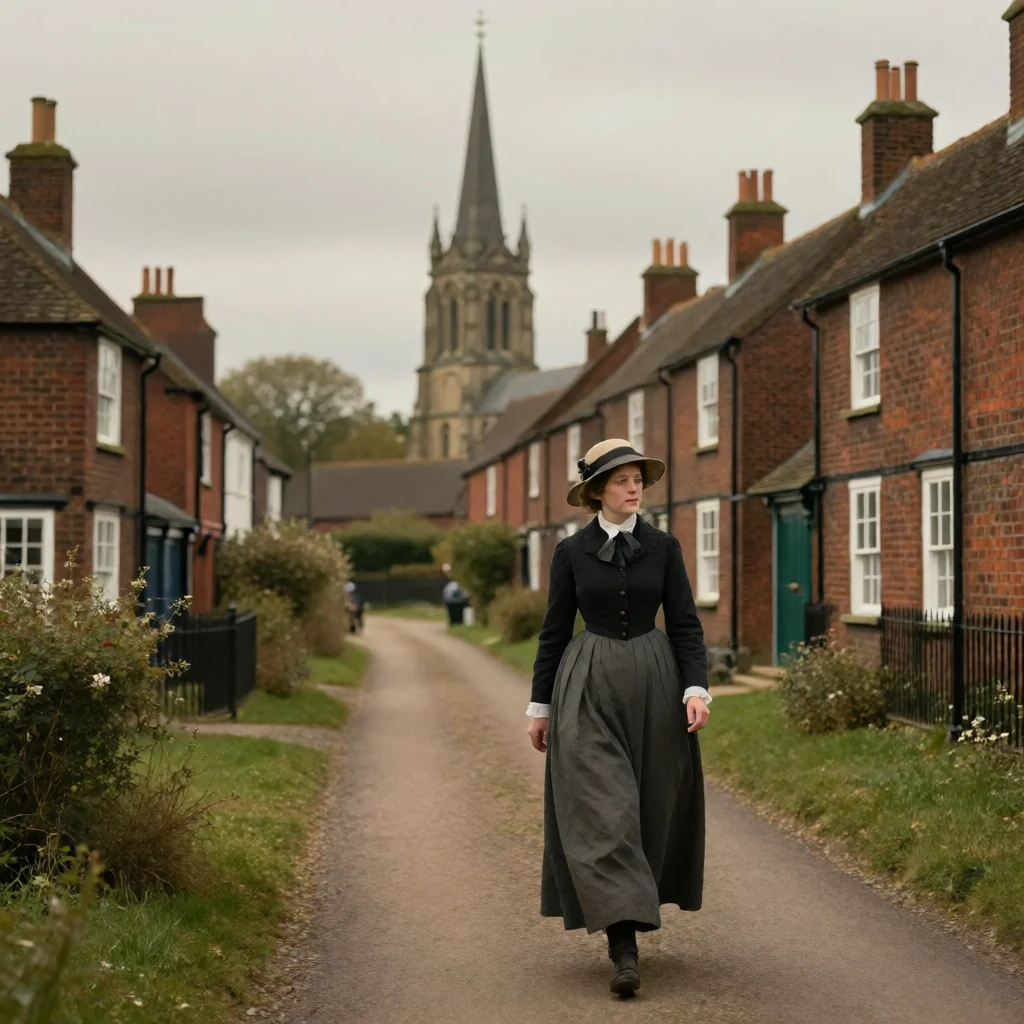
The next day Lydgate goes to Brassing and tells Rosamond he will be away until evening. Rosamond has lately kept to her house and garden except for church and one visit to her papa, to whom she said, “If Tertius goes away, you will help us to move, will you not, papa?” Mr. Vincy answered that he didn’t mind a hundred or two. She has sat at home in languid melancholy, fixing her mind on Will Ladislaw’s coming as the one point of hope, associating it with new urgency on Lydgate to arrange for leaving Middlemarch. This morning she descends equipped for a walk in the town, carrying a letter to post to Ladislaw, written with charming discretion but intended to hasten his arrival.
Meanwhile, Dorothea’s mind is filled with her project of visiting Rosamond. Until yesterday, the image of Mrs. Lydgate had always been associated for her with that of Will Ladislaw. She had resisted any sullying surmises about him and had a quick, sad, excusing vision of the charm in his companionship with Rosamond. But his parting words—implying that she herself was the object of his love—had convinced Dorothea that his regard for Mrs. Lydgate was blameless. Dorothea’s nature is of the kind where, if others love us, we feel ourselves bound to rectitude and purity. Her belief in Will has been a sort of baptism and consecration.
She has also observed with anger the animus with which Will’s part in the Bulstrode story has been recalled—“Young Ladislaw the grandson of a thieving Jew pawnbroker” entering into dialogues at Lowick, Tipton, and Freshitt. Sir James Chettam has found in this an added league of distance between Ladislaw and Dorothea. Dorothea’s silence has only shrouded her resistant emotion into a more thorough glow; this misfortune in Will’s lot, which others wished to fling at his back as an opprobrium, only gave more enthusiasm to her clinging thought.
Driving toward the town with clear spring morning around her, Dorothea reflects that she is taking Mrs. Lydgate good news, perhaps making a friend. At Lowick Gate, near Lydgate’s house, she alights to attend to another errand about a new bell for the school-house. The servant Martha shows her into the drawing-room, intending to fetch Rosamond. But Dorothea, advancing unconsciously a step or two beyond a projecting bookcase, sees something that makes her pause motionless.
Seated with his back toward her on a sofa, she sees Will Ladislaw; close by him, turned toward him with flushed tearfulness, sits Rosamond, her bonnet hanging back, while Will leans toward her and clasps both her upraised hands. Dorothea moves confusedly backward, and Rosamond becomes aware of her presence, snatching away her hands and rising. Will Ladislaw, starting up, meets Dorothea’s eyes with a new lightning in them and seems changing to marble. Dorothea says in a firm voice, “Excuse me, Mrs. Lydgate, the servant did not know that you were here. I called to deliver an important letter for Mr. Lydgate.” She lays down the letter and includes them both in one distant glance and bow before going quickly out of the room.
Dorothea crosses the street with her most elastic step and is quickly in her carriage again. She has drunk a great draught of scorn that stimulates her beyond susceptibility to other feelings. She has seen something so far below her belief that her emotions rush back from it. She feels power to walk and work for a day without meat or drink. She will carry out her purpose of going to Freshitt and Tipton to tell Sir James and her uncle all she wishes them to know about Lydgate. Her married loneliness under his trial now presents itself with new significance and makes her more ardent in readiness to be his champion. At Freshitt, Celia remarks that Dodo’s eyes are very bright, that she is going to do something uncomfortable. Dorothea answers lightly that a great many things have happened, “all the troubles of all people on the face of the earth.” She finishes her expedition well.
The original text of this work is in the public domain. This page focuses on a guided summary article, reading notes, selected quotes, and visual learning materials for educational purposes.