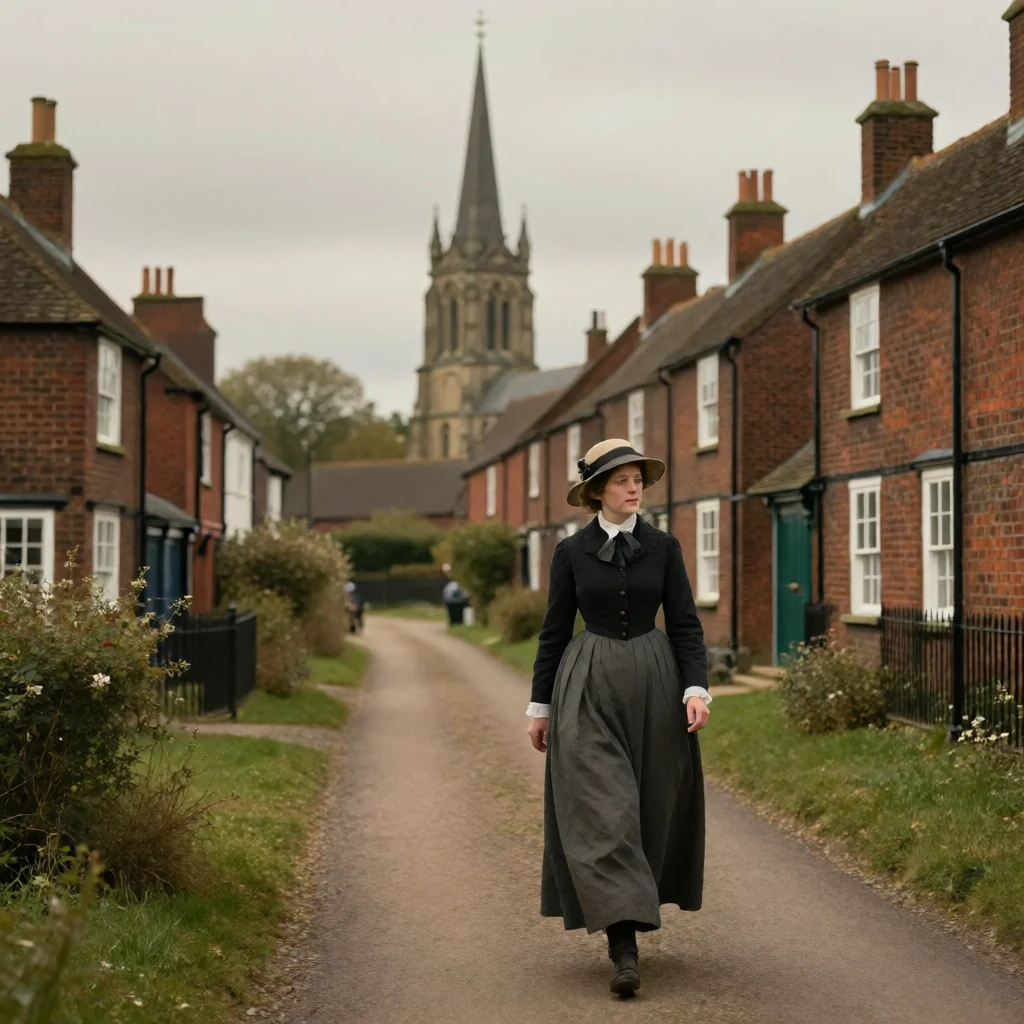
The next two days Lydgate observed a change in her, and believed that she had heard the bad news. Would she speak to him about it, or would she go on forever in the silence which seemed to imply that she believed him guilty? He was in a morbid state of mind, in which almost all contact was pain. He started from his chair with an angry impulse and walked up and down the room. There was an underlying consciousness all the while that he should have to master this anger and tell her everything. He did not know how long he had been walking uneasily, but Rosamond felt that it was long, and wished that he would sit down. He at last seated himself not in his usual chair, but in one nearer to her, leaning aside in it towards her. He had even opened his lips, when Rosamond, letting her hands fall, looked at him and said, surely, Tertius. Surely now at last you have given up the idea of staying in Middlemarch. I cannot go on living here. Let us go to London. Lydgate felt miserably jarred. With a quick change of countenance he rose and went out of the room. Perhaps if he had been strong enough to persist in his determination to be the more because she was less, that evening might have had a better issue. But poor Lydgate had a throbbing pain within him, and his energy had fallen short of its task. The beginning of mutual understanding and resolve seemed as far off as ever. They lived on from day to day with their thoughts still apart. It was of no use to say anything to Tertius; but when Will Ladislaw came, she was determined to tell him everything.
CHAPTER LXXVI.
The chapter opens with an epigraph from William Blake’s Songs of Innocence, celebrating mercy, pity, peace, and love as divinely human virtues. Days later, Tertius Lydgate rides toward Lowick Manor in response to a summons from Dorothea Casaubon. The summons follows a letter from Nicholas Bulstrode, who has resumed arrangements for quitting Middlemarch and reminds Lydgate of their earlier communications about the hospital, deferring to Dorothea’s wishes in the matter.
Dorothea awaits Lydgate with eager interest. Though she has refrained from what Sir James called “interfering in this Bulstrode business,” Lydgate’s hardship has weighed continually on her mind, and she sees in Bulstrode’s renewed appeal the opportunity she has long awaited. Wandering beneath her own great trees, she finds her thoughts going out over the lot of others while her own emotions remain imprisoned. The idea of some active good within her reach has haunted her like a passion. When Lydgate enters, she is shocked at the change in his face—not emaciation, but the persistent presence of resentment and despondency. Her cordial look softens his expression, but only with melancholy.
“I have wished very much to see you for a long while, Mr. Lydgate,” Dorothea says when they are seated. She explains that she wants to know exactly what he thinks about the hospital, since its proper management depends on him. Lydgate responds curtly that he cannot advise her to support the hospital in dependence on his activity, as he may be obliged to leave the town. Dorothea, pouring out her words in clearness from a full heart, declares that she knows the unhappy mistakes about him to be mistakes from the first moment. “You have never done anything vile. You would not do anything dishonorable.” It is the first assurance of belief that has fallen on Lydgate’s ears. He can only say, “Thank you.”
She begs him to tell her everything, assuring him that the truth would clear him. Lydgate starts toward the window, torn between his habitual reluctance to explain and the temptation Dorothea’s trust presents. At last he sits down again, feeling himself recovering his old self in the consciousness that he is with one who believes in it. He tells her everything: his reluctant first application to Bulstrode for money, his treatment of the patient against dominant practice, his doubts, his ideal of medical duty, his uneasy consciousness that accepting the money had subtly altered his private inclination. He explains that the suspicions against him—that he took a bribe to hold his tongue—cling obstinately because they lie in people’s inclination and can never be disproved. “I am simply blighted—like a damaged ear of corn—the business is done and can’t be undone.”
“Oh, it is hard!” says Dorothea. She understands the difficulty and cannot bear to rest in this as unchangeable. She proposes that they keep the hospital according to the present plan, that Lydgate stay with the friendship and support of a few, and that the evil feeling gradually die out. Lydgate mournfully says he has lost his old trust in himself, but Dorothea insists she has money that troubles her—seven hundred a year of her own fortune, nineteen hundred from Mr. Casaubon, and three or four thousand ready in the bank. She had wished to raise money to found a village that should be a school of industry, but her advisers convinced her the risk was too great. What she would most rejoice at would be having something good to do with her money.
Lydgate’s smile dies away. At last he says, “Why should I not tell you?—you know what sort of bond marriage is.” Dorothea’s heart beats faster. He explains that he cannot now do anything without considering his wife’s happiness, and Rosamond has set her mind against staying. Dorothea eagerly asks if she might go and see Rosamond, to cheer her heart and tell her that her husband has not been blamable. Lydgate, seizing the proposition with hope, agrees. Returning to the outward question, Dorothea suggests that if Rosamond knew there were friends who believed in Lydgate, she might be glad for him to stay and recover his hopes. Lydgate deliberates, then decides: no. He is no longer sure enough of himself, and it would be dishonorable to let others engage themselves seriously in dependence on him. He will not be pensioned for work he never achieved. He must creep into some shell and try to keep his soul alive.
“Now that is not brave,” Dorothea says, “to give up the fight.” Lydgate admits it is not brave, but says she has made a great difference in his courage by believing in him. He asks her to clear him in a few other minds, especially Farebrother’s, and to come and see his wife. Dorothea agrees. As Lydgate rides away, he reflects that Dorothea has a heart large enough for the Virgin Mary, and wonders if she could have any other sort of passion for a man. Meanwhile, Dorothea sits down under the inspiration of their interview and writes a brief note pleading that she has more claim than Bulstrode to the satisfaction of providing the money serviceable to Lydgate. She encloses a check for a thousand pounds and determines to take the letter the next day when she visits Rosamond.
The original text of this work is in the public domain. This page focuses on a guided summary article, reading notes, selected quotes, and visual learning materials for educational purposes.