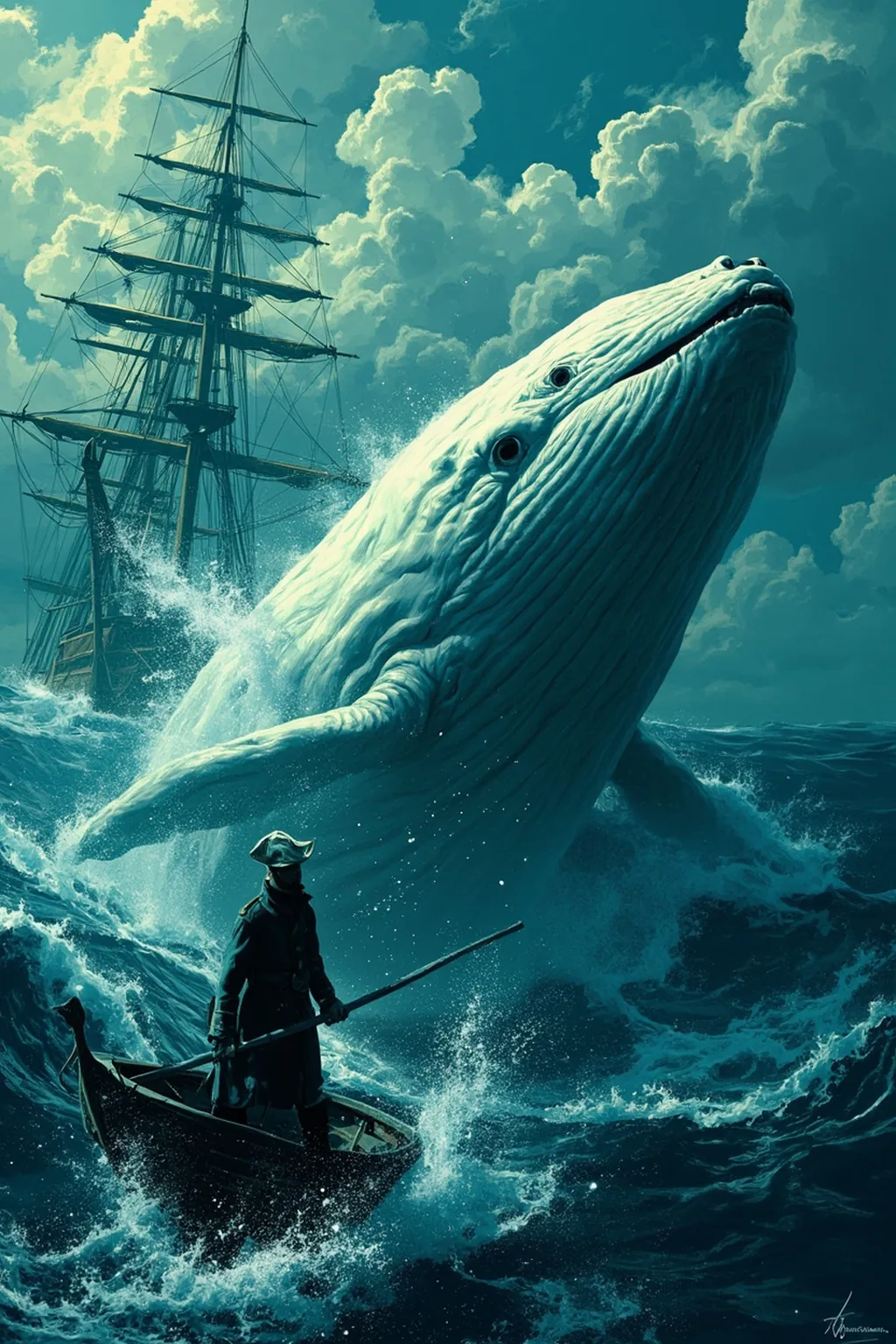
Jonah’s Prayer of Repentance
While Father Mapple speaks these words, the howling of the shrieking, slanting storm without seems to add new power to the preacher, who appears tossed by a storm himself. His deep chest heaves like a ground-swell, his tossed arms seem the warring elements at work, and the thunders roll away from his swarthy brow while light leaps from his eye. All his simple hearers look on him with a quick fear that is strange to them. A lull follows as he silently turns the leaves of the Book once more, and for a moment he stands motionless with closed eyes, communing with God and himself.
The Preacher’s Greater Sin
Again leaning over toward the people, Father Mapple bows his head lowly with an aspect of the deepest yet manliest humility and addresses his shipmates. He declares that God has laid but one hand upon them, but both His hands press upon him. He has read to them the lesson that Jonah teaches to all sinners, and therefore to them, and still more to himself, for he is a greater sinner than they. He would gladly come down from the mast-head and sit among them, listening while someone reads him the more awful lesson which Jonah teaches to him as a pilot of the living God.
The Pilot-Prophet’s Duty
Father Mapple then recounts Jonah’s specific sin as a pilot-prophet. Being an anointed speaker of true things, bidden by the Lord to sound unwelcome truths in the ears of a wicked Nineveh, Jonah, appalled at the hostility he would raise, fled from his mission and sought to escape his duty and his God by taking ship at Joppa. But God is everywhere; Tarshish he never reached. God came upon him in the whale, swallowed him down to living gulfs of doom, and with swift slantings tore him along into the midst of the seas. The eddying depths sucked him ten thousand fathoms down, weeds were wrapped about his head, and the watery world of woe bowled over him.
Preaching Truth to Falsehood
Yet even then, beyond the reach of any plummet, out of the belly of hell, when the whale grounded upon the ocean’s utmost bones, God heard the engulfed, repenting prophet when he cried. God spake unto the fish, and the whale came breaching up toward the warm and pleasant sun, vomiting out Jonah upon the dry land. When the word of the Lord came a second time, Jonah, bruised and beaten, his ears still murmuring of the ocean like sea-shells, did the Almighty’s bidding. And what was that bidding? Father Mapple concludes: to preach the Truth to the face of Falsehood! That was it.
CHAPTER 9. The Sermon.
The sermoner begins with a fierce litany of woes directed at any pilot of the living God who neglects gospel duty, who would pour oil on waters God has brewed into a gale, who values his good name above true goodness, or who, like the great Pilot Paul, preaches to others while being himself a castaway. Lifting his face with a deep joy, he then cries out that on the starboard hand of every woe there is a sure delight, a far upward and inward gladness reserved for the man who, against the proud gods and commodores of the earth, stands forth his own inexorable self, acknowledges no law or lord but the Lord his God, and can never be shaken from the sure Keel of the Ages by the billows of the boisterous mob. Concluding his prayer, the preacher yields his soul to the Father, preferring to be Thine rather than this world’s or his own, and then slowly waves a benediction, covers his face with his hands, and remains kneeling alone in the empty place long after the congregation has departed.
The Other Lesson
Father Mapple introduces “that other lesson” to his shipmates, warning of woe upon any pilot of the living God who neglects this duty, drawing a parallel to sailors who must respond to storms rather than calm the waters.
The original text of this work is in the public domain. This page offers a compressed quick-read summary for educational purposes.