Stubb Jokes About Wreck, Ahab Rebukes Him
Stubb approaches Ahab, who pauses before his wrecked boat on the quarter-deck, and jokes callously about the wreck. Ahab rebukes him for laughing before a wreck, declaring him soulless. Starbuck draws near, calling it a solemn sight and ill omen, but Ahab dismisses omens as old wives’ darkling hints, declaring he stands alone among millions.
Ahab Posts Doubloon Reward for Moby Dick’s Death
As night falls and the spout becomes invisible, Ahab addresses the crew at the doubloon. He declares the gold his until the White Whale is dead, then it will belong to whoever first raises him on the day he is killed. If Ahab himself raises the whale, ten times the sum will be divided among all.
Ahab Tracks Whale Through Night Till Dawn
Ahab orders the ship kept full before the wind, with the mast-head manned through the night. He stations himself half within the scuttle, slouching his hat, monitoring the night and tracking the whale through darkness until dawn.
CHAPTER 134. The Chase—Second Day.
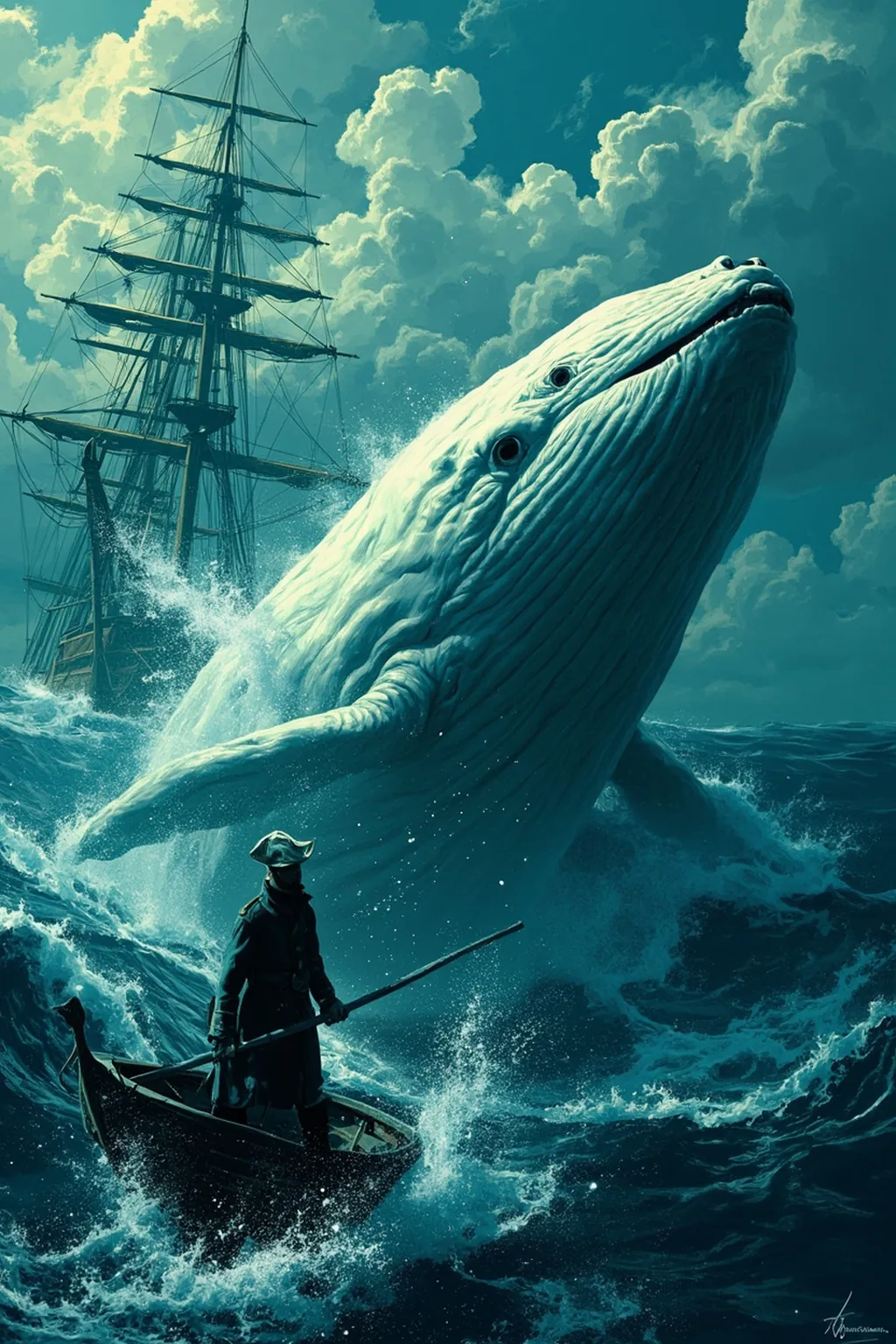
This chapter continues the relentless pursuit of the white whale on the second day. At daybreak, the three mast-heads are manned anew, and Ahab demands to know if the whale has been spotted. The narrative describes the remarkable navigational skills of Nantucket whaling captains, who can predict a whale’s trajectory and speed with extraordinary accuracy based on their observed wake patterns, much like a railway engineer timing a train’s arrival. The Pequod tears through the seas at great speed, leaving a furrow like a cannon-ball turned ploughshare, as Stubb celebrates the ship’s swift motion. The chapter builds mounting tension as the crew enters a state of chase frenzy, their individual fears dissolved by the collective momentum of the pursuit, unified under Ahab’s command like a single ship made of contrasting woods and materials unified by its keel.
Day-break Pursuit
At dawn, all three mast-heads are punctually manned as the Pequod continues its chase. Ahab, after allowing light to spread across the horizon, asks if anyone has spotted the whale, receiving only a negative reply. Impatient with the delay, he orders all hands to make sail and calls for the top-gallant sails, reasoning that they should have been kept set all night. He dismisses the setback as merely resting before the imminent rush, demonstrating his relentless determination to continue the hunt despite the whale’s apparent speed.
Nantucket Commanders’ Skill
The narrative elaborates on the extraordinary navigational abilities possessed by the great whaling captains of Nantucket. These skilled hunters can observe a whale’s last known position and predict with remarkable accuracy both the direction it will continue swimming while out of sight and its probable rate of speed during that period. The author draws an extended comparison to a pilot navigating along a familiar coastline, using visible landmarks to calculate the course toward distant, unseen destinations. Like a train engineer who knows a locomotive’s every movement and can predict its arrival time, these whalemen time the great Leviathan of the deep according to the observed humor of its speed, confidently declaring that a whale will reach a certain latitude or longitude at a specific hour. However, the text notes that favorable wind and sea conditions must ally with the hunter’s skill for this expertise to prove useful in the end.
Ship Tears On
The Pequod charges forward through the ocean with tremendous velocity, leaving a deep furrow in the sea comparable to a cannon-ball that transforms from a weapon into a agricultural tool, turning up a level field. Stubb enthusiastically cries out about the swift motion that tingles through the legs and heart, declaring that the ship and he are two brave fellows. He humorously suggests launching himself spine-wise into the sea, declaring his spine to be a keel like the live-oak timbers of the vessel. Stubb celebrates their speed with boisterous laughter, noting that they travel at a pace that leaves no dust behind, capturing the exhilarating momentum of the chase.
The original text of this work is in the public domain. This page focuses on a guided summary article, reading notes, selected quotes, and visual learning materials for educational purposes.