Mast-head Cry
The long-awaited cry finally rings out from the mast-head: “There she blows—she blows—she blows! right ahead!” Stubb recognizes the announcement with satisfaction, having anticipated the sighting, and taunts the whale mercilessly, declaring that it cannot escape despite its spouting and trumpeting. He calls upon Ahab himself to dam off the whale’s blood like a miller shutting his watergate, showing how deeply the frenzies of the chase have consumed the entire crew, transforming them into a unified force of determination and aggression.
Chase Frenzy
The frenzied excitement of the chase has worked upon the crew like old wine fermented anew. Whatever pale fears or forebodings some men may have felt earlier have been completely overwhelmed by the growing awe of Ahab and the stirring perils of the previous day. The crew moves as a single entity rather than thirty separate individuals, unified by the ship’s construction of contrasting materials—oak, maple, pine, iron, pitch, and hemp—all running together into one concrete hull directed by the central keel. Their hearts are bowled along by the wild craft’s reckless approach toward its mark, while an invisible wind fills their sails with irresistible force, symbolizing the unseen agency that has enslaved them to the pursuit.
Rigging Manned
The rigging comes alive with activity as the mast-heads, resembling the tufted tops of tall palm trees, become covered with sailors clinging to the spars. Some men reach out with impatient wavings while grasping a spar with one hand, others shade their eyes from the brilliant sunlight while sitting far out on the rocking yards. Every spar bears its full complement of mortals, all ready and prepared for whatever fate awaits them, as they strain through the infinite blueness of the sky and sea to spot the creature that might destroy them.
Ahab Questions Lookouts
Growing impatient when no additional cry follows the initial sighting, Ahab demands to know why the lookouts aren’t calling out if they can see the whale. He orders himself hoisted up to the mast-head, accusing the men of having been deceived, insisting that Moby Dick would not cast a spout in that direction before disappearing. His sharp hearing and experience prove correct—when he reaches his perch and secures the rope, he immediately strikes the keynote that makes the air vibrate with the combined force of thirty voices, confirming that the men had mistaken some other phenomenon for a whale-spout.
Moby Dick Breaches
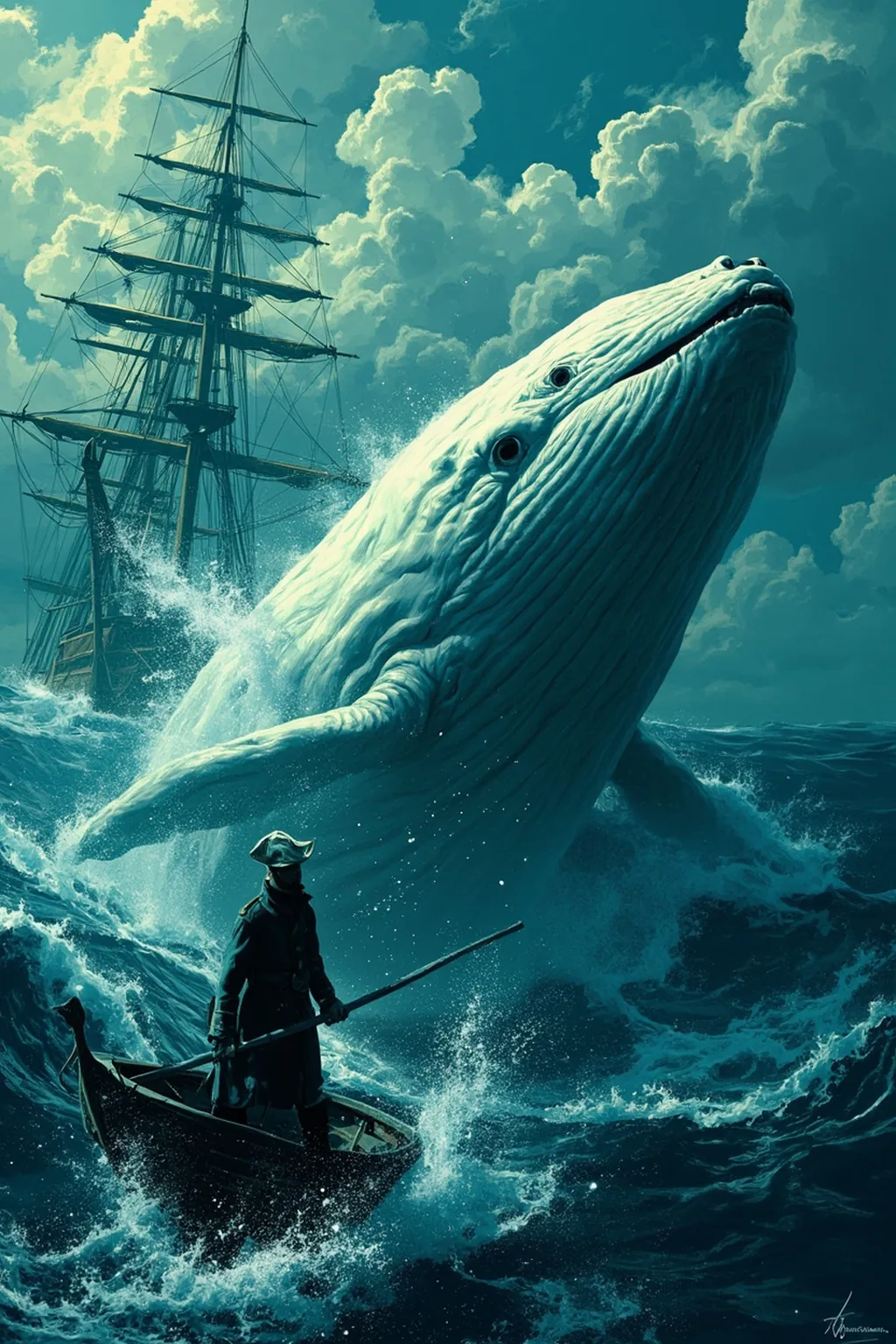
Much closer to the ship than the location of the mistaken spout—less than a mile ahead—Moby Dick suddenly bursts into view in a spectacular breach. The White Whale does not reveal himself through calm spouting but through the wondrous phenomenon of breaching, rising with utmost velocity from the deepest waters and propelling his entire bulk into the air. He piles up a mountain of dazzling foam visible from seven miles distant, shaking off torn, enraged waves that resemble his mane in what may be an act of defiance. The spray he raises glitters like a glacier against the blue sea and sky, creating a magnificent but terrifying sight as he tosses himself skyward like a salmon in his immeasurable bravadoes.
Ahab Orders Boats
Triumphantly crying out to the whale to breach his last to the sun, Ahab declares that his hour and harpoon are at hand. He commands all hands to come down except for one man at the fore, and orders the boats to be prepared. Without bothering with the slow rope-ladders, the men slide down the backstays and halyards like shooting stars, while Ahab descends more rapidly to his waiting boat—a spare one rigged the previous afternoon. He commands the boats to be lowered, instructing Starbuck to take command of the ship, keep it away from the boats but near them. In a terrifying maneuver, Moby Dick turns and begins charging directly toward the three crews, with Ahab positioning his boat centrally and announcing his intention to take the whale head-and-head, approaching straight to the whale’s forehead where sidelong vision cannot detect the approach.
The original text of this work is in the public domain. This page focuses on a guided summary article, reading notes, selected quotes, and visual learning materials for educational purposes.