Danish Sailor Praises Ship’s Storm Sturdiness
The Danish sailor celebrates the ship’s endurance with his refrain “crack, crack, old ship! so long as thou crackest, thou holdest!” He praises the mate for keeping the ship stiff and tough, comparing the vessel to a fort at Cattegat fighting the Baltic with storm-lashed guns where sea-salt cakes.
4th Nantucket Sailor Recounts Ahab’s Squall Order
The fourth Nantucket sailor reveals what he heard from old Ahab: the mate was ordered to “always kill a squall, something as they burst a waterspout with a pistol—fire your ship right into it!” This exemplifies Ahab’s aggressive approach to the sea’s challenges.
English Sailor Praises Captain Ahab
The English sailor gives a hearty endorsement of Captain Ahab, declaring “that old man’s a grand old cove!” He proclaims the crew is “the lads to hunt him up his whale!” The entire crew echoes this sentiment with a unified “Aye! aye!”
Old Manx Sailor Notes Storm and Captain’s Birthmark
The old Manx sailor observes the three pines shaking in the storm and notes the crew’s “cursed clay” can’t match the hardness of pine trees. He warns the helmsman to “steady, steady” and observes that this weather makes “brave hearts snap ashore, and keeled hulls split at sea.” He cryptically observes that their captain has his birthmark and sees another in the sky—“lurid-like, ye see, all else pitch black.”
Daggoo Confronts Spanish Sailor Over Racist Taunt
Daggoo, the enormous African harpooneer, confronts a Spanish sailor who makes a racist comment about his race being “the undeniable dark side of mankind—devilish dark at that.” The Spanish sailor claims “no offence” but his advance is clearly provocative. Daggoo responds grimly with a single word: “None.”
Crew Fight Erupts Between Daggoo and Spaniard
The tension escalates as a St. Jago’s sailor observes the Spaniard seems “mad or drunk” and comments that the Mogul’s fire-waters are taking long to work. Lightning—or Daggoo’s bared teeth—occurs. Daggoo springs at the Spaniard, shouting “Swallow thine, mannikin! White skin, white liver!” The Spaniard meets him with “Knife thee heartily! big frame, small spirit!” The crew shouts “A row! a row! a row!” Tashtego observes “A row a’low, and a row aloft—Gods and men—both brawlers! Humph!” A Belfast sailor calls to “plunge in,” an English sailor demands fair play and a ring, and the old Manx sailor notes “in that ring Cain struck Abel.”
Mate Calls Crew to Reef Topsails
The mate’s voice from the quarterdeck interrupts the brawl with urgent commands: “Hands by the halyards! in top-gallant sails! Stand by to reef topsails!” The crew recognizes the squall’s approach and prepares to respond.
Crew Scrambles as Squall Hits the Ship
The entire crew responds with “The squall! the squall! jump, my jollies!” as they scatter to their stations. The chaos of the storm contrasts sharply with the earlier dancing revelry as the ship must now face a genuine emergency.
Pip Hides from Squall, Laments Crew Chaos
Pip, shrinking under the windlass, laments the crew’s frenzy. He observes “Crish, crash! there goes the jib-stay! Blang-whang!” and prays to God to “duck lower” as the royal yard comes crashing. He compares the chaos to being in “the whirled woods, the last day of the year” and sarcastically notes “Fine prospects to’em; they’re on the road to heaven.”
Pip First Mentions the White Whale
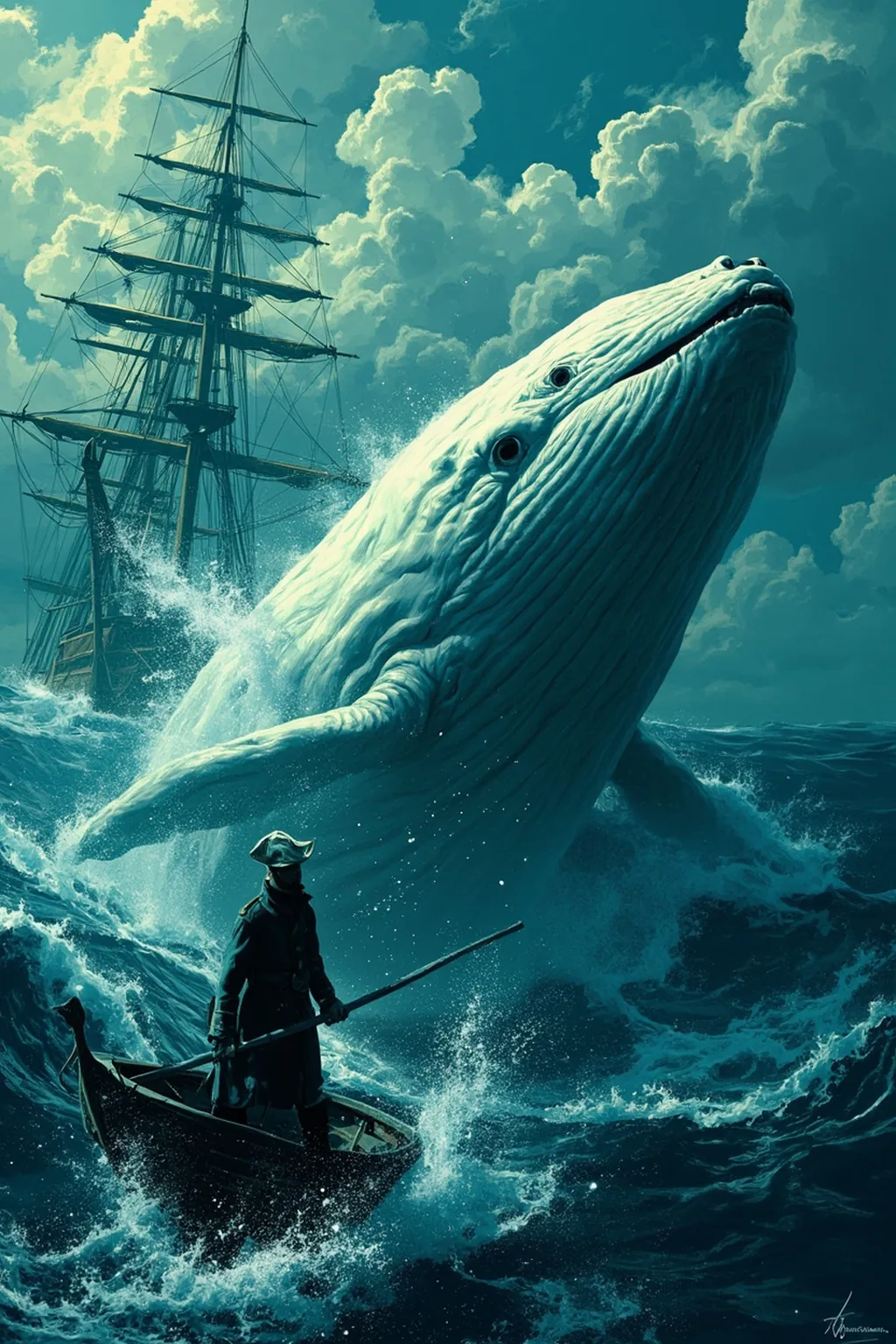
In a pivotal moment, Pip first mentions the white whale, revealing he has heard all the crew’s chat about Ahab’s obsessive hunt. He reveals that the white whale has been “spoken of once! and only this evening” but it makes him “jingle all over like my tambourine.” He warns that the “anaconda of an old man” (Ahab) has sworn them to hunt the whale. Pip prays to “thou big white God aloft” to have mercy on “this small black boy down here” and preserve him from “all men that have no bowells to feel fear”—the first ominous mention of Moby Dick and the foreshadowing of Pip’s fate.
The original text of this work is in the public domain. This page offers a compressed quick-read summary for educational purposes.