CHAPTER 78. Cistern and Buckets.
Tashtego climbs out onto the overhanging mainyard-arm, runs to its tip, secures a small tackle called a whip, swings the rope down, and hand-over-hands to the summit of the head like a Turkish muezzin. A short spade is sent up; he probes to find the exact spot to break into the tun. An iron-bound bucket is hoisted to him, lowered into the tun, and up it comes bubbling like a dairy-maid’s pail of new milk, poured into tubs on deck. Bucket after bucket, until he must ram the long pole twenty feet deep for the last oil.
Then disaster: as the eightieth or ninetieth bucket came up, the Indian slipped and fell headfirst into the tun with a horrible oily gurgle. Daggoo, first to react, had himself hoisted to the head and began ramming the bucket down to give Tashtego something to grab. “Are you ramming a cartridge in there? You’ll be jamming that bucket on his head!” Stubb yelled. Before he finished, a sharp crack: one of the two hooks holding the head tore out. The head swung sideways, the ship reeled, the remaining hook straining. The next instant that hook gave way, and the enormous head dropped into the sea with a boom. Daggoo swung over the water, Tashtego sank into the depths.
Then a naked figure with a boarding-sword leapt from the bulwarks: Queequeg, diving to the rescue. Minutes passed with no sign of either man. A boat was lowered. Then Daggoo yelled: “Both! Both!” An arm thrust up from the waves—Queequeg, clutching Tashtego by the long hair, striking out with one hand. They were hauled in, Tashtego limp. Later Queequeg explained: diving after the sinking head, he cut a hole in the tun with his sword, thrust his arm in, grabbed Tashtego, and hauled him out. He had felt a leg first but knew that would not do, so he tossed the Indian into a somersault to bring him out headfirst. A running delivery, and a lesson that midwifery should be taught with fencing and boxing. If Tashtego had died there, he would have been coffined in the sweetest spermaceti, like the Ohio honey-hunter who died embalmed in honey.
CHAPTER 79. The Prairie.
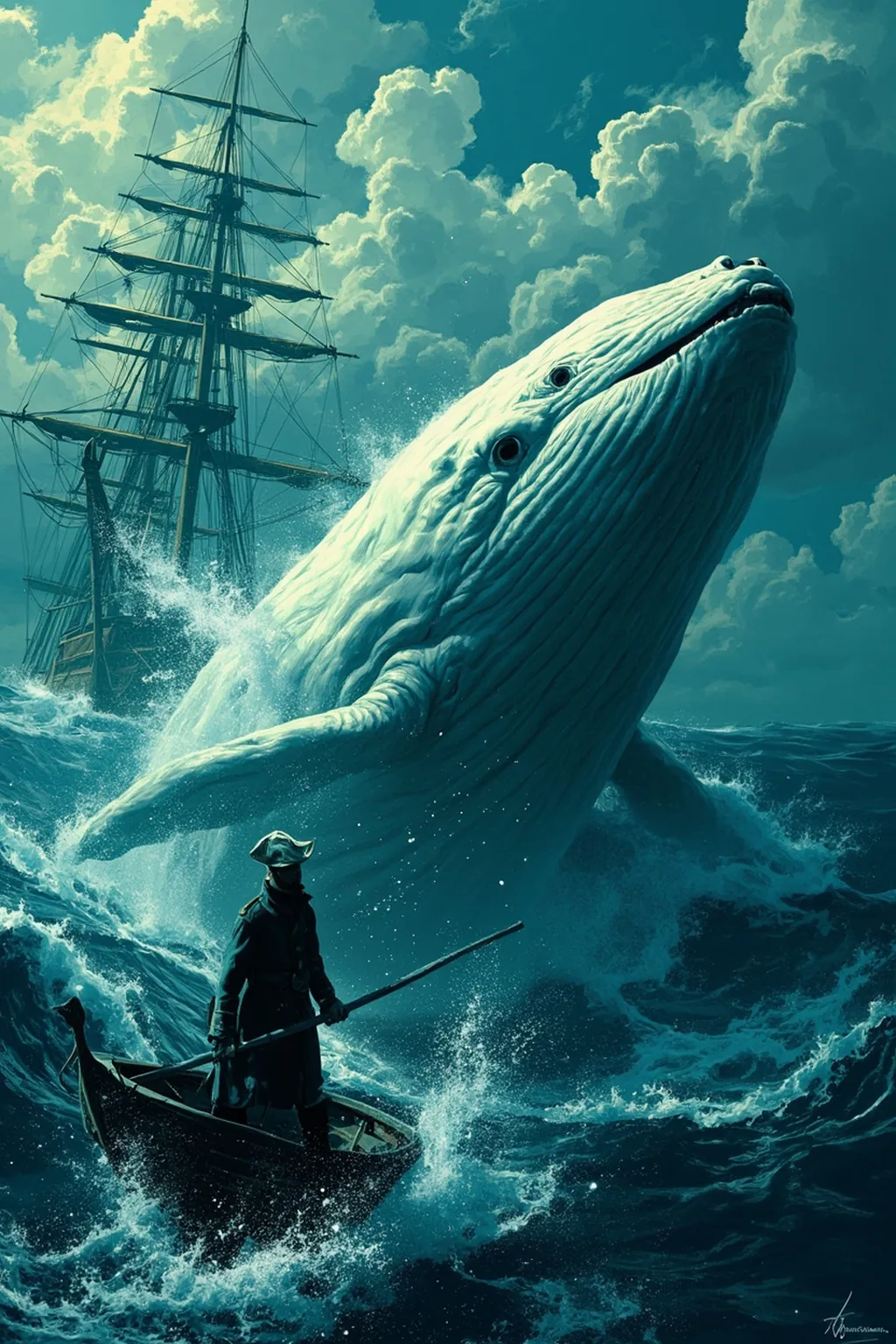
No physiognomist has tried to read the face of a whale—it would be like Lavater reading the wrinkles of Gibraltar, or Gall climbing a ladder to feel the dome of the Pantheon. Still, the attempt is worth making. The sperm whale’s most striking feature is that he has no nose, no central feature to anchor his face. On a man that would be hideous; on the whale, whose proportions are so stately, it is no blemish but added grandeur. A nose would be impertinent on such a creature. The most imposing view is the full front: a vast broad brow, pleated with wrinkles, no distinct features visible, just that great firmament of a forehead lowering with the doom of boats and ships and men. Sublime, like the brow of a god, or the seal of a German emperor, signifying “God: done this day by my hand.” The whale’s brow is a Chaldee script no one can read, no Champollion to decipher. Physiognomy is a passing fable; even great scholars cannot read the face of a peasant, so how can a simple sailor read the awful brow of the leviathan? He can only put it before you and let you look.
CHAPTER 80. The Nut.
To the phrenologist, the sperm whale’s brain is impossible to square. The skull is twenty feet long, but the actual brain, hidden deep in the rear, is a mere handful, ten inches long and deep, twenty feet from the apparent forehead, secreted behind the vast outworks of junk and spermaceti like the innermost citadel of Quebec. Some whalemen deny the whale has a brain, thinking the oil and tissue is the seat of intelligence. But unload the skull of its oily heaps and the rear looks exactly like a human skull scaled up: the phrenologist would say no self-esteem, no veneration, only negations, which fit the whale’s prodigious power. The spinal cord is as large as the brain, continuous with it. The Germans say the vertebrae are undeveloped skulls; there is something to that. The whale’s great hump, rising over the larger vertebrae, is the organ of indomitableness, the seat of his unbreakable will. That is why he is so hard to kill, so relentless.
The original text of this work is in the public domain. This page focuses on a guided summary article, reading notes, selected quotes, and visual learning materials for educational purposes.