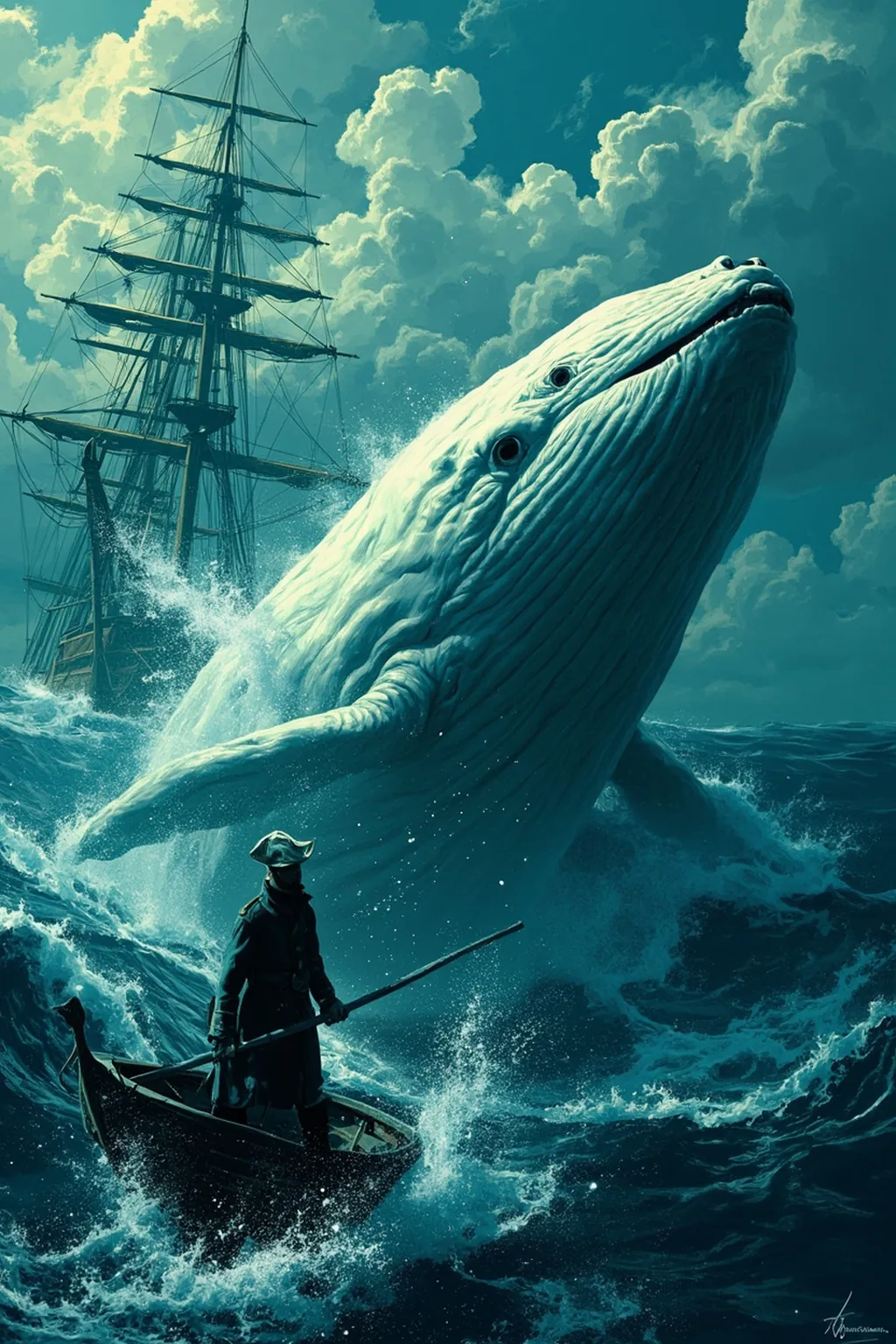
CHAPTER 96. The Try-Works.
Few sights mark an American whaler as unmistakably as her try-works: a hulking brick-and-mortar structure planted squarely between the foremast and mainmast, so curious an anomaly that it looks as though a whole brick kiln were dragged from an open field and set down upon the ship’s oak planks. Ten feet square and five feet tall, the structure is braced to the deck with heavy iron knees, its flanks cased in wood, its top sealed under a sloped, battened hatch that lifts to reveal two massive iron try-pots, each capable of holding several barrels of oil. When not in use, the pots are scrubbed so thoroughly with soapstone and sand that they shine like polished silver punch-bowls; cynical old sailors sometimes curl up inside them for a nap during night watches, and when men polish the pots side by side, they carry on whispered confidential conversations over the iron rims, or work through deep mathematical problems—one of which first struck Ishmael as he sat polishing the Pequod’s left-hand pot: that any body sliding along a cycloid, his soapstone included, will descend from any point in exactly the same amount of time. Lift the fire-board at the front of the works, and you’ll see the bare masonry pierced by two iron furnace mouths directly beneath the pots, fitted with heavy iron doors. A shallow water reservoir runs under the entire structure to keep the deck from scorching from the intense heat, fed constantly by a tunnel at the rear as water evaporates; there are no external chimneys, only sooty flues opening straight out the back wall.
It was around nine o’clock at night on the Pequod’s current voyage when the try-works were first lit, with Stubb put in charge of the operation. “All ready there? Off hatch, then, and start her. You cook, fire the works,” he called. The carpenter had been stuffing shavings into the furnace throughout the passage, so ignition was easy, but the first fire has to be fed with wood for a time; once going, the staple fuel is the crisp, shriveled blubber scraps—called fritters—left over after the oil is tried out, which still hold enough unctuous fat to feed the flames. As Melville wryly notes, the whale ends up burning by his own body, a self-consuming martyr or misanthrope; if only he burned his own smoke, too, for the thick, acrid fumes are unbearable to inhale, carrying a wild, funereal Hindoo odor like the smoke of a funeral pyre, “the left wing of the day of judgment,” an argument for the pit.
By midnight, the works were roaring at full tilt. The Pequod had cleared the whale carcass, was under full sail with a freshening wind, and the pitch black night was licked up by fierce flames forking out of the sooty flues, lighting every rope in the rigging like the famed Greek fire. The burning ship drove on like a Hydriote fire ship commissioned for vengeance, Canaris’s brigs bearing down on Turkish frigates with sheets of flame for sails. The top hatch was removed, leaving a wide wooden hearth in front of the pots, where the pagan harpooneers stood like Tartarean shapes, stoking the fires and pitching sizzling masses of blubber into the scalding pots with huge pronged poles, snaky flames darting out to lick at their feet. Thick smoke rolled away in sullen heaps, and with every roll of the ship, boiling oil seemed eager to leap into their faces. Opposite the works, the windlass served as a sea-sofa for the off-duty watch, who stared into the red heat till their eyes burned in their heads, their tawny, smoke-begrimed faces, matted beards, and bright white teeth flickering in the firelight as they told tales of terror between peals of uncivilized laughter, gesturing wildly with their pronged forks. The wind howled, the sea leaped, the ship groaned and dived, yet shot its red hell further into the blackness, champing the white bone of a whale in its jaws—so it seemed to Ishmael, standing at the helm for hours, guiding the fire-ship through the dark, the fiendish shapes before him searing his mind until he fell into his usual midnight drowsiness at the wheel.
That night, a strange, inexplicable hallucination struck him. He woke from a brief standing sleep, horribly conscious something was wrong: the jawbone tiller smote his side, he heard the low hum of sails just catching the wind, thought his eyes were open, stretched his lids wider, but saw no compass, only jet black gloom lit by flashes of red. The impression seized him that the ship was rushing away from all havens astern, not toward any ahead; a stark, deathlike feeling washed over him, and he convulsively grabbed the tiller, convinced it was inverted, enchanted. “My God! what is the matter with me?” he thought. In his brief sleep, he had turned around, facing the stern with his back to the prow and the compass. He whipped around just in time to keep the ship from flying up into the wind and capsizing, relief flooding him when the hallucination broke. His warning to readers is sharp: never stare long into the face of artificial fire, never dream with your hand on the helm, never turn your back to the compass, never trust the false light of fire that makes all things look ghastly. The natural sun of tomorrow will show the devilish shapes for what they are, gentle and ordinary; the true lamp is the golden, glad sun, all others liars. But even the sun cannot hide the world’s darkness: Virginia’s Dismal Swamp, Rome’s accursed Campagna, the Sahara, all the millions of miles of deserts and griefs under the moon, the two-thirds of the earth covered by dark ocean. A man with more joy than sorrow in him is not true, not developed; the truest of all men was the Man of Sorrows, the truest book Ecclesiastes, fine hammered steel of woe. The man who dodges hospitals and jails, crosses graveyards fast, talks of operas not hell, calls Cowper and Pascal poor sick devils, swears by Rabelais as wise—he is not fit to sit on tombstones and break the green mould of Solomon’s wisdom. Even Solomon says the man who wanders from understanding stays in the congregation of the dead; do not give yourself up to fire, lest it invert and deaden you as it did Ishmael that night. There is a wisdom that is woe, but a woe that is madness; still, some souls have a Catskill eagle that can dive into the blackest gorges and soar out again invisible in the sunny spaces, and even if it stays in the gorge, the mountain is still higher than the plain below, even if the other birds soar.
The original text of this work is in the public domain. This page focuses on a guided summary article, reading notes, selected quotes, and visual learning materials for educational purposes.