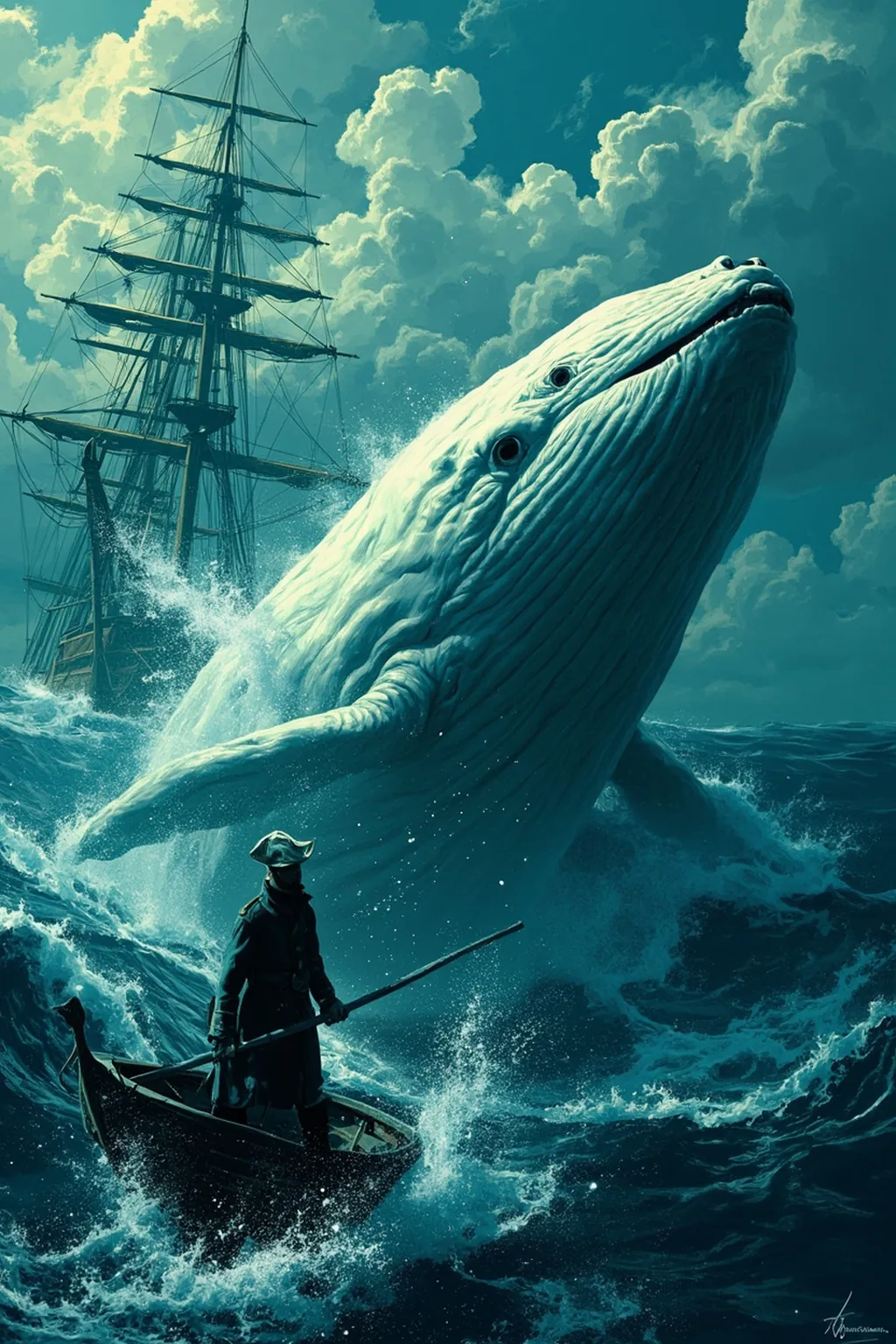
The Cash Motive
Ahab recognized that while mankind in times of strong emotion disdain all base considerations, such times are evanescent. The permanent constitutional condition of manufactured man is sordidness. Even though the White Whale incited his crew and even bred knight-errantism in them, they needed food for their daily appetites. Just as Crusaders were not content to fight for the holy sepulchre without committing burglaries and picking pockets along the way, Ahab would not strip his men of all hopes of cash. Without perspective promise of it, the crew would mutiny.
Usurpation Fears
Having impulsively revealed the prime private purpose of the Pequod’s voyage, Ahab was conscious that he had laid himself open to the unanswerable charge of usurpation. The crew could, with perfect impunity both moral and legal, refuse further obedience and violently wrest command from him. From even barely hinted imputations of usurpation and possible consequences, Ahab needed to protect himself through his predominating brain, heart, and hand, backed by heedful attention to every atmospheric influence his crew might be subjected to.
Maintaining the Pretense
For all the reasons previously stated, Ahab saw that he must continue true to the natural, nominal purpose of the Pequod’s voyage and observe all customary usages. Moreover, he had to force himself to evince all his well-known passionate interest in the general pursuit of his profession.
Renewed Vigilance
His voice was now often heard hailing the three mast-heads, admonishing the lookouts to keep a bright watch and not omit reporting even a porpoise. This vigilance was not long without reward.
CAPÍTULO 47. The Mat-Maker.
The chapter opens on a cloudy, sultry afternoon as the crew lazily lounges. Queequeg and the narrator weave a sword‑mat while an uncanny stillness blankets the ship. The scene is laced with a dreamlike reverie that sets the stage for philosophical reflection and the imminent whale hunt.
The Mat-Maker
Queequeg and the narrator quietly craft a sword‑mat for an additional boat lashing. The narrator acts as a shuttle, passing marline between the warp threads, while Queequeg drives his heavy oaken sword through the weave. The calm, almost hypnotic atmosphere makes each sailor seem absorbed into his own invisible self.
The Loom of Time
The narrator likens the weaving to the “Loom of Time,” seeing the ship as a mechanism of destiny. The fixed warp threads represent necessity; the shuttle of free will weaves between them, and Queequeg’s careless sword strokes embody chance. Together they shape the fabric of fate, with necessity, free will, and chance interweaving in a delicate balance.
There She Blows
From the cross‑trees, Tashtego spots a whale and lets out the traditional cry, “There she blows! There! There! She blows!” The crew snaps to attention, asking direction and confirming a school of whales about two miles off the lee‑beam. The shout galvanizes the ship into a flurry of activity.
The Sperm Whale
The narrative notes that the Sperm Whale’s blow is as regular as a clock’s tick, allowing whalemen to differentiate it from other species. This uniform, undeviating spout becomes a hallmark for identifying the quarry.
Preparing the Boats
With the whales fleeting, the ship is kept away from the wind and gently rolls. Crew members secure line tubs, thrust out cranes, and swing the three boats over the sea, their crews poised with one hand on the rail and a foot ready on the gunwale, eager to launch the hunt.
Ahab’s Phantoms
Just as the boats are about to be lowered, a sudden exclamation diverts all eyes from the whale. Dark Ahab appears, surrounded by five dusky phantoms that seem to materialize from thin air, instantly capturing the crew’s attention and ending the momentarily focused pursuit.
CAPÍTULO 48. The First Lowering.
This chapter, titled “The First Lowering,” chronicles the Pequod’s first attempt to hunt a sperm whale. It opens with mysterious phantom-like figures casting loose the captain’s spare starboard quarter boat, introduces the enigmatic white-turbaned Fedallah and his crew of tiger-yellow Manilla natives, covers Ahab’s order to lower the boats and the crew’s eager leap into them despite their amazement at the strangers, Ahab’s arrival in a fourth windward boat with the five mysterious men, the officers’ reactions and questions about the stowaways, the crew’s superstitious concerns and their partial easing, the powerful rowing of Ahab’s crew that pulls them ahead of the other boats, Ahab’s spotting of the whale that halts all vessels, crew members taking high vantage points to scan for the whale, Stubb pausing to light his pipe during the wait, Tashtego’s signal that the whale has been spotted, the ensuing high-speed chase, Flask’s wild antics and Stubb’s ambiguous humorous leadership during the pursuit, Ahab’s fierce commands to his crew, and the intense, awe-inspiring thrill of the crew’s first whale hunt. As the whales dispersed and the darkening cloud-shadows deepened over the sea, Starbuck gave chase to three whales running dead to leeward while the crew pulled their boats farther apart, sailing with such speed through the white water that the oarsmen could scarcely keep pace. Suddenly a squall overtook them, wrapping the scene in a suffusing mist that hid both ship and boat, and amid the chaos Starbuck whispered the order to stand up as Queequeg hurled his harpoon; the strike grazed the whale, which escaped, while the combined force of squall, whale, and harpoon swamped the boat and left the crew half-suffocated, clinging to their seats with water up to their knees. The storm intensified into a howling wilderness of forked lightning and crashing waves, the useless oars were pressed into service as life-preservers, and Starbuck finally managed to ignite the lantern and hand it to Queequeg, who sat holding up that feeble light in the heart of the squall as a symbol of a man without faith, hopelessly upholding hope amid despair. At dawn, hearing the muffled creak of rigging through the mist, the crew glimpsed the looming hull of their ship bearing down upon them; they leaped into the sea as the vessel rolled over and crushed the abandoned boat, and after being dashed against the wreckage by the waves they were at last taken up and safely landed aboard, where they learned the ship had only just ceased searching for tokens of their perishing.
The original text of this work is in the public domain. This page focuses on a guided summary article, reading notes, selected quotes, and visual learning materials for educational purposes.