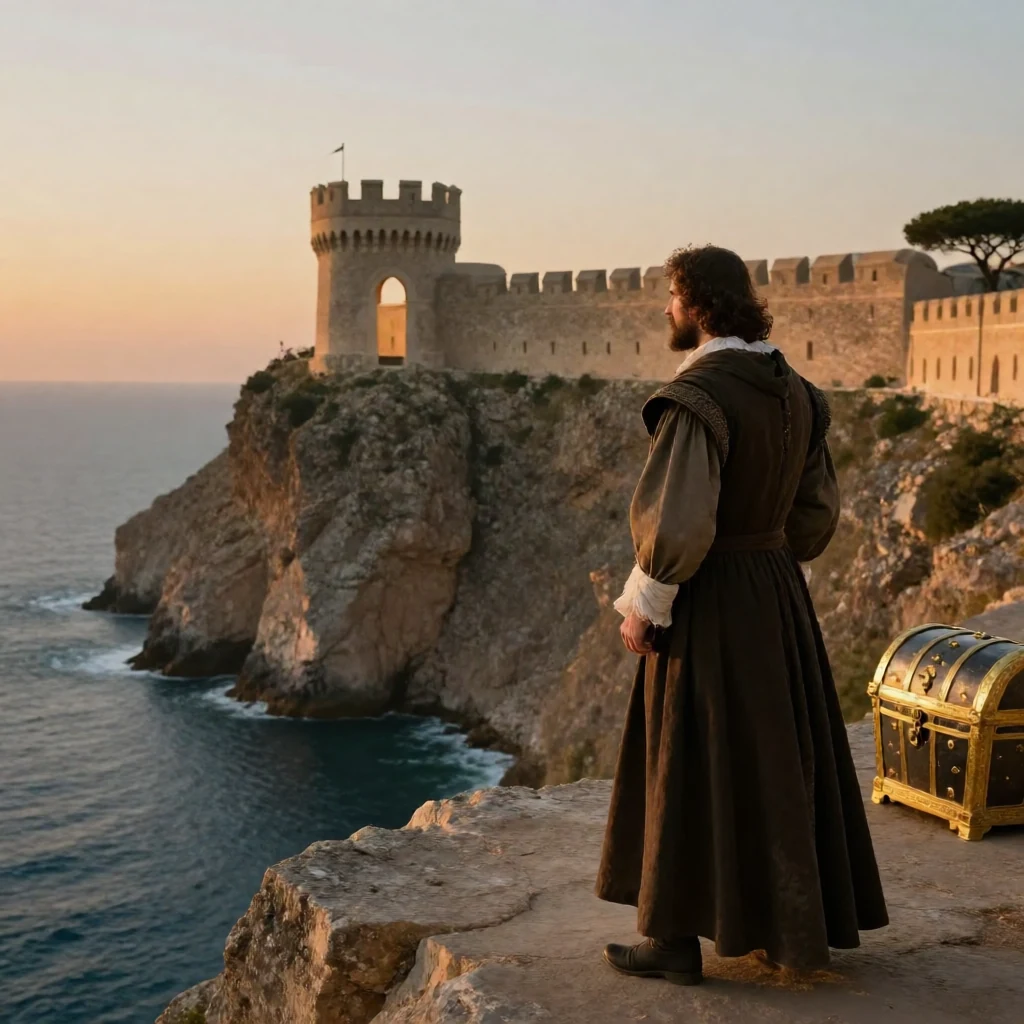
Chapter 41. The Presentation
Chapter 41, “The Presentation,” opens with Monte Cristo taking polite leave of the Countess de Morcerf, who must depart to speak at a sitting. After a courteous exchange, Monte Cristo exits the house to find his lavish carriage waiting. Albert, escorting him to the door, is impressed by the elegance of the equipage. When Albert returns to his mother, he finds her visibly unsettled in the dimly lit boudoir. A conversation unfolds in which Mercédès questions Albert closely about the Count of Monte Cristo—his origins, manners, age, and intentions. Albert describes the Count as a man of remarkable distinction, comparing him to one of Byron’s romantic heroes. Despite Albert’s reassurances, Mercédès remains uneasy, her private reflections suggesting a deeper, unspoken connection to the mysterious visitor. The chapter closes with Albert leaving his mother to her reverie, reflecting on the undeniable impression the Count has made.
Chapter 42. Monsieur Bertuccio
This chapter details Monte Cristo’s arrival at his new Parisian residence on the Champs-Élysées, the purchase of an estate at Auteuil, and his steward’s growing apprehension about the destination. The Count conducts business with a notary, signs the deed for the Auteuil property, and prepares to depart with Bertuccio in tow, despite the steward’s visible distress.
Arrival at the Champs-Élysées House
Monte Cristo arrives at his town house after a six-minute journey that draws admiration from young men envious of his expensive horses worth 20,000 francs each. The gates open before the coachman even hails the concierge, and the Count is served with lightning speed upon his arrival.
Description of the Mansion
The mansion sits on the right side of the Champs-Élysées, isolated from neighboring properties. A thick clump of trees and shrubs masks part of the front, with two alleys branching left and right to form a carriage-drive. Iron gates lead to a double portico where porcelain vases filled with flowers line each step. The house has a main entrance and a secondary one on Rue de Ponthieu.
Meeting with Bertuccio
Count greets his steward with thanks and inquires about the notary, who awaits in the small salon. Bertuccio reports that the visiting cards have been engraved and the first delivered to Baron Danglars. The time is four o’clock. Monte Cristo hands his hat, cane, and gloves to a French footman and enters the small salon, preceded by Bertuccio, whom he dismisses the antechamber’s “indifferent marbles.”
The Notary’s Visit
A provincial solicitor arrives to complete the sale of a country house. Monte Cristo asks if the deed is ready and reveals he does not know the property’s location. The notary explains the house is at Auteuil, close to Passy, in the heart of the Bois de Boulogne. Bertuccio reacts with visible distress to this revelation.
Learning of the Auteuil Estate
Monte Cristo feigns ignorance of the property’s whereabouts, claiming he only saw an advertisement with the false title “a country house.” The notary describes it as a charming location with spring-water, fine trees, valuable old furniture, and magnificent surroundings. The Count decides to keep the property despite its proximity to Paris.
Bertuccio’s Apprehension
Bertuccio grows increasingly agitated when the house at Auteuil is mentioned. His copper complexion turns livid, and he appears to fight against revealing something. The Count notices his steward’s nervous trembling, which he attributes to great disquietude. Bertuccio cannot bring himself to answer the Count’s question about what has happened to him.
Signing the Purchase Deed
Monte Cristo rapidly signs the deed after reviewing the property details. He instructs Bertuccio to pay fifty-five thousand francs, and the steward departs with faltering steps before returning with banknotes. The notary counts the money and confirms all forms are complete, with keys held by the house concierge.
Consulting Private Records
Alone after dismissing the notary, Monte Cristo retrieves a locked book from his pocket and opens it with a key worn around his neck. He compares notes with the deed of sale and confirms the address matches his records: “Auteuil, Rue de la Fontaine, No. 28.”
The original text of this work is in the public domain. This page focuses on a guided summary article, reading notes, selected quotes, and visual learning materials for educational purposes.