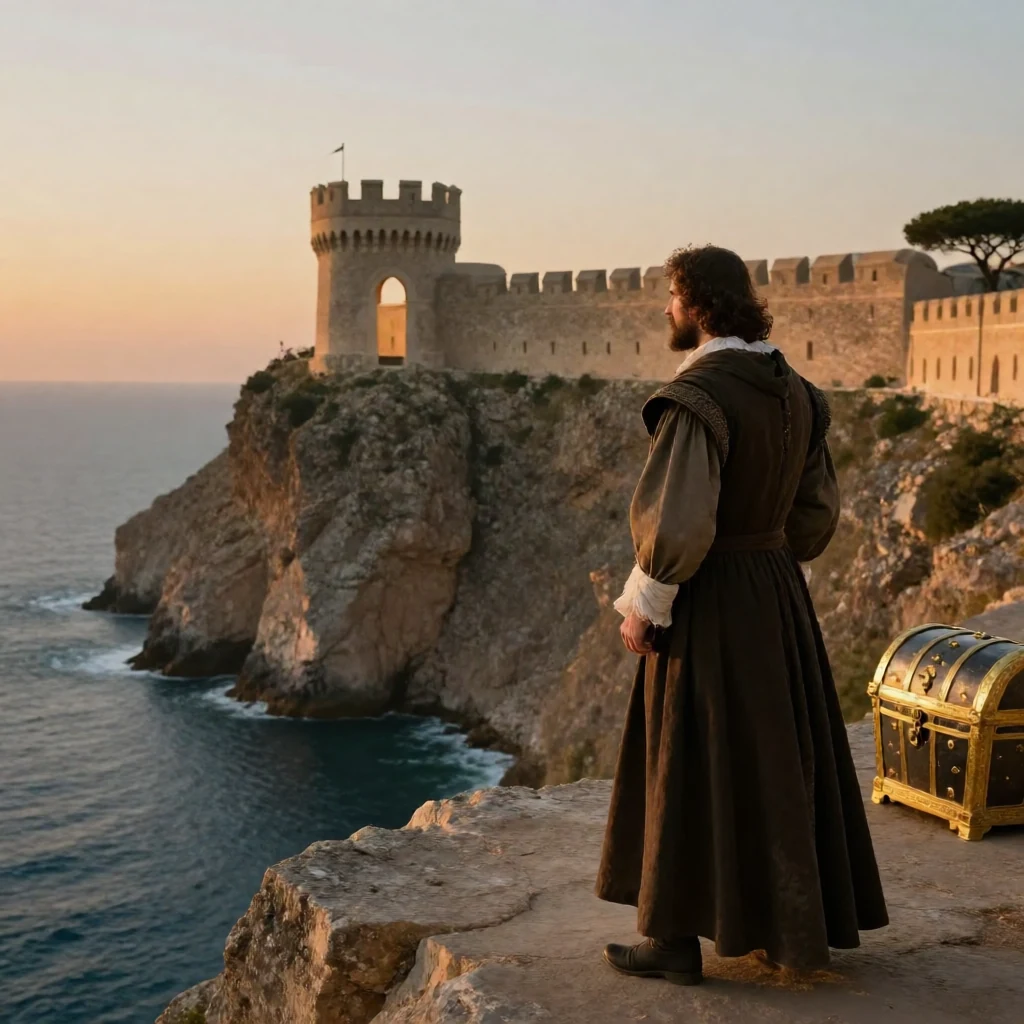
Chapter 47. The Dappled Grays
The baron led the Count to the baroness’s pink-satin boudoir, the house’s only room with distinctive taste. Still strikingly handsome, Madame Danglars sat at her piano while Debray turned album pages. The Count was received with gracious formality. Soon, her attendant announced the prized dappled grays had vanished. The baroness rounded on her husband. Crimson, Danglars confessed he had sold the horses for 32,000 francs—double their purchase price—after a “madman or fool” sent a steward to buy them at any price. As Madame Danglars prepared to storm out, Debray moved to the window and spotted the very horses harnessed to the Count’s carriage below. The Count professed innocent astonishment and offered to return them. That evening he wrote to Madame Danglars entreating her to accept the horses back; they arrived wearing the same harness, each rosette fastened with a large diamond by Monte Cristo. That night, he set out for Auteuil with Ali, instructing him to stop a runaway carriage at risk of his own life. Ali marked a line on the pavement and sat calmly smoking his chibouque until wheels thundered down. The dappled grays, mad with terror, carried a young woman and a seven- or eight-year-old child. Ali threw his lasso, caught the near horse’s forelegs, brought the animal down, and seized the second horse’s nostrils. The coachman leaped down. Monte Cristo rushed out, took the fainting woman and unconscious boy into his salon, and let a single drop of blood-red liquid from a Bohemian-glass phial fall onto the boy’s lips; Edward opened his eyes. The woman was Madame Héloïse de Villefort, who had borrowed the Danglars horses for a Bois drive; her curiosity had nearly killed her son. Monte Cristo sent them home in his own carriage with Ali driving, after calming the horses with aromatic vinegar. That evening, Madame de Villefort wrote to Madame Danglars describing the “illustrious personage” who had saved her life and begging to be introduced. By nightfall, the adventure was the talk of Paris: Albert told his mother, Château-Renaud told the Jockey Club, Debray told the minister’s salon, Beauchamp gave it twenty lines in his journal. That same night, M. de Villefort ordered his carriage and drove to No. 30 Avenue des Champs-Élysées.
Chapter 48. Ideology
M. de Villefort had weathered four revolutions, held an impregnable position as king’s attorney, and was regarded as a statue of the law. He entered the Count’s study with a grave, measured step, sharp eyes behind gold spectacles, dressed in unrelieved black save for a thin red ribbon in his buttonhole. He found Monte Cristo leaning over a map tracing the route from St. Petersburg to China. The procureur delivered his thanks with rigid inflexibility; Monte Cristo’s cold, edged reply made clear he would not be condescended to. The conversation shifted from geography to philosophy to law: the Count observed human justice was “pede claudo”; Villefort replied codes derived from Gallic customs, Roman laws, and Frank usages required laborious study. Monte Cristo countered he knew the codes of all nations—English, Turkish, Japanese, Hindu—rendering the procureur’s labor negligible beside his own. “You have, then, some ambition,” said Villefort. “I too have been taken by Satan to the highest mountain on earth,” replied the Count, “and he showed me all the kingdoms of the world, saying, ‘What wouldst thou have to make thee adore me?’ I answered, ‘I wish to be Providence myself, for the most beautiful, noblest, most sublime thing in the world is to recompense and punish.’” Villefort stared. He then mentioned his father, fiery Jacobin M. Noirtier de Villefort, struck down by apoplexy into a helpless, speechless state, able to communicate only with his grandchild Valentine. Monte Cristo listened, murmuring a deep, unheard groan. “Enough of this poison,” the Count said when Villefort departed; “let me now seek the antidote.” He ordered his carriage for one o’clock and set out to visit Haydée.
Chapter 49. Haydée
The young Greek occupied apartments separate from the Count’s, fitted to Oriental ideals: rich Turkish carpets, brocaded silk walls, divans piled with cushions. She had three French maids and a Greek translator. The rooms were entered through a tapestried curtain. Haydée reclined on silver-dotted blue satin cushions, drawing narghile smoke through perfumed water. She wore Epirus women’s costume: white satin trousers embroidered with pink roses, a striped vest with pearl buttons, a gold silk cap embroidered with pearls, and a purple rose in her luxuriant blue-tinged black hair. Her beauty was purely Grecian: large dark melting eyes, finely formed nose, coral lips, pearly teeth. She was not yet twenty. “Am I no longer your master, or have I ceased to be your slave?” Haydée asked when the Count entered. “You know you are now in France, and are free,” he replied. “Free to do what?” “Free to leave me.” She would hear none of it. The Count tried to explain they must mix in society, that she must accustom herself to northern manners, that in ten years he would be old. She answered her father had a long white beard and she still loved him; at sixty, he was handsomer than any youth. The Count extended his hand; she carried it to her lips. Murmuring a line of Pindar, he departed for the Rue Meslay.
The original text of this work is in the public domain. This page focuses on a guided summary article, reading notes, selected quotes, and visual learning materials for educational purposes.