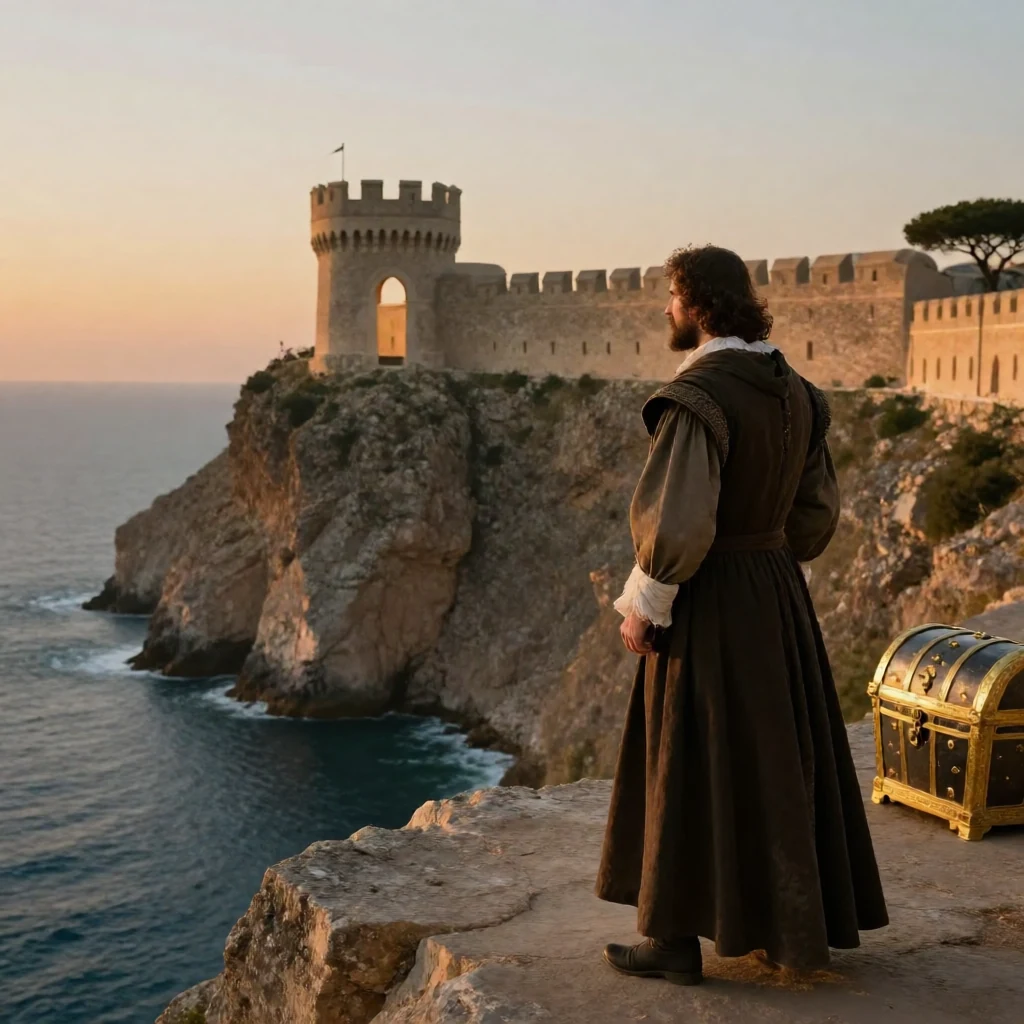
Monte Cristo Reveals Pre-Arranged Paris Residence
Monte Cristo Reveals Pre-Arranged Paris Residence Monte Cristo thanks Morrel and says he will content himself with being presented to his sister and brother-in-law, but cannot accept any of the offers since his habitation is already prepared. Morcerf exclaims that a hotel will be dull, but the count reminds him of how well he was lodged at Rome. Morcerf notes that the count spent fifty thousand piastres on those apartments, but the count explains that he had decided to have a house of his own and sent his valet de chambre ahead to buy and furnish it. The guests are astonished that a Nubian mute could be trusted with such a task, but Monte Cristo assures them that Ali knows his tastes, caprices, and wants, has been in Paris for a week, and arranged everything. Ali met the count at nine o’clock at the Barrière de Fontainebleau, knowing he would arrive at ten, and handed him a paper with the address of his new home. The count says he read the address only that morning and has never seen the house.
Conversation on Monte Cristo’s Servants Ali and Bertuccio
Conversation on Monte Cristo’s Servants Ali and Bertuccio Beauchamp marvels at the originality and princely nature of this arrangement. Debray asks if the count has a steward who knows Paris, and Monte Cristo replies that his steward is a Corsican whom Morcerf knows. Morcerf identifies him as the excellent M. Bertuccio. Debray teasingly asks how much Bertuccio robs the count each year, and Monte Cristo defends him, saying he answers the count’s purpose, knows no impossibility, and is therefore retained.
Discussion of Monte Cristo’s Slave and French Freedom Laws
Discussion of Monte Cristo’s Slave and French Freedom Laws Château-Renaud remarks that since the count has an establishment, a steward, and a hotel in the Champs-Élysées, he only lacks a mistress. The count replies that he has something better, a slave purchased in Constantinople at greater cost but with nothing to fear. Debray reminds him that the Franks, as King Charles said, are frank by name and frank by nature, and that the moment the slave sets foot in France she becomes free. The count dismisses the concern, asking who would tell her, since she only speaks Romaic. Beauchamp insists they must at least see her, asking if the count also keeps eunuchs, but Monte Cristo says he does not carry brutalism so far. He adds that everyone around him is free to leave and that when they do, they will no longer need him or anyone else—which is perhaps why they do not leave.
Guests Depart the Breakfast Gathering
Guests Depart the Breakfast Gathering They have long since passed to dessert and cigars. Debray rises, noting it is half-past two, and says he must return to the minister’s office, where he will report on the count so that they may soon learn who he is. Morcerf warns him that no one has yet succeeded in uncovering the count’s identity, but Debray declares that the police have three million francs available and fifty thousand for this purpose alone. He promises to tell Morcerf what he learns and departs, calling loudly for his carriage. Beauchamp, declining to go to the Chamber, tells Morcerf he will offer his readers something better than a speech from M. Danglars, but Morcerf begs him not to deprive him of the merit of introducing the count everywhere. Château-Renaud, leaving with Morrel, reminds the count of his promise to visit Rue Meslay, No. 14; the count bows and promises not to fail. After Morrel and Château-Renaud depart, Monte Cristo is left alone with Morcerf.
Chapter 41. The Presentation
Chapter 41, “The Presentation,” follows Albert de Morcerf’s tour of his Parisian apartment for the Count of Monte Cristo, moving from the atelier through the salon to the bedchamber, where Monte Cristo is struck by a portrait of Albert’s mother, Mercédès. Albert then invites Monte Cristo to meet his parents, leading to a discussion of family heraldry and a formal introduction to Count de Morcerf, whose career in the military and politics is examined. The chapter culminates in the dramatic entrance of Countess Mercédès, who expresses profound gratitude to Monte Cristo for saving her son’s life, with undercurrents of shared history and recognition between the count and the countess barely concealed beneath polite social exchange. Chapter 41, “The Presentation,” opens with Monte Cristo taking polite leave of the Countess de Morcerf, who must depart to speak at a sitting. After a courteous exchange, Monte Cristo exits the house to find his lavish carriage waiting. Albert, escorting him to the door, is impressed by the elegance of the equipage. When Albert returns to his mother, he finds her visibly unsettled in the dimly lit boudoir. A conversation unfolds in which Mercédès questions Albert closely about the Count of Monte Cristo—his origins, manners, age, and intentions. Albert describes the Count as a man of remarkable distinction, comparing him to one of Byron’s romantic heroes. Despite Albert’s reassurances, Mercédès remains uneasy, her private reflections suggesting a deeper, unspoken connection to the mysterious visitor. The chapter closes with Albert leaving his mother to her reverie, reflecting on the undeniable impression the Count has made.
The original text of this work is in the public domain. This page focuses on a guided summary article, reading notes, selected quotes, and visual learning materials for educational purposes.