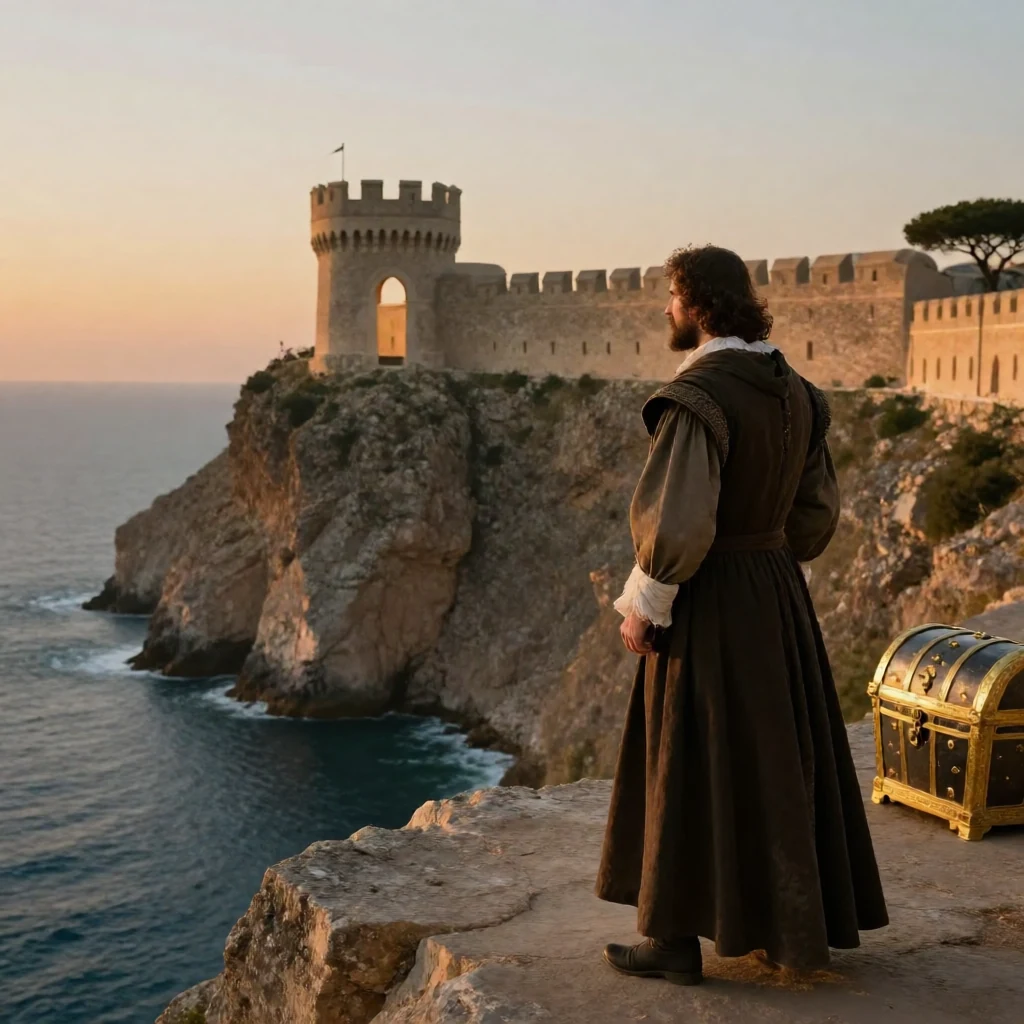
Chapter 41. The Presentation
Chapter 41, “The Presentation,” follows Albert de Morcerf’s tour of his Parisian apartment for the Count of Monte Cristo, moving from the atelier through the salon to the bedchamber, where Monte Cristo is struck by a portrait of Albert’s mother, Mercédès. Albert then invites Monte Cristo to meet his parents, leading to a discussion of family heraldry and a formal introduction to Count de Morcerf, whose career in the military and politics is examined. The chapter culminates in the dramatic entrance of Countess Mercédès, who expresses profound gratitude to Monte Cristo for saving her son’s life, with undercurrents of shared history and recognition between the count and the countess barely concealed beneath polite social exchange.
Albert’s Apartment and Atelier Tour
Albert de Morcerf, finding himself alone with Monte Cristo, offers to serve as cicerone through his bachelor apartment, inviting the count to calculate the modest square footage in which a well-lodged young Parisian lives. He proposes to open the windows for fresh air as they pass between rooms, having already shown the ground-floor breakfast room and salon.
Atelier Global Artifact Collection
In Albert’s atelier, his favorite room, Monte Cristo quickly identifies and appreciates the collection of old cabinets, Japanese porcelain, Oriental fabrics, Venetian glass, and arms from around the world. Rather than Albert guiding the tour, it becomes Monte Cristo who leads, discoursing on archaeology, mineralogy, and natural history while dating, locating, and tracing the origins of each piece at a glance.
First Floor Modern Art Salon
Descending to the first floor, Albert leads Monte Cristo into the salon filled with works of modern artists, including landscapes by Dupré, Arabian cavaliers by Delacroix, aquarelles of Notre Dame by Boulanger, flower paintings by Diaz, designs by Decamp, pastels by Giraud and Müller, and sketches torn from Dauzats’ “Travels in the East.” Monte Cristo surprises Albert by instantly naming each artist without seeking the signatures, many of which are only initials, demonstrating that each style and author was well known to him.
Bedchamber Mercédès Portrait
In the elegantly simple bedchamber, a single portrait signed by Léopold Robert, set in a carved and gilded frame, commands attention. Monte Cristo is visibly moved, taking three rapid steps toward it and stopping suddenly to gaze at the depiction of a dark-complexioned young woman of twenty-five or twenty-six in a picturesque Catalan fisherwoman’s costume, with red and black bodice and golden pins in her hair, looking out at the sea. Albert misinterprets the count’s interest, calling her a charming mistress, only to correct him: it is his mother, Mercédès, painted in this fancy costume six or eight years earlier.
Morcerf Portrait Backstory
Albert explains the portrait’s backstory: the countess had it painted during her husband’s absence, apparently intending a pleasant surprise, but the picture somehow displeased Count de Morcerf, whose indifference to art—as an assiduous peer at the Luxembourg and a mediocre amateur—overcame its value as one of Léopold Robert’s finest works. Mercédès, an excellent painter unwilling to part with it, placed it with Albert. Albert notes that the picture seems to exercise a malign influence, for his mother rarely sees it without weeping, and this disagreement is the only one in their otherwise harmonious marriage of over twenty years.
Invitation to Meet the Morcerfs
Albert invites Monte Cristo to accompany him to the apartments of M. de Morcerf, having already written from Rome of the services Monte Cristo rendered him and announced this promised visit, for which both the count and countess have anxiously waited. Monte Cristo accepts the offer without enthusiasm or regret, treating it as one of society’s conventional duties, and Albert summons a servant to inform his parents of the guest’s arrival.
Morcerf Family Heraldry Discussion
In the antechamber, Monte Cristo pauses to examine attentively the Morcerf family shield above the door, with its azure field, seven gold merlets, and quartered shield bearing gules with a silver tower representing the maternal Spanish line. Morcerf confirms these are his father’s arms joined to his mother’s, making him Spanish by her side while the Morcerf family is one of the oldest of southern France. Monte Cristo notes that the blazons point to an ancestor’s participation in the Crusades, possibly even that of St. Louis in the thirteenth century.
The original text of this work is in the public domain. This page focuses on a guided summary article, reading notes, selected quotes, and visual learning materials for educational purposes.