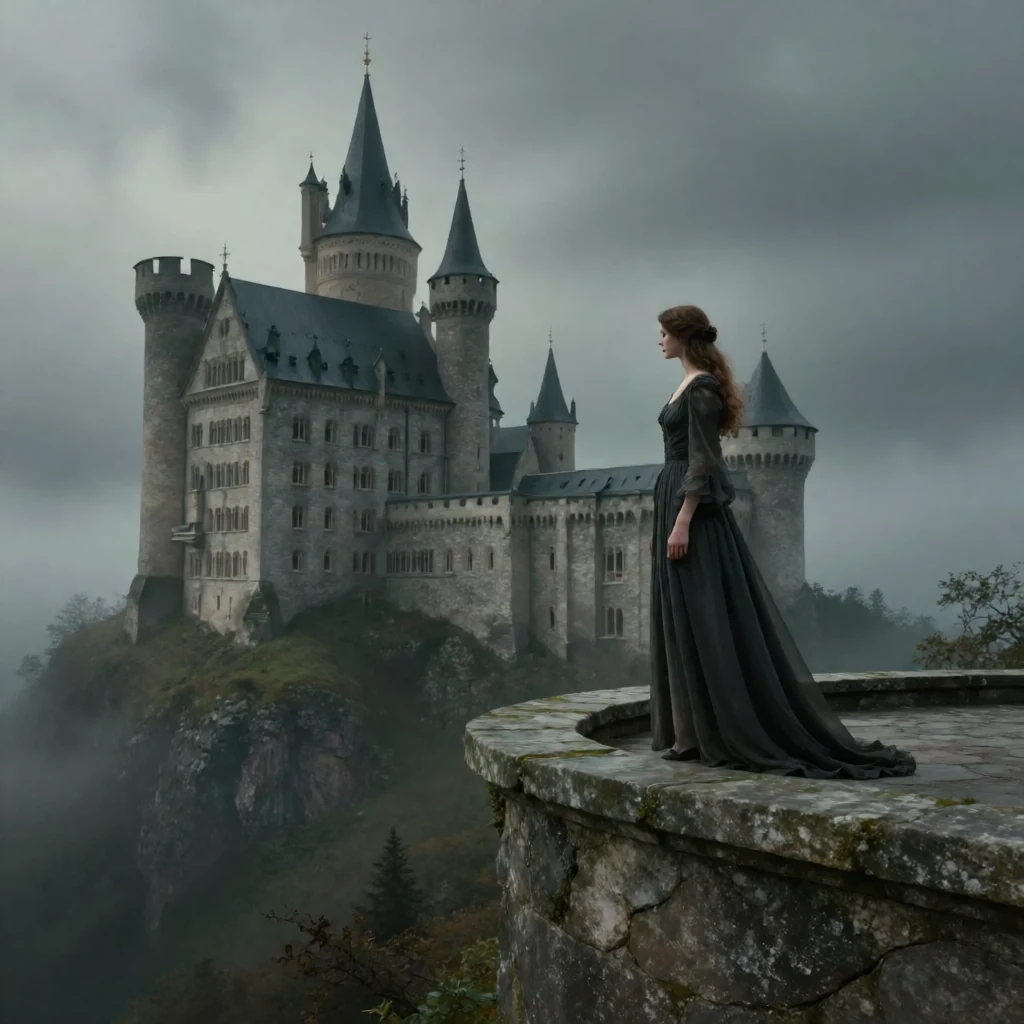
Count Hears Mysterious Midnight Music
After the party separates for the night, the Count retires to his dressing-room, still preoccupied with the desolate state of the north apartments, when he suddenly hears soft, delicate music. He asks his valet Pierre who is playing, and Pierre hesitantly explains the music often occurs at midnight, seemingly coming from the nearby woods though no mortal musician is present, and that a voice is sometimes heard accompanying it. The Count listens in amazement as the music plays, praising its delicate touch and sweet, dying cadences as something more than mortal, and orders Pierre to close the casements before dismissing him, but remains haunted by the memory of the music long after, as surprise and perplexity occupy his thoughts.
Ludovico Reads a Provençal Tale at Midnight
In his remote chamber, Ludovico hears the distant hall clock strike twelve, marking midnight, and looks around the spacious room with suspicion. He finds his fire nearly expired, so adds fresh wood not for warmth but to lift his cheerless spirits, trims his lamp, pours a glass of wine, and draws his chair closer to the crackling blaze. He tries to ignore the howling wind at the casements and the melancholy stealing over him, then takes up the Provençal tale volume lent to him by Dorothée, who had found the mouldy, discoloured book in an obscure corner of the Marquis’s library and kept it for her own entertainment. The book contains fables drawn from Arabian legends brought to Spain by the Saracens and chivalric exploits of crusaders accompanied by Troubadors, and Ludovico opens a simple, marvel-tinctured tale from the collection that reflects the superstitions of the era, becoming wholly absorbed in its scenes.
CHAPTER VI
This chapter presents “The Provençal Tale,” a narrative read aloud by Ludovico, recounting the adventure of a magnificent Baron of Bretagne who is visited one midnight by a sorrowful stranger claiming to bear a terrible secret. The mysterious Knight leads the Baron through secret passages into a wind-swept forest, where he reveals a murdered body resembling himself before vanishing, leaving a disembodied voice with solemn commands. The chapter closes with Ludovico’s drowsy impressions lingering into uneasy sleep.
The Baron’s Court
The tale opens by establishing the splendid court of a noble Baron of Bretagne, famed for hospitality and magnificence. His castle is filled with beautiful ladies and illustrious knights drawn from distant lands by his love of chivalry, and is served by eight minstrels who perform romances and crusader tales. The great hall is vividly described with costly tapestry, painted casements, banners, gold and silver plate, and richly dressed guests assembling for banquet.
The Midnight Stranger
After dismissing his attendants late at night, the Baron is startled by the appearance in his chamber of a stranger of noble air but dejected countenance, whom he could not have passed unseen by the waiting pages. The Baron draws his sword, but the stranger advances calmly, declaring he has come with no hostile design but to communicate a terrible secret of importance.
The Forest Summons
The stranger refuses to reveal his errand within the chamber and insists the Baron must follow him to the edge of the forest to be convinced. Despite the Baron’s alarm at being lured to so solitary a spot, the stranger’s solemn hints awaken a curiosity that eventually persuades the Baron to consent, provided no harm befalls him. The stranger pledges his knightly honour and warns that the night’s decision will shape the Baron’s future prosperity or ruin.
Secret Passages
The Baron agrees and follows the stranger, who is revealed to be Sir Bevys of Lancaster, an English knight returning from the Holy City. Passing through an ante-room where all the pages are inexplicably asleep, the Knight opens a secret door the Baron believed known only to himself and leads him through narrow winding passages to a small gate beyond the castle walls. The Baron is amazed and suspicious at the Knight’s knowledge of these hidden ways but steadies his courage and resolves to trace the mystery.
The original text of this work is in the public domain. This page focuses on a guided summary article, reading notes, selected quotes, and visual learning materials for educational purposes.