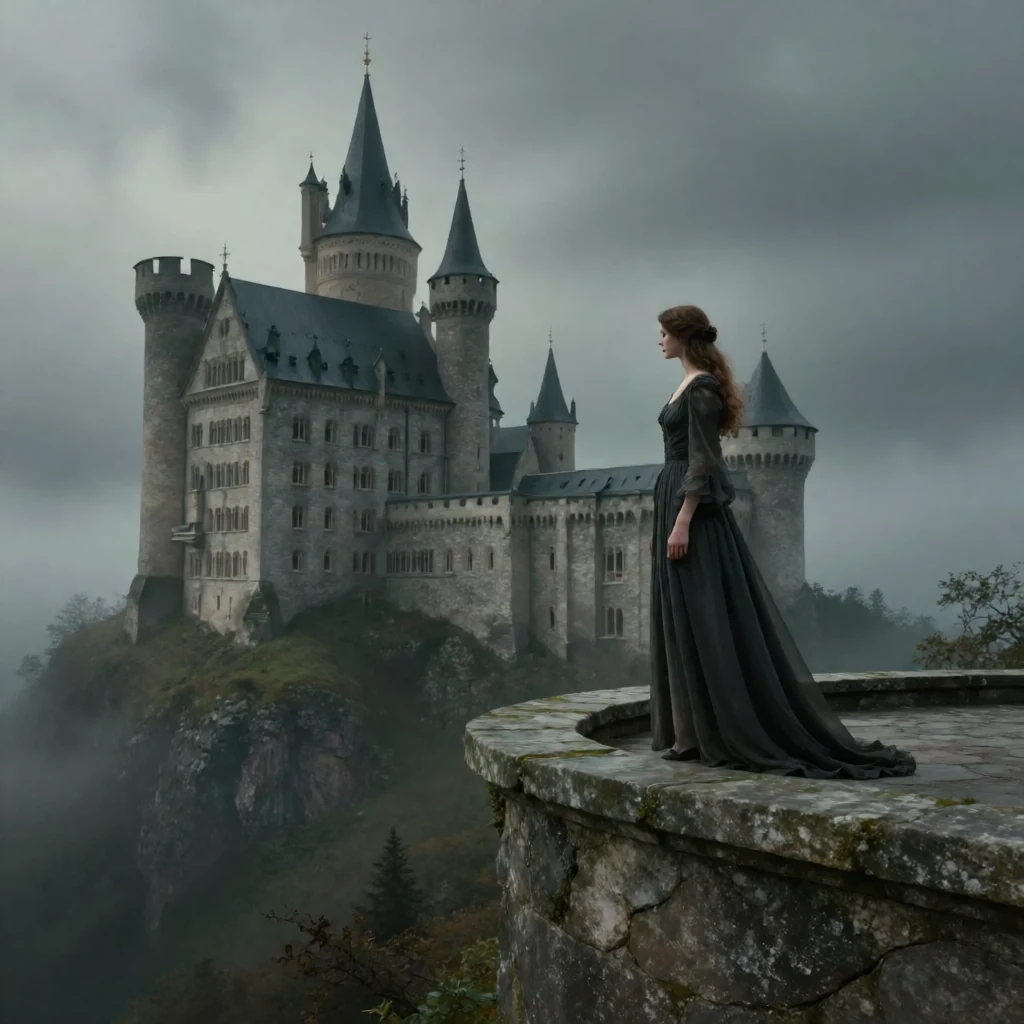
Emily’s Melancholy Walk and Remembrance of Valancourt
Emily also rises early and takes her customary walk along the promontory above the Mediterranean. Her mind is not occupied with the château’s events; instead, Valancourt preoccupies her mournful thoughts, though her judgment has abandoned its esteem for him. Memories of his parting look and voice move her to bitter tears. Reaching the watch-tower, she sits on the broken steps and, in melancholy dejection, watches the waves until the remembrance of past times grows too painful and she abruptly quits the place.
Emily Finds Valancourt’s Shipwreck Poem
On passing the little gate of the watch-tower, Emily notices letters rudely cut into the stone postern with a pen-knife. She recognizes Valancourt’s hand and reads, with trembling anxiety, his poem “SHIPWRECK,” which describes a solemn midnight vigil beneath the watch-tower amid tempestuous waves and the shrieks of imperiled mariners. From the poem and the freshness of the engraving, she infers that Valancourt visited the tower on the preceding night and may still be in the gardens. Overcome by contending emotions, her first impulse is to avoid him, and she hastens back toward the château, briefly wondering whether the recent music and figure near the tower had been his.
Emily’s Conversation with the Count
In a thicker part of the woods, Emily mistakes a figure for Valancourt, but it proves to be the Count, who lightly rallies her on her early solitude before perceiving her distress. He affectionately expostulates with her for indulging unavailing regret; she acknowledges his counsel while unable to restrain her tears. He then expresses surprise at having heard nothing from his advocate at Avignon regarding the estates of the late Madame Montoni and tries to cheer her with hopes of establishing her claim, though Emily feels the estates would matter little without Valancourt.
Failed Attempts to Rouse Ludovico
Returning to the château, the Count renews his efforts to arouse Ludovico, calling more loudly at the north chambers’ door, but a total silence follows. The Count begins to fear that some accident has befallen Ludovico, perhaps driven to distraction by terror of the imagined apparition, and goes to summon servants to force the door. The servants, however, confess in fright that none of them has ventured to the north side of the château since the previous night.
Ludovico’s Mysterious Disappearance
The Count orders the door forced, but the servants’ terror delays compliance. Dorothée mentions a nearer door opening from a gallery of the great staircase into the last ante-room of the saloon, but the Count’s calls at this door are equally ineffectual. He restrains himself from striking the beautifully carved larch-wood door and returns to the back staircase door, which is at length forced. The Count, followed by Henri and the bravest servants, enters the chambers, where all is silent, and finds the bedroom dark, its shutters closed, and no sound of breathing. Henri throws open a shutter, and a servant crossing the room stumbles over a chair near the hearth—the very chair in which Ludovico had been sitting. Ludovico is nowhere to be seen.
Investigation of Ludovico’s Locked Chambers
Opening the remaining shutters, the Count examines the chamber, the oriel, and the bed, finding no sign of Ludovico. Every outer door is bolted or locked from the inside, with keys within, and the windows are secured by iron bars or shutters with no evidence of forced passage. The Count cannot accept a supernatural explanation, yet cannot find any concealed passage behind the arras despite a laborious search. The chambers remain in perfect order, as if Ludovico had simply walked out. The Count secures the last ante-chamber, taking its key into his own possession, and orders a strict search throughout the château and the neighbourhood.
Aftermath of Ludovico’s Disappearance
Conversations between the Count and Henri follow in the Count’s closet, after which Henri loses his former vivacity and becomes grave and reserved whenever the topic arises. Baron St. Foix, strengthened in his belief in apparitions, and his adherents grow more bigoted to their systems, while the Count’s servants, their terrors increased, begin quitting the mansion immediately. The most strenuous search for Ludovico proves unsuccessful; after several days, Annette gives herself up to despair and the other inhabitants to amazement.
The original text of this work is in the public domain. This page focuses on a guided summary article, reading notes, selected quotes, and visual learning materials for educational purposes.