Approaching the Fortress
Approaching the Fortress
Blanche perceives they are at the foot of the cliff on whose summit the building stands, but no light issues from it and the dog’s barking has ceased. From a distance, imperfectly lit by a cloudy moon, the edifice appears larger than a single watch-tower, yet the guides doubt whether it is truly their goal, for its abrupt declivities seem to offer no pathway. While the guides examine the cliff with the torch, the Count consults St. Foix on the risks of seeking admittance to a place that may harbour banditti; weighing the dangers of passing the night in the open wild against those of the unknown edifice, they resolve to attempt entry at any hazard, despite the darkness and silence suggesting it may be uninhabited.
The Ruined Edifice
The Ruined Edifice
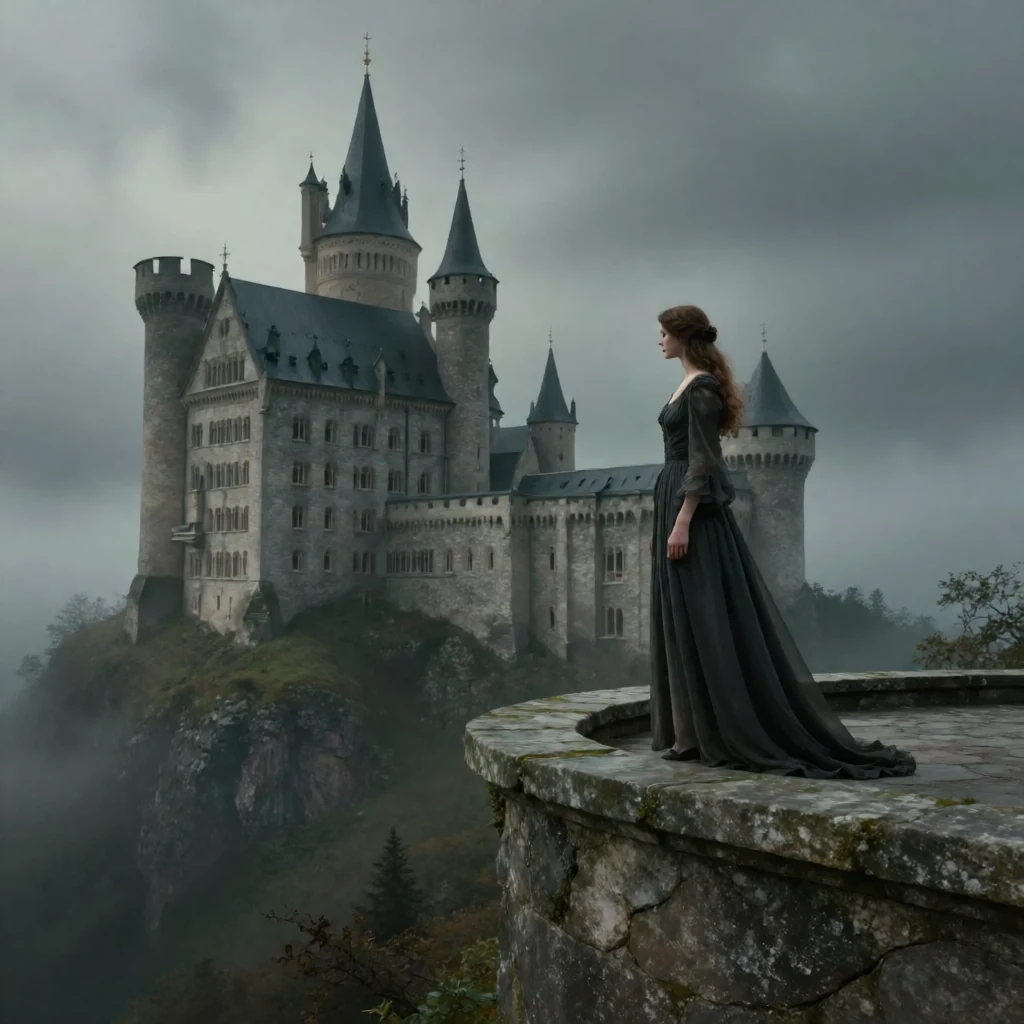
A shout from the guides announces a path has been found, and the party ascends a winding way cut in the rock among thickets of dwarf wood. At the summit they behold several ruined towers surrounded by a massy wall, partially illumined by moonlight, the surrounding space silent and forsaken. The Count cautions them to step softly as they reconnoitre. Reaching a gate of terrifying aspect even in ruins, they pass into a court of entrance where, beyond a terrace running along a precipice, rises an ancient fortress in heavy Saxon-gothic style, with round towers, proportionable buttresses, and a round-arched gate leading to its hall. Shattered battlements, half-demolished walls, and grass-grown ruins of massy stone heighten the air of solemnity, while the gigantic remains of an aged oak, leafless and moss-grown, seem frowningly to guard the pile. The Count reflects with melancholy awe that such a once-powerful fortification, perched on a rock over a deep glen, should have been suffered to sink into ruin.
A Dog’s Warning
A Dog’s Warning
The Count’s melancholy reflection is broken by what he takes to be the sound of remote voices stealing upon the stillness from within the building, though no light is visible from the front. Determining to investigate, he enters the terrace, where the remains of cannon are yet apparent in the thick walls, but he is suddenly arrested by the loud barking of a dog within—the same voice, he fancies, that earlier drew the travellers thither. The sound confirms the place is inhabited and somewhat shakes his former resolution, yet after a second consultation, the discovery of the guarding dog and the prevailing stillness strengthen his determination to seek admittance.
Knocking at the Gate
Knocking at the Gate
The Count orders a servant to knock at the gate, but a light appearing through a tower’s loop-hole prompts him to call out himself. Receiving no answer, he strikes the gate with an iron-pointed pole he has used to climb the steep; the renewed barking of more than one dog is the only response. Stepping back to observe whether the light still burns in the tower, he finds it gone, and upon returning to strike again he fancies he hears a murmur of voices within. Letting the pole fall heavily, he is answered by profound silence, and he concludes the inhabitants are cautious folk, likely hunters or shepherds sheltering from the night. Calling aloud that they are friends seeking shelter, he hears approaching steps and a voice demanding to know who calls; when he answers, strong bolts are drawn and a man armed with a hunting spear appears at the gate.
The Hunters’ Welcome
The Hunters’ Welcome
The man at the gate demands what is wanted at such an hour, and when the Count explains he wishes to enquire the way to the nearest cabin, the hunter scoffs that there is none within several leagues and begins to close the gate. Before the Count can turn away disappointed, another voice from above, accompanied by a light at the grate of the portal, calls him to stay, assuming they are hunters like the dwellers. Shortly the gate is opened and several men in hunters’ habits appear, listening to the Count and welcoming him to rest there for the night, pressing him with much courtesy to enter and share their fare. Though cautious and somewhat suspicious, the Count—weary, fearful of the approaching storm, and confident in the strength of his attendants—accepts the invitation, and with his servants, Blanche, and St. Foix follows the hunters into the fortress.
The original text of this work is in the public domain. This page focuses on a guided summary article, reading notes, selected quotes, and visual learning materials for educational purposes.