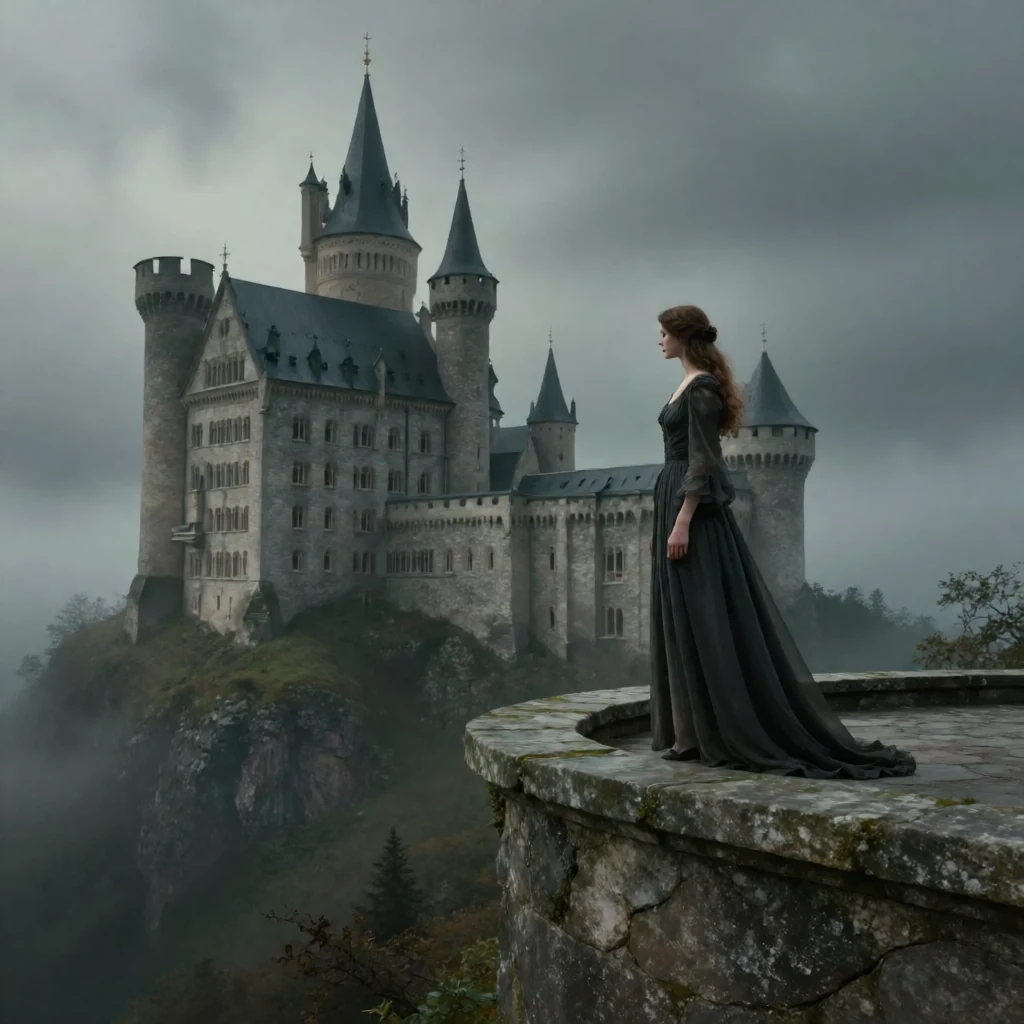
Du Pont’s Captivity Narrative
Du Pont explains that he came into Italy in the service of his country, where his party was routed by Montoni’s bands and he was taken captive. Recognizing the name Montoni as the husband of her aunt Madame Cheron, he eventually confirmed that Emily was under the same roof. A sentinel won to his interest granted him many indulgences but refused to carry letters for fear of Montoni’s vengeance; he did, however, allow Du Pont air and exercise on the terrace.
The Hidden Passage
The compliant sentinel also showed Du Pont a door concealed in the cedar wainscot of his prison apartment, opening into a passage built within the thickness of the castle walls. This avenue extended far along the edifice — one of many such passages designed for wartime escape — and finally emerged on an obscure corner of the eastern rampart.
The Figure on the Terrace
Du Pont used the hidden passage at dead of night to reach the terrace, where one end, screened by high buildings, went unwatched. On one midnight wandering he saw a light in a casement immediately above his prison chamber, and, hoping it might be Emily, stationed himself opposite the window. Emily, recalling a figure that had once alarmed her, realizes with relief that this was Du Pont himself; he explains how he often stood below her window, once hearing her voice, but was forced to flee when a sentry approached and felled the superstitious pursuer with a strange noise that threw the man into a fit.
The Midnight Lute
Alarmed by the increased watchfulness his terrace appearances provoked, Du Pont afterwards confined himself to his prison, where in the still of night he consoled himself with an old lute procured by a soldier, sometimes singing with it in the hope of being heard by Emily. Only a few evenings before, he had dared to reply to a voice he thought he heard calling him from the wind, fearing all the while that the sentinel at his door might overhear. Emily confirms it was indeed she who spoke.
Du Pont Overhears Montoni
Du Pont then relates that during another excursion through the hidden passage he overheard a singular conversation held by Montoni and his companions in an adjoining chamber. The wall there was thin and partly decayed, so that every word carried clearly: Montoni spoke at length of the mysterious fate of his predecessor in the castle, and Du Pont, fearing Montoni’s guests intended harm to Emily, added his voice to the most striking passages in a hollow, disguised tone. He escaped discovery by retreating far along the passage to his distant prison. Emily remembers the alarm this voice caused throughout the household.
Plans for Return to France
Conversation turns from Montoni to France and the plan of their voyage. Emily intends to retire to a convent in Languedoc, where she was once kindly treated, and from there to write to her relation Monsieur Quesnel, hoping to wait out the period until La Vallée is restored to her. Du Pont raises her hopes by suggesting that the estate Montoni tried to defraud her of may not be irrecoverably lost — news that secretly gladdens her, though she conceals her joy lest it remind Du Pont painfully of his rival Valancourt. The party moves on as the sun declines.
Along the Arno at Twilight
Descending the lower slopes of the valley, the travellers reach the Arno and wind along its pastoral margin for many miles, enchanted by the classic scenery and the distant songs of peasants among the vineyards. The setting sun gilds the waves, twilight deepens the mountains into dusky purple, and the fire-flies of Tuscany spark among the foliage while cicadas grow clamorous. They cross the river by moonlight at a ferry and, learning Pisa is only a few miles downstream, would gladly have taken a boat but, finding none, ride wearied horses toward the city.
The original text of this work is in the public domain. This page focuses on a guided summary article, reading notes, selected quotes, and visual learning materials for educational purposes.