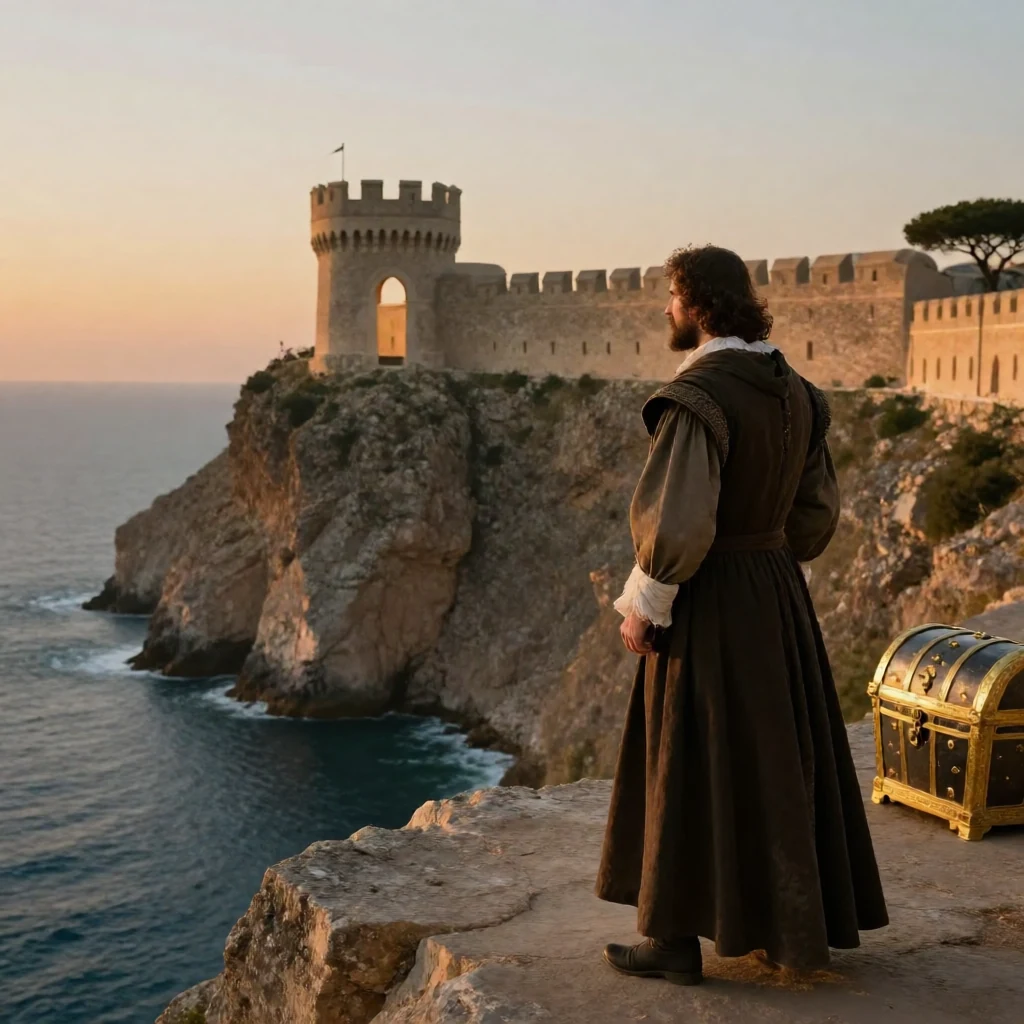
Conversation about the Marchioness Corsinari and agreed backstory
Conversation about the Marchioness Corsinari and agreed backstory Turning to the mother of the young man, Monte Cristo notes that she has been dead for ten years; the Major, with theatrical sorrow, mimes weeping with a checked handkerchief. They then settle on the story Cavalcanti must tell in France. Rather than the Italian tale of gypsy abduction, which would not be believed in Paris, the Count devises a more credible version: the Major sent his son to a provincial college for his education and has now come to Paris to complete it. The reason for his stay in Via Reggio since his wife’s death will be presented as mourning. Should anyone ask about the fifteen-year separation, the agreed explanation is that an unfaithful tutor, bribed by the Corsinari family, stole the child to extinguish the Cavalcanti name—an only son, making the threat plausible. The Major accepts this arrangement.
Revelation that Andrea Cavalcanti is awaiting his father
Revelation that Andrea Cavalcanti is awaiting his father The Count announces that he has prepared a surprise: the long-lost son, Andrea, is already in the house, having arrived during their conversation (Baptistin has seated him in the blue drawing-room). The Major, affecting great paternal emotion while clutching the buttons of his coat, claims to have guessed as much. Monte Cristo, reading the Major’s eagerness, offers to go and prepare the young man for the meeting, observing that father and son must be equally impatient. The Count declines to intrude on the reunion, announcing that Andrea will enter alone through that door in a quarter of an hour. He describes the young man in advance—fair-complexioned, pleasing in manners—so that the Major cannot fail to recognize him, even should the “powerful voice of nature” be silent.
KAPITEL 55. Major Cavalcanti
In this scene, the major candidly admits to Monte Cristo that the 2,000 francs sent by the Abbé Busoni has been spent on travel, prompting the count to hand over 8,000 francs on account toward a larger debt of 40,000. Monte Cristo then gently chides the major for his outdated attire, advising him to adopt more current Parisian fashions while assuring him that his luggage has already been forwarded to the Hôtel des Princes on the Rue de Richelieu. The encounter concludes with Monte Cristo urging the major to ready himself to be reunited with his long-lost Andrea before slipping away behind the tapestry, leaving Cavalcanti delighted by the warmth of the reception.
Cavalcanti’s Exhausted Travel Funds
The major confides to Monte Cristo that the 2,000 francs forwarded by Abbé Busoni have been entirely consumed by his travel expenses, leaving him without funds and prompting him to hint at the need for additional money.
Monte Cristo Provides 8,000 Francs On Account
Anticipating the request, Monte Cristo smoothly offers 8,000 francs on account. The major’s eyes glitter with delight as he accepts this unexpected advance, clearly pleased by the count’s generosity and discretion.
40,000 Franc Debt and Receipt Discussion
Monte Cristo notes that the new disbursement brings the major’s total obligation to 40,000 francs. When the major tentatively offers a receipt, Monte Cristo declines, suggesting such paperwork is unnecessary between honorable men and that a receipt in full can wait until the remaining balance is settled.
Advice on Cavalcanti’s Outdated Paris Attire
Turning to practical matters, Monte Cristo gently points out that the major’s current style of dress, however elegant in itself, belongs to Via Reggio rather than contemporary Paris. He advises Cavalcanti to abandon the old fashion while in the capital, offering to resume it after his departure if he remains attached to it.
Pre-Sent Luggage at Hôtel des Princes
Monte Cristo reveals that he anticipated the major’s needs and arranged for luggage to be sent ahead to the Hôtel des Princes on the Rue de Richelieu. He describes how the major’s prudent foresight would naturally have led him to send trunks containing plain clothes, a uniform, and ornamental crosses suitable for grand Parisian occasions.
The original text of this work is in the public domain. This page focuses on a guided summary article, reading notes, selected quotes, and visual learning materials for educational purposes.