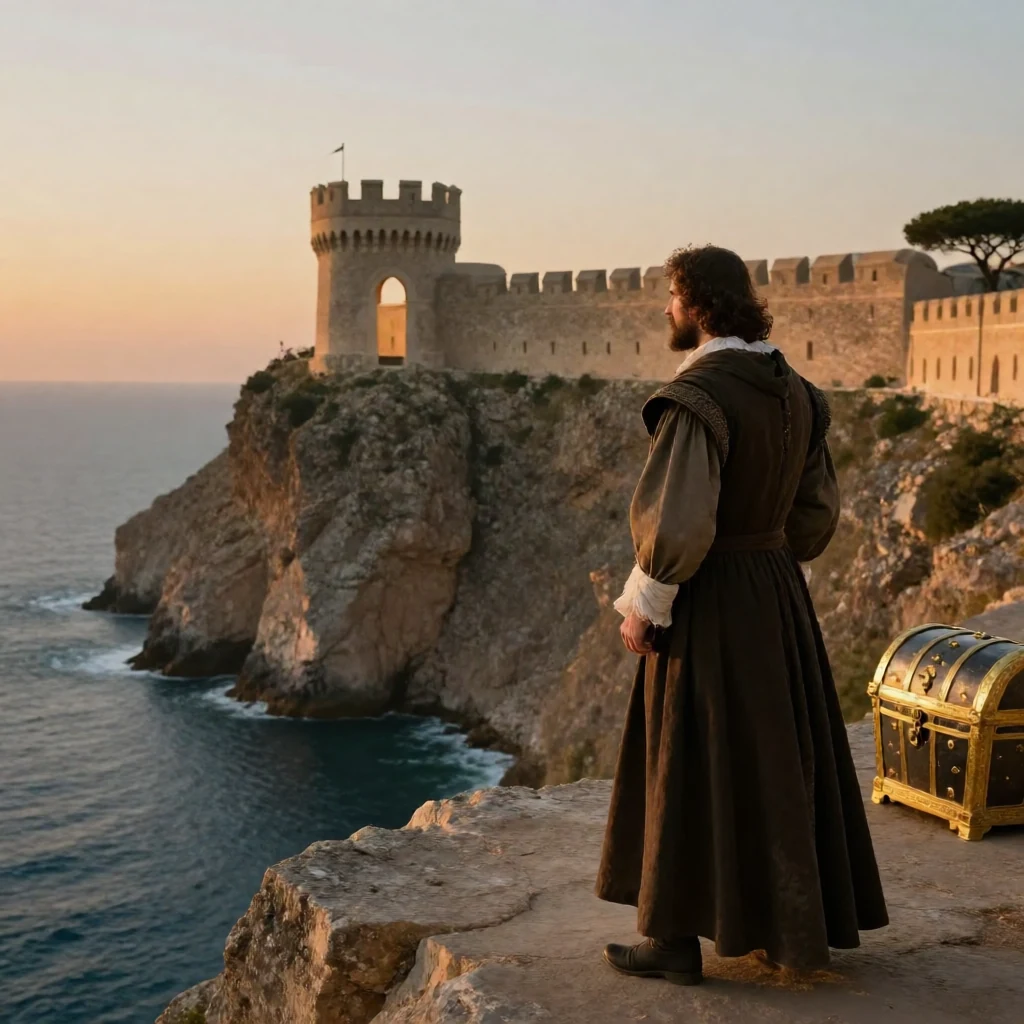
Initial Imprisonment and Nighttime Escort
Dantès is first transferred from the court to a grim prison cell after his arrest, spending hours locked in darkness clinging to the hope of release based on Villefort’s earlier assurances. Later that night, gendarmes return to escort him out of the cell and place him in a locked carriage for transport.
Transfer from Court to Prison Cell
After being processed at the Palais de Justice, Dantès is marched through long, shadowy corridors flanked by gendarmes to the grim prison building overlooking the Accoules clock tower. A gendarme uses an iron mallet to knock three times on the iron-wicket door, which opens to admit Dantès before slamming shut behind him, sealing him in the foul, thick air of the prison. He is placed in a neat but grated cell, still convinced of his imminent release.
Midnight Escort by Carriage
After hours of waiting in his cell in alternating hope and despair, gendarmes arrive at 10 PM with torches to escort Dantès out. He climbs into a police carriage accompanied by two gendarmes, and the carriage travels through the streets of Marseilles toward the quay, passing the Rue Caisserie, Rue Saint-Laurent, and Rue Taramis, until it stops at the La Consigne guardhouse on the waterfront.
Boat Journey to the Château d’If
Dantès is transferred from the carriage to a small boat manned by four oarsmen, with a police officer and gendarmes accompanying him. The boat travels out of the harbor, passing the Point des Catalans where Mercédès lives, and Dantès briefly considers shouting to her before pride stops him. He learns from a gendarme that their destination is the Château d’If, makes a failed attempt to jump overboard to escape, and is subdued at gunpoint before being forced to continue the journey to the fortress.
Across the Harbor
The boat departs the quay under the guard of a dozen soldiers, with a chain lowered to allow it to exit the port. It passes the Tête de Mort and Anse du Pharo, then sails out past the Ile Ratonneau lighthouse, leaving the inner harbor behind as it heads toward open sea.
Passing Mercédès’ Dwelling
As the boat travels along the coast, Dantès spots a single light on the beach at the Point des Catalans, the home of his fiancée Mercédès, the only person awake in the area. He considers shouting to her but restrains himself out of pride, not wanting his guards to see him as irrational. A rise in land soon blocks his view of the light as the boat continues further out to sea.
Destination Revealed
Unable to contain his anxiety, Dantès asks a gendarme for their destination. The gendarme directs him to look ahead, where Dantès sees the ominous black rock of the Château d’If rising 100 yards away. Shocked that he is being taken to the fortress known for holding only political prisoners, he demands to know why he is being imprisoned there without inquiry, and is told all formalities have already been completed.
Failed Escape Attempt
Convinced he is being unjustly imprisoned despite Villefort’s promises, Dantès makes a sudden attempt to jump overboard and swim to shore. Four gendarmes seize him before he can exit the boat, and one threatens to shoot him if he resists further. Realizing escape is impossible for the moment, Dantès stops struggling, seething with rage but unable to act.
Arrival at the Château d’If
The boat docks at the Château d’If, and Dantès is escorted by armed guards up a flight of steps to the fortress gate, which closes behind him. He is led through the fortress courtyard, past rows of soldiers with fixed bayonets, before being turned over to an under-jailer who leads him to a cell for the night.
Imprisonment and Descent into Despair
After arriving at the Château d’If, Dantès is locked in a dank underground cell overnight, and spends the next day in acute emotional distress, tormented by regret over missed opportunities to escape during his journey and grief over his betrayal and uncertain future for his father and Mercédès.
The original text of this work is in the public domain. This page focuses on a guided summary article, reading notes, selected quotes, and visual learning materials for educational purposes.